


Disaster Recovery as a Service (DRaaS) in South Africa: The 2026 Architect’s Guide

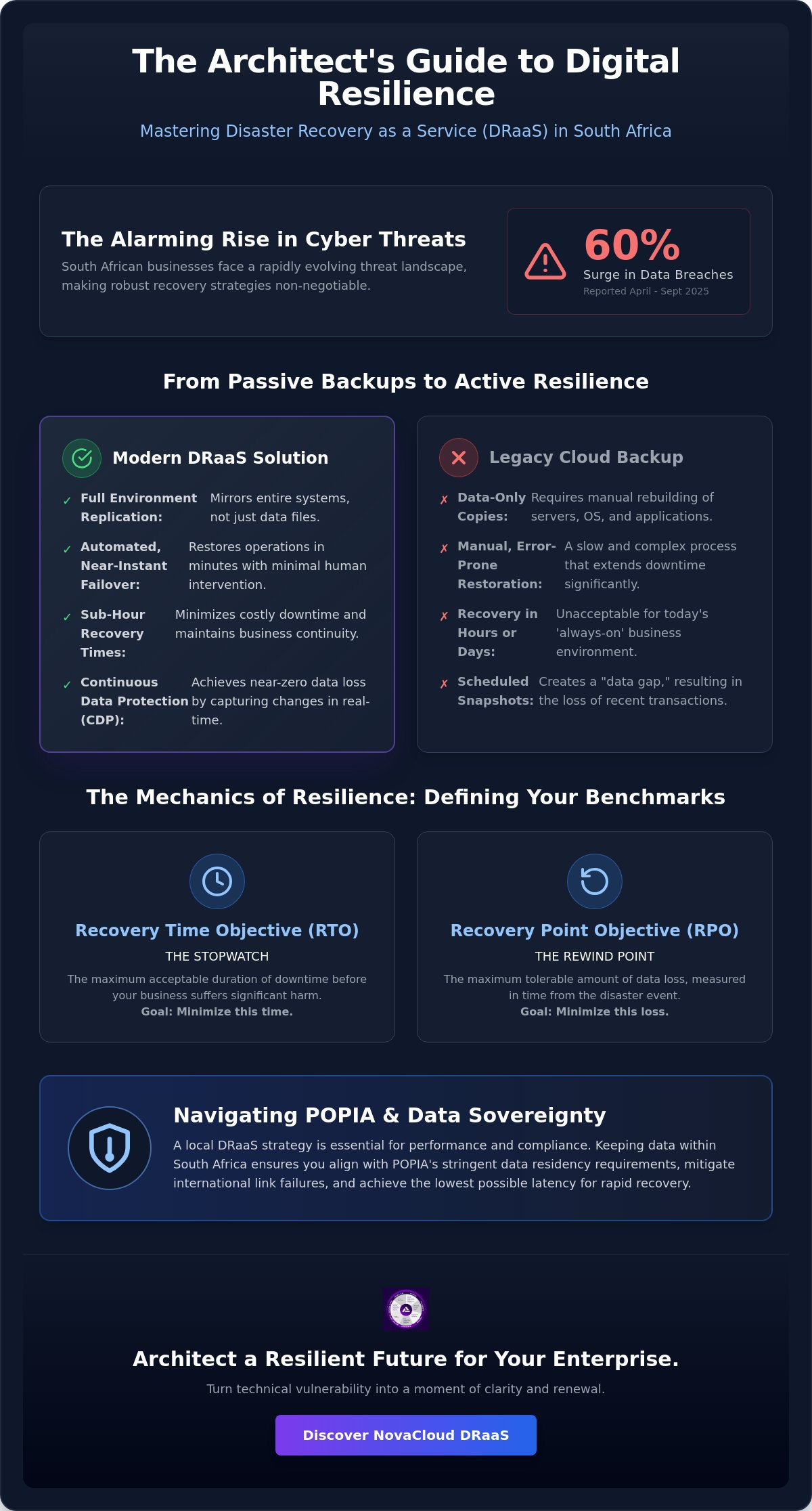
Between April and September 2025, South Africa witnessed a 60% surge in data breaches reported to the Information Regulator. This isn't just a trend; it's a clear signal for a more sophisticated approach to digital survival. You've likely felt the weight of maintaining expensive, idle standby hardware while trying to untangle the complexities of multi-site replication. Adopting disaster recovery as a service (DRaaS) South Africa is no longer just an IT checkbox. It's a strategic move to ensure your organization's digital light never flickers, even when faced with the harshest cyber threats.
We understand that keeping up with the March 2026 POPIA updates regarding health information and strict data residency can feel like chasing a moving target. You need a solution that offers sub-hour recovery times without the burden of capital expenditure. This guide will master the strategic framework of DRaaS to ensure your enterprise remains resilient and compliant. We'll preview the roadmap to zero-infrastructure recovery and show you how to turn technical vulnerability into a moment of clarity and renewal for your business operations.
Key Takeaways
- Master the strategic framework of disaster recovery as a service (DRaaS) south africa to transform potential downtime into a moment of seamless digital renewal.
- Define precise RTO and RPO metrics to align your technical recovery capabilities with your most critical business outcome requirements.
- Contrast the rapid, automated failover of modern DRaaS against the slower, manual limitations of traditional cloud backups for superior business continuity.
- Secure your digital perimeter by aligning with the latest POPIA data residency requirements, ensuring your enterprise’s sensitive information stays within national borders.
- Leverage high-performance tools like Acronis Cloud to build an elastic recovery architecture that scales alongside your organization's regional expansion.
What is Disaster Recovery as a Service (DRaaS) in the South African Context?
Disaster recovery is no longer a passive insurance policy. It's a high-performance architectural framework designed for near-instantaneous system restoration. While many organizations still rely on standard cloud backups, the distinction is vital. A backup is simply a copy of your data stored in the cloud. In contrast, What is Disaster Recovery as a Service (DRaaS) involves the full replication of your entire computing environment. This includes your applications, operating systems, and network configurations. When a primary site fails, DRaaS allows you to failover to a functional virtual environment in minutes.
South African enterprises operate in a landscape where digital sovereignty is a core competitive advantage. We face a unique set of challenges, from unpredictable infrastructure instability to a 60% year-on-year increase in reported data breaches. In this environment, disaster recovery as a service (DRaaS) south africa serves as a strategic investment. It ensures that your operational continuity remains unbroken, even when local systems face catastrophic failure. By adopting this cloud-native approach, you're not just saving data; you're preserving the digital light of your business.
The Evolution from Backup to Resilience
Legacy backup methods belong to an era that tolerated days of downtime. Today's business expectations are different. We live in an 'always-on' economy where every minute of silence costs money and reputation. Modern recovery workflows utilize cloud-native infrastructure to automate what used to be a manual, error-prone process. Virtualisation acts as the primary catalyst here. It enables the rapid capture of entire server states, allowing for failover capabilities that feel seamless. This transition from simple storage to active resilience is what defines the 2026 architect's approach to infrastructure.
Why South African Businesses Need Local DRaaS
Proximity is the silent partner of performance. High-latency replication to international data centres often leads to data lags or failed synchronisation during a crisis. By keeping your recovery data within South African borders, you ensure that your restoration speeds are optimized for local reality. This regional focus also mitigates the risks of international link failures, which can leave your business stranded during a global connectivity event. Harnessing robust Business Fibre provides the high-speed backbone necessary for real-time data synchronisation. This localized strategy ensures that your path to renewal is clear, immediate, and fully under your control.
The Mechanics of Resilience: Understanding RTO and RPO
Resilience isn't a vague concept; it's a measurable outcome defined by two critical variables. To master disaster recovery as a service (DRaaS) south africa, you must first define your tolerance for silence and loss. These metrics aren't just technical benchmarks. They are the financial guardrails that dictate your architecture and your budget.
The Recovery Time Objective (RTO) represents your stopwatch. It defines the duration of acceptable downtime before the business suffers irreparable harm. If your systems go dark, how many minutes can you afford to wait before the digital light returns? Conversely, the Recovery Point Objective (RPO) is your rewind button. It marks the maximum tolerable data loss, measured in time. An RPO of four hours means you're comfortable losing four hours of work; an RPO of near-zero means you need every transaction preserved.
Premium DRaaS solutions often utilize Continuous Data Protection (CDP). This mechanism captures every change in real-time rather than relying on scheduled snapshots. This ensures that your RPO remains as close to zero as possible. While this high-performance approach requires more robust infrastructure, it eliminates the "data gap" that often plagues legacy systems. You can explore how these high-performance systems integrate with your existing setup by reviewing our cloud infrastructure options.
Setting Your Survival Benchmarks
Not every workload deserves the same level of protection. Architects must categorise systems into tiers. Your customer-facing portal or ERP system is mission-critical, requiring aggressive RTOs. Internal file shares might be non-essential, allowing for a more relaxed recovery window. To find your balance, calculate your cost-per-hour of outage. When you see the financial impact of a single hour of downtime, the investment in sub-hour recovery becomes a logical business decision rather than a technical luxury.
The Replication Workflow
Real-time replication is the constant shadowing of your production environment in a secondary, secure location. Data flows continuously from your primary site to the DR site, ensuring the two environments remain in perfect sync. This isn't a manual upload. It's a sophisticated stream managed by automated orchestration. When the primary site falters, this orchestration triggers a failover, instantly pointing your traffic to the replicated environment. This transition is the hallmark of a truly resilient system.
DRaaS vs. Traditional Cloud Backups: A Strategic Comparison
Choosing between a backup and a recovery system is the difference between owning a spare tyre and having a second vehicle ready to drive. While backups preserve your history, DRaaS preserves your future. Traditional backups often require manual intervention, where data must be downloaded and reinstalled onto new hardware. This process can take hours or even days, which is a luxury most modern enterprises can't afford. In the context of disaster recovery as a service (DRaaS) south africa, we move beyond simple file storage. We focus on business momentum.
DRaaS maintains standby virtual machines in a 'ready-to-run' state. These systems are already configured with your specific applications, operating systems, and network settings. When a failure occurs, the transition isn't a restoration; it's a switch. This automated failover reduces recovery times from days to mere minutes. When evaluating disaster recovery as a service (DRaaS) south africa, architects must look at the cost-benefit ratio of downtime versus infrastructure spend. While the standby nature of DRaaS carries a different investment profile than cold storage, the protection it offers against total operational paralysis is unmatched.
When Backup is Not Enough
Standard Cloud backups excel at recovering a lost spreadsheet or an accidentally deleted folder. However, they often struggle during total hardware failure or widespread corruption. Ransomware attacks, in particular, demand more than just data integrity. They require a 'clean room' environment where you can spin up systems without re-infecting your primary network. DRaaS provides this isolated, functional space, ensuring system availability rather than just file existence. It allows your business to find clarity and renewal even in the wake of a sophisticated cyber assault.
Architecting a Hybrid Approach
A sophisticated ICT stack uses both tools strategically to balance performance with budget. You don't need a high-cost recovery site for every piece of data. Use long-term archival backups for historical records and reserve high-availability DRaaS for your mission-critical engines. By utilizing Virtual Private Servers as scalable recovery targets, you can optimize your infrastructure costs. Tiering your data ensures that your most vital assets are always under the protection of the fastest recovery protocols while non-essential files sit in more cost-effective storage tiers.
Navigating POPIA and Data Sovereignty in DRaaS
The Information Regulator of South Africa has made it clear: compliance is mandatory and evolving. With the March 2026 regulations specifically targeting the processing of health information, the stakes for disaster recovery as a service (DRaaS) south africa have never been higher. POPIA doesn't just govern how you collect data; it dictates how you protect it during a crisis. For an architect, this means ensuring that your recovery environment is as compliant as your production site.
Data residency is the cornerstone of this regulatory framework. Keeping your recovery data within South African borders isn't just a preference; it's a necessity for maintaining legal jurisdiction and meeting strict POPIA requirements. When your data stays local, you ensure that it remains under the oversight of regional authorities, providing a layer of digital sovereignty that international clouds cannot always guarantee. A robust Managed Firewall acts as the primary sentinel here, securing the replication tunnel that carries your sensitive data between sites.
Regulatory Peace of Mind
True resilience requires transparency in the supply chain. You must verify that your provider maintains audited security controls and adheres to local data centre standards. Managing third-party risk involves ensuring that your data is encrypted both at rest and while in transit during the replication process. This multi-layered approach to security ensures that even if a breach occurs, the information remains unreadable to unauthorized actors. It's about building a fortress that supports your business growth without compromising your legal standing.
Testing for Compliance and Confidence
A recovery plan is only a theory until it's tested. To maintain stakeholder confidence, you should conduct quarterly failover simulations. These tests must be non-disruptive, allowing you to prove your RTO and RPO metrics without interrupting daily operations. Documenting these procedures is essential for internal and external audits, providing a clear paper trail of your resilience. Automated reporting tools now make it easier to share these results, turning technical success into a powerful narrative of reliability for your board of directors.
Ready to secure your enterprise with a locally hosted, compliant recovery strategy? Explore our high-performance cloud infrastructure to start architecting your resilience today.
Architecting Your Recovery with NovaCloud Africa
NovaCloud Africa stands as a strategic partner, meticulously designing high-performance ICT infrastructure that empowers your organization to lead. We don't just offer tools; we provide a sophisticated framework where technology serves as a catalyst for regional empowerment. By integrating enterprise-grade solutions like Acronis Cloud, we ensure that your disaster recovery as a service (DRaaS) south africa is seamless, secure, and ready for any challenge. Our national reach means we're present where you are, combining international benchmarks with the deep localized context that South African enterprises require to thrive.
In a landscape often clouded by technical complexity, we bring the clarity of visionary optimism. We view every system we design as a path toward renewal and business efficiency. This isn't about mere survival; it's about creating a state of readiness that allows you to focus on growth. Our role as a reliable technical executor means you can trust that your digital evolution is in expert hands. We strike a balance between high-level strategic planning and granular execution, ensuring your path to resilience is both logical and inspired.
The NovaCloud Advantage
Our approach centers on the synergy between top-tier technology and human-centric expertise. We leverage Business-Grade Cloud Infrastructure to deliver the performance levels required for real-time replication and sub-hour recovery. This isn't a one-size-fits-all model. Through personalized IT Assistance, we collaborate with your team to design a custom DR roadmap that aligns with your specific business outcomes. Our proactive monitoring ensures that your recovery environment isn't just a dormant backup, but a living, breathing extension of your production site, managed with quiet confidence and purposeful energy.
Next Steps: From Vulnerability to Vision
Transitioning from a state of uncertainty to one of visionary readiness begins with a single, purposeful step. We invite you to initiate a resilience audit of your current infrastructure to identify hidden vulnerabilities. This assessment helps you select the right service tier for your enterprise needs, ensuring your budget aligns with your critical RTO and RPO targets. Whether you're a growing SME or a large enterprise, our systems are designed to scale with your ambition and protect your digital light. It's time to move beyond the fear of downtime and embrace a future defined by operational continuity. Architect your business continuity with NovaCloud today and experience the clarity of a truly resilient system.
Empowering Your Enterprise with Visionary Resilience
The journey toward digital sovereignty requires a fundamental shift from reactive data storage to proactive system replication. You've explored how aligning your RTO and RPO targets with business value transforms technical vulnerability into a moment of strategic clarity. By prioritizing local data residency and navigating the nuances of POPIA, your organization is now positioned to lead with confidence in the regional market. Adopting disaster recovery as a service (DRaaS) south africa is the definitive step toward ensuring your digital light never fades during a crisis.
Our framework provides the perfect synergy of POPIA-compliant local data residency and enterprise-grade Acronis Cloud technology. This architecture is supported by 24/7 expert IT assistance and constant monitoring, giving you the freedom to focus on expansion while we safeguard your continuity. It's time to replace uncertainty with a roadmap for growth and renewal.
Secure your enterprise continuity with NovaCloud's DRaaS solutions
Step into a future where your business remains resilient, compliant, and ready for every new possibility.
Frequently Asked Questions
Is DRaaS the same as offsite backup?
No, DRaaS and offsite backups serve different strategic purposes. While backups focus on long-term data integrity, disaster recovery as a service (DRaaS) south africa ensures immediate system availability. Backups require manual restoration onto new hardware, which can take days. DRaaS utilizes automated failover to spin up your entire environment in minutes, keeping your digital light shining during a crisis.
How much bandwidth does DRaaS require for replication?
Bandwidth requirements depend on your daily data churn rather than your total storage volume. For real-time replication, we recommend high-performance Business Fibre to ensure that changes are synchronized without latency. A lower change rate requires less throughput, but a robust connection is essential to maintain your RPO targets and prevent data gaps during the replication process.
Can DRaaS protect my on-premise servers and my cloud VMs simultaneously?
Yes, modern DRaaS is designed to protect hybrid environments seamlessly. You can replicate physical on-premise servers and Virtual Private Servers simultaneously into a unified recovery site. This flexibility allows architects to bridge legacy hardware with cloud-native infrastructure, ensuring that every component of your ICT stack is covered by a single, cohesive resilience strategy.
What happens to my data if a disaster occurs at the DR provider's site?
Reliable providers use multi-site redundancy to protect your replicated data. If a localized event affects a specific data centre, your information remains safe through geographic mirroring across other South African zones. This multi-layered approach ensures that your path to renewal is never blocked by a single point of failure within the provider's own architecture.
How does DRaaS help in the event of a ransomware attack?
DRaaS provides a vital 'clean room' for recovery after a ransomware event. Unlike simple backups that might contain infected files, DRaaS allows you to failover to a precise point-in-time snapshot before the encryption occurred. This isolated environment enables you to resume operations quickly while your primary site is being sanitized and restored.
Is DRaaS cost-effective for small to medium enterprises in South Africa?
It's highly cost-effective because it converts massive capital expenditure into a predictable operational expense. Small and medium enterprises in South Africa can access the same high-performance infrastructure as large corporations without building a secondary data centre. This democratisation of resilience allows smaller firms to compete with the same uptime guarantees as industry giants.
How often should we test our disaster recovery failover?
We recommend conducting non-disruptive failover tests at least once every quarter. Regular testing proves that your recovery procedures work as intended and identifies any configuration drift in your production environment. These simulations provide the documented evidence needed for internal audits and give stakeholders the confidence that your business is truly ready for any disruption.
What is the typical setup time for a DRaaS solution?
The setup period varies based on the complexity of your environment, but initial replication can often begin within a few business days. Our process starts with a resilience audit to map your critical workloads. Once the architectural roadmap is clear, our IT assistance team configures the replication tunnels and standby virtual machines to ensure a smooth transition to visionary readiness.
