


Fixed Wireless Internet in South Africa: The 2026 Strategic Business Guide

What if your most critical business connection didn't depend on a physical cable buried under a Johannesburg pavement? In 2024, South African enterprises faced average losses of R1.2 million per hour during unplanned connectivity outages caused by cable theft and infrastructure damage. You understand the frustration of watching high-stakes VoIP calls drop or cloud-based ERP systems freeze because a fibre line was severed three blocks away. It's a vulnerability that modern digital leaders can no longer afford to ignore.
This guide illuminates how fixed wireless internet south africa serves as the resilient backbone for the next generation of cloud-first enterprises. We'll show you how to bypass the 60-day waiting periods for physical installations and achieve high-speed deployment in as little as 5 business days. You'll discover the strategic roadmap for integrating microwave technology into your 2026 infrastructure plan; ensuring your team maintains uninterrupted access to the tools that drive growth across the continent.
Key Takeaways
- Understand why fixed wireless internet south africa is no longer just a fallback but a primary, high-speed catalyst for resilient business growth.
- Navigate the technical spectrum of 5G and Point-to-Point Microwave to choose the specific frequency bands that deliver the low latency your digital infrastructure demands.
- Master a strategic decision framework that compares installation lead times and Mean Time To Repair (MTTR) against traditional fibre to maximize your operational uptime.
- Identify the critical SLA metrics and core network peering relationships that distinguish a truly business-grade provider from standard retail offerings.
- Learn how to bridge the gap between connectivity and the cloud, ensuring your architecture remains illuminated and secure even during physical cable outages.
Redefining Connectivity: The Role of Fixed Wireless in South African Enterprises
Fixed wireless internet south africa has transitioned from a niche fallback option into a primary contender for corporate connectivity. At its core, fixed wireless is a high-speed data link established via radio waves between two fixed locations. It eliminates the need for physical copper or fibre lines, using a direct line-of-sight connection to transmit data at speeds that now rival traditional terrestrial methods. For the modern enterprise, this technology represents a shift toward a more resilient and agile digital architecture.
The historical trajectory of the Internet in South Africa shows a clear progression from restrictive dial-up to the current era of high-capacity wireless. Local businesses are no longer willing to wait for lengthy municipal approvals or trenching projects. They are prioritizing wireless solutions to ensure rapid deployment and total cloud readiness. By removing the physical tether to the ground, companies gain a level of flexibility that was previously impossible in the local market.
Why Wireless is Vital for the Modern African Market
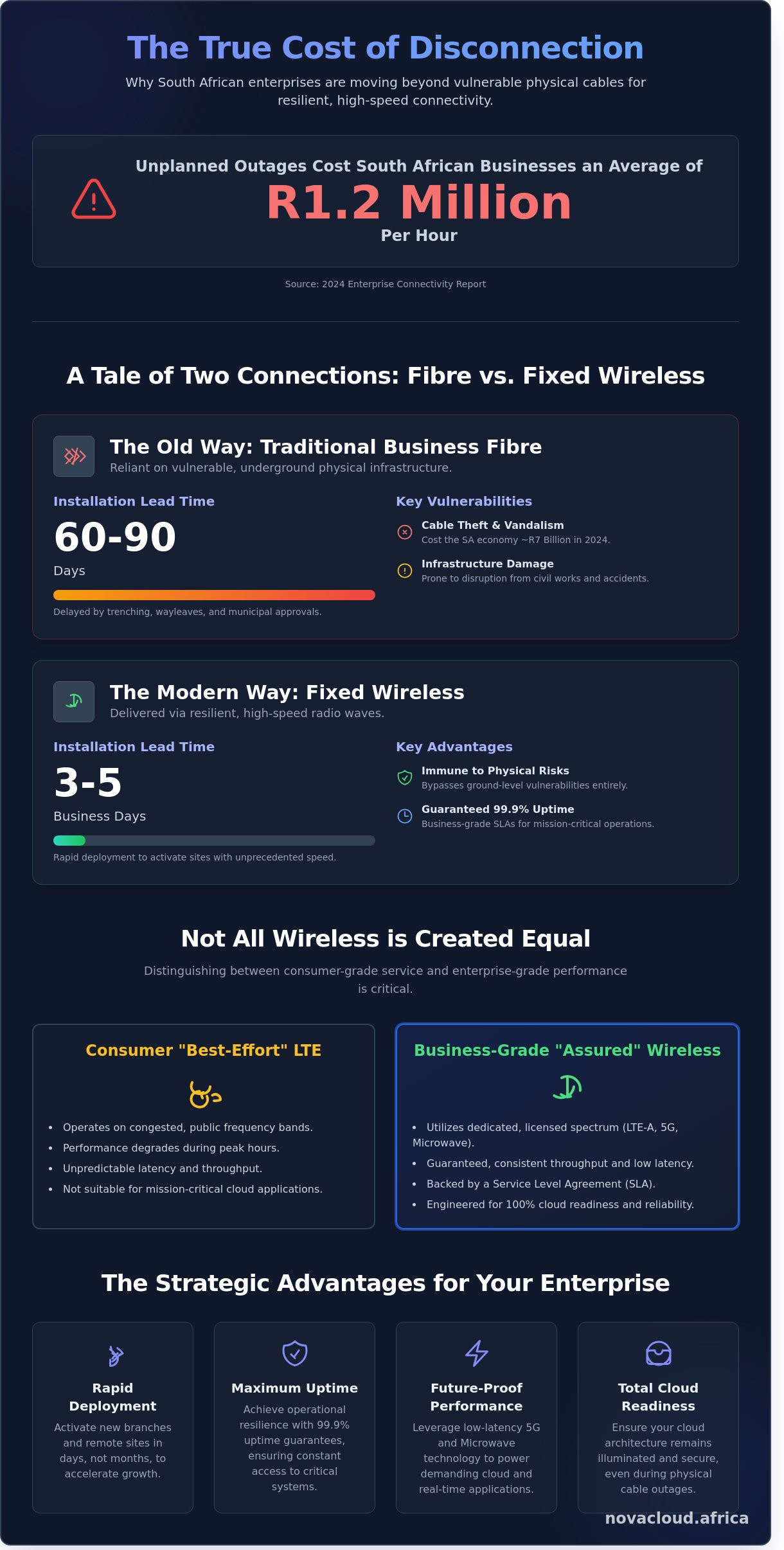
Infrastructure stability is the foundation of digital transformation. In 2024, cable theft and infrastructure vandalism cost the South African economy approximately R7 billion, causing significant disruptions to traditional fibre networks. Wireless bypasses these physical vulnerabilities entirely. The "Time-to-Site" advantage is equally critical. While fibre trenching often takes 60 to 90 days to complete, a professional wireless installation is frequently operational within 3 to 5 business days. This speed allows companies to activate new branches or remote sites with unprecedented momentum.
The Shift from Residential LTE to Business-Grade Wireless
Corporate leaders must distinguish between consumer "best-effort" LTE and corporate "assured" connectivity. Business-grade fixed wireless utilizes dedicated, often licensed spectrum to avoid the congested public bands that plague residential services. This ensures consistent throughput even during peak usage hours. Reliability is the ultimate metric for success, particularly for organizations running VPS hosting South Africa to manage their mission-critical data. These businesses require the 99.9% uptime guarantees that only dedicated wireless architectures can provide, ensuring that cloud-hosted assets remain accessible to every employee, regardless of local infrastructure challenges.
Modern enterprises are choosing fixed wireless internet south africa to bypass the limitations of the past. It's a strategic move toward a future where connectivity is defined by its reliability and speed of execution rather than the physical cables in the ground. As we move toward 2026, the reliance on these air-borne links will only grow, cementing wireless as the backbone of the country's digital economy.
The Technology Spectrum: From Fixed LTE to Enterprise Microwave
The architectural foundation of fixed wireless internet south africa rests on three distinct pillars: LTE-A, 5G NR, and Licensed Microwave. Each technology addresses specific geographic and operational constraints. Understanding frequency bands is vital for strategic planning. Lower frequencies offer superior penetration for indoor environments, while higher frequencies provide the massive bandwidth required for data-heavy cloud applications. ICASA regulates these spectrums strictly. This oversight ensures that your business communication remains free from the crippling interference that plagues unlicensed consumer bands. Every deployment requires a precise match between the frequency used and the distance from the base station to ensure peak performance.
Fixed LTE and 5G: The Agile Choice
5G NR (New Radio) represents a paradigm shift for South African enterprises. It isn't just a speed upgrade; it provides a low-latency environment essential for real-time digital transformation. While mobile LTE users share bandwidth dynamically, "Fixed" LTE is location-locked. This geographic anchoring ensures your connection remains stable even during peak traffic hours in busy commercial districts. Fixed Wireless Access (FWA) utilizing 5G NR technology can achieve sub-20ms latency, rivaling fibre performance in optimal conditions. Recent reports indicate that 5G fixed wireless access is currently expanding across urban centers, though rural adoption follows a different trajectory based on ICASA’s latest 2024 infrastructure data.
Licensed Microwave: The Gold Standard for Reliability
When your operations demand zero compromise, licensed Point-to-Point (P2P) microwave is the answer. Think of it as a dedicated, private highway through the air. These links require a clear Line of Sight (LoS) between your premises and the provider's base station. By utilizing licensed spectrum, you avoid the signal congestion common in 2.4GHz or 5GHz bands. This results in a superior signal-to-noise ratio and carrier-grade reliability. To achieve this, we deploy specialized hardware including:
- High-gain parabolic antennas: These focus the signal into a narrow beam to maximize distance and stability.
- Enterprise-grade routers: These units handle complex traffic shaping and secure tunneling for sensitive corporate data.
- Redundant power systems: Essential for maintaining link integrity during local power fluctuations.
A resilient connection is only the first step in your journey. If you're looking to build a robust foundation for your digital assets, exploring a scalable cloud architecture can ensure your connectivity translates directly into transformative growth. NovaCloud positions itself as your strategic ally, turning these technical specifications into tangible business outcomes across the African continent.
Strategic Comparison: Fixed Wireless vs. Business Fibre and Satellite
Choosing the right connectivity is no longer a matter of speed alone. In 2026, South African enterprises prioritize uptime and architectural agility. A strategic decision framework must weigh three critical pillars: latency, throughput, and installation lead times. While business fibre offers massive capacity, its lead times often stretch to 60 days due to municipal wayleaves and civil works. Fixed wireless internet south africa delivers comparable throughput with deployment windows as short as five business days. This speed to market allows your business to scale and occupy new premises before your competitors even clear their first trench.
Physical cable breaks remain a persistent reality in our local landscape. Fibre repairs involve complex splicing and civil coordination that averages a 12-hour Mean Time To Repair (MTTR). Fixed wireless systems bypass terrestrial disruptions entirely. If a radio unit fails, a technician swaps the hardware in under four hours. This resilience is why the Wireless Access Provider's Association (WAPA) advocates for wireless as a primary enterprise solution for high-stakes environments. By 2026, the cost-per-megabit for high-capacity wireless has reached parity with fibre in urban hubs, with rates averaging R15 to R25 per Mbps on enterprise-grade links. This makes it an affordable foundation for true path diversity.
Fibre vs. Wireless: Performance and Resilience
Fibre provides a deep well of capacity, yet fixed wireless offers unmatched scalability. For hosted pbx providers in South Africa, a hybrid model is the gold standard for 99.99% uptime. It ensures voice traffic never drops during a physical line break. Modern Adaptive Power Control (APC) data shows that weather interference is a relic of the past. High-frequency radios now automatically boost signal strength during heavy rain, maintaining consistent throughput even in Cape storms or Gauteng downpours.
Wireless vs. Satellite (LEO): Low Latency Matters
Low Earth Orbit (LEO) satellites have changed the game for rural areas, but terrestrial fixed wireless internet south africa remains superior for the urban office. Terrestrial links offer 10 to 15ms latency, whereas LEO jitter still creates echoes in VoIP calls and noticeable lag in RDP sessions. For a high-usage office environment, the cost of fixed wireless is roughly 30% lower than comparable LEO business tiers when you factor in data caps and the high cost of specialized satellite hardware. Terrestrial wireless keeps your data local, reducing the hops required to reach South African data centres. This ensures your cloud applications feel local, fast, and responsive.
Criteria for Excellence: Choosing a Business-Grade Wireless Provider
Selecting a provider for fixed wireless internet south africa requires moving beyond simple price-per-megabit comparisons. Performance isn't accidental; it's engineered through intentional network architecture. A business-grade provider distinguishes itself by maintaining a 1:1 contention ratio, ensuring your bandwidth isn't diluted by neighboring residential traffic during peak hours. While consumer links often suffer at 1:10 or 1:20 ratios, a dedicated business link provides the consistent throughput necessary for high-stakes digital operations.
The provider's core network and peering relationships dictate your actual user experience. Premium providers peer directly at major South African exchange points like NAPAfrica. This reduces the number of "hops" your data takes, resulting in faster access to local cloud resources and international gateways. When your data stays on a high-capacity core network rather than traversing congested public transit routes, your business gains a competitive edge in speed and stability.
The Anatomy of a Robust Business SLA
Service Level Agreements (SLAs) are the heartbeat of professional connectivity. There's a massive operational gap between a 99% uptime guarantee and a 99.9% guarantee. A 99% uptime allows for over three days of downtime annually, while 99.9% limits that risk to less than nine hours. For businesses relying on the Yealink T31P IP Phone for daily communication, latency and jitter thresholds are non-negotiable. High jitter causes "choppy" voice calls that erode professional credibility.
- Latency: Should consistently remain below 30ms for local traffic to support real-time voice and video.
- Jitter: Must stay under 10ms to prevent packet arrival delays that disrupt synchronization.
- Packet Loss: "A business-grade SLA should specify maximum packet loss percentages to ensure seamless cloud application execution."
Support and Managed Services Integration
Connectivity shouldn't exist in a vacuum. Partnering with a provider that offers both the link and managed IT services creates a unified accountability structure. When a single partner manages your infrastructure, they don't just provide a pipe; they illuminate the entire network path. This integration allows for proactive monitoring where potential faults are identified and mitigated before they impact your staff. It's the difference between a technician calling you to report a resolved issue and you calling a global help desk to report a failure.
Security is the final pillar of excellence. Managed firewalls at the wireless entry point ensure that your high-speed link doesn't become an open door for threats. By integrating security into the connectivity layer, businesses in South Africa can scale with confidence, knowing their digital perimeter is as resilient as their connection. This holistic approach transforms internet access from a utility into a strategic asset.
Ready to elevate your connectivity standards? Partner with NovaCloud for resilient business wireless solutions.
Beyond the Connection: Powering Your Cloud Infrastructure
Connectivity is the oxygen for any cloud-first business model in 2026. Without a stable link, even the most sophisticated digital tools become inaccessible. High-performance fixed wireless internet south africa provides the resilient architecture required to keep modern enterprises operational. It acts as a vital bridge between local operations and global data centers. This technology ensures that cloud backups remain secure and consistent, even during the frequent fibre outages caused by cable theft or municipal construction projects that affected 34% of local businesses in 2024.
The synergy between high-speed wireless and scalable Virtual Private Servers is transformative. Low-latency wireless links provide the responsiveness needed for real-time data processing and application hosting. Businesses don't need to rely on aging copper lines or vulnerable ground-based cables anymore. They can deploy complex cloud environments with the confidence that their connection is hardened against physical disruptions. It's about building a foundation for growth that doesn't falter when the ground is disturbed.
Empowering Remote and Hybrid Workforces
Fixed wireless provides office-grade connectivity for key personnel who drive your business from home. It's no longer enough to rely on consumer-grade mobile data for executive functions. By deploying dedicated wireless links, companies ensure seamless integration of VoIP services and Microsoft 365 environments. This empowerment allows South African businesses to operate from anywhere, from the heart of Sandton to the growing hubs in the Western Cape, without sacrificing security or speed. It's a strategic move that treats every remote office as a high-priority node in your network.
The NovaCloud Advantage: A Unified Ecosystem
Sourcing your connectivity, security, and cloud infrastructure from a single expert eliminates the friction of multi-vendor management. NovaCloud serves as your Innovative Architect, designing bespoke networks that prioritize uptime and scalability. We don't just provide a pipe; we build the digital ecosystem that carries your brand forward. The future of South African business connectivity is bright, illuminated by technologies that bypass traditional limitations. Consult with an Innovative Architect today to design a network that isn't just a utility, but a catalyst for your continental reach.
Illuminating Your Digital Path to 2026
The roadmap to 2026 demands a shift from reactive connectivity to proactive network architecture. You've seen how enterprise microwave delivers 99.9% uptime, effectively bridging the gap where traditional fibre reach falters. By integrating fixed wireless internet south africa into your primary infrastructure stack, you're not just buying bandwidth; you're securing a resilient foundation for your entire cloud ecosystem. This technology now supports sub-20ms latency, making it a critical asset for real-time South African business operations and high-stakes digital transformation.
NovaCloud stands ready as your strategic ally. We provide a sophisticated cloud-first infrastructure backed by an expansive national footprint. Our team offers expert technical assistance for complex enterprise migrations, ensuring your transition is seamless and your growth is unhindered. It's time to move beyond standard connections and embrace a network built for the African market's unique challenges. We're here to ensure your business doesn't just survive the next digital shift but leads it with confidence.
Architect your resilient business network with NovaCloud’s connectivity solutions
Your journey toward a more connected, empowered future starts with a single, decisive step today.
Frequently Asked Questions
What is the difference between home LTE and business fixed wireless?
Business fixed wireless provides dedicated bandwidth and 99.5% uptime guarantees, whereas home LTE relies on congested consumer towers. While home LTE speeds fluctuate based on neighborhood usage, our business solutions utilize licensed spectrum to ensure consistent performance. This resilient architecture supports your digital transformation by eliminating the latency issues common in consumer-grade mobile data, providing a stable foundation for professional growth.
Can I run a VoIP phone system over a fixed wireless connection?
You can absolutely run a high-definition VoIP system over a fixed wireless connection without compromising audio quality. Modern 2026 infrastructure delivers sub-20ms latency; this is essential for crystal-clear voice calls and seamless integration with cloud PBX systems. We prioritize voice traffic through Quality of Service protocols, ensuring your client communications remain professional and uninterrupted even during periods of high data demand.
How long does it typically take to install fixed wireless internet in South Africa?
Standard installation for fixed wireless internet in South Africa typically takes 3 to 7 business days once your site survey is approved. This rapid deployment provides a significant advantage over fibre, which often requires 30 to 90 days for civil works and municipal permits. We focus on getting your operations online quickly, providing a bright beginning for new branch offices or temporary project sites across the country.
Does weather like heavy rain affect business-grade fixed wireless internet?
Heavy rain rarely impacts business-grade fixed wireless internet in South Africa due to built-in power fade margins and sophisticated modulation techniques. While extreme storms might cause minor signal attenuation, our resilient architecture is designed to maintain 99.9% availability in local climate conditions. We use high-gain equipment that pierces through atmospheric interference, ensuring your connectivity remains a reliable pillar for growth regardless of the season.
What speeds can I expect from fixed wireless internet in 2026?
In 2026, businesses can expect symmetrical speeds ranging from 100Mbps to 1Gbps on premium fixed wireless tiers. These scalable solutions allow your enterprise to expand its digital footprint without the physical constraints of traditional copper or cable. By utilizing 60GHz and 5G-Advanced technology, we deliver the high-speed throughput required for data-intensive cloud applications and real-time analytics across the African continent.
Is fixed wireless a suitable backup for business fibre?
Fixed wireless is the premier choice for a redundant backup to business fibre because it provides a completely independent path into your building. If a construction crew accidentally cuts your underground fibre line, your wireless link keeps your systems illuminated and operational. This strategic diversity ensures 100% uptime, protecting your revenue from the local infrastructure failures that occur on average 4 times per year in major metropolitan hubs.
Do I need line-of-sight for a fixed wireless connection to work?
Most high-performance business connections require a clear line-of-sight between your roof and the local base station. Our technicians use precision alignment tools to establish this link, ensuring transformative growth through stable signal strength. While some Near-Line-of-Sight technologies exist for 2026 deployments, a direct visual path remains the gold standard for achieving the lowest possible latency and maximum throughput for your corporate network.
Is fixed wireless internet secure for sensitive business data?
Fixed wireless internet is highly secure, utilizing AES-256 bit encryption to protect your sensitive business data from interception. This level of security matches global banking standards, providing a safe environment for your financial transactions and proprietary cloud workloads. We build every link as a private, encrypted tunnel; this ensures your digital transformation remains protected from the evolving threats in the modern technological landscape.
