


IT Disaster Recovery Plan for SMEs: Architecting Digital Resilience in 2026

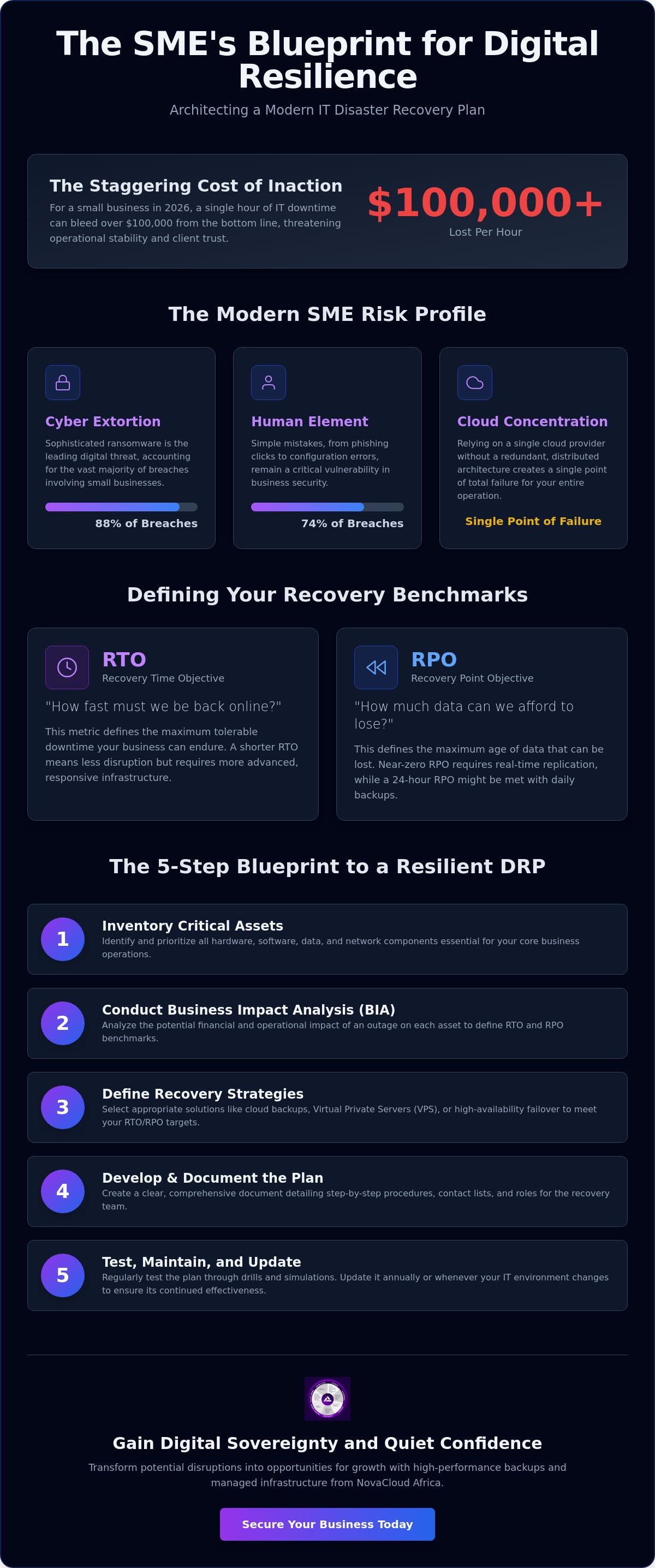
Did you know that for a small business in 2026, a single hour of IT downtime can bleed over $100,000 from your bottom line? This reality makes a robust IT disaster recovery plan for SMEs an essential pillar of your digital architecture rather than a luxury. You likely recognize the anxiety that comes with every power flicker or news report of a new ransomware surge. You've built a legacy, and the fear of losing data or connectivity shouldn't be what keeps you up at night.
We're here to help you master the strategic framework necessary to ensure your business remains secure and sovereign in an unpredictable landscape. This guide provides an actionable roadmap to reduce downtime and protect your digital assets with quiet confidence. We'll show you how to architect resilience that acts as a beacon of clarity, illuminating the path toward renewed growth. By the end, you'll have the tools to transform potential disruptions into opportunities for regional empowerment and operational excellence.
Key Takeaways
- Shift your perspective from emergency kits to architectural blueprints by understanding how sophisticated cyber-extortion defines the 2026 threat landscape.
- Establish clear survival benchmarks with precise RTO and RPO metrics that dictate exactly how fast your business returns to full strength.
- Master a strategic IT disaster recovery plan for SMEs that leverages Virtual Private Servers and cloud-first strategies to replace the vulnerabilities of legacy hardware.
- Follow a structured five-step blueprint to inventory critical assets and conduct impact analyses that safeguard your most vital digital workflows.
- Gain the confidence to maintain digital sovereignty through the seamless integration of high-performance backups and managed infrastructure.
Architecting Resilience: Why an IT Disaster Recovery Plan is Vital for SMEs
A strategic Disaster Recovery plan serves as a blueprint for renewal rather than a simple emergency kit. It's the architectural foundation that allows your business to rise from the ashes of a digital disruption with its integrity intact. In 2026, the landscape has shifted. We no longer just fear hardware failures or local power outages. Instead, we face a new era of sophisticated cyber-extortion and AI-driven attacks that can paralyze an entire operation in seconds. For a micro-business, the cost of this silence is staggering, often reaching approximately $1,670 per minute according to recent industry estimates. An IT disaster recovery plan for SMEs is the difference between a temporary pause and a permanent closure.
True digital sovereignty requires more than just storing data in a remote location. It demands a sophisticated understanding of where your data lives and how quickly it can be reclaimed. When you architect for resilience, you ensure that your SME remains a sovereign entity, capable of maintaining its promises to clients even when the global digital environment becomes volatile. This level of readiness transforms your technology from a vulnerability into a catalyst for regional growth and stability.
The Shift from Reactive to Proactive Sovereignty
Moving away from "emergency fixes" toward a culture of continuous availability creates a powerful competitive advantage. When you lead with a proactive IT disaster recovery plan for SMEs, you build deep trust with enterprise-level partners who demand rigorous uptime standards. This shift offers a profound psychological benefit. You can lead your team with quiet confidence, knowing that your digital evolution is anchored by systems designed for endurance. It’s about creating a state of readiness where every potential challenge is met with a pre-designed path to recovery.
Identifying Modern SME Risk Profiles
Modern risks are multi-layered and often invisible. While natural disasters still pose a threat, digital catastrophes like ransomware now account for 88% of breaches involving small businesses. We also see the rising danger of "cloud concentration," where relying on a single provider without redundant infrastructure can lead to total blackout. Perhaps most critically, the human element remains a primary factor, with 74% of data breaches involving some form of human error. By utilizing cloud backups and distributed architectures, you can mitigate these risks and ensure that a single mistake doesn't result in total data loss. Understanding these profiles is the first step in designing a system that reflects both global benchmarks and your specific regional needs.
Defining Your Recovery Benchmarks: Understanding RTO and RPO
Designing a resilient future requires more than just intent; it demands precise metrics. Every IT disaster recovery plan for SMEs must be anchored by two fundamental benchmarks: Recovery Time Objective (RTO) and Recovery Point Objective (RPO). These aren't merely technical specifications. They represent the boundaries of your digital endurance and the promises you keep to your stakeholders. When you define these targets, you're essentially mapping out the survival threshold of your organization.
RTO defines the clock. It's the maximum tolerable duration that your business can remain offline before the damage to your revenue or reputation becomes irreversible. In contrast, RPO defines the data. Specifically, the Recovery Point Objective is the maximum age of files that must be recovered from backup storage for normal operations to resume. Aligning these targets with a formal IT disaster recovery plan framework ensures your strategy meets international standards while remaining grounded in your specific operational needs.
There's a direct relationship between these benchmarks and your total cost of ownership (TCO). Generally, the shorter the recovery window, the more sophisticated the infrastructure required. Achieving near-zero downtime might involve Virtual Private Servers or real-time replication, which carries a different investment profile than standard daily backups. Finding the equilibrium between the cost of protection and the potential cost of failure is a strategic exercise in visionary leadership. If you're looking to refine your current strategy, our team can provide the IT Assistance needed to audit your existing infrastructure and set achievable goals.
Setting Realistic RTOs for Different Business Functions
Not all systems carry the same weight. Your Hosted PBX and core transactional databases are mission-critical; they require RTOs measured in minutes to maintain customer trust. Secondary systems, such as legacy archives, can often tolerate longer recovery periods. Your connectivity is the silent engine behind these numbers. High-speed, symmetrical Business Fibre is vital because it provides the necessary throughput to restore massive datasets from the cloud at the speed your business demands.
Calculating Your RPO: Data Integrity vs. Storage Costs
Determining your RPO involves identifying "vital records" that require zero-loss recovery strategies. If your SME processes hundreds of digital interactions an hour, a 24-hour backup cycle is no longer sufficient. You can find a deeper analysis of how to balance these requirements in our guide on Strategic Data Resilience. By categorizing data based on its impact on business continuity, you can architect a system that provides maximum protection where it’s most needed without inflating your storage budget.
Cloud-First vs. Legacy Infrastructure: Choosing Your Recovery Environment
Traditional on-premise backups often act as a tether rather than a lifeline. In our mobile-first era, relying on physical hardware located within your four walls creates a single point of failure that can jeopardize your entire IT disaster recovery plan for SMEs. If your primary office becomes inaccessible due to a localized disaster or a prolonged power outage, those on-site drives are effectively trapped. A cloud-first architecture removes these geographic constraints, ensuring your data and applications remain accessible from anywhere on the planet.
Choosing the right recovery environment is a matter of strategic design. For many, Microsoft 365 Business Licensing provides the initial layer of resilience, allowing your team to maintain productivity through cloud-based collaboration even when local systems are dark. However, true digital sovereignty requires a more robust "warm site" where your core business applications can be resurrected instantly. This is where the transition from legacy hardware to sophisticated cloud infrastructure becomes a catalyst for your organization's renewal.
The Power of Virtual Private Servers (VPS) for Continuity
A VPS serves as the ultimate standby environment. Unlike cold storage, Virtual Private Servers allow for rapid environment cloning, creating a functional mirror of your production systems. If your primary server fails, you can scale resources instantly to meet demand. This flexibility ensures that your IT disaster recovery plan for SMEs isn't just a document on a shelf but a living, high-performance architecture ready to take over at a moment's notice.
Integrated Security: The Managed Firewall Advantage
A recovery plan is fundamentally useless if the environment you're restoring to is already compromised. Security must be baked into the architecture, not added as an afterthought. By utilizing a Managed Firewall, specifically leveraging FortiNet infrastructure, you create a secure perimeter that shields your recovered data from opportunistic threats. This proactive approach includes threat hunting and real-time monitoring, which often prevents the need for a full disaster recovery activation by neutralizing risks before they escalate into catastrophes. It’s about building a digital fortress that protects your legacy while enabling your future growth.
The 5-Step Blueprint: Building a Practical IT Disaster Recovery Plan
Moving from the conceptual phase to operational readiness requires a disciplined approach to systems design. A high-performance IT disaster recovery plan for SMEs isn't a static document; it's a living framework that evolves alongside your business. By following a structured five-step blueprint, you can transform your digital infrastructure into a resilient environment capable of withstanding the most sophisticated disruptions of 2026.
- Step 1: Conduct a Business Impact Analysis (BIA). Map your critical dependencies to understand which workflows drive your revenue and which can wait.
- Step 2: Inventory all IT assets. Create a comprehensive list of every component, from your Yealink T31P IP Phone hardware to your cloud-hosted databases and Ubiquity networks.
- Step 3: Define procedures and assign ownership. Clarity is vital during a crisis. Assign specific recovery tasks to team members so everyone knows their role when the clock is ticking.
- Step 4: Implement the technology stack. Deploy robust solutions like Acronis Cloud backups and managed connectivity to ensure your data is secure and retrievable.
- Step 5: Test, audit, and refine. A plan is only as good as its last successful test. Conduct quarterly drills to identify bottlenecks and update your strategies.
If you're ready to move beyond basic backups and architect a truly sovereign system, our team provides the expert IT Assistance needed to design and implement your custom recovery blueprint.
Inventory and Dependency Mapping
In the regional market, connectivity challenges often stem from localized infrastructure issues or power fluctuations. You must identify every "single point of failure" in your network, from your primary server to your edge devices. Ensuring redundancy isn't just about software; it requires a physical foundation of reliable Business Fibre. This provides the symmetrical throughput necessary to maintain operations when your primary site is under pressure, serving as the architect’s choice for enterprise-grade stability.
Communication and Execution Protocols
When your physical office is inaccessible, maintaining your professional presence is paramount. Utilizing Hosted PBX allows your team to leverage Unified Communications from any location, ensuring that your clients never experience a break in service. Your "Emergency Contact Tree" should dictate exactly who executes which restoration procedure in the first 60 minutes of an incident. Documenting these steps in clear, non-technical language empowers your entire staff to contribute to the recovery process, fostering a culture of collective resilience and renewed focus.
Navigating the Digital Horizon: How NovaCloud Africa Secures Your Business
Securing your legacy in a volatile digital era requires more than just software. It demands a partnership with a strategic ally who understands that technology is a catalyst for regional empowerment. At NovaCloud Africa, we don't just provide tools; we architect resilient systems that act as a beacon of clarity for your organization. By integrating an IT disaster recovery plan for SMEs into your core business strategy, we help you transform potential vulnerabilities into a foundation for renewed growth and operational dignity.
The true power of our approach lies in the synergy between sophisticated protection and high-performance recovery. We combine the precision of Acronis Cloud backups with the agility of Virtual Private Servers to ensure that your data isn't just stored, but ready for immediate resurrection. This technical execution is backed by our human-first IT assistance. When every second of downtime counts, you need more than a support ticket; you need expert architects who are passionately committed to your continuity and success.
Strategic Infrastructure Integration
We provide a holistic look at business-grade cloud infrastructure designed specifically for the unique challenges of the South African market. Our solutions go beyond simple storage. We build a protective shield around your operations by layering Managed Firewall security with high-speed Business Fibre. This integrated environment allows us to offer customized Disaster Recovery as a Service (DRaaS) that is precisely tailored to your specific RTO and RPO requirements. It’s an architectural approach that ensures your IT disaster recovery plan for SMEs is both robust and sovereign.
Partnering for Future-Proof Growth
Maintaining readiness is a continuous journey of evolution. As your business scales and the global threat landscape shifts, your recovery strategies must adapt. There's immense value in Strategic IT Assistance to ensure your digital evolution remains in expert hands. We provide the technical expertise and visionary guidance needed to keep your systems at the forefront of international benchmarks. We invite you to embrace the future with quiet confidence. Speak to a NovaCloud architect today to secure your digital future.
Secure Your Sovereignty in the Digital Age
True digital resilience is an active choice to protect your hard-won progress. By establishing clear recovery benchmarks and embracing cloud-first architectures, you transform your technology into a foundation for permanent growth. Implementing a comprehensive IT disaster recovery plan for SMEs ensures your business remains a sovereign, operational force regardless of the challenges 2026 presents. This strategic readiness allows you to lead with quiet confidence, knowing your systems are designed for endurance rather than just survival.
Our team is ready to serve as your strategic ally, providing the technical execution needed to safeguard your digital evolution. We offer seamless Acronis Cloud integration for immutable backups and FortiNet-powered Managed Firewall security to protect your perimeter. Combined with our 24/7 Strategic IT Assistance, South African enterprises can navigate the future with total clarity and purpose. We focus on the intricate details of your infrastructure so you can focus on the expansion of your legacy.
Architect your resilience with NovaCloud Cloud Infrastructure and step into a new era of business efficiency. Your digital future is bright, and we're here to ensure it stays that way through every turn in the road.
Common Questions on Digital Resilience
What is the difference between a backup plan and a disaster recovery plan?
A backup plan focuses on the preservation of data, while a disaster recovery plan encompasses the entire strategy for restoring operational continuity. Think of backups as the raw materials and the recovery plan as the architectural blueprint for renewal. While backups ensure you have the files, the recovery plan dictates how quickly and in what order your systems, such as Hosted PBX or cloud databases, return to a functional state.
How often should an SME test its IT disaster recovery plan?
You should test your IT disaster recovery plan for SMEs at least once every quarter to ensure it remains effective against evolving threats. Regular drills reveal hidden bottlenecks in your restoration procedures and allow your team to practice their specific roles with quiet confidence. Testing after any significant change to your network architecture or the addition of new cloud services is also essential for maintaining a state of readiness.
Do I need a disaster recovery plan if all my data is in Microsoft 365?
Yes, because Microsoft 365 operates on a shared responsibility model where you remain responsible for your data's integrity and long-term retention. While the platform ensures high availability of the infrastructure, it doesn't protect you from accidental deletion, internal threats, or sophisticated ransomware within your own tenant. Integrating external Cloud backups provides the necessary redundancy to ensure your business remains sovereign and resilient.
What are the most common mistakes SMEs make in disaster recovery planning?
The most frequent error is treating a disaster recovery plan as a static document rather than a living strategy. Many organizations also fail to account for the human element, leaving staff untrained on how to execute restoration protocols under pressure. Another critical mistake is ignoring connectivity redundancy, assuming that a single internet line will be sufficient for high-speed data restoration during a regional crisis.
How much does a professional IT disaster recovery plan cost to implement?
The investment required depends on your specific recovery benchmarks, such as your RTO and RPO targets. High-performance architectures that utilize Virtual Private Servers for near-instant restoration involve different resource allocations than basic offsite storage. We recommend focusing on the total cost of ownership and the potential revenue loss from downtime to determine an appropriate budget that aligns with your business's growth objectives.
Can a Managed Firewall prevent the need for a disaster recovery plan?
A Managed Firewall is a vital defensive layer that significantly reduces your risk profile, but it cannot replace a recovery plan. While it neutralizes many cyber threats before they penetrate your network, it cannot protect against hardware failure, natural disasters, or human error. A robust security perimeter works in harmony with your recovery strategy to ensure that if a breach does occur, your systems can be restored safely.
What is the role of VPS in a modern disaster recovery strategy?
Virtual Private Servers act as a "warm site" where you can clone your production environment almost instantly during an outage. In a modern IT disaster recovery plan for SMEs, a VPS provides the scalable compute power needed to run critical applications while your primary hardware is being repaired or replaced. This ensures that your digital presence remains uninterrupted, allowing your team to maintain productivity from any location.
How does Business Fibre connectivity affect my recovery time?
Symmetrical Business Fibre provides the high-speed throughput necessary to pull massive datasets from the cloud at the speed your business requires. Without enterprise-grade connectivity, your recovery time objective (RTO) is limited by the physical constraints of your internet line. Fast, reliable fibre acts as a catalyst for regional empowerment, ensuring your restoration process is measured in minutes rather than days.
