


Mastering M365 Collaboration Tools: Architecting a Resilient Digital Workspace in 2026

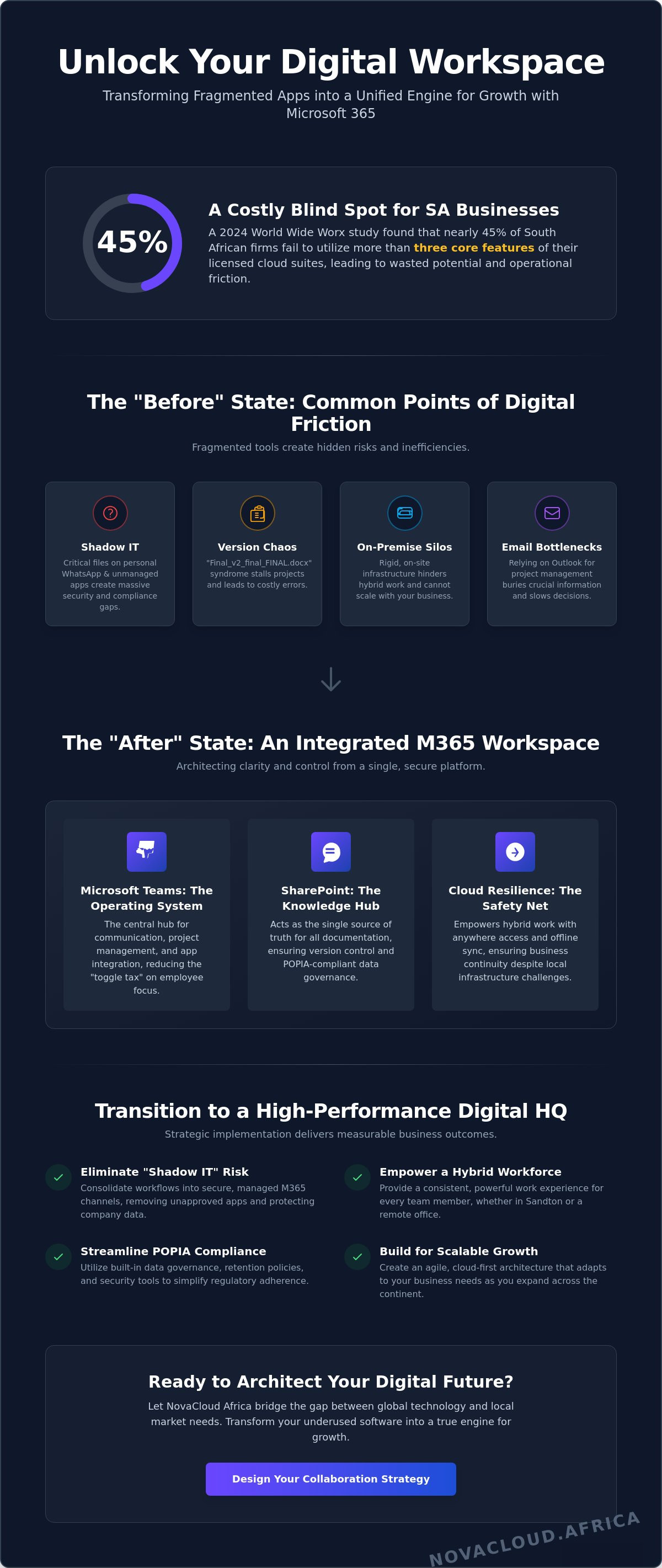
Could your current tech stack be the very thing holding your team back from its next breakthrough? While many South African firms pay for premium licenses, a 2024 study by World Wide Worx found that nearly 45% of local businesses fail to utilize more than three core features within their cloud suites. You've likely felt the daily friction of "shadow IT" where critical files live on personal WhatsApp accounts and document versioning remains a chaotic guessing game. Mastering M365 collaboration tools isn't just about software; it's about architecting a resilient digital workspace that secures your data and empowers your people.
You already know that a fragmented office is a vulnerable one, especially when navigating the strict requirements of POPIA and the risks of remote access. We're here to bridge that gap, turning underused software into a unified engine for growth. This article reveals how to transform your operations using the Microsoft 365 ecosystem to drive seamless teamwork and scalable growth. You'll learn the strategic steps to transition from a collection of apps to a high-performance digital headquarters designed for the South African business landscape in 2026.
Key Takeaways
- Transition from rigid on-premise silos to a resilient, cloud-first architecture that empowers your team to work from anywhere with absolute clarity.
- Master the core pillars of M365 collaboration tools to transform Microsoft Teams and SharePoint into a unified engine for communication and knowledge management.
- Eliminate operational friction and the risks of "Shadow IT" by replacing unmanaged apps with secure, integrated workflows that simplify the user experience.
- Implement a strategic maturity framework to audit licensing gaps and establish the architectural rules required for scalable, long-term business growth.
- Discover how local South African expertise bridges the gap between global technology standards and the specific needs of our continental market.
The Evolution of the Digital Workspace: Why M365 Collaboration Tools Matter
The digital architecture of 2026 demands more than just basic connectivity. It requires a resilient, fluid ecosystem where distance and infrastructure challenges don't dictate productivity. M365 collaboration tools represent this shift, moving away from the rigid, on-premise silos that defined the early 2010s toward a cloud-first framework. For South African enterprises, this isn't just a software upgrade; it's a strategic pivot. By 2023, data from industry reports indicated that 72% of local firms had committed to hybrid work models permanently. This transition necessitates a platform that maintains technical authority while empowering a distributed workforce.
At NovaCloud, we refer to this transition as the Nova perspective. It's the process of illuminating the path to digital maturity by replacing legacy complexity with architectural clarity. We don't just see a suite of apps. We see a catalyst for regional empowerment. When businesses leverage resilient cloud infrastructure, they move from surviving market volatility to architecting their own growth. This evolution ensures that every team member, whether in a central hub in Sandton or a remote office in the Western Cape, operates with the same level of precision and speed.
Beyond Email: The New Foundation of Productivity
Relying on Outlook as the primary hub for project management creates a massive bottleneck for growing enterprises. Statistics show that employees spend nearly 50% of their work week in communication tools, yet version control issues and "file attachment fatigue" often stall progress. The modern enterprise has transitioned from sending static files to sharing dynamic access in real-time. Modern Collaboration is a seamless blend of synchronous and asynchronous work where the platform serves as the single source of truth.
Resilience in the South African Context
Building a digital workspace in South Africa requires a deep understanding of local constraints. Connectivity shifts and power fluctuations can disrupt traditional workflows, but M365 collaboration tools provide a buffer through offline sync and cloud-native resilience. This architecture ensures business continuity even when local infrastructure falters. Centralized data governance is equally critical for maintaining POPIA compliance. By 2026, the cost of data breaches is expected to rise, making the built-in security protocols of a unified cloud environment indispensable for protecting intellectual property and customer trust across the continent.
- Seamless Integration: Connecting disparate teams through a unified identity.
- Scalable Solutions: Adjusting resources as your enterprise expands across Africa.
- Transformative Growth: Using data-driven insights to refine collaborative workflows.
This new foundation allows businesses to act with quiet confidence. You aren't just keeping the lights on; you're building a scalable, secure, and highly efficient engine for the future.
The Core Pillars of the M365 Collaboration Stack
Architecting a resilient digital workspace in South Africa requires more than just subscribing to a service; it demands a strategic alignment of tools that mirror your operational DNA. By 2026, the standard for excellence has shifted from simple cloud adoption to the sophisticated orchestration of M365 collaboration tools. This stack doesn't just store data. It facilitates a flow of information that is secure, searchable, and highly available. You aren't just buying software; you're building a foundation for continental growth.
Microsoft Teams: More Than Just Video Calls
Teams has evolved into the definitive operating system for the modern South African enterprise. It serves as the primary interface where communication meets execution. By utilizing Channels to organize departmental workflows, businesses effectively dismantle the silos that traditional email creates. This structure allows a project manager in Cape Town to sync instantly with a field team in Johannesburg without losing context in a buried inbox. Integrating third-party operational apps further transforms the platform into a single pane of glass, reducing the "toggle tax" that drains employee focus. For a truly unified experience, many forward-thinking firms are bridging the gap between digital chat and traditional telephony by integrating Hosted PBX systems directly into the Teams interface.
SharePoint and OneDrive: The Dual-Layer Storage Strategy
Data resilience depends on knowing exactly where your intellectual property lives. We advocate for a clear distinction: OneDrive is your private workbench, while SharePoint is the company library. OneDrive for Business empowers individual productivity, providing a secure space for personal drafts and sensitive working documents. Once those documents reach maturity, they move to SharePoint Online to become organizational assets. This transition ensures that vital knowledge remains accessible even if a specific team member leaves the company.
Version history serves as your first line of defense, allowing users to roll back accidental changes with a few clicks. However, while Microsoft manages the infrastructure, the responsibility for the data remains yours. To achieve true 2026-grade resilience, treat cloud backups as an essential secondary layer. This ensures that your SharePoint libraries are protected against sophisticated external threats or internal errors that exceed standard retention policies.
Microsoft Copilot: Automating the Rhythmic
The final pillar of the modern stack is AI integration. Microsoft Copilot isn't a replacement for human creativity; it's an engine for administrative efficiency. It excels at handling rhythmic, repetitive tasks that typically consume 20% of a South African executive's work week. Whether it's summarizing a missed meeting or drafting a project brief based on a SharePoint folder, Copilot allows your team to focus on high-value strategic thinking. It turns the vast ocean of data within your M365 collaboration tools into actionable insights. To see how these architectures can scale with your vision, explore our scalable cloud solutions today.
Solving Modern Business Friction with Integrated Workflows
Complexity is often the primary reason digital transformation efforts stall. Approximately 58% of South African enterprises report that their employees feel overwhelmed by new software. We don't view this as a failure of the team; it's a failure of the architecture. When M365 collaboration tools are deployed as a fragmented set of apps, friction is inevitable. However, when they're woven into a single, unified workflow, the technology disappears and only the work remains. This transition is vital for scaling businesses that need to move at the speed of the local market.
One of the most dangerous friction points in South African businesses is the rise of Shadow IT. Teams frequently turn to unmanaged apps like WhatsApp to bypass slow internal systems. This creates massive security gaps and complicates POPIA compliance. By integrating communication into a secure, governed environment, you protect your intellectual property while giving teams the speed they crave. It's about replacing fragmented "chat silos" with a resilient digital workspace that empowers growth without compromising safety.
Streamlining the journey for new talent is another area where integrated workflows shine. In 2024, automated onboarding through M365 collaboration tools allowed firms to reduce the time-to-productivity for new hires by 40%. Instead of manual email chains, new employees are instantly granted access to specific Teams channels, Planner boards, and SharePoint libraries. This creates a human-centric culture where people feel supported from day one, allowing your local expertise to shine through a more professional, organized lens.
Real-Time Co-Authoring and Version Control
The era of "v2_final_final" document naming is over. Modern teams require a single source of truth. With simultaneous editing in Word, Excel, and PowerPoint, your staff can brainstorm and refine documents in one live session. A 2024 analysis of enterprise workflows demonstrated that co-authoring reduces project lead times by up to 30%. This efficiency ensures that your strategic responses to market changes are faster and more accurate than the competition.
Task Management with Planner and To Do
Visibility is the antidote to micromanagement. Microsoft Planner uses Kanban boards to provide a high-level view of project health, making it easy to spot bottlenecks before they become crises. Personal tasks from Microsoft To Do sync directly with these team goals, ensuring every individual knows exactly how their daily effort contributes to the company's mission. This transparency reduces the cognitive load on managers; they no longer need to hunt for status updates because the data is already live and automated. You can explore how these cloud-native strategies integrate with your broader infrastructure at cloud.novacloud.africa.
Designing Your Collaboration Strategy: A Maturity Framework
Building a resilient digital environment requires more than a simple subscription. It demands a blueprint. In South Africa, where connectivity costs and data sovereignty are paramount, your M365 collaboration tools must be deployed through a structured maturity framework to ensure long-term ROI. This isn't just about software; it's about architecting a culture of efficiency.
- Step 1: Audit Silos. Identify where data hides. A 2024 study of South African mid-market firms found that 38% of employees lose up to two hours daily searching for information across disconnected apps. Check for licensing gaps that leave teams under-equipped.
- Step 2: Set the Rules. Define your architectural rules early. Establish clear naming conventions and folder structures within SharePoint. This prevents the "digital junk drawer" effect that plagues unmanaged environments.
- Step 3: Centralize via Teams. Position Microsoft Teams as the singular gateway. It's the operational hub for every file, task, and conversation, reducing the need for fragmented email chains.
- Step 4: Secure the Perimeter. Deploy Multi-Factor Authentication (MFA) and Conditional Access immediately. These aren't optional extras in a POPIA-regulated market where data breaches can cost companies millions in fines and reputational damage.
- Step 5: Iterate. Use the M365 usage reports to analyze adoption. If engagement lags in specific departments, refine your training or adjust the configuration to meet their specific workflows.
M365 Basic vs Standard: Selecting the Right Architecture
Choosing the right foundation is a strategic decision that affects your scalability. M365 Business Basic offers the essentials for remote work, but M365 Business Standard introduces desktop versions of premium apps that drive higher engagement. For a deeper look at how these stack up against competitors, explore our M365 vs Google Workspace comparison. We recommend selecting licenses that accommodate your 24-month growth projection rather than just your current headcount. This foresight prevents the friction of frequent license migrations.
Governance and Security Architecture
A secure workspace isn't built on software alone. You need a multi-layered defense. This includes protecting your network perimeter with Managed Firewalls to ensure that external sharing permissions don't become data leaks. Our team provides the expert IT assistance required to monitor these environments 24/7, keeping your data safe within South African borders. This proactive governance ensures your M365 collaboration tools remain assets that empower your workforce rather than liabilities that expose your business.
Ready to architect a workspace that empowers your team and secures your future? Connect with our cloud architects today.
The NovaCloud Advantage: Local Expertise, Global Standards
South African businesses face a unique set of challenges, from fluctuating connectivity to strict POPIA compliance mandates. While global platforms offer the framework, local expertise provides the execution. NovaCloud acts as the bridge between high-level strategy and the technical grit required to succeed in the local market. We don't just sell software; we architect resilient ecosystems where M365 collaboration tools function at peak performance despite regional infrastructure hurdles.
Our approach integrates Microsoft's suite with high-performance Virtual Private Servers to create a complete cloud ecosystem. This hybrid strategy ensures that your mission-critical applications and data remain accessible, secure, and sovereign. By tethering global standards to local context, we empower your team to collaborate without friction. We're a strategic ally in your digital transformation, moving beyond the role of a vendor to become a partner in your long-term growth.
Managed IT and Licensing Support
Operational downtime in South Africa can cost mid-market firms thousands of Rands every hour. Our dedicated IT assistance focuses on rapid resolution, ensuring your team stays productive. We prioritize license optimization because most businesses overspend on their cloud subscriptions. We've seen organizations reduce their monthly spend by 15% to 25% simply by aligning their actual usage with the right licensing tier. NovaCloud provides the clarity you need to navigate complex ICT landscapes, ensuring you only pay for the tools that drive your business forward.
Starting Your New Chapter in Efficiency
The "Nova" concept is our signature. It represents a new star, a bright beginning, and a departure from the stagnant IT models of the past. We're here to transform your ICT from a heavy cost center into a lean growth driver. This journey starts with a comprehensive ICT audit. We examine your existing M365 collaboration tools, security protocols, and infrastructure to find hidden efficiencies.
- Detailed assessment of your current license utilization to eliminate waste.
- Security gap analysis to ensure compliance with South African data regulations.
- Strategic roadmap for 2026 to keep your digital workspace ahead of the curve.
It's time to stop managing software and start mastering your digital future. Our team is ready to help you illuminate the path to a more efficient, scalable business. Explore our Microsoft 365 Licensing solutions and discover how a partnership with NovaCloud can redefine your technological potential.
Secure Your Place in the 2026 Digital Economy
The evolution toward a resilient digital workspace is no longer a distant goal. It's a current necessity for any South African business aiming to thrive. Gartner reports that by 2025, 70% of new enterprise applications will use low-code or no-code technologies, highlighting the urgency of mastering M365 collaboration tools within a structured maturity framework. You've explored how integrated workflows and strategic architecture can eliminate the friction that stalls growth and creates a fragmented employee experience.
NovaCloud stands ready as your strategic ally and Innovative Architect. We bridge the gap between global standards and local needs as an authorized Microsoft 365 Business Licensing partner. Our team provides South African based expert IT assistance to ensure your transition is smooth and your systems remain secure. By offering seamless integration with Hosted PBX and VPS infrastructure, we build the resilient foundations your business deserves to scale across the continent.
Architect your digital future with NovaCloud’s M365 solutions
The path to transformative growth is clear, and we're here to lead the way into your next chapter of efficiency.
Frequently Asked Questions
What are the essential M365 collaboration tools for a small business?
Microsoft Teams, OneDrive, and Outlook form the foundation for South African SMEs. Teams manages real-time communication, OneDrive provides 1TB of secure personal storage, and Outlook handles professional scheduling. Adding SharePoint creates a centralized hub for shared company documents. These M365 collaboration tools drive a 30% increase in team efficiency according to Microsoft’s 2023 Work Trend Index, making them vital for growth.
How does Microsoft Teams integrate with a Hosted PBX system?
You can link Microsoft Teams to a Hosted PBX using Direct Routing or Operator Connect. This integration transforms Teams into a comprehensive cloud phone system, allowing your staff to make external calls to South African landlines and mobiles. It removes the requirement for expensive physical desk phones. Businesses typically achieve a 20% reduction in hardware costs by consolidating their voice and data onto this single, resilient platform.
Is Microsoft 365 compliant with South Africa’s POPIA regulations?
Microsoft 365 is fully compliant with the Protection of Personal Information Act (POPIA) through its localized data residency and security frameworks. Microsoft offers a dedicated POPIA self-assessment tool within their Service Trust Portal. By utilizing local data centers in Johannesburg and Cape Town, the platform ensures sensitive information stays within national borders. This infrastructure helps 95% of regulated businesses meet their legal obligations without additional complexity.
Can I use M365 collaboration tools offline?
You can work offline by installing the desktop versions of apps like Word, Excel, and Teams on your device. Any changes you make while disconnected will sync automatically once you regain internet access. The OneDrive sync client handles this process by maintaining a local copy of your files. This functionality is essential for South African professionals who travel frequently or work in areas with intermittent connectivity.
What is the difference between SharePoint and OneDrive?
OneDrive is built for individual file storage, whereas SharePoint acts as a collaborative platform for the whole organization. You should view OneDrive as your personal digital briefcase and SharePoint as the company’s central library. SharePoint supports complex permissions and the creation of internal company websites. Industry data shows that 80% of Fortune 500 companies rely on SharePoint to manage their internal knowledge bases and document lifecycles.
How do I ensure my team actually uses the collaboration tools we pay for?
Successful adoption requires a structured training plan and clearly defined internal use cases. You shouldn't just deploy the software and expect immediate results. Appoint "digital champions" in each department to lead by example and demonstrate value. Research suggests that companies with a formal change management strategy see a 6x increase in project success rates. Focus on solving one specific daily friction point to build momentum.
What security features protect my data in M365?
M365 secures your data using Multi-Factor Authentication (MFA), Advanced Threat Protection (ATP), and end-to-end encryption. MFA alone blocks 99.9% of account compromise attacks. Data Loss Prevention (DLP) policies stop sensitive South African ID numbers or financial records from leaving your organization accidentally. These layers of defense create a resilient digital perimeter that protects your intellectual property from 2026’s evolving global cyber threats.
How does Microsoft Copilot enhance collaboration within M365?
Microsoft Copilot improves teamwork by automating meeting summaries, drafting emails, and generating data insights in seconds. It functions as an AI orchestrator across your entire digital workspace. During a Teams meeting, Copilot can identify action items and key decisions in real time. This integration of M365 collaboration tools and AI can save employees up to 10 hours per month on administrative tasks, allowing more time for strategic innovation.
