


South African Data Residency and Cloud Hosting: The 2026 Strategic Guide

Data sovereignty isn't a regulatory hurdle to clear; it's the high-octane fuel your enterprise needs to outpace global competitors. While many organizations view the National Data and Cloud Policy of 2024 as a complex maze of restrictions, the most forward-thinking leaders recognize that South African data residency and cloud hosting is actually a strategic performance asset. By anchoring your digital infrastructure within our borders, you aren't just ticking a POPIA compliance box; you're shedding the dead weight of international latency and illuminating a path toward true operational clarity.
It's frustrating to watch your applications lag on distant servers while the threat of massive fines creates a shadow of uncertainty over your digital evolution. This guide promises to help you master these local complexities while architecting a cloud environment designed for the unique demands of South African enterprise. We'll break down the 2026 regulatory landscape and show you how to achieve sub-20ms latency through a strategic, localized approach to your digital infrastructure that acts as a catalyst for regional growth.
Key Takeaways
- Understand how POPIA and FICA form the foundation of your data rights, ensuring your organization meets the rigid compliance standards of the 2026 digital landscape.
- Discover how localizing your infrastructure eliminates latency, allowing you to master South African data residency and cloud hosting while achieving sub-20ms application response times.
- Distinguish between data residency and true sovereignty to protect your mission-critical assets from international jurisdictional reach and external policy shifts.
- Learn a step-by-step approach to architecting a sovereign cloud, from deploying high-performance Virtual Private Servers to implementing immutable cloud backups within our borders.
- Transition from navigating complex, faceless self-service portals to collaborating with a strategic ICT partner who understands the specific nuances of the South African digital territory.
The Strategic Importance of Data Residency in South Africa’s Digital Economy
The year 2026 represents a watershed moment for the South African digital economy. With the full implementation of the National Data and Cloud Policy (2024), the conversation has shifted from mere storage to profound regional empowerment. South African data residency and cloud hosting is no longer just a technical checkbox for IT departments; it's a foundational pillar for organizations seeking clarity and a fresh start in business efficiency. By anchoring infrastructure within our borders, enterprises gain a level of control that international benchmarks simply cannot match. This isn't just about technical specifications. It's about a mission-driven focus on local progress and the quiet confidence that comes from knowing your digital assets are secure on home soil.
Residency vs. Sovereignty: Why the Distinction Matters
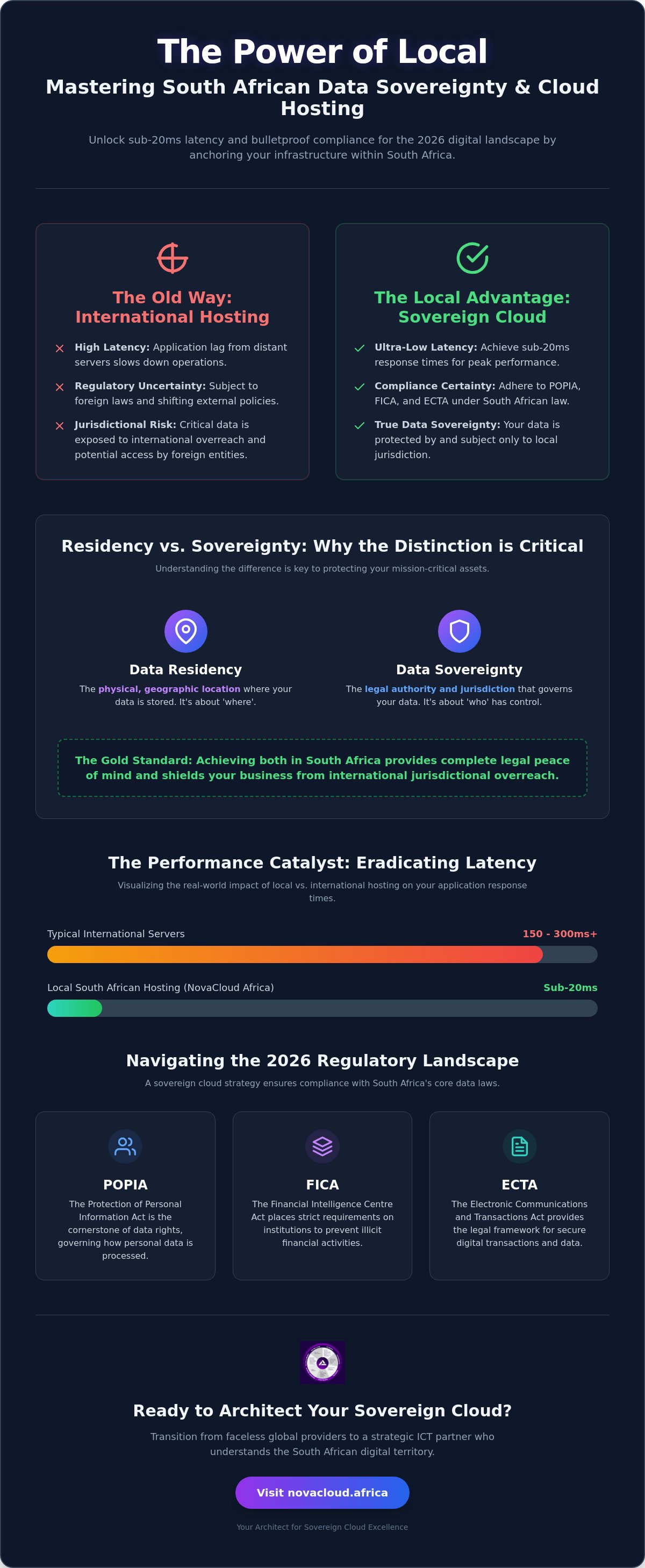
Understanding the nuance between these terms is critical for any forward-thinking designer of systems. Data residency refers strictly to the physical geographic location where your information sits. Data sovereignty, however, is the legal authority that governs that data. When you host locally, you ensure your operations fall under the Protection of Personal Information Act (POPIA) and South African law, rather than being subject to the shifting political or legal whims of a foreign jurisdiction. Achieving both residency and sovereignty in South Africa is the gold standard. It provides legal peace of mind and acts as a shield against international jurisdictional overreach, ensuring your data remains your own.
The Shift Toward Local-First Cloud Strategies
We are witnessing a purposeful migration away from faceless global hyperscalers. While these giants offer scale, they often lack the regional expertise and personalized support that a strategic ICT partner provides. South African enterprises are increasingly demanding technological authority that is tethered to tangible local outcomes. A local-first approach through sophisticated cloud hosting solutions allows for a more energetic and purposeful communication rhythm within your digital ecosystem. Localized infrastructure acts as a catalyst for national empowerment by fostering a competitive market where regional expertise thrives.
This transition from uncertainty to readiness is powered by three core advantages:
- Jurisdictional Certainty: You know exactly which laws apply to your sensitive data at all times.
- Operational Cadence: You align your technical execution with the specific needs and rhythms of the South African market.
- Strategic Alliance: You partner with experts who view your growth as a shared victory rather than just another line item in a global database.
By prioritizing South African data residency and cloud hosting, you aren't just managing a regulatory burden. You're architecting a high-performance environment that illuminates new possibilities for expansion. This strategic choice creates a ripple effect of efficiency, ensuring your digital evolution is handled with the dignity and precision it deserves.
Navigating the Regulatory Landscape: POPIA, FICA, and ECTA
The regulatory environment in South Africa is often perceived as a dense fog of mandates, yet for the prepared organization, it serves as a blueprint for architectural excellence. While POPIA is the cornerstone of data rights, a truly robust strategy for South African data residency and cloud hosting must also account for the requirements of FICA and ECTA. This multi-layered legal framework ensures that your digital evolution isn't just fast, but legally invincible. Moving beyond a state of uncertainty requires a precise understanding of how these acts intersect to protect both the enterprise and the individual, creating a fresh start for business efficiency rooted in trust.
POPIA Compliance in the Cloud
Lawful processing on virtual servers hinges on the clear distinction between the "Responsible Party" and the "Operator." As the business, you remain the Responsible Party, holding ultimate accountability for how personal information is handled. Your cloud provider acts as the Operator, executing technical tasks on your behalf. This relationship must be governed by rigorous contracts to manage the risks of cross-border data transfers under Section 72 of POPIA. Non-compliance with these data protection standards can result in a precedent-setting fine of up to R10 million. By keeping data within South African borders, you eliminate the complexity of verifying whether foreign jurisdictions offer "adequate protection," ensuring your operations remain under the quiet confidence of local law.
Sector-Specific Requirements: FICA and Beyond
For those in the financial and legal sectors, the stakes are even higher. FICA Section 28 mandates that accountable institutions maintain client identification and transaction records for at least five years. This isn't just about storage; it's about the integrity and accessibility of that data during an audit. Utilizing local Cloud backups simplifies this audit trail significantly, ensuring that your records are always within reach of local regulators and protected against loss.
Additionally, the Electronic Communications and Transactions Act (ECTA) reinforces the legal validity of electronic data, provided its integrity is maintained. Implementing a Managed Firewall is essential here, as it creates a secure perimeter that satisfies both ECTA's integrity requirements and POPIA's security safeguards. This integrated approach transforms compliance from a defensive posture into a strategic advantage. Navigating these laws with a strategic ally ensures your South African data residency and cloud hosting strategy remains a source of strength rather than a point of vulnerability. If you're looking to solidify your compliance posture, partnering with a local expert can illuminate the path forward.
The Performance Catalyst: How Local Hosting Eradicates Latency
Distance is the enemy of digital precision. While data moves at the speed of light, the physical reality of thousands of kilometers between a user in Johannesburg and a server in London creates a tangible friction known as latency. This delay isn't just a technical metric. It's a barrier to the fresh starts in business efficiency that organizations crave. When you embrace South African data residency and cloud hosting, you're choosing to eliminate the 150ms to 200ms round-trip time (RTT) typical of international routes. Instead, you're operating within the sub-20ms range that only geographic proximity can provide.
High latency is particularly destructive for real-time applications. VoIP calls become disjointed. Collaborative cloud tools lose their fluidity. For a South African enterprise, this lag translates to lost productivity and a fractured user experience. Local hosting ensures that your technical execution matches your strategic ambition, providing a foundation for expansion that feels both stable and limitless.
Latency and the User Experience
The quiet confidence required to scale a business depends on systems that respond instantly. Aiming for sub-30ms response times isn't a luxury; it's a necessity for modern digital operations. Lag has a ripple effect, leading to employee frustration and customer churn. By deploying local Virtual Private Servers, you provide the rhythmic speed and stability that high-performance applications demand. This ensures that every interaction feels crisp and every process remains uninterrupted, illuminating a clear path toward growth.
Connectivity: The Backbone of the Cloud
Performance doesn't exist in a vacuum. A high-performance cloud environment requires an equally robust connection. Symmetrical Business Fibre serves as the vital architect of this connectivity, ensuring that your office remains tethered to your local cloud resources with unwavering stability. Within your premises, utilizing Ubiquiti networks allows for the seamless internal distribution of these resources to every endpoint. This creates a cadence of efficiency that global providers simply cannot mirror.
Relying on local transit and peering also mitigates the risks associated with vulnerable undersea cables. When your data stays within the country, a break in an international line won't bring your mission-critical systems to a halt. This localized approach to South African data residency and cloud hosting offers a level of resilience that global-only strategies cannot replicate. It's about building a system that isn't just fast, but fundamentally reliable, serving as a catalyst for regional empowerment.
Architecting the Sovereign Cloud: From VPS to Immutable Backups
Designing a sovereign cloud environment is a deliberate exercise in precision. It requires moving beyond the generic configurations of global giants to build a system that reflects the specific needs of the South African digital territory. This journey toward digital sovereignty begins with a clear audit of your data assets. You must identify mission-critical information that mandates local residency under POPIA and FICA, such as sensitive client records or financial transaction logs. Once identified, this data is transitioned into high-performance Virtual Private Servers sitting within South African borders, ensuring your technical execution remains tethered to regional legal standards and high-speed local peering.
Perimeter defense serves as the next layer of this architectural masterpiece. By implementing a Managed Firewall powered by FortiNet, you create a sophisticated barrier against evolving cyber threats that target local infrastructure. This is complemented by establishing a local, offsite backup routine using Acronis Cloud. Finally, integrating Microsoft 365 Business Licensing allows you to maintain global productivity standards while keeping your underlying data governance firmly rooted in local soil. This multi-layered approach ensures your South African data residency and cloud hosting strategy is both resilient and compliant.
Virtual Private Servers as a Security Anchor
Isolated resources are the bedrock of enterprise security. Unlike the crowded environments of basic shared hosting, Virtual Private Servers provide dedicated slices of hardware that ensure your sensitive data remains partitioned. This isolation is essential for meeting South African regulatory standards, as it prevents the "noisy neighbor" effect and limits the attack surface of your infrastructure. Scaling your environment no longer feels like a cold, sterile technical task. Instead, it becomes a rhythmic expansion of your capabilities, handled with the quiet confidence that your systems are architected for the unique demands of the local market.
Data Resilience through Local Backups
True resilience is defined by how quickly you can recover. Utilizing Acronis Cloud to create immutable, ransomware-proof backups ensures that your data cannot be altered or deleted by malicious actors. Storing these backups locally is essential for achieving aggressive Recovery Time Objectives (RTO) and Recovery Point Objectives (RPO), as restoring large datasets from international servers can take days rather than hours. This local backup strategy is a critical component of your broader business-grade cloud infrastructure. It provides a fresh start for business efficiency by guaranteeing that your operations can withstand even the most severe digital disruptions. To begin designing your high-performance environment, you can connect with our strategic architects for a tailored consultation.
NovaCloud Africa: Your Architect for Sovereign Cloud Excellence
NovaCloud Africa’s mission is rooted in the belief that technology should be a catalyst for regional empowerment. We don't just provide infrastructure; we design systems that empower South African enterprise through visionary ICT. While global hyperscalers often offer a cold, sterile self-service experience, we position ourselves as a human-centric strategic ally. This approach ensures that your South African data residency and cloud hosting strategy is handled with the quiet confidence and technical precision it deserves. We bridge the gap between high-level strategic concepts and granular technical execution, providing a dignified path for your organization’s digital evolution.
A fresh start in business efficiency begins with a unified ecosystem. By integrating Hosted PBX, high-performance Virtual Private Servers, and robust security protocols into a single sovereign environment, we eliminate the fragmentation that slows down modern operations. This integrated architecture provides the stability and expansion required to outpace competitors. We take pride in our role as an enabler of regional progress, ensuring that every layer of your digital infrastructure is tethered to tangible business outcomes and local regulatory standards.
The NovaCloud Difference
Our commitment to your growth is reflected in our personalized IT Assistance. Unlike faceless global support desks, our team understands the specific nuances of the South African market and the unique challenges of our primary regional landscape. We offer more than just troubleshooting; we provide strategic guidance that brings celestial clarity to your business operations. Our national reach ensures that your enterprise is supported with the same level of authority and care, regardless of where your offices are located within our borders. This geographic presence is our signature, defining our unique position as a local leader in sovereign cloud excellence.
Next Steps for Your Digital Evolution
The transition from uncertainty to readiness starts with a purposeful audit of your current infrastructure. We invite you to partner with a technical executor who shares your vision for national progress. Our consulting services cover everything from optimizing your Microsoft 365 Business Licensing to architecting complex cloud migration paths that respect South African data residency and cloud hosting requirements. Securing your perimeter is a vital part of this renewal, and our Managed Firewall solutions provide the sophisticated defense your data deserves.
Your digital renewal is a journey toward greater clarity and efficiency. By choosing a strategic partner who understands the local territory, you ensure your infrastructure acts as a foundation for long-term stability rather than a source of compliance anxiety. Let us help you architect a high-performance environment that reflects the dignity and ambition of your enterprise. Contact us today to begin your evolution toward a more secure, sovereign, and successful future.
Illuminating Your Path to Digital Sovereignty
Mastering the complexities of the 2026 regulatory landscape is about more than just avoiding a R10 million POPIA fine. It is about architecting a foundation of trust that allows your enterprise to scale with quiet confidence. By choosing South African data residency and cloud hosting, you are prioritizing sub-20ms latency and jurisdictional certainty, ensuring your technical execution remains as agile as your strategic vision. This localized approach sheds the dead weight of international lag and provides a fresh start for business efficiency that is anchored right here on home soil.
NovaCloud Africa stands ready as your strategic ally, offering a POPIA and FICA compliant infrastructure backed by the technical authority of FortiNet and Acronis powered security. Our national South African support team is committed to your regional empowerment, providing the human-centric expertise that global hyperscalers simply cannot match. It is time to move from a state of uncertainty to one of readiness and growth.
Architect Your Sovereign Cloud with NovaCloud Africa and embrace a future where your digital evolution is in expert hands. Your journey toward clarity and regional progress begins today.
Frequently Asked Questions
Does POPIA require all data to be stored in South Africa?
No, POPIA doesn't strictly mandate that all personal information remains within our borders. However, Section 72 of the Act imposes rigorous conditions on cross-border data transfers, requiring the recipient country to have "adequate protection" laws. Storing your information locally through a strategy of South African data residency and cloud hosting simplifies your legal posture by removing the need to verify foreign jurisdictional frameworks, ensuring you remain under the quiet confidence of local law.
How does local cloud hosting improve my website or app speed?
Geographic proximity is the only permanent cure for latency. When your servers are located in Johannesburg or Cape Town rather than London or Dublin, you eliminate the physical distance that causes lag. This shift typically reduces round-trip times from over 150ms to sub-20ms. For your users, this means snappier interfaces, faster load times, and a rhythmic digital experience that global hosting simply cannot mirror.
Can I use Microsoft 365 and still comply with South African data residency rules?
Yes, you can leverage global productivity tools while maintaining local control. By utilizing Microsoft 365 Business Licensing configured for local data residency, your core data sits within South African data centers. This allows your enterprise to benefit from world-class software standards while ensuring your underlying data governance remains firmly rooted in South African soil, meeting the requirements of both POPIA and the National Data and Cloud Policy.
What is the difference between a local cloud provider and a global hyperscaler?
The primary distinction lies in personalized strategic partnership versus faceless self-service. A local provider acts as a technical executor with deep regional expertise, offering human-centric IT Assistance that hyperscalers often lack. While global giants provide massive scale, a local ally understands the specific nuances of the South African digital territory and provides a more energetic, purposeful response to your organization's unique growth needs.
Are local data centres in South Africa as secure as those in Europe or the US?
South African tier-rated data centers meet or exceed international benchmarks for physical and digital security. When you anchor your infrastructure locally and implement a Managed Firewall powered by FortiNet, you achieve a level of protection that is both world-class and sovereign. This combination ensures your digital assets are shielded from global threats while remaining accessible for local audits and regulatory inspections without jurisdictional interference.
How do cloud backups help with POPIA and FICA compliance?
Backups are essential for maintaining the data integrity and availability required by law. FICA Section 28 mandates a five-year record-keeping period for accountable institutions. Local Cloud backups through Acronis Cloud create an immutable, ransomware-proof audit trail that is always within reach of local regulators. This ensures you can meet recovery time objectives and provide a fresh start for business efficiency even after a significant digital disruption.
What happens to my data if an undersea cable is cut?
Your mission-critical operations remain uninterrupted if your data is hosted within the country. Local transit and peering allow your office to connect to your cloud resources via Business Fibre without relying on international undersea cables. This localized approach to South African data residency and cloud hosting provides a layer of resilience that keeps your business running even when global connectivity is compromised by external infrastructure failures.
How much does it cost to move my business to a local VPS?
Investment levels depend entirely on the complexity of your digital architecture and resource requirements. Moving to a local Virtual Private Server often proves more cost-efficient over time by eliminating international data egress fees and reducing the productivity losses caused by high latency. We recommend a localized infrastructure audit to determine the most strategic and dignified migration path for your specific enterprise needs.
