


The Silent Erosion: Effects of Slow Internet on Business Productivity in 2026

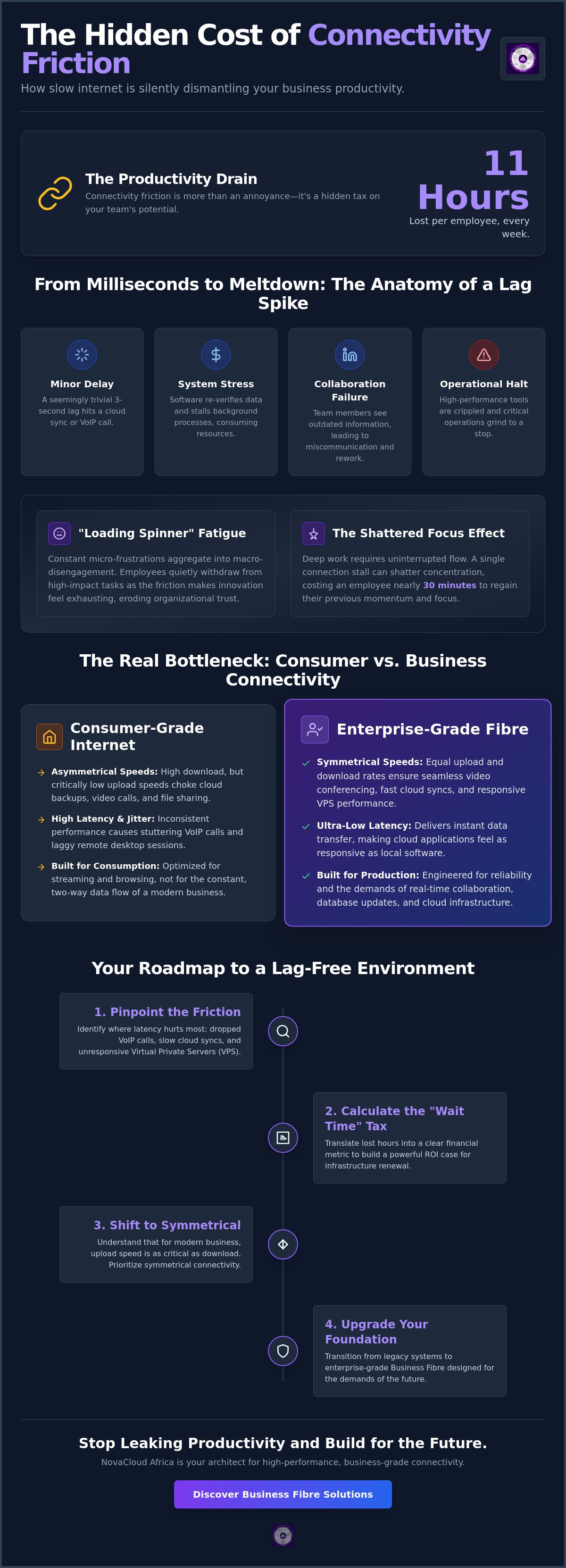
Small businesses are currently losing an average of 11 hours every week to connectivity friction. This staggering statistic reveals how the effects of slow internet on business productivity function like a shadow over your daily operations, quietly dimming the potential of your most talented people. You've likely seen the frustration in your team's eyes when a vital VoIP call drops, or felt the stagnation as cloud syncing stalls during a high-stakes deadline. It's more than a minor annoyance; it's a systematic dismantling of your enterprise efficiency that prevents your most sophisticated tools from reaching their full potential.
We know you've invested in top-tier talent and modern systems, only to be held back by a legacy foundation that can't keep pace with the demands of 2026. This guide will show you how to restore your digital momentum by identifying the hidden costs of subpar connectivity and building a clear ROI case for business-grade fibre. We'll explore the vital link between connection speed and cloud security, providing you with a strategic roadmap for infrastructure renewal that brings a sense of clarity and a fresh start to your business efficiency.
Key Takeaways
- Pinpoint the exact moment when minor latency transforms into operational failure and learn how a few seconds of delay can stall your entire cloud ecosystem.
- Uncover the hidden cultural cost of connectivity friction, where persistent loading spinners lead to employee disengagement and an erosion of organizational trust.
- Master a clear formula to calculate your "Wait Time" tax and accurately measure the effects of slow internet on business productivity.
- Shift your perspective on bandwidth by understanding why symmetrical upload speeds have become the most critical bottleneck for modern enterprise efficiency.
- Follow a strategic architectural roadmap to transition your infrastructure from legacy systems to enterprise-grade Business Fibre designed for the future.
The Architecture of Delay: How Latency Undermines Modern Enterprise
Think of your internet connection as the central nervous system of your 2026 digital office. It isn't just a utility line entering the building; it's the invisible architecture that allows your strategy to execute in real-time. When this system falters, the effects of slow internet on business productivity shift from a minor annoyance to a total operational failure. Research into the economic impact of the digital divide proves that businesses with superior infrastructure don't just work faster, they capture more market share by remaining agile while others wait for a connection.
Operational failure occurs the moment your tools can no longer synchronize with the speed of human thought. A 3-second delay in cloud syncing might seem trivial on paper, but it creates a destructive ripple effect across your entire workflow. It forces software to re-verify data packets, stalls automated background processes, and prevents team members from seeing live updates during collaborative sessions. This lag isn't just a pause; it's a structural barrier that prevents your high-performance tools from doing their jobs.
Most consumer-grade fibre packages fail the enterprise stress test because they're built for the asymmetric needs of a household. While they might offer high download speeds for streaming, they often lack the sustained, symmetrical throughput required for a modern boardroom. In a professional environment, your upload speed is just as vital as your download capacity, especially when your team is pushing large datasets to the cloud or hosting high-definition video conferences simultaneously.
The Latency-Throughput Paradox
Many providers push "megabits per second" as the only metric of success, but high bandwidth is useless if your latency is high. Jitter and packet loss are the true culprits behind broken business continuity. They're responsible for the stuttering audio in your Hosted PBX calls and the frustrating lag in remote desktop sessions. Latency is the silent killer of real-time collaboration. Even with a "fast" connection, high latency ensures that your team remains out of sync, leading to miscommunication and wasted hours.
Cloud-First Vulnerability
Your team's reliance on Virtual Private Servers makes ultra-low latency a non-negotiable requirement. For a VPS to feel as responsive and "local" as a computer sitting under a desk, the data must travel back and forth instantly. Slow connections don't just delay file access; they impact real-time database updates and can lead to costly synchronization errors. Prioritizing business-grade cloud infrastructure ensures that your digital tools remain catalysts for growth rather than sources of technical friction.
The Human Cost: Psychological Friction and Cultural Erosion
The psychological toll of a buffering screen is often underestimated in the modern boardroom. When your staff encounters constant interruptions, they experience what we call "Loading Spinner" fatigue. These micro-frustrations seem small in isolation, but they aggregate into macro-disengagement. Over time, the effects of slow internet on business productivity manifest as a quiet withdrawal from high-impact tasks. Your team stops pushing for innovation because the technical friction makes every new idea feel like an exhausting uphill battle.
This friction eventually erodes organizational trust. Employees don't just see a slow connection; they see a leadership team that hasn't prioritized the essential tools they need to succeed. In the competitive landscape of 2026, top talent avoids firms with "laggy" tech stacks. They understand that deep work requires a state of uninterrupted flow, and intermittent lag shatters that concentration instantly. Once a deep-work session is broken by a stalling cloud sync or a frozen application, it can take nearly half an hour for an employee to regain their previous momentum.
Recruitment and retention are now directly tied to your digital architecture. High-performers want to work in environments that empower them, not hinder them. When your infrastructure feels like a relic of the past, it sends a message that your company's growth has plateaued. Providing a seamless, high-speed environment is an act of respect toward your workforce, signaling that you value their time and their cognitive energy. If you're ready to revitalize your workspace, exploring a transition to Business Fibre can be the first step toward cultural renewal.
The Rise of Shadow IT
When the corporate network fails to deliver, employees inevitably take matters into their own hands. This leads to the dangerous rise of Shadow IT, where staff bypass slow systems using insecure personal hotspots. This creates a massive security vulnerability, as unmanaged data traffic flows outside your protected perimeter. Slow connectivity is a primary driver for Managed Firewall bypasses, as users prioritize immediate task completion over long-term network safety.
Communication Breakdowns
The professional cost of dropped calls is immense in a world built on remote collaboration. Whether it's a pixelated video conference or stuttering audio, technical failures destroy the visionary optimism of a high-stakes sales pitch. It makes your organization appear unprepared and technically deficient. This is particularly damaging for companies relying on Hosted PBX systems and VoIP reliability to maintain global client relationships. When the voice on the other end of the line cracks and fades, the clarity of your business message fades with it.
Quantifying the Friction: Calculating the ROI of Symmetrical Connectivity
Managing the effects of slow internet on business productivity requires moving beyond frustration and into the realm of financial precision. We often view connectivity as a fixed overhead, but it's actually a variable performance driver. To understand the "Wait Time" tax, consider that small businesses lose an average of 11 hours per week to connection issues. When you multiply those lost man-hours by your average hourly salary cost, the result is a staggering drain on capital. This isn't just lost time; it's an invisible tax on your ambition that prevents you from realizing your full regional potential.
The difference between standard broadband and Dedicated Internet Access (DIA) is where many enterprises find their breakthrough. While consumer-grade broadband relies on shared "contention" lines, DIA provides a reserved lane specifically for your traffic. This eliminates the peak-hour slowdowns that typically cripple productivity during the mid-day rush. By securing a dedicated path, you're not just buying speed; you're purchasing the certainty that your team can execute at peak performance every hour of the day. The opportunity cost of a single hour of uptime is the difference between a project delivered and a client lost.
The Upload Bottleneck
In the cloud-first era of 2026, upload speed has become the new productivity bottleneck. Most asymmetrical fibre lines prioritize downloads, leaving your cloud backups and Microsoft 365 synchronizations to crawl. This imbalance creates a massive lag in outgoing data, which directly impacts your Yealink hardware integration and other real-time communication tools. When your upload capacity is throttled, your voice data packets are delayed, leading to the jitter and distortion that ruin professional calls. Symmetrical fibre ensures the celestial clarity of business voice, allowing every syllable to reach its destination with the crispness and authority your brand deserves.
Operational Resilience and Uptime
The financial impact of a total connectivity failure is no longer a localized inconvenience. With the average cost of a business internet outage ranging from $100,000 to over $540,000 per hour, downtime is a luxury no modern enterprise can afford. Transitioning to Business Fibre provides the SLA-backed reliability needed to mitigate these risks. These agreements aren't just legal protections; they're commitments to your business continuity. By investing in proactive ICT infrastructure, you aren't just spending on a service; you're architecting a resilient environment where growth is never paused by a broken link. This strategic renewal provides the clarity needed to focus on expansion rather than troubleshooting.
Architecting a Lag-Free Environment: Strategic Infrastructure Renewal
Restoring your digital momentum requires more than a simple hardware swap; it demands a deliberate, architectural approach to renewal. To reverse the effects of slow internet on business productivity, you must first understand where your current system is leaking potential. This process begins with a comprehensive performance and security audit to identify the specific bottlenecks throttling your growth. Once the gaps are identified, the transition from legacy copper or consumer-grade lines to enterprise-grade glass becomes the essential next step. This isn't just an upgrade; it's the installation of a foundation designed for the symmetrical demands of the 2026 enterprise.
Optimizing your local area network (LAN) is equally vital to ensure that high-speed data actually reaches the user’s desk. We favor modern Ubiquiti deployments to create a seamless fabric of connectivity throughout your office. By implementing sophisticated Quality of Service (QoS) rules, you can prioritize mission-critical traffic like VoIP and VPS data over less urgent background tasks. Finally, moving to a managed model ensures that your network is never left to chance. Continuous monitoring and rapid assistance transform your internet from a source of anxiety into a reliable engine for regional progress.
The Role of Managed IT
DIY network management often leads to "bottleneck blindness," where internal teams are too close to the daily fires to see the structural flaws. Engaging with Strategic IT Assistance allows you to step back and view your ICT infrastructure as a cohesive system. Proactive threat hunting and real-time performance tuning ensure that your Managed Firewall doesn't become a choke point. A fast line is only as good as the security and management that guide it, and expert oversight provides the clarity needed for a fresh start in operational efficiency.
Optimizing the Microsoft 365 Ecosystem
Your investment in Microsoft 365 Business Licensing shouldn't be wasted on a connection that can't handle the load. Modern collaboration tools like OneDrive and SharePoint require high-speed, symmetrical synchronization to function as intended. In a hybrid workforce, the data load is constant and heavy; without enterprise-grade fibre, your team will spend more time waiting for files to save than actually creating value. Designing your network to handle these specific cloud-first demands is the only way to fully mitigate the negative effects of slow internet on business productivity.
If you're ready to design a more resilient and empowered future for your team, our experts can help you audit and renew your business connectivity today.
NovaCloud Africa: Your Architect for High-Performance Connectivity
At NovaCloud Africa, we don't view connectivity as a simple utility line. We see it as the fundamental catalyst for regional empowerment and a primary driver of your organization's renewal. Our mission is to serve as your high-level strategic partner, designing systems that move you beyond the effects of slow internet on business productivity. With 40% of small and medium-sized businesses reporting that connectivity issues directly impact their revenue, the stakes for your infrastructure have never been higher. We provide the technical execution and visionary oversight needed to ensure your business remains on the right side of that statistic.
Our Business Fibre is engineered specifically for the symmetrical and scalable demands of the 2026 enterprise. It provides a stable foundation that allows your team to work with quiet confidence, knowing that their digital tools will respond at the speed of their ambition. We go far beyond the wire, integrating Virtual Private Servers, VoIP, and robust security protocols into a unified technical ecosystem. This holistic approach eliminates the fragmented performance that often plagues growing firms, replacing technical friction with a sense of momentum and readiness.
South African leaders trust NovaCloud because we combine international benchmarks with deep regional expertise. We understand the specific challenges of our local market and design our architectures to withstand them. Our focus is on creating a resilient ICT environment where technology serves the human-centric goals of your business. When you partner with us, you aren't just buying a connection; you're securing a strategic ally committed to your long-term growth and digital evolution.
Unified Communications and Cloud Synergy
Precision in communication is the hallmark of a modern enterprise. Our Hosted PBX solutions are designed to thrive on our high-performance fibre backbone, ensuring that every client interaction is handled with professional clarity. To protect your most valuable digital assets, we integrate Acronis Cloud backups directly into your workflow. This synergy ensures data integrity and provides a fresh start in efficiency, allowing your team to focus on innovation rather than recovery. The NovaCloud promise is simple: we provide the clarity you need to lead your industry.
Next Steps for Digital Evolution
The path to a lag-free environment begins with a clear understanding of your current landscape. We invite you to request a tailored connectivity audit for your national operations to identify exactly where the effects of slow internet on business productivity are holding you back. From there, we can scale your VPS and hosting infrastructure with the confidence that only an enterprise-grade foundation can provide. It's time to move from uncertainty to a state of total operational readiness. Experience the clarity of high-performance connectivity with NovaCloud Africa and redefine what your business can achieve.
Restoring Digital Momentum for the 2026 Enterprise
The path to operational excellence requires a departure from legacy thinking. We've explored how latency functions as a structural barrier and why symmetrical upload speeds are now the lifeblood of the modern cloud ecosystem. By addressing the effects of slow internet on business productivity through strategic infrastructure renewal, you don't just fix a technical problem; you empower your people to lead with clarity and purpose. A high-performance environment is built on the pillars of stability and foresight.
Whether it's through our symmetrical Business Fibre solutions, enterprise-grade VPS infrastructure, or national ICT expert assistance, the goal remains the same: to turn your connectivity into a strategic asset. It's time to reclaim the hours lost to friction and replace them with a state of total readiness. Your digital evolution is in expert hands, and the future of your enterprise has never looked brighter.
Architect your high-performance connectivity with NovaCloud Africa
Frequently Asked Questions
How much internet speed does a small business really need in 2026?
In 2026, a small business typically requires at least 100 Mbps of symmetrical bandwidth to support a cloud-first environment. This threshold ensures that simultaneous video conferencing, real-time database updates, and background backups don't compete for the same narrow lane. As your team scales, your connectivity must scale with it to maintain a state of total operational readiness and visionary growth.
What is the difference between home fibre and business-grade fibre?
The primary difference lies in the contention ratio and the level of professional support provided. Home fibre is a shared service where your speed fluctuates based on your neighbors' usage, while business-grade fibre offers a dedicated or low-contention path. This ensures consistent, high-performance execution during peak office hours when your team needs it most to stay ahead of the competition.
Can slow internet actually cause security vulnerabilities?
Slow internet creates security gaps by driving employees to use "Shadow IT," such as personal hotspots that bypass your Managed Firewall. When corporate systems are sluggish, staff often prioritize immediate task completion over security protocols. This behavior exposes your sensitive data to unmanaged networks and potential breaches, turning a technical lag into a significant organizational risk.
How does latency affect Hosted PBX and VoIP call quality?
Latency is the primary cause of jitter and packet loss, which manifest as stuttering audio or dropped calls in Hosted PBX systems. For high-quality VoIP, your data packets must travel instantly and in the correct order. High latency breaks this flow, turning a visionary sales pitch into a frustrated technical struggle that erodes client trust and professional authority.
Is symmetrical fibre worth the extra investment for a standard office?
Symmetrical fibre is essential for any office that relies on cloud backups or video collaboration. The effects of slow internet on business productivity are most visible when upload speeds are throttled, causing file syncs to stall and outgoing video to pixelate. Symmetrical lines ensure that your data moves out as fast as it comes in, maintaining a perfect rhythm of efficiency.
How do I know if my productivity issues are caused by the internet or my hardware?
You can identify the culprit by performing a wired speed test directly at your router while bypassing your local Wi-Fi. If the speeds match your service plan but applications remain sluggish, the bottleneck is likely your hardware or local network congestion. If the speeds are consistently below your plan, the issue resides with your service provider and requires a strategic infrastructure review.
What is an SLA and why is it critical for business connectivity?
An SLA, or Service Level Agreement, is a contract that guarantees specific uptime and response times for your connection. It's the difference between being a priority and waiting in a general queue when a fault occurs. For a modern enterprise, an SLA provides the quiet confidence that business continuity is a contractual obligation rather than a best-effort hope.
How does slow internet impact Microsoft 365 performance?
Because Microsoft 365 is entirely cloud-dependent, slow internet leads to synchronization conflicts in SharePoint and lag during Teams meetings. The effects of slow internet on business productivity are compounded when multiple users attempt to save large files simultaneously. A robust connection ensures that your Microsoft 365 Business Licensing translates into actual output rather than endless loading bars.
