


3-2-1 Backup Strategy for Business Compliance: Architecting Data Resilience in 2026

With 96% of ransomware incidents in the first quarter of 2026 involving sensitive data exfiltration, your traditional safety net has likely become a high-stakes compliance liability. For South African enterprises, the 3-2-1 backup strategy for business compliance is no longer just a technical recommendation; it's the architectural foundation of your digital sovereignty. You've felt the pressure of shifting POPIA requirements while managing the persistent instability of local infrastructure and power cycles. It's a heavy burden to carry when a single point of failure could lead to massive regulatory fines or the permanent loss of operational momentum.
We believe that your digital evolution deserves a foundation of quiet confidence rather than constant anxiety. You need a resilient system that guarantees continuity regardless of external volatility. This article provides the master blueprint for the gold standard of data protection to ensure absolute compliance and significantly reduced recovery time objectives. We'll explore the evolution toward immutable cloud backups, the necessity of the 3-2-1-1-0 rule, and a clear roadmap to secure your organization's future. It's time to move beyond simple storage and toward a sophisticated architecture that empowers regional growth and protects your most vital assets.
Key Takeaways
- Understand how the 3-2-1 backup strategy for business compliance aligns with POPIA mandates to protect your organization from significant legal and financial risks.
- Identify the ideal balance between high-speed local storage and cloud resilience to minimize recovery time objectives during infrastructure failures.
- Explore the 2026 upgrade to the 3-2-1-1-0 rule, introducing immutable data copies that remain immune to encryptionless extortion and ransomware.
- Follow a clear roadmap for data classification and infrastructure auditing to ensure your most critical systems are always ready for a fresh start.
- Discover how integrating Acronis Cloud with high-performance Business Fibre creates a seamless architecture that empowers your digital growth and regional reach.
What is the 3-2-1 Backup Strategy and Why Does Compliance Demand It?
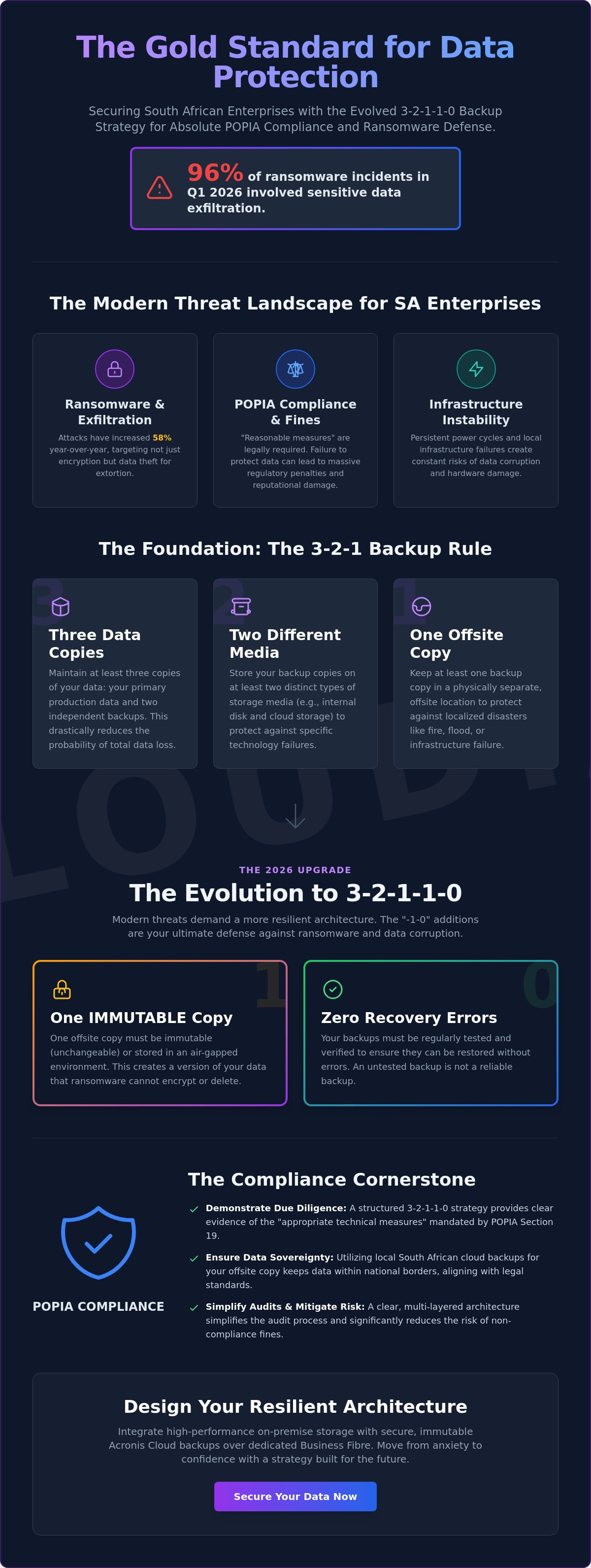
Every organization in South Africa faces a digital landscape that is both promising and perilous. By 2026, global ransomware attack volume has increased by 58% year-over-year. In this environment, a simple backup isn't enough. You need an intentional 3-2-1 backup strategy for business compliance. This framework serves as a cornerstone for meeting the "reasonable measures" required by the Protection of Personal Information Act (POPIA). It transforms your data from a vulnerable asset into a resilient foundation for growth. Moving from basic storage to architectural resilience is no longer optional. It's a requirement for survival.
The Three Pillars of the 3-2-1 Framework
The 3-2-1 Rule is an elegant solution to a complex problem. Its logic is grounded in mathematical redundancy. By maintaining three copies of your data, you reduce the statistical probability of total loss to near zero. Two of these copies should live on different media types. This diversity protects you if a specific storage technology suffers a systemic failure. The math is simple. Redundancy equals safety. Diversity ensures that a single hardware flaw doesn't compromise your entire history.
The final "one" is perhaps the most critical component: one copy must reside in an offsite location. This creates a logical "air gap" between your primary environment and your recovery data. Whether it's a surge in power instability or a localized infrastructure failure, your offsite copy remains your ultimate line of defense. It's the difference between operational paralysis and a swift recovery. Without this separation, your backups are just as vulnerable as your live data.
POPIA and the Legal Necessity of Redundancy
Compliance isn't just about avoiding penalties; it's about demonstrating stewardship. Section 19 of POPIA mandates that organizations implement appropriate technical measures to secure personal information. A robust 3-2-1 backup strategy for business compliance provides clear evidence of this due diligence. It simplifies the audit process by showing a structured approach to risk mitigation. When the regulator asks how you protect citizen data, you can point to a multi-layered architecture rather than a single, fragile drive.
Data sovereignty is a vital consideration here. Your offsite copy needs to be housed in a jurisdiction that aligns with South African legal standards. When you leverage local Cloud backups, you ensure your data remains within reach and under the protection of regional law. Failing to meet these standards doesn't just invite fines. It erodes the trust your clients place in your digital evolution. By architecting resilience, you choose a path of empowerment over uncertainty. Resilience is a choice. We help you make it.
Architecting the Strategy: Media Selection and Offsite Logic
Designing a 3-2-1 backup strategy for business compliance requires more than a checklist; it demands an architectural mindset. In the South African context, where infrastructure instability and power fluctuations are operational constants, your choice of media is a strategic decision. You must balance the immediate need for high-speed recovery with the long-term necessity of offsite resilience. A single point of failure in your hardware chain doesn't just risk data loss. It threatens your ability to remain compliant with POPIA during a crisis. True resilience comes from a multi-layered approach that bridges the gap between local speed and global security.
Media Type 1: On-Premise High-Speed Recovery
Local copies are your first line of defense against minor disruptions. They provide the low Recovery Time Objectives (RTO) essential for keeping your team productive. However, managing local media in our region requires specific foresight. Power instability can easily corrupt physical drives or lead to systemic hardware failure. We recommend utilizing Virtual Private Servers (VPS) for localized staging. This allows you to test recovery protocols in a controlled environment before deploying them. By isolating your local copy from the primary production hardware, you ensure that a surge or failure in one system doesn't cascade through your entire architecture.
Media Type 2: The Resilient Cloud
For absolute peace of mind, cloud backups have become the ultimate offsite solution for 2026. Unlike physical offsite drives that require manual handling and face transit risks, the cloud offers automated, real-time synchronization. The effectiveness of this layer depends heavily on your connection. There is a powerful synergy between high-speed Business Fibre and cloud reliability. A robust fibre link ensures that even large datasets are mirrored to the cloud without bottlenecking your daily operations. This connection transforms the cloud from a distant archive into a living, breathing extension of your infrastructure.
Strategic placement is the final piece of the logic. Your offsite copy must be geographically distinct enough to survive a localized disaster, yet remain accessible through low-latency networks. Evaluating providers based on South African throughput is vital for maintaining compliance and performance. When your architecture is sound, your organization gains a sense of quiet confidence. You aren't just storing data; you're enabling a fresh start for your business efficiency. If you're ready to strengthen your connection to the cloud, exploring our Business Fibre options is the first step toward total synchronization.
Modernizing for 2026: The 3-2-1-1-0 Rule and Ransomware Defense
The digital landscape of 2026 demands a shift from passive protection to active resilience. Ransomware was a factor in 44% of all confirmed data breaches in 2025. This reality means the traditional 3-2-1 backup strategy for business compliance has undergone a necessary evolution. We call this the 3-2-1-1-0 rule. This modern standard adds two critical layers: one immutable copy and zero verified recovery errors. It’s an architectural upgrade designed to survive the era of encryptionless extortion and sophisticated exfiltration tactics. By adding these layers, you ensure that your enterprise isn't just following a guideline but building an impenetrable fortress.
While backups are your final safety net, your first line of defense remains a robust Managed Firewall. By preventing unauthorized access at the perimeter, you reduce the frequency of restoration events. This integrated approach ensures that your recovery systems aren't just reactive tools but part of a proactive security posture. Prevention and recovery must work in tandem to maintain the momentum of your digital evolution. When these systems are synchronized, your organization operates with a sense of quiet confidence.
Immutable Storage: The Ransomware Kill-Switch
Ransomware attackers often target the backup infrastructure itself to ensure you have no choice but to pay. Acronis Cloud solves this vulnerability through immutability. Immutability is a 'read-only' lock on historical data. Unlike standard cloud storage where files can be overwritten or deleted, an immutable vault creates a version of your data that is technically impossible to alter for a set period. This architectural barrier means that even if an attacker gains administrative credentials, your historical records remain untouched. It provides the ultimate fresh start for your business efficiency and protects your most vital assets from the 96% of ransomware incidents that now involve data exfiltration.
Zero-Error Recovery: The Testing Mandate
A backup that hasn't been tested is merely a collection of hope. The '0' in our updated 3-2-1-1-0 framework represents the requirement for zero recovery errors. In 2025, 53% of organizations were able to recover from an attack within one week, a significant rise from 35% in 2024. This improvement was driven by the adoption of automated verification and regular, rigorous restoration drills. This is where strategic IT Assistance becomes invaluable. Professional oversight ensures that your Recovery Point Objective (RPO), the maximum age of files that must be recovered from storage for operations to resume, is consistently met. When you verify your integrity through testing, you replace uncertainty with the clarity of a system designed to succeed.
Implementation Roadmap: Aligning 3-2-1 with Business Continuity
Implementing a 3-2-1 backup strategy for business compliance is a journey of technical precision and strategic foresight. It requires a fundamental shift from viewing data as a digital burden to seeing it as the lifeblood of your regional progress. This roadmap ensures that your resilience architecture is both legally sound and operationally agile. By following a structured progression, you move from uncertainty to a state of readiness where your organization can withstand any infrastructure failure.
Your journey begins with a meticulous data classification process. You must distinguish between mission-critical records that require near-instant recovery and archival data that can wait. Once identified, conduct a thorough infrastructure audit to assess your current business-grade cloud infrastructure capabilities. This assessment reveals whether your existing hardware can handle the throughput required for modern redundancy. Finally, select tools that offer integrated security, such as Acronis, to streamline your management and reduce complexity.
Policy configuration follows, where you align retention periods with POPIA mandates. This isn't a "set and forget" process. Continuous monitoring and maintenance ensure the celestial light of your data never dims, providing clarity even during the darkest infrastructure failures. A well-maintained system is an empowered system. If you are ready to evaluate your current readiness, our team can help you audit your cloud infrastructure to ensure it meets 2026 standards.
Classifying Your Digital Assets
Data discovery is the catalyst for effective protection. You need to separate personal information, which carries high POPIA risk, from general operational metadata. Advanced Microsoft 365 Business Licensing tools provide built-in discovery features that simplify this identification. Don't overlook communication channels; ensure your Hosted PBX systems and call logs are prioritized in your backup queue. These records are often vital for both customer service continuity and meeting regulatory audit requirements. With 96% of ransomware incidents in early 2026 involving data exfiltration, knowing exactly where your sensitive data lives is your most powerful defensive move.
Configuring Retention and Deletion
Compliance is a dual-edged sword. While losing data is a disaster, keeping sensitive records longer than necessary is equally risky under POPIA. You must automate the deletion of expired records to minimize your attack surface. This logic balances storage costs with long-term archival needs, ensuring your architecture remains lean and purposeful. By automating these cycles, you maintain a fresh start in business efficiency every day. It's about creating a system that grows with you while shedding the liabilities of the past.
Designing Your Resilience with NovaCloud Africa
Navigating the complexities of data protection in 2026 requires more than a software license; it demands a strategic partner who understands the pulse of the South African market. At NovaCloud Africa, we serve as the architect of your digital sovereignty. We ensure that your 3-2-1 backup strategy for business compliance is not just a reactive measure against threats but a proactive engine for growth. By integrating high-performance Virtual Private Servers with the impenetrable security of Acronis Cloud, we build systems that remain steady even when the external landscape shifts. Our role is to provide the technical execution that allows you to focus on your visionary goals.
We pride ourselves on a human-centric approach that transcends the cold, sterile feel of traditional IT providers. You aren't just managing servers; you're protecting the trust of your clients and the legacy of your enterprise. Our managed solutions, including FortiNet firewalls and robust Business Fibre, create a unified environment where stability and expansion coexist. This synergy is what empowers regional progress. When your infrastructure is handled by experts who share your mission-driven focus, you gain the freedom to innovate without fear. It's about creating a foundation where your digital evolution is always in expert hands.
Why Local Expertise Matters in Global Cloud
While the cloud is global, its impact is always local. Having a partner with deep regional expertise means your mission-critical recovery is supported by people who understand the specific nuances of the national ICT landscape. We bridge the gap between international benchmarks and South African realities, such as managing data sovereignty under POPIA or ensuring connectivity during power cycles. This localized context is a recurring verbal anchor in our service. It ensures that your offsite copies aren't just stored; they're managed with the precision required for South African enterprises to thrive. Your resilience is our priority.
Next Steps: Architecting Your Fresh Start
The path to absolute business continuity begins with clarity. We invite you to book a strategic consultation for a comprehensive backup audit. This process identifies gaps in your current architecture and provides a clear roadmap for scaling your infrastructure with confidence. Whether you need to secure your Hosted PBX communication logs or implement immutable vaults for your core databases, we are here to guide you. Technology should be a catalyst for renewal and efficiency. Let us help you find the celestial light in your data, ensuring a fresh start for your business efficiency that never dims. Your journey toward total data resilience starts today.
Empowering Your Enterprise Through Architectural Certainty
The transition from digital vulnerability to absolute resilience is a strategic evolution that defines the future of your organization. By modernizing your 3-2-1 backup strategy for business compliance, you do more than satisfy a legal requirement; you build a foundation that remains unshaken by infrastructure failure or cyber extortion. You've seen how integrating immutable storage and automated verification creates a system where recovery is guaranteed, not just hoped for. This level of clarity allows your leadership to focus on regional growth while we handle the complexities of your digital sovereignty.
Our commitment to South African enterprises involves bridging the gap between global benchmarks and local operational needs. Through our Acronis Cloud integration and POPIA compliant infrastructure, we provide the technical authority required for a fresh start in business efficiency. We stand as your strategic ally, offering dedicated IT assistance to ensure your systems reflect the stability your clients expect. It's time to lead with quiet confidence and visionary security. Let the celestial light of your data shine through every disruption.
Architect your business resilience with NovaCloud Cloud Backups today
Step into a future where your data serves as a catalyst for empowerment and renewal. Your digital evolution is in expert hands.
Frequently Asked Questions
Is the 3-2-1 backup strategy enough to satisfy POPIA requirements?
Implementing a 3-2-1 backup strategy for business compliance serves as a foundational "technical and organizational measure" mandated by Section 19 of POPIA. This framework ensures the availability and integrity of personal information during a crisis. However, compliance is a holistic process. You must also address data classification, access controls, and impact assessments to fully satisfy the Information Regulator’s requirements for protecting citizen data.
What is the difference between a cloud backup and cloud storage like OneDrive?
Cloud storage solutions like OneDrive are designed for real-time collaboration and file synchronization, meaning if a file is corrupted or deleted locally, that change mirrors immediately across all devices. In contrast, cloud backups create point-in-time snapshots of your entire environment. This architecture allows you to roll back to a clean version of your data from before an incident occurred, which is essential for true disaster recovery.
How often should my business perform a full backup under the 3-2-1 rule?
Your backup frequency should be dictated by your Recovery Point Objective (RPO), which is the maximum amount of data your business can afford to lose. Most enterprises perform incremental backups daily, with full snapshots weekly. For mission-critical databases or communication logs, many organizations now move toward near-real-time synchronization to minimize operational gaps and ensure the momentum of their digital evolution remains uninterrupted.
Can I use an external hard drive as one of my two media types?
You can use an external hard drive as your second media type, but you must account for its physical vulnerabilities. While it provides a low-cost local copy for fast recovery, it is susceptible to mechanical failure and electrical surges during power instability. For a more resilient architecture, consider using a Virtual Private Server for localized staging to ensure your redundancy isn't compromised by a single hardware flaw.
What happens if my offsite backup is stored outside of South Africa?
Storing data outside South Africa triggers Section 72 of POPIA, which governs the cross-border transfer of personal information. You must ensure the destination country has "adequate" data protection laws or that you have a binding agreement with the provider. Utilizing locally hosted cloud backups simplifies this process by keeping your offsite copy within our national jurisdiction, ensuring your digital sovereignty and regional compliance remain intact.
How does the 3-2-1-1-0 rule specifically protect against ransomware?
The 3-2-1-1-0 rule introduces an immutable copy that cannot be altered or encrypted by external actors, effectively neutralizing ransomware's leverage. The "zero" represents the mandate for verified, error-free recovery testing. Since 96% of ransomware incidents in early 2026 involved data exfiltration, having a clean, unchangeable copy ensures you can restore operations without succumbing to extortion demands or permanent data loss.
Is a 3-2-1 backup strategy expensive for a small business to maintain?
Maintaining a 3-2-1 backup strategy for business compliance is highly scalable and often more affordable than the cost of a single day of operational paralysis. Modern cloud backup solutions allow organizations to pay only for the storage they consume. When you weigh these costs against the average $1 million ransom payment reported in 2025, the investment becomes a clear catalyst for long-term stability and business efficiency.
What is the role of immutable backups in a 3-2-1 strategy?
Immutable backups act as a read-only lock on your historical data, providing a final line of defense within your resilience architecture. Even if an attacker gains administrative access to your network, they cannot delete or modify these specific records. This ensures that a fresh start is always possible, allowing you to bypass the encryption phase of an attack and restore your systems with total confidence and clarity.
