


How Load Shedding Damages IT Equipment: A Strategic Guide to Hardware Resilience

With the North American Electric Reliability Corporation issuing a Level 3 Essential Action Alert in May 2026, the pressure on our digital infrastructure has never been higher. When downtime costs for small businesses can reach $10,000 per hour, understanding how load shedding damages IT equipment is no longer optional. It's a fundamental requirement for any organization that values its operational longevity. This isn't just about the lights going out; it's about the microscopic stress placed on every capacitor and drive head during every cycle of grid instability.
You've likely felt the sting of a server that refuses to reboot or an insurance claim that gets rejected because of power-related damage. It's frustrating to watch your hardware lifespan evaporate under the pressure of a strained regional grid. We agree that your business deserves better than a cycle of constant hardware replacement and unplanned downtime. There is a path toward clarity and renewal that moves your critical assets out of harm's way and into a more resilient future.
This guide illuminates the technical silent killers lurking in your power lines and reveals how to architect a business-grade defense. We'll explore the shift toward 95 percent efficiency standards and provide a roadmap for cloud-based continuity. From leveraging Acronis Cloud backups to migrating core workloads to Virtual Private Servers, you'll discover how to transform grid instability into an opportunity for digital evolution and regional progress.
Key Takeaways
- Identify how the three phases of power instability, the dip, the blackout, and the surge, create a multi-vector assault on your hardware's internal components.
- Gain clarity on how load shedding damages IT equipment through the "Write Hole" phenomenon and file system metadata corruption.
- Evaluate the critical differences between lead-acid and lithium-ion UPS batteries to break the cycle of frequent hardware failure.
- Learn to architect a "Cold Start" policy and conduct power audits that distinguish between mission-critical assets and non-essential gear.
- Discover the strategic advantage of decoupling your infrastructure from the local grid by migrating to high-performance Virtual Private Servers.
The Anatomy of Power Failure: Surges, Sags, and Inrush Current
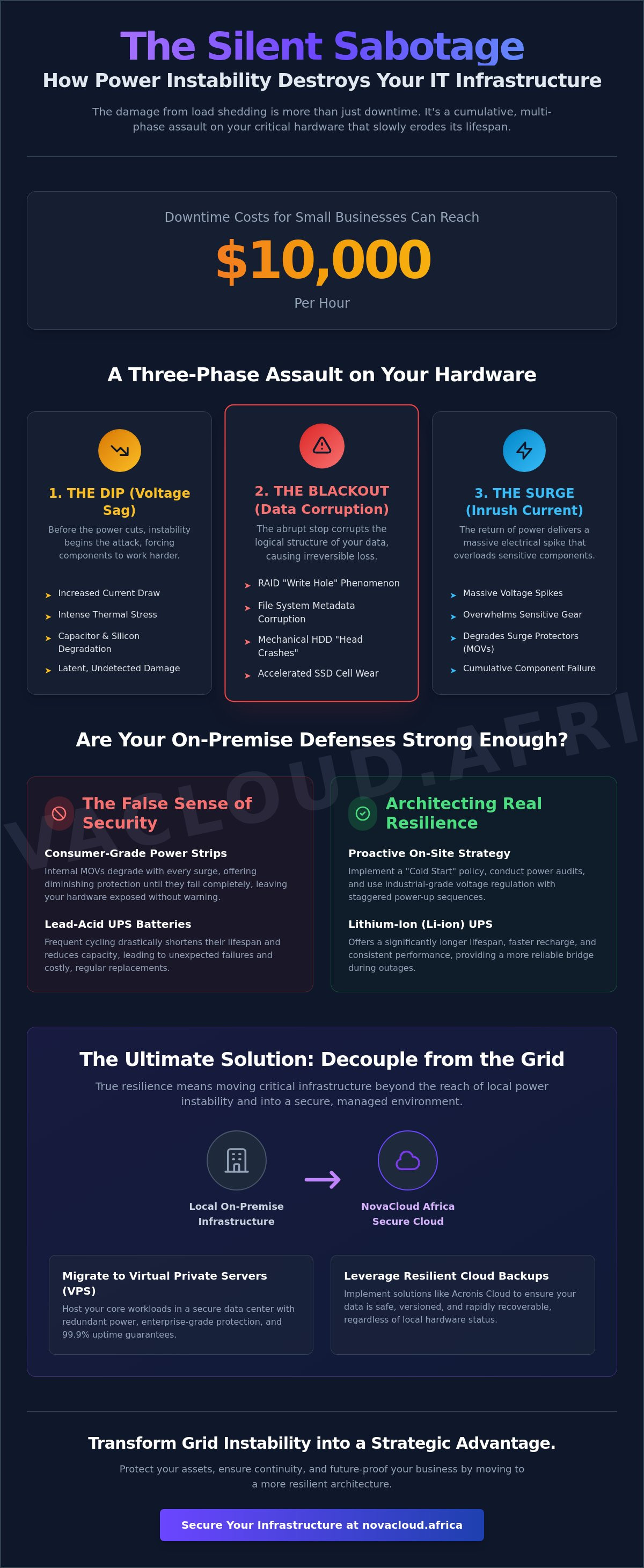
Load shedding is rarely a clean break. It's a violent sequence of electrical events that stresses every component in your server rack. To protect your investment, you must view a power cut as a three-phase assault: the dip, the blackout, and the surge. Understanding how load shedding damages IT equipment starts with recognizing that the most significant damage often happens before the power actually fails and immediately after it returns. This cycle creates a cumulative burden on silicon that traditional consumer-grade protection simply cannot handle.
The Silent Killer: Voltage Sags and Thermal Stress
Voltage sags, often called brownouts, are the silent killers of the modern data center. When the grid fluctuates, your server’s power supply unit (PSU) works overtime to maintain a steady output. As voltage drops, the PSU must draw more current to compensate for the loss. This increased current generates intense thermal stress, rapidly degrading the electrolytic capacitors on motherboards and in power units. Adhering to international power quality standards is nearly impossible when the local supply is inconsistent. This thermal fatigue doesn't always cause an immediate crash. Instead, it creates latent damage; silicon components are weakened, leading to mysterious failures weeks or months down the line.
Inrush Current and the Restoration Spike
The moment of restoration is equally perilous for your infrastructure. When the grid re-energizes, a massive wave of electricity floods the system. This is known as inrush current. Every device on the circuit, from air conditioners to industrial motors, demands maximum load at the exact same time. In a standard 230V environment, this can manifest as a momentary spike that far exceeds the tolerance of sensitive networking gear.
Many organizations rely on daisy-chaining power strips, but this provides a false sense of security. The Metal Oxide Varistors (MOVs) inside these strips degrade with every hit, eventually leaving your gear completely exposed. A professional resilience strategy requires more than just a surge protector. It demands:
- Staggered power-up sequences to prevent the cumulative load from tripping breakers.
- Industrial-grade voltage regulation to smooth out the "dirty power" common during grid restoration.
- Active monitoring to identify hardware that has suffered latent damage before it results in unplanned downtime.
By identifying these technical mechanisms, you move from a state of reactive repair to one of strategic readiness. This clarity is the catalyst for a fresh start in operational efficiency. Protecting your hardware is the first step in ensuring your digital evolution remains on track, empowered by a resilience that survives the shadows of grid instability.
Beyond the Circuit: Data Corruption and File System Integrity
While the physical scars of a power surge are easy to spot, the invisible damage to your data layer is often more catastrophic. This is a critical aspect of how load shedding damages IT equipment. When the flow of electrons stops mid-write, the logical structure of your information collapses. It isn't just about the hardware failing; it's about the data becoming unreadable or completely lost. Schneider Electric identifies various power disturbances that compromise system integrity, and sudden interruptions are among the most destructive.
RAID arrays are particularly vulnerable to the "Write Hole" phenomenon. This occurs when power loss happens in the millisecond between a data write and its corresponding parity update. The result is an inconsistent array that can lead to total volume loss upon reboot. Beyond the array, mechanical hard drives face "head crashes" as the read arm loses its protective air cushion and strikes the spinning platter. Even SSDs aren't immune; abrupt shutdowns accelerate cell wear and can corrupt the internal translation layer. The hidden cost here is the grueling "rebuild time," where your system remains online but performance is decimated for days as the parity is painstakingly recalculated.
In Windows and Linux environments, abrupt shutdowns scramble file system metadata. This metadata acts as the digital map for your storage. Without it, the operating system can't locate files, leading to "kernel panic" or "blue screen" errors on reboot. Recovering from these logical failures often requires professional IT Assistance to prevent permanent loss. Understanding how load shedding damages IT equipment at the software level is the first step toward building a truly resilient architecture.
Database Inconsistency and Transactional Failure
SQL databases depend on atomic transactions. A Stage 4 or 6 cut can leave these transactions half-completed, resulting in "bit rot" that stays hidden for weeks. You might only discover the corruption when trying to access a critical client record months later. To mitigate this risk, you should implement a robust strategy as outlined in our guide on Strategic Data Resilience: The 2026 Guide to Cloud Backups. Maintaining data integrity requires a proactive approach that extends beyond the local server room.
The Impact on Managed Firewalls and Security Appliances
Security hardware is highly sensitive to firmware integrity. A power drop during a routine update can brick a device or force it into an "open" state, leaving your perimeter defenseless precisely when the grid re-energizes. Our Managed Firewall solutions ensure your defense remains stable and properly configured regardless of the energy landscape. By moving security logic to a managed environment, you eliminate the risk of a local hardware failure compromising your entire network's safety.
The Battery Fatigue Cycle: Why Your UPS is Not a Permanent Fix
Many organizations view the Uninterruptible Power Supply (UPS) as a complete shield against grid instability. This is a dangerous misconception. While a UPS is an essential tactical tool, it's a consumable asset with a finite lifespan that diminishes with every power cycle. To understand how load shedding damages IT equipment, you must look at the hidden fatigue occurring within the batteries themselves. They aren't just holding a charge; they are undergoing a chemical transformation that is accelerated by the relentless schedule of modern grid management.
The old standard of Lead-Acid (VRLA) batteries is particularly ill-suited for the current energy landscape. These units are designed for occasional standby use, not the daily deep-cycling required by high-stage schedules. While Lithium-Ion alternatives offer better resilience, the fundamental truth remains that every discharge is a step toward failure. Relying solely on on-site batteries creates a false sense of security that often vanishes at the most critical moment.
Battery Degradation in the Load Shedding Era
A battery rated for 500 cycles might last years in a stable environment, but under current conditions, it can fail in as little as six months. Cycle Life is the total number of charge and discharge sequences a battery can perform before its capacity drops below 80 percent of its original rating. When a battery's health declines, its internal resistance increases. This creates a risk where the UPS might fail precisely during a surge, essentially bypassing your protection and delivering "dirty power" directly to your servers.
There is also the "Switchover Gap" to consider. Most standby and line-interactive UPS units have a transfer time of 10 to 20 milliseconds. While this is fast, it's often enough to trigger a reboot in sensitive VoIP hardware or cause a momentary dip that corrupts active database transactions. This millisecond of uncertainty is another way how load shedding damages IT equipment, even when you think you're protected. It's a subtle, repetitive stress that wears down the internal components of your network rack.
UPS vs. Cloud Infrastructure: A Strategic Comparison
The Total Cost of Ownership (TCO) for on-premise power protection is rising. Beyond the initial purchase, you must factor in the recurring costs of replacement batteries, the electricity required for specialized cooling, and the manual labor involved in monitoring health. It's a heavy operational burden that distracts from your core mission of growth. By contrast, migrating workloads to Virtual Private Servers eliminates on-site battery anxiety entirely.
Professional data centers utilize industrial-grade, redundant power architectures that far exceed what is possible in a standard office environment. These Tier-3 and Tier-4 facilities leverage high-capacity Lithium-Ion arrays and massive diesel generators, ensuring that your digital assets remain bathed in "clean" electricity. This shift isn't just about saving money; it's about claiming digital sovereignty and ensuring your business isn't tethered to the local grid's instability. It's a move toward a more resilient, visionary future where your progress is never interrupted by the shadows of a failing circuit.
Architecting Resilience: Proactive Hardware Protection Strategies
Building a defense against grid instability requires moving beyond reactive measures. It's about designing a system that anticipates the cycle of failure rather than just surviving it. By understanding how load shedding damages IT equipment, you can implement a multi-layered strategy that preserves both hardware longevity and data integrity. A sophisticated architecture doesn't just react to a power cut; it prepares for it with quiet confidence.
To secure your digital evolution, follow this five-step roadmap for hardware resilience:
- Conduct a Comprehensive Power Audit: Identify mission-critical assets like servers and networking hubs versus non-essential hardware like printers or auxiliary monitors. Knowing your load requirements is the first step toward efficient protection.
- Implement a "Cold Start" Policy: Manually or automatically power down non-essential gear 15 minutes before a scheduled cut. This prevents the thermal stress and inrush current spikes discussed in previous sections.
- Deploy DB Board Surge Protection: Consumer-grade power strips are insufficient for business environments. Install enterprise-grade surge protection at your distribution board to stop transients before they enter your internal wiring.
- Automated Offsite Backup Routines: Schedule your Cloud backups to trigger and complete before the scheduled outage window. This ensures that even if a local drive fails, your data remains safe in the cloud.
- Migrate to Hosted PBX: Move your communication brain to a managed environment. This ensures your business stays reachable even when your physical office is dark.
Unified Communications Resilience
On-premise PBX systems are notoriously sensitive to power fluctuations. A single voltage sag can corrupt call logs or damage expensive interface cards. Transitioning to Hosted PBX systems provides a visionary solution for mobile workforce continuity. For those who require physical desk phones, the Yealink T31P IP Phone offers a resilient hardware option. When paired with Power over Ethernet (PoE) and a stable network backbone, these devices maintain clarity and professional presence regardless of local grid conditions.
Managed IT Assistance and Proactive Monitoring
The role of remote monitoring is vital in detecting hardware health before a catastrophic failure occurs. Our Strategic IT Assistance provides the oversight needed to catch UPS battery degradation or server temperature spikes in real time. Setting up automated alerts allows your team to intervene before the "silent killers" of heat and voltage stress claim another motherboard. This proactive stance is a hallmark of a growth-oriented organization that values its technological foundation.
Secure your perimeter and ensure your network remains a catalyst for growth with our Managed Firewall solutions.
The Ultimate Solution: Decoupling IT Infrastructure from the Local Grid
Maintaining physical hardware on-site has become a significant strategic liability. As we have explored, the cumulative stress of voltage sags and inrush currents creates a cycle of failure that no amount of local patching can fully resolve. The most effective way to address how load shedding damages IT equipment is to remove your most sensitive assets from the path of the surge entirely. By decoupling your infrastructure from the local grid, you transition from a state of constant vulnerability to one of digital sovereignty.
This evolution isn't merely a technical shift; it's a visionary move toward operational clarity. When your core processing power and data storage reside in a high-performance cloud environment, the instability of the regional power supply ceases to be a threat to your business continuity. You're no longer fighting a losing battle against heat buildup and capacitor degradation. Instead, you're leveraging a system designed for stability and expansion, where technology acts as a catalyst for your regional empowerment.
Migrating to Business-Grade Cloud Infrastructure
Moving your workloads to a managed environment offers the peace of mind that comes with 99.9 percent uptime guarantees. In a professional data center, power redundancy is handled at a scale that is impossible to replicate in a standard office. This environment ensures your mission-critical databases are bathed in clean, regulated electricity, far from the "dirty power" of a recovering grid.
If you're ready to begin this transition, our Business-Grade Cloud Infrastructure: The 2026 Strategic Buyer’s Guide provides a roadmap for a phased migration. Starting with your most sensitive databases and moving toward full-scale Virtual Private Servers allows you to build resilience without disrupting your current momentum. It's a fresh start for your business efficiency, unburdened by the weight of failing on-premise hardware.
Future-Proofing with Symmetrical Connectivity
A grid-independent office requires more than just cloud hosting; it demands a robust, high-speed umbilical cord. High-performance Business Fibre is the backbone of this strategy. Symmetrical speeds ensure that your team interacts with cloud-based tools as if they were sitting in the next room. However, true resilience requires ensuring your connectivity provider maintains their own power redundancy at every Point of Presence (POP).
NovaCloud Africa stands as your strategic partner in this digital evolution. We combine regional expertise with international benchmarks to ensure your infrastructure is not just surviving, but thriving. We don't just provide services; we architect systems that empower your growth and secure your future against the shadows of grid instability. Contact NovaCloud Africa to architect your resilient cloud future today and experience the quiet confidence of a truly protected enterprise.
Architecting a Future Beyond Grid Instability
The cycle of grid instability doesn't have to dictate your operational lifespan. We've explored the technical mechanisms of how load shedding damages IT equipment, from the silent thermal stress of voltage sags to the data-shattering "Write Hole" phenomenon. While industrial-grade surge protection and cold-start policies offer essential tactical defense, true resilience requires a more visionary approach. By decoupling your infrastructure from the local grid, you reclaim your digital sovereignty and ensure your growth remains uninterrupted.
NovaCloud Africa is your strategic partner in this evolution. We provide the stability your business needs to thrive in a challenging landscape. With our 99.9% Uptime SLA and industrial-grade power redundancy, your critical workloads are housed in an environment designed for absolute reliability. You'll also benefit from expert South African technical support, ensuring that your transition to the cloud is handled with precision and care.
Secure your business continuity with NovaCloud Africa’s resilient cloud solutions
Your digital future is bright. With the right architecture, your progress will never be left in the dark.
Frequently Asked Questions
Can load shedding damage my computer even if it is turned off?
Yes, your hardware remains vulnerable even when powered down if it is still physically connected to a wall socket. The primary threat isn't the blackout itself, but the massive voltage spike that occurs when the grid re-energizes. These transients can bypass the power button and strike the power supply unit directly, causing immediate failure or weakening internal components over time. Unplugging non-essential gear is the only way to ensure total protection during a cut.
How do I know if my server hardware has been damaged by a power surge?
Signs of surge damage often manifest as intermittent stability issues rather than total failure. You might notice random reboots, a persistent "burnt" smell near the server rack, or bulging capacitors on the motherboard. In many cases, the damage is latent, meaning the hardware continues to function but with a significantly compromised lifespan. Professional IT Assistance can help identify these early warning signs through hardware health monitoring before they lead to a catastrophic crash.
Why does my UPS battery only last 10 minutes when it used to last an hour?
This rapid decline is typically caused by battery fatigue from frequent cycling. Lead-acid batteries, common in many older UPS units, are designed for occasional standby use rather than the daily deep discharges required by modern load shedding schedules. Every time your battery discharges and recharges, its chemical capacity diminishes. If your backup time has plummeted, it's a clear signal that the battery has reached the end of its effective cycle life and requires replacement.
Is a surge protector plug enough to protect a business server?
A standard surge protector plug is insufficient for protecting a business-grade server environment. While these plugs can handle minor transients, they don't provide voltage regulation or protection against the thermal stress caused by brownouts. Servers require a clean, consistent flow of electricity to maintain data integrity. A more robust architecture involves DB-board level protection and high-quality UPS systems that can bridge the millisecond switchover gap without triggering a reboot.
Does load shedding cause data loss on SSDs (Solid State Drives)?
Sudden power loss is a major risk for SSDs because they rely on internal mapping tables to locate data. If the power cuts while the drive is updating these tables, the entire file system can become unreadable. While modern enterprise drives have some "power-loss protection" capacitors, they aren't foolproof. Implementing automated Cloud backups is the most reliable way to ensure your data remains safe even if the physical drive suffers a logical collapse.
How can I protect my office network when the power comes back on?
The best way to protect your network during restoration is to implement a staggered power-up sequence. By waiting a few minutes after the lights return before turning on heavy loads like servers and air conditioners, you avoid the worst of the inrush current. You should also ensure that your managed firewalls and network switches are behind a line-interactive UPS that can filter out the "dirty power" often present in the first few minutes of grid re-energization.
What is "dirty power" and how does it affect IT equipment?
Dirty power refers to electricity that suffers from voltage fluctuations, frequency variations, or electromagnetic interference. This inconsistency is a primary factor in how load shedding damages IT equipment because it forces power supplies to operate outside their optimal range. This creates excessive heat, which is the leading cause of premature component failure. Transitioning to a managed cloud environment ensures your workloads are powered by clean, industrial-grade electricity that meets international standards.
Is it better to move to a VPS than to buy a larger inverter for the office?
Moving your core infrastructure to a Virtual Private Server (VPS) is a more strategic long-term investment than buying larger inverters. While an inverter provides a local patch, it doesn't eliminate the risk of hardware fatigue or the hidden costs of battery maintenance and cooling. By understanding how load shedding damages IT equipment, you can see that removing the hardware from the local grid entirely is the only way to achieve true digital sovereignty and 99.9 percent uptime.
