


Architecting Success: The Ultimate Guide to Ubiquiti Networks for South African Enterprises

Your network hardware should be a strategic asset, not a monthly subscription liability that drains your IT budget. For South African enterprises, the hidden cost of "business as usual" often arrives in the form of expensive recurring licensing fees and high latency, often exceeding 150ms, which compromises your Hosted PBX call quality. You need a foundation that remains stable even when the power grid falters, yet many traditional vendors continue to charge you for the privilege of owning your own hardware. Deploying Ubiquiti networks allows you to break this cycle by building a professional-grade infrastructure with zero recurring software costs.
We understand that digital transformation requires a balance of high-level strategy and technical reliability. You deserve a system that offers a single pane of glass for management, ensuring your cloud-based VPS and VoIP tools perform at their peak. This guide provides the blueprint to design, deploy, and manage a resilient network architecture tailored for the local market. We will walk through the steps to achieve seamless integration and scalable growth, starting a new chapter in business efficiency that turns your connectivity into a competitive advantage.
Key Takeaways
- Learn why a "Single Pane of Glass" management philosophy provides the scalable foundation South African SMEs need for seamless digital growth without recurring subscription fees.
- Master the product ecosystem by identifying whether UniFi, UISP, or EdgeMax provides the specific hardware architecture required for your office or industrial environment.
- Discover how high-performance Ubiquiti networks serve as the resilient bridge to your cloud-first operations, ensuring your virtual private servers and symmetrical fibre perform at their peak.
- Follow a strategic roadmap for transitioning from legacy hardware to a modern stack, using professional site surveys and heat mapping to guarantee optimal Wi-Fi 6 coverage.
- Understand why expert managed ICT services are the final piece of the puzzle, turning high-end hardware into a strategic asset that empowers your business's continental reach.
What are Ubiquiti Networks? Architecting the Modern Digital Foundation
Ubiquiti isn't just another hardware manufacturer; it's a fundamental shift in how we think about connectivity. Founded in 2003, Ubiquiti Networks has dismantled the traditional enterprise model by removing the recurring license fees that often drain South African ICT budgets. For a local enterprise, this means high-performance gear without the vendor lock-in that costs thousands of Rands annually. It's a disruptive approach that prioritizes transparency and performance over arbitrary paywalls.
The magic lies in the UniFi ecosystem. It's a Software-Defined Networking (SDN) platform that bridges the gap between consumer-grade ease and enterprise-grade performance. This "Single Pane of Glass" management philosophy is a game-changer for South African SMEs with limited IT staff. Instead of managing individual devices through clunky, disconnected interfaces, you control your entire site, from Wi-Fi 6 access points to security cameras, from one central dashboard. As your business transitions to resilient cloud architectures, having this robust, unified physical foundation becomes a non-negotiable asset for growth.
The shift toward SDN means your network is no longer a static collection of boxes. It's a dynamic, programmable environment. This flexibility allows businesses to deploy sophisticated security protocols and guest networks in minutes rather than hours. Ubiquiti networks empower local teams to execute complex configurations that were once the exclusive domain of high-priced consultants.
The Core Philosophy: Performance Without the License Tax
Traditional networking players often charge "per-seat" or "feature" licenses that inflate long-term costs. Ubiquiti eliminates this. When you buy the hardware, you own the software. This approach saves businesses up to 40% on total cost of ownership over a five-year cycle. The UniFi ecosystem simplifies configurations; you don't need a PhD to set up a VLAN. It's about resilient architecture that scales from one office to ten without your software costs ballooning.
Ubiquiti in the African Context: Why Local Businesses are Switching
In our developing digital economy, every Rand counts. South African businesses face unique challenges like power instability and the need for rapid deployment. Ubiquiti networks provide the scalability required to pivot quickly. Local distributor availability ensures that hardware replacements don't involve weeks of international shipping. This accessibility, combined with a massive global community, provides a safety net for local IT teams. Ubiquiti serves as the definitive catalyst for regional digital empowerment, providing the tools for African enterprises to compete on a global stage.
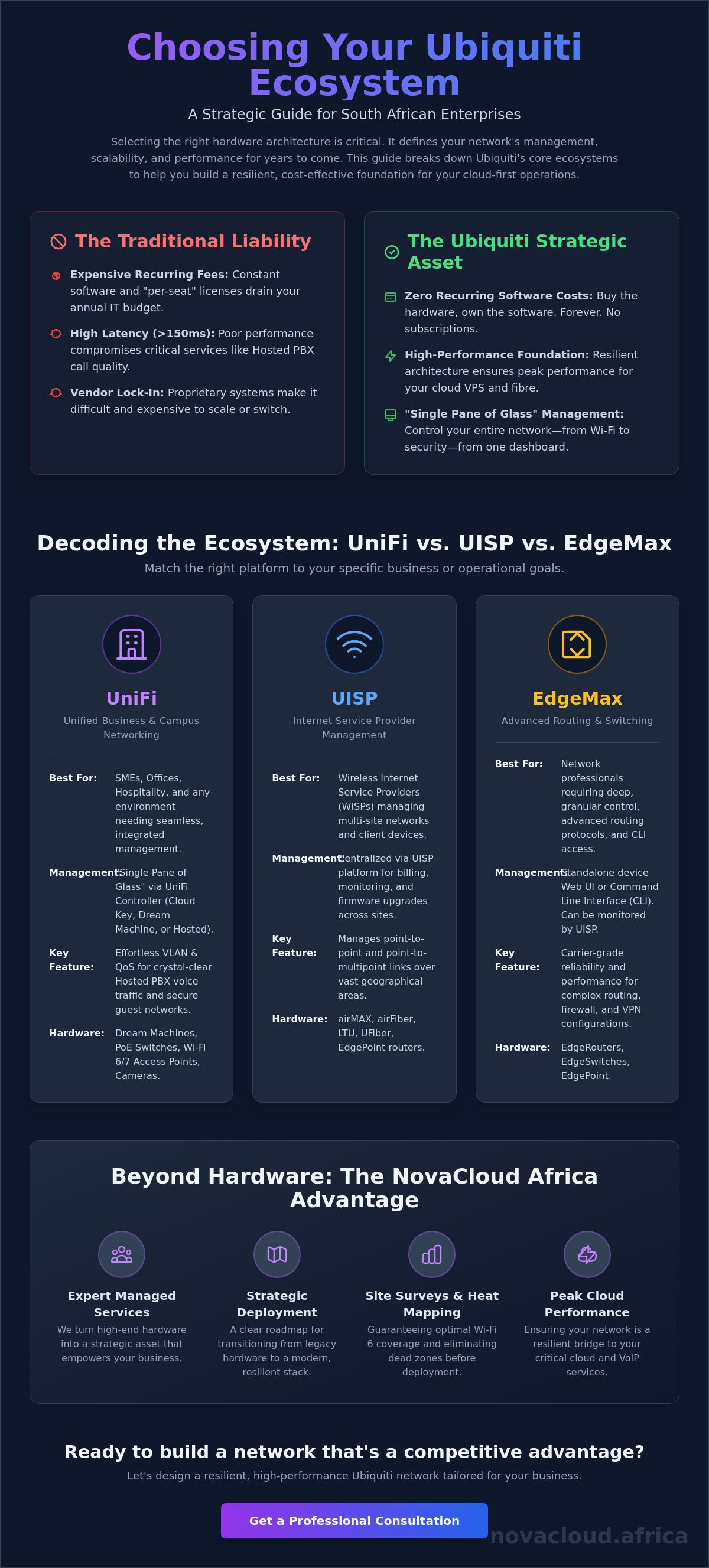
Decoding the Ecosystem: UniFi vs. UISP vs. EdgeMax
Selecting the right hardware architecture is the most critical decision you'll make when deploying Ubiquiti networks. While the hardware shares a common pedigree of reliability, the software ecosystems serve vastly different operational goals. For a South African enterprise, this choice dictates how your IT team manages growth, handles multi-site connectivity, and ensures uptime across diverse geographic locations. You aren't just buying hardware; you're choosing a management philosophy that will define your digital agility for years to come.
UniFi: The Business Standard for Unified Management
UniFi is the ecosystem that defined the "single pane of glass" philosophy. It's the preferred choice for managed office environments where simplicity and visibility are paramount. The stack typically begins with a Dream Machine Pro or Special Edition, acting as the gateway, security appliance, and controller. From there, your architecture expands through high-performance PoE switches to Wi-Fi 6 or Wi-Fi 7 Access Points. This synergy is why UniFi is the gold standard for supporting Hosted PBX systems. It allows for effortless VLAN tagging and Quality of Service (QoS) prioritization, ensuring voice traffic remains crystal clear even during peak data usage.
The real power lies in the UniFi Controller. It provides a centralized dashboard to monitor global health. Industry experts often describe it as the ultimate prosumer networking solution that has successfully crossed over into the enterprise space. Whether you're managing a single floor in Sandton or twenty satellite offices across the continent, the controller offers granular visibility into every connected device and client. It's about empowerment through clarity.
UISP and EdgeMax: When to Step Outside the UniFi Bubble
Sometimes your requirements exceed the standard office footprint. This is where UISP and EdgeMax become essential tools for your infrastructure. UISP (Ubiquiti ISP) is designed for high-capacity, long-range wireless links. If your business operates a multi-building campus or needs to bridge a 5km gap between a warehouse and a main office without the R100,000 plus cost of trenching fiber, UISP is the answer. It's built for point-to-point (PtP) and point-to-multipoint (PtMP) deployments that require carrier-grade stability in harsh environments.
EdgeMax, specifically the EdgeRouter line, appeals to technical teams who demand granular control. Unlike the GUI-driven UniFi series, EdgeMax focuses on a robust Command Line Interface (CLI). It's particularly effective for complex WAN load balancing. In a market like South Africa, where businesses often juggle multiple fiber providers and 5G backups to combat local outages, the ability to script specific failover behaviors is a massive advantage. While UniFi is centralized, EdgeMax is device-centric, offering the "power user" features needed for sophisticated routing tables and advanced firewall rules. If you're ready to build a more resilient foundation, you can explore our cloud-integrated infrastructure options to see how these Ubiquiti networks components fit your strategic roadmap.
Selecting Infrastructure for Cloud-First Operations
The shift toward decentralized work across South Africa demands more than just a basic internet connection. Your local hardware acts as the primary gateway to your digital assets. If your on-premise switches can't keep pace, your investment in high-performance Virtual Private Servers won't deliver the ROI you expect. Ubiquiti networks provide the necessary throughput to handle symmetrical fibre connections, ensuring that upload speeds match download speeds for seamless data synchronisation. This is vital for South African enterprises that rely on real-time backups and cloud-hosted databases to maintain business continuity during power disruptions or regional connectivity shifts.
Optimizing for VPS and Cloud Application Latency
Latency isn't always an ISP issue; it often starts in the server room. Selecting switches with high backplane capacity ensures that internal data traffic doesn't bottleneck before it reaches the WAN. By utilizing 10G SFP+ ports on UniFi Aggregation switches, businesses create a high-speed highway to local cloud gateways. This technical precision is supported by data in official FCC filings, which detail the rigorous standards Ubiquiti maintains for wireless and wired efficiency. A 20ms reduction in internal latency can translate to a 15% increase in employee productivity when accessing cloud-hosted ERP systems, as every click responds with near-instantaneous feedback.
VoIP Excellence: QoS and VLAN Configuration
Crystal-clear communication depends on traffic hierarchy. Without proper segmentation, a large file download can degrade a critical board meeting call. You should isolate voice traffic into a dedicated VLAN to prevent data congestion from affecting your hosted PBX system. Configuring Quality of Service (QoS) on UniFi gateways allows you to tag Yealink hardware for immediate priority. Smart buffer management reduces jitter to under 30ms, even during peak usage hours. This ensures that every client interaction remains professional and uninterrupted, regardless of how much data the rest of the office is consuming.
Building a network that supports a hybrid workforce requires a "Remote-First" mindset. Ubiquiti networks enable this through secure, high-speed Site-to-Site VPNs and the Teleport VPN feature. These tools allow remote staff in Cape Town or Durban to access Johannesburg-based resources as if they were sitting in the main office. By 2025, it's estimated that 40% of South African knowledge workers will operate in hybrid environments. Architecting your infrastructure today with scalable Ubiquiti hardware ensures you're ready for this shift, providing a resilient foundation that empowers growth rather than restricting it.
- Symmetrical Fibre Support: Ensures high-speed uploads for cloud backups.
- 10G SFP+ Connectivity: Eliminates bottlenecks between the local network and the cloud.
- VLAN Tagging: Protects voice quality by isolating communication traffic.
- Unified Management: Allows IT teams to manage multiple branch offices from a single dashboard.
How-To: Deploying a Resilient Ubiquiti Network
Moving from aging, disparate hardware to a unified Ubiquiti networks stack requires a strategic shift in perspective. It's not just a hardware swap; it's a structural upgrade that aligns your digital foundation with your growth goals. This process transforms fragmented connectivity into a cohesive ecosystem that's easier to manage and scale across South African provinces.
Step 1: Planning and Site Auditing
Precision starts before the first cable is laid. We utilize the UniFi Design Centre to build digital twins of your office space, simulating Wi-Fi 6 signal penetration through various wall materials like concrete or drywall. This data-driven approach identifies potential dead zones in high-density areas like boardrooms or open-plan floors before a single technician arrives on site. A successful network is 70% planning and 30% execution. By mapping cable runs and access point placements digitally, you eliminate the guesswork that leads to costly post-installation adjustments and signal interference.
Step 2: Configuration for Maximum Uptime
Resilience is built into the software layer. Configuring your Gateway involves balancing high-speed throughput with robust security. Enabling Intrusion Detection and Prevention (IDS/IPS) provides a real-time shield against external threats, yet modern Ubiquiti networks hardware maintains high speeds even with these filters active. For the South African context, setting up automated failover for internet redundancy is non-negotiable. Whether it's a secondary fiber line or a high-gain LTE backup, the system switches paths instantly to keep your operations live. Secure remote access is handled via Teleport or Site-to-Site VPNs, allowing your team to connect from home or satellite offices with zero-config simplicity.
Managing Power Resilience for Network Continuity
In a landscape where power stability is a constant variable, your network must be self-sustaining. Calculating your PoE (Power over Ethernet) budget is the first step. You must ensure your switches can handle the peak draw of Wi-Fi 6 APs and security cameras simultaneously without overtaxing the power supply. A smart UPS is mandatory. It doesn't just provide runtime during load shedding; it protects the UniFi Cloud Key database from corruption by initiating a graceful shutdown during extended outages. For UISP wireless deployments in more remote areas, integrating DC-to-DC power solutions ensures that your long-range links remain active even when the local grid fails.
Ready to architect a future-proof foundation for your business? Explore our cloud-managed networking solutions.
Beyond Hardware: The NovaCloud Approach to Managed Networks
Hardware represents the physical skeleton of your digital environment. However, even the most advanced Ubiquiti networks require a master architect to function at peak efficiency. In the South African business landscape, where connectivity challenges and security threats are constant, having high-end gear is only half the battle. NovaCloud transforms these components into a resilient bridge between your local office and the cloud. We've moved past the era of reactive IT support. We act as a growth partner, ensuring your infrastructure scales alongside your commercial ambitions.
Strategic ICT integration isn't just about fixing what's broken. It's about designing systems that prevent failure before it occurs. We analyze your traffic patterns, identify bottlenecks, and optimize every access point to ensure your team stays productive. This transition from a cost center to a strategic asset is what defines the NovaCloud partnership. We provide the technical execution that allows you to focus on your core business.
Managed Ubiquiti: Peace of Mind for the C-Suite
Outsourcing network management to a specialized ICT provider eliminates the hidden costs of operational friction. Industry data suggests that unplanned downtime costs South African mid-market firms an average of R15,000 per hour in lost productivity. NovaCloud mitigates this risk through proactive monitoring and automated firmware patching. We ensure your security protocols remain current against evolving threats without requiring your internal team's constant intervention.
- Proactive Security: We deploy patches the moment they're verified, closing vulnerabilities before they can be exploited by bad actors.
- Optimized Configuration: Expert tuning reduces latency and improves device lifespan, which significantly lowers your total cost of ownership.
- Local Expertise: You gain access to a South African team that understands the local fiber landscape and unique power constraints.
Your ICT Roadmap for 2026
Looking toward 2026, a fragmented tech stack is a significant liability. The most successful South African enterprises combine robust Ubiquiti networks hardware with a unified software layer. Integrating your physical infrastructure with Microsoft 365 Business Licensing creates a seamless ecosystem where identity management and network security work in tandem. This alignment ensures that your data remains protected whether it's on a local server or in the cloud.
This is the essence of a "Nova" start. It brings illumination and clarity to operations that were previously opaque or disorganized. Your digital transformation shouldn't be a series of disconnected purchases; it should be a deliberate, architected journey toward efficiency. We provide the vision to make that journey possible. It's about creating a foundation that supports innovation for years to come.
Ready to illuminate your path? The first step is a comprehensive network audit. We'll analyze your current throughput, security gaps, and scalability potential to build a roadmap that lasts. Contact our team today to schedule your assessment and begin your transition to a managed, high-performance network that empowers your growth.
The Blueprint for a Connected South African Future
Building a resilient digital foundation requires a strategic choice between UniFi’s seamless management and the high-performance routing of EdgeMax. South African enterprises need infrastructure that handles local connectivity challenges while scaling with global standards. Ubiquiti networks provide this essential balance; they offer a hardware ecosystem that matures alongside your business goals and operational demands. Success in the 2024 digital economy depends on moving beyond basic connectivity toward a fully integrated, cloud-first architecture.
NovaCloud Africa brings certified Ubiquiti implementation expertise to your organization with national support coverage spanning all nine provinces. Our integration specialists ensure your hardware works in perfect harmony with Hosted PBX and high-performance VPS environments to eliminate technical silos. We don't just supply equipment; we act as your strategic ally to ensure your digital transformation stays on track and remains resilient. It's time to replace legacy constraints with a system designed for regional empowerment and technical excellence. Architect your future-proof network with NovaCloud Africa. Let's start this new chapter and secure your business's role in the continent’s bright digital future.
Frequently Asked Questions
Is Ubiquiti suitable for large-scale enterprise environments?
Ubiquiti networks provide the robust scalability required for high-density enterprise environments. Modern access points like the U6-Enterprise handle over 600 concurrent connections per unit. This architecture allows South African businesses to scale from a single office to a campus-wide deployment without hitting performance ceilings.
Do I need a dedicated server to run the UniFi Controller software?
You don't need a dedicated physical server to run the UniFi Controller. You can choose between a hardware-based Cloud Key, a Dream Machine, or a cloud-hosted instance. This flexibility ensures your management layer is as lean or as powerful as your specific digital strategy requires.
Can Ubiquiti routers handle multiple Fibre WAN connections for failover?
Ubiquiti routers like the Dream Machine Special Edition handle multiple Fibre WAN connections for seamless failover. You can configure secondary links to activate instantly if your primary provider goes offline. This redundancy is vital for maintaining 99.9% uptime in the local business landscape.
How does Ubiquiti handle security compared to traditional firewalls?
Ubiquiti provides enterprise-grade security through Integrated Threat Management and Deep Packet Inspection. While traditional firewalls often require complex, paid subscriptions, Ubiquiti offers signature-based detection and traffic analysis as standard features. It's a sophisticated way to illuminate and block potential threats before they reach your internal network.
Is there a recurring cost or license fee for Ubiquiti software?
There are zero recurring license fees for the UniFi management software. You buy the hardware once and own the entire ecosystem for its lifetime. This transparent pricing model helps South African firms avoid the vendor lock-in that often costs thousands of Rands in hidden annual renewals.
What is the difference between UniFi and EdgeMax for a standard office?
UniFi is built for centralized management through a single dashboard, while EdgeMax offers granular, command-line control for complex routing. Most modern offices choose UniFi for its visual interface and ease of use. It simplifies the digital architecture, allowing your IT team to focus on strategic growth rather than manual configuration.
How do I ensure my Ubiquiti network stays online during load shedding?
You ensure uptime during load shedding by integrating Ubiquiti hardware with high-quality UPS systems and the UniFi SmartPower Redundant Power System. This setup protects your gear from power instability. It provides a bridge to solar or generator power, keeping your digital infrastructure resilient during every Stage of the schedule.
Can I manage multiple office branches from a single dashboard?
You can manage hundreds of global or local office branches from a single, unified dashboard. The UniFi Site Manager allows for remote updates and configuration across different geographic locations. This centralized control acts as a catalyst for regional empowerment, giving you total visibility over your entire African footprint.
