


Business Fibre Contention Ratio Explained: Architecting Uncompromised Enterprise Connectivity

What if the bandwidth you've carefully budgeted for is being quietly siphoned away by the neighboring office's heavy downloads? It's a frustrating reality for many growing enterprises. You pay for high-speed connectivity, yet your VoIP calls drop and cloud backups crawl during peak hours. Having the business fibre contention ratio explained reveals the hidden architecture behind these slowdowns, moving you beyond the confusion of shared versus dedicated lines. This clarity is essential for any organization that views its digital infrastructure as a foundation for expansion rather than a mere utility.
We recognize that in an era where downtime can cost your organization between $137 and $427 every single minute, inconsistent performance is a strategic risk you can't afford. This article promises to help you master the technical nuances of contention to ensure your connectivity remains a focused catalyst for growth. We'll explore how to eliminate network bottlenecks, ensure maximum uptime for mission-critical cloud apps, and provide the insights needed to make a sophisticated procurement decision that aligns with your vision for the future.
Key Takeaways
- Decode the technical architecture of shared bandwidth with the business fibre contention ratio explained to pinpoint exactly where your network performance is being compromised.
- Distinguish between residential-grade lines and enterprise-class connectivity to avoid the "after-school" surges and evening congestion that derail professional productivity.
- Safeguard high-intensity applications like Hosted PBX and cloud backups by selecting ratios that eliminate jitter and ensure crystal-clear data transmission.
- Utilize a strategic framework to balance budget constraints with the high-performance requirements of your growing digital workforce and application intensity.
- Transition from a state of uncertainty to one of strategic readiness by aligning your infrastructure with international benchmarks for stability and expansion.
The Mechanics of Shared Connectivity: Business Fibre Contention Ratio Explained
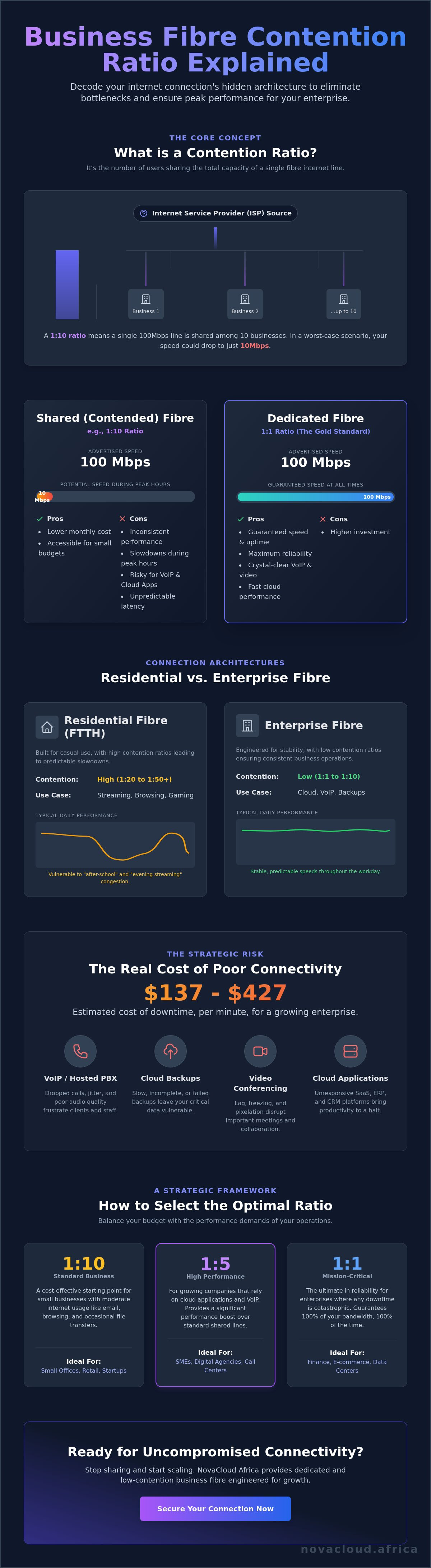
Visualizing data flow as a beam of light provides a clear window into how modern networks operate. In a perfect architecture, that light travels directly from the source to your office without interference. However, most commercial connections operate on a shared model. A Contention ratio represents the number of distinct users or businesses sharing a fixed amount of bandwidth on a single provider line. When you have the business fibre contention ratio explained, you begin to see why a line that performs beautifully at 3:00 AM might struggle at 10:00 AM. It isn't a failure of the fibre itself, but rather a result of how many other "prisms" are splitting that same beam of light simultaneously.
Internet Service Providers utilize contention primarily to manage the massive costs of regional infrastructure. By oversubscribing a line, they can offer lower price points to a broader range of clients. This creates a gap between your theoretical line speed and your effective throughput. While your contract might promise 100Mbps, your actual experience depends heavily on the digital behavior of your neighbors. During peak business hours, as nearby offices initiate large Cloud backups or host high-definition video conferences, the available "slice" of bandwidth for your enterprise can shrink significantly.
Understanding the 1:1 vs. 1:10 Mathematical Impact
The math behind contention is straightforward but carries heavy implications for your daily operations. If you're on a 1:10 contention ratio, your 100Mbps line is technically shared with nine other entities. In a worst-case scenario where every business on that segment maxes out their connection, your speed could drop to just 10Mbps. This is why 1:1 connectivity, often referred to as Dedicated Internet Access, remains the gold standard for South African enterprises. It ensures that 100% of the bandwidth you pay for is yours alone, regardless of national peak usage times or local congestion.
The Role of the Optical Line Terminal (OLT) in Sharing
Hardware is where these mathematical ratios become physical reality. The Optical Line Terminal (OLT) is the specific piece of equipment in the local exchange where your office's fibre line terminates and joins the provider's backbone. If an office park is heavily populated, the OLT can become a localized bottleneck. Contention ratio is the architectural blueprint of bandwidth distribution, and understanding its limits allows you to design a more resilient network. When the local exchange is congested, even the most advanced internal hardware won't fix a slow connection if the "pipe" leading to the OLT is already full.
Contention Ratios: The Invisible Barrier Between Home and Enterprise Fibre
Headline speeds often mask the structural reality of a connection. While a 100Mbps residential line and a 100Mbps business line might look identical on a marketing flyer, the underlying architecture tells a different story. Having the business fibre contention ratio explained reveals why home fibre frequently falters under the weight of professional demands. Residential packages, or Fibre to the Home (FTTH), are built on the assumption that not every user will require maximum bandwidth simultaneously. This leads to ratios as high as 1:20 or 1:50, where your performance is directly tethered to the browsing habits of dozens of neighbors.
This shared environment creates predictable but paralyzing surges. The "after-school" rush and "evening streaming" spikes aren't just minor inconveniences for a business; they're operational bottlenecks. If your team is pushing a critical project update at 4:00 PM just as the local neighborhood begins high-bandwidth activities, your effective speed can crater. According to the Cisco Annual Internet Report, the global shift toward data-heavy applications means these contention points are becoming more congested than ever. For an enterprise, the priority isn't just speed; it's the stability of that speed throughout the entire working day.
Why Residential Fibre Fails the Corporate Test
Using home fibre for mission-critical operations is a gamble with your productivity. Most residential packages operate on a "best-effort" basis, lacking the Service Level Agreements (SLAs) that guarantee uptime and repair times. Furthermore, home lines are typically asymmetrical, offering fast downloads but painfully slow uploads. This imbalance cripples essential business functions like Cloud backups and large file transfers, which require a symmetrical flow to remain efficient. When your upload speed is a fraction of your download, your digital evolution hits a hard ceiling.
Defining Enterprise-Grade Reliability
True business-grade connectivity shifts the narrative from "best-effort" to guaranteed throughput. Lower contention ratios ensure that your network remains responsive even during peak national usage times. This consistency is vital for maintaining the performance of Virtual Private Servers, where even minor latency can disrupt complex workflows. By architecting a system with low contention, you ensure that real-time digital collaboration remains fluid and uninterrupted. If you're ready to move beyond the limitations of shared residential lines, exploring a tailored Business Fibre solution is the next logical step for your organization's growth.
How High Contention Ratios Diminish Your Cloud and VoIP Performance
High contention ratios aren't just a minor annoyance for the modern workforce; they're a direct threat to the integrity of real-time digital services. When you have the business fibre contention ratio explained in the context of application performance, it's clear that "best-effort" bandwidth fails most when it matters most. While a standard file download can wait for a few milliseconds, real-time data packets for voice and cloud-hosted environments cannot. A high contention ratio introduces jitter, which is the technical term for the irregular arrival of data packets. This inconsistency creates a fractured experience that undermines the stability of your most critical systems, turning what should be a seamless digital workflow into a series of stuttering interruptions.
VoIP and the Latency Bottleneck
Voice data is incredibly fragile. Unlike an email that can be delivered in bursts, voice packets require a steady, rhythmic flow to remain intelligible. In a high-contention environment, your voice data must compete with every other user on the local exchange. This competition often leads to packet loss, where snippets of audio are simply discarded to keep the stream moving. For businesses relying on Hosted PBX systems, this manifests as metallic voices, dropped syllables, or disconnected calls. To maintain professional standards, your infrastructure must prioritize these packets. You can explore high-performance voice solutions designed to bypass the common pitfalls of congested local networks, ensuring every conversation is a catalyst for partnership rather than a source of frustration.
Cloud Infrastructure and Remote Work
The impact of shared bandwidth extends deep into your cloud architecture and the daily reality of remote collaboration. Organizations utilizing Virtual Private Servers often experience frustrating "lag" when bandwidth is contested. This delay isn't just a slow screen refresh; it's a breakdown in the synchronization between your local team and their remote workspace. When your ERP or CRM synchronization slows down, it impacts data accuracy and decision-making speed across the entire company. Similarly, high-intensity Cloud backups face data integrity risks when the connection flickers. If the upload stream is interrupted by a neighbor's sudden bandwidth surge, the backup may fail or become corrupted, leaving your data resilience strategy in jeopardy. Having the business fibre contention ratio explained in this technical light empowers you to visit low-latency server options and architect a network that truly supports your vision.
Architecting Your Connectivity: A Guide to Selecting the Optimal Ratio
Selecting the right network architecture requires a deep understanding of your organization's digital pulse. It's about matching the "pipe" to the actual flow of your operations. Having the business fibre contention ratio explained serves as the first step in this design process. You must evaluate your Connectivity Profile by looking at two primary metrics: user count and application intensity. A small team performing basic administrative tasks has vastly different requirements than a medium-sized enterprise running real-time synchronization across multiple branches.
For many small to medium enterprises (SMEs), a 1:5 or 1:10 ratio offers a pragmatic balance between performance and investment. It provides enough dedicated space to handle standard workflows while sharing the broader infrastructure costs. However, as an organization scales beyond 50 users, the 1:1 ratio, often called Dedicated Internet Access, becomes a non-negotiable standard. At this scale, the collective demand for bandwidth is so high that any level of sharing creates an immediate risk of congestion. When reviewing your current ISP contract, look closely for terms like "best effort" or "oversubscription." These are often euphemisms for high contention that can throttle your growth.
The Selection Framework by Business Type
Retail environments and small administrative offices often find that a 1:10 ratio provides sufficient celestial clarity for basic tasks like point-of-sale processing and email. The demand is steady but rarely hits the ceiling of the connection. In contrast, tech startups and creative agencies deal with massive data transfers and constant cloud-based collaboration. For these pioneers, 1:1 symmetrical fibre is the only path to sustainable growth, ensuring that upload speeds never become a bottleneck for innovation.
Financial and legal firms occupy a unique position where data integrity and security are paramount. These organizations must prioritize low contention to facilitate secure, immutable Cloud backups. When a connection is uncontested, the risk of packet loss during sensitive data transmissions is virtually eliminated, ensuring that compliance standards are met with quiet confidence.
Redundancy and the "Always-On" Architecture
Modern enterprise connectivity isn't just about a single line; it's about architecting for resilience. Combining a low-contention primary line with a secondary failover creates an "always-on" environment that empowers your team to work without fear of disconnection. Within this ecosystem, Managed Firewalls play a crucial role by optimizing traffic across available lines, ensuring that mission-critical data always takes the fastest path. The right ratio is an investment in human productivity, not just a line item in your budget. If you're ready to architect a network that supports your specific business goals, view our Business Fibre solutions to find your perfect fit.
Beyond Ratios: NovaCloud’s Vision for Uncompromised Business Connectivity
Connectivity serves as the bedrock of national digital empowerment. In the specialized South African ICT landscape of 2026, stability is no longer an optional luxury; it's the primary currency of organizational progress. Having the business fibre contention ratio explained across these sections underscores a vital reality: your network's underlying architecture determines your ultimate capacity for expansion. We provide transparent, business-grade Business Fibre designed to eliminate the performance ceilings common in oversubscribed networks. By integrating high-performance Virtual Private Servers, resilient VoIP, and multi-layered security under one architectural umbrella, we ensure your digital assets work in perfect harmony to support your long-term vision.
Our approach is defined by a commitment to territorial reach and regional expertise. We recognize that businesses operating within our primary markets require more than just a faceless provider; they need an ally that understands the specific infrastructure challenges of the local landscape. This localized focus allows us to deploy solutions that aren't just technically sound but are also strategically aligned with the economic pulse of the region. We pride ourselves on being enablers of progress, ensuring that every bit of data transmitted over our network contributes to a larger story of growth and digital sovereignty for the organizations we serve.
A Strategic Ally in Your Digital Evolution
NovaCloud positions itself as a strategic architect rather than a mere service provider. We understand that moving from "buying internet" to "investing in a growth engine" is a significant shift in corporate mindset. This transition requires a partner who can translate complex technical benchmarks into tangible business outcomes. Our proactive IT Assistance plays a pivotal role in this journey, maintaining the health of your infrastructure so your team can focus on innovation. We bridge the gap between global standards and localized context, ensuring your connectivity is built for the specific challenges of the regional market while remaining aspirational in its reach.
Igniting Growth with Clarity
Our commitment is rooted in the promise of celestial light, a metaphor for data flow that remains clear, fast, and unfailingly reliable. When your business is powered by a connection free from the drag of high contention, every digital interaction becomes a fresh start in efficiency. This clarity allows your Hosted PBX and Cloud infrastructure to perform at their peak potential, unhindered by the browsing habits of neighboring offices. It's time to audit your current network constraints and step into a new era of uncompromised performance. Architect your business connectivity with NovaCloud Africa and transform your network from a bottleneck into a catalyst for regional progress and visionary success.
Designing for Digital Sovereignty and Growth
Mastering your network architecture is the definitive step toward ensuring your enterprise remains a leader in the South African digital landscape. By prioritizing low-contention environments, you protect the performance of your Hosted PBX and cloud-hosted assets from the unpredictable surges of shared traffic. Having the business fibre contention ratio explained provides the clarity needed to transition from a reactive IT posture to a proactive, growth-oriented strategy. It's about securing a foundation where data flows with celestial clarity, unhindered by the limitations of residential-grade infrastructure.
We invite you to leverage our carrier-grade South African infrastructure to secure your organization's future. With symmetrical 1:1 dedicated options and integrated managed security powered by FortiNet, we offer the stability and protection your digital evolution requires. Your journey toward uncompromised connectivity is a shared mission; we're ready to serve as your strategic partner in this transformation. Architect your uncompromised business connectivity today and embrace a future where your technology acts as a limitless catalyst for regional progress.
Frequently Asked Questions
What is a good contention ratio for a small business in South Africa?
A ratio of 1:10 or 1:5 is typically the benchmark for smaller South African enterprises seeking reliable performance without the cost of a fully dedicated line. This balance ensures that your essential operations remain fluid while managing infrastructure expenses effectively. As your team scales or adopts more data-heavy applications, moving toward a lower ratio becomes a strategic necessity to maintain your momentum and avoid peak-hour congestion.
Does a 1:1 contention ratio mean I always get my full advertised speed?
A 1:1 ratio guarantees that your specific portion of the local network is never shared with other businesses. Having the business fibre contention ratio explained in this context means you always have access to your full bandwidth within the provider's architecture. While external factors like global cable conditions or remote server speeds can influence performance, your local "pipe" remains exclusively yours at all times, providing a stable foundation for growth.
Can a high contention ratio cause my VoIP calls to drop?
Yes, high contention is a primary driver of poor voice quality and dropped calls. Because VoIP packets are time-sensitive, they cannot wait for a gap in a congested shared line. When multiple neighbors max out their connections, your voice data may suffer from packet loss or jitter. Moving to a lower contention ratio is often the most effective way to ensure your Hosted PBX remains a crystal-clear communication tool for your team.
How do I find out what my current business fibre contention ratio is?
You can usually find this information within your Service Level Agreement (SLA) or the technical specifications of your contract. Look for terms like "oversubscription" or "shared bandwidth." If these details are absent, your connection is likely a "best-effort" service with a higher ratio. Consulting with a technical partner can help you audit these documents to gain a clear understanding of your current network architecture and performance limits.
Is symmetrical fibre always 1:1 contention?
No, symmetry and contention are two distinct architectural features. Symmetrical fibre simply ensures that your upload and download speeds are equal, which is vital for Cloud backups and video conferencing. However, a symmetrical line can still be shared among multiple users. It is possible to have a symmetrical 1:10 line, meaning you share that balanced speed with nine other offices in your area, potentially leading to slowdowns during peak hours.
What happens if my business grows but my contention ratio remains high?
Your network will eventually become a bottleneck that stifles your organizational growth. As you add more staff and cloud-based tools, the demand on your shared bandwidth increases, leading to inconsistent speeds and reduced productivity. A high contention ratio acts like a ceiling on your digital evolution. It makes it difficult to maintain the high-performance standards required for modern enterprise operations and real-time collaboration.
Why is dedicated fibre (1:1) so much more expensive than 1:10 fibre?
The price difference reflects the exclusive reservation of network resources for your organization. In a 1:10 model, the cost of the underlying infrastructure is distributed across ten different clients. With a 1:1 dedicated line, you are investing in the full capacity of that network segment. This ensures absolute stability and uncompromised throughput, making it a high-value investment for mission-critical digital environments that cannot afford performance fluctuations.
How does contention affect my cloud backup speeds during the night?
Contention typically has less impact during off-peak hours because fewer users are competing for the shared light on the network. This often results in faster, more stable Cloud backups during the night. However, if your provider manages a very high business fibre contention ratio explained by heavy oversubscription, you may still face competition from other automated systems or large-scale data synchronizations running after hours, which can slow down your data resilience tasks.
