


Symmetrical vs Asymmetrical Fibre for Business: The Strategic Architect’s Guide

What if the very infrastructure meant to propel your organization forward is actually acting as a silent anchor? You've likely seen the marketing for "blazing fast" speeds, yet your team still struggles with dropped VoIP calls during the afternoon rush or slow cloud backup syncs that stall productivity. Choosing between symmetrical vs asymmetrical fibre for business isn't just a technical checkbox; it's a strategic decision that defines the ceiling of your digital agility. While asymmetrical lines might seem sufficient for basic browsing, they often fail to support the high-performance demands of a modern, cloud-first enterprise.
It's frustrating to pay for "up to" speeds that vanish when you need to upload critical data to your Virtual Private Servers or host a high-stakes video conference. We believe your digital evolution deserves a foundation of absolute clarity and reliability rather than a bottlenecked struggle. This guide will show you how the right fibre architecture transforms your operations into a scalable, high-performance digital engine. You'll discover the technical differences that impact your Hosted PBX performance and learn how to future-proof your connectivity to scale alongside your regional growth.
Key Takeaways
- Learn the fundamental distinction between symmetrical vs asymmetrical fibre for business and why prioritizing download speeds alone is an outdated strategy for modern enterprises.
- Understand why upload capacity is the new benchmark for digital agility, empowering your team to create and sync data as fast as they consume it.
- Discover how symmetrical architecture stabilizes sensitive real-time applications like VoIP and Hosted PBX to eliminate dropped calls and communication jitter.
- See how high-performance connectivity optimizes your Virtual Private Servers and Acronis Cloud backups for seamless, uninterrupted data protection and integrity.
- Acquire a strategic framework to assess your future bandwidth needs, ensuring your infrastructure acts as a catalyst for growth rather than an operational bottleneck.
Demystifying Connectivity: The Strategic Difference Between Symmetrical and Asymmetrical Fibre
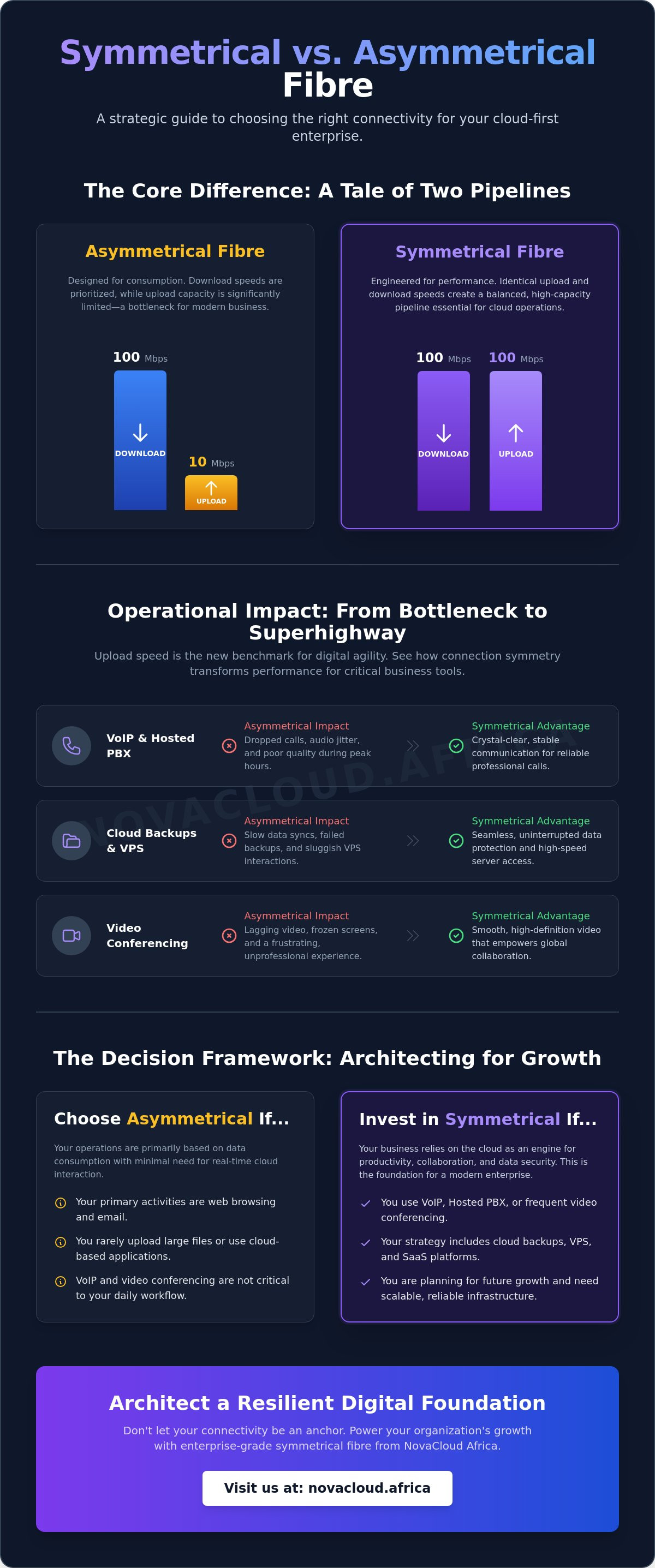
At the core of every high-performing digital ecosystem lies a choice that many leaders overlook until a system failure forces their hand. Symmetrical fibre provides an identical capacity for both sending and receiving data, creating a balanced pipeline that handles modern workloads with ease. Choosing between symmetrical vs asymmetrical fibre for business is the first step in architecting a network that empowers your team rather than restraining them. While the former offers a mirror image of speed, the latter remains weighted toward consumption, a relic of an era when the internet was a one-way street.
When your organization migrates to the cloud, your relationship with data changes fundamentally. You are no longer just a passive consumer of information; you are a creator and a synchronizer. The "Cloud Bottleneck" occurs when low upload speeds fail to keep pace with the demands of real-time backups and external server requests. Investing in a balanced connection is the first layer of a resilient business-grade cloud infrastructure, ensuring that your data flows out as effortlessly as it flows in.
The Anatomy of an Asymmetrical Connection
Asymmetrical connections, such as cable broadband or Asymmetric Digital Subscriber Line (ADSL), were designed for residential use where streaming and browsing are the primary activities. These lines prioritize download speeds, often leaving upload capacity at a fraction of the total bandwidth. In a commercial setting, this creates significant friction. During peak business hours, high contention ratios on shared asymmetrical lines mean you are competing with neighbors for a limited slice of the spectrum. When multiple users attempt to sync large files or join high-definition meetings simultaneously, upload throttling kicks in, leading to the stuttering performance that kills professional momentum.
The Symmetrical Advantage: A Dedicated Pathway
The Symmetrical Advantage is built on the physics of modern light pulses. Inside a dedicated fibre optic cable, data travels via light at the same frequency and speed in both directions. This allows for simultaneous two-way traffic without the collisions or queuing inherent in older copper-based or shared architectures. In professional ICT environments, "Business Fibre" is synonymous with this level of symmetry because it provides the stability required for enterprise tools.
Beyond simple file transfers, this architecture directly influences your defensive posture. A Managed Firewall performs most effectively when it can inspect incoming and outgoing traffic without being hindered by bandwidth limitations. By removing the asymmetry, you provide your security systems and your staff with a dedicated, unobstructed pathway to the global stage, turning your connectivity from a simple utility into a strategic asset.
The Architecture of Speed: Why Upload Capacity is the New Business Benchmark
The traditional view of internet speed often centers on how quickly we can download information, but for the modern enterprise, this is only half of the story. In the debate of symmetrical vs asymmetrical fibre for business, the real differentiator is how your network handles the data you create. We've moved beyond the era of simple browsing into an age of execution. Every time your team saves a file, starts a video call, or pushes a code update, they are executing in the cloud. This shift from consumption to creation means your upload speed is no longer a secondary luxury; it's the primary engine of your daily workflow.
The Synchronous Office relies on a constant stream of outgoing data. Background cloud tasks, from security telemetry to real-time analytics, require significant upload headroom to function without interrupting human productivity. When upload capacity is constrained, it doesn't just slow down your outgoing files; it actually cripples your downloads. This happens because of ACK packet delays. In most internet protocols, your computer must send a small acknowledgment (ACK) packet for every chunk of data it receives. If the upload path is congested, these tiny signals are delayed, forcing the sender to wait and effectively slowing your download speed to a crawl regardless of your advertised downstream bandwidth.
True digital sovereignty comes from having an unthrottled, reliable transmission path that your organization controls. As noted by industry analysts, symmetrical fiber speeds ensure that your business isn't at the mercy of a lopsided connection that treats your outgoing data as a secondary priority. By providing equal weight to both directions, you ensure that your digital presence remains robust and responsive.
Cloud Synchronization and the Death of the Local Server
Modern suites like Microsoft 365 and Google Workspace have effectively replaced the local office server. This shift demands high-performance upload capacity because every keystroke and version change is synced to the cloud in real time. When uploads are slow, version control becomes a nightmare, leading to conflicting files and lost work hours. Upload latency is the primary killer of cloud-based productivity in 2026. If your team constantly waits for saving icons to disappear, your architecture is likely the bottleneck.
Latency, Jitter, and the User Experience
There is a vital distinction between raw speed and responsiveness. While speed is the volume of data you can move, responsiveness is how quickly a single packet makes the round trip. Symmetrical fibre ensures a fresh start for every data packet by providing a wide, dedicated lane for outgoing traffic, which significantly reduces jitter. This is critical when accessing Virtual Private Servers or remote desktops. Without symmetry, the lag between your mouse click and the server response makes remote work feel sluggish and disconnected. Designing a network that feels instantaneous requires a balance of power in both directions. If you're ready to elevate your team's digital experience, consider how a tailored business fibre solution can remove these invisible barriers.
Operational Impact: How Fibre Symmetry Drives VoIP, Cloud, and VPS Performance
Digital infrastructure is the nervous system of the modern office, where the quality of your connection dictates the fluidity of your communication. When evaluating symmetrical vs asymmetrical fibre for business, the most immediate impact is felt in Unified Communications. Voice data is uniquely fragile. Unlike a file download that can pause and resume without error, a voice packet delayed is a conversation disrupted. In an asymmetrical environment, a sudden background sync can saturate your limited upload capacity, leading to the dreaded "robotic" voice or dropped calls that undermine your professional image.
The stability of Hosted PBX systems relies on this predictable, two-way flow. Symmetrical lines allow for sophisticated Quality of Service (QoS) configurations, ensuring that voice traffic always has a dedicated lane, regardless of what else is happening on the network. This technical harmony is what enables enterprise-grade hardware, such as the Yealink T31P IP Phone, to perform at its peak. It transforms a simple phone call into a reliable strategic tool for client engagement.
Data Resilience and the Symmetrical Vault
Beyond communication, symmetry is the silent guardian of your data integrity. Modern backup solutions like Acronis Cloud require consistent upload bandwidth to meet strict Recovery Point Objectives (RPO). If your upload speed is a fraction of your download, your daily data changes might take hours to sync, leaving your business vulnerable during the lag. High-speed symmetrical connectivity creates a vital synergy with Strategic Data Resilience. It ensures that your protective measures are always current, providing a fresh start for your security posture every single day.
High-Performance Hosting: Connecting to your VPS
For IT managers and developers, the connection to offsite infrastructure is a daily reality. Managing Virtual Private Servers via an asymmetrical line often results in frustrating lag during SSH sessions or database management. Every command sent to the server feels sluggish when the return path is congested. Symmetrical fibre removes this friction, making remote server management feel as responsive as a local connection. This fluidity is essential for seamless data migrations and real-time system monitoring, allowing your technical team to focus on innovation rather than fighting their own network.
The Decision Framework: Choosing the Right Connectivity for Your Digital Evolution
Selecting the ideal network architecture requires a shift in perspective. You aren't just buying a utility; you're investing in the capacity for your team to remain productive and focused. When weighing symmetrical vs asymmetrical fibre for business, the primary question isn't about the monthly price tag. Instead, it's about the cost of friction. A cheaper, asymmetrical connection might save a few dollars on an invoice, but if it causes five minutes of daily frustration for every employee, the hidden productivity drain quickly outweighs the initial savings. We believe in architecting systems that remove these invisible barriers, allowing your digital evolution to proceed without hesitation.
A strategic evaluation starts with your current and projected bandwidth requirements. If your organization relies on "best-effort" broadband, you're essentially gambling on the stability of a shared resource. Conversely, enterprise-grade connectivity is typically backed by a Service Level Agreement (SLA). These agreements provide a technical guarantee of uptime and performance, ensuring that your business remains online when it matters most. It's the difference between a connection that merely works and one that empowers your entire operational engine.
When Asymmetrical is Sufficient (The Exception)
Asymmetrical fibre still has a place in the modern landscape, though its role is increasingly specialized. Small retail shops with minimal cloud reliance or home-based businesses that primarily consume content may find these lines sufficient. In a larger enterprise context, asymmetrical fibre serves as an excellent low-cost secondary backup line. It provides a basic safety net for essential browsing if your primary circuit fails. However, even these users should plan for a transition. As digital tools become more upload-intensive, today's "sufficient" connection can easily become tomorrow's bottleneck.
The Symmetrical Mandate (The Rule)
For the vast majority of modern firms, symmetry is no longer optional. It's a mandate for any business that checks these boxes:
- Teams that collaborate via real-time video or unified communications.
- Organizations utilizing cloud-first environments for data storage and processing.
- Firms that host their own web services or manage offsite infrastructure.
Architecting Your Foundation: Enterprise-Grade Business Fibre with NovaCloud Africa
Choosing the right infrastructure is a transformative act that moves your organization beyond simple connectivity into a state of operational excellence. As we have explored, the debate between symmetrical vs asymmetrical fibre for business is ultimately about the ceiling you place on your own growth. At NovaCloud Africa, we don't just provide a cable; we act as a strategic ally in designing high-performance connectivity ecosystems that serve as the vital nervous system for your digital ambitions. Our approach involves a sophisticated blend of international technology benchmarks and deep regional expertise, ensuring that South African enterprises have the unthrottled power they need to compete on a global stage.
The "NovaCloud Signature" represents our commitment to absolute clarity and renewal in business efficiency. We believe that your network should be a source of quiet confidence, a reliable engine that powers your Virtual Private Servers and cloud environments without the friction of legacy limitations. By prioritizing unthrottled, symmetrical pathways, we empower organizations to embrace a future where data moves at the speed of thought. This foundation allows you to move away from the bottlenecked struggle of the past and toward a high-performance digital engine built for the long term.
Beyond the Cable: Managed Connectivity
True resilience is found in the integration of services. We specialize in architecting environments where Business Fibre works in perfect harmony with Managed Firewalls and Unified Communications. Whether you are deploying FortiNet security layers or optimizing your VoIP traffic for a fleet of Yealink devices, our infrastructure provides the necessary headroom for peak performance. This holistic view provides the peace of mind that comes from dedicated IT Assistance, ensuring your systems are always aligned with your strategic goals. Our infrastructure is built for celestial-grade clarity, offering a fresh start for businesses tired of the compromises inherent in residential-grade solutions.
Next Steps for Your Digital Sovereignty
Reclaiming your digital sovereignty begins with a clear understanding of your current landscape and your future requirements. Transitioning from legacy asymmetrical lines to a dedicated symmetrical circuit is a seamless process when handled by experts who understand the nuances of the regional market. We invite you to request a customized connectivity map tailored to your national operations, allowing you to visualize a network that scales alongside your success. Don't let your architecture be an afterthought. Architect your future with NovaCloud Business Fibre and experience the empowerment of a connection designed for the modern enterprise.
Empowering Your Digital Evolution with Precision Connectivity
The shift from passive consumption to active execution requires a network that doesn't hold your team back. We've explored how upload capacity has become the vital heartbeat of the synchronous office, ensuring that your data moves with the same urgency as your ideas. Choosing between symmetrical vs asymmetrical fibre for business is about more than just raw bandwidth; it's about providing your organization with the unthrottled clarity needed to excel in a cloud-first landscape. By prioritizing a balanced architecture, you eliminate the invisible friction that stalls unified communications and compromises your long-term data resilience.
At NovaCloud Africa, we're ready to serve as your strategic partner in this journey toward digital sovereignty. Our SLA-backed symmetrical connectivity, integrated cloud and VoIP ecosystem, and expert South African technical support provide the stable foundation your organization deserves. It's time to move beyond the limitations of legacy broadband and embrace a system designed for regional empowerment and global reach. Architect your high-performance business foundation with NovaCloud Fibre today. Your digital potential is limitless when your foundation is built for growth and your vision is supported by technical excellence.
Frequently Asked Questions
What is the main difference between symmetrical and asymmetrical internet for businesses?
The main difference is the balance of data flow. Symmetrical connections offer identical speeds for both uploading and downloading. Asymmetrical connections prioritize downloading, which often leaves upload capacity significantly lower. This distinction is the core of the symmetrical vs asymmetrical fibre for business debate, as it determines how well your network handles two-way traffic like video conferencing or cloud syncing.
Does symmetrical fibre really improve VoIP call quality?
Symmetrical fibre significantly improves VoIP call quality by providing a dedicated, unobstructed lane for outgoing voice packets. In an asymmetrical environment, a single large file upload can saturate the path, leading to jitter or robotic audio. Symmetry ensures that your Hosted PBX and hardware like the Yealink T31P IP Phone maintain crystal-clear audio even during peak usage hours.
Why is upload speed important for cloud backups and Acronis?
Upload speed is the primary factor in meeting your Recovery Point Objectives (RPO) with services like Acronis Cloud. When your upload capacity is high, your systems can sync data changes to the cloud almost instantaneously. This minimizes the gap between your last backup and a potential system failure, ensuring your cloud backups are always current and reliable.
Can I run a Virtual Private Server (VPS) on an asymmetrical connection?
You can technically run a Virtual Private Server (VPS) on an asymmetrical connection, but the experience is often sluggish and frustrating. Managing remote servers requires a responsive two-way link for SSH sessions and database queries. Symmetrical fibre removes the lag inherent in asymmetrical lines, making offsite management feel as fast and fluid as working on a local machine.
Is symmetrical fibre more expensive than standard business broadband?
Symmetrical fibre is typically positioned as an enterprise-grade service, while standard business broadband often utilizes asymmetrical architecture. While the monthly cost reflects the dedicated nature of the circuit, the investment often pays for itself by eliminating productivity bottlenecks. It's best to evaluate the cost of potential downtime and slow performance against the stability of a dedicated business line.
How do I know if my current business fibre is symmetrical or asymmetrical?
You can determine your connection type by running a standard speed test. If your download speed is significantly higher than your upload speed, you're likely on an asymmetrical line. A symmetrical connection will show nearly identical numbers for both metrics. You can also check your Service Level Agreement (SLA) to see if it guarantees a 1:1 ratio.
What happens if my business outgrows its current upload capacity?
If your business outgrows its upload capacity, you'll notice frequent lag during video calls and slow responses from cloud applications. This bottleneck occurs when your team creates more data than the connection can push out. Scaling to a dedicated Business Fibre circuit provides a fresh start, allowing your digital infrastructure to expand without restraining your operational momentum.
Does symmetrical fibre offer better security for managed firewalls?
Symmetrical fibre supports better security performance by ensuring that Managed Firewalls can inspect outgoing traffic without causing a network slowdown. Security appliances like FortiNet perform deep packet inspection on both incoming and outgoing data. A balanced connection ensures these security layers don't become a bottleneck, maintaining both safety and speed across your national operations.
