


Business Fibre: The Architect’s Guide to Enterprise Connectivity in 2026

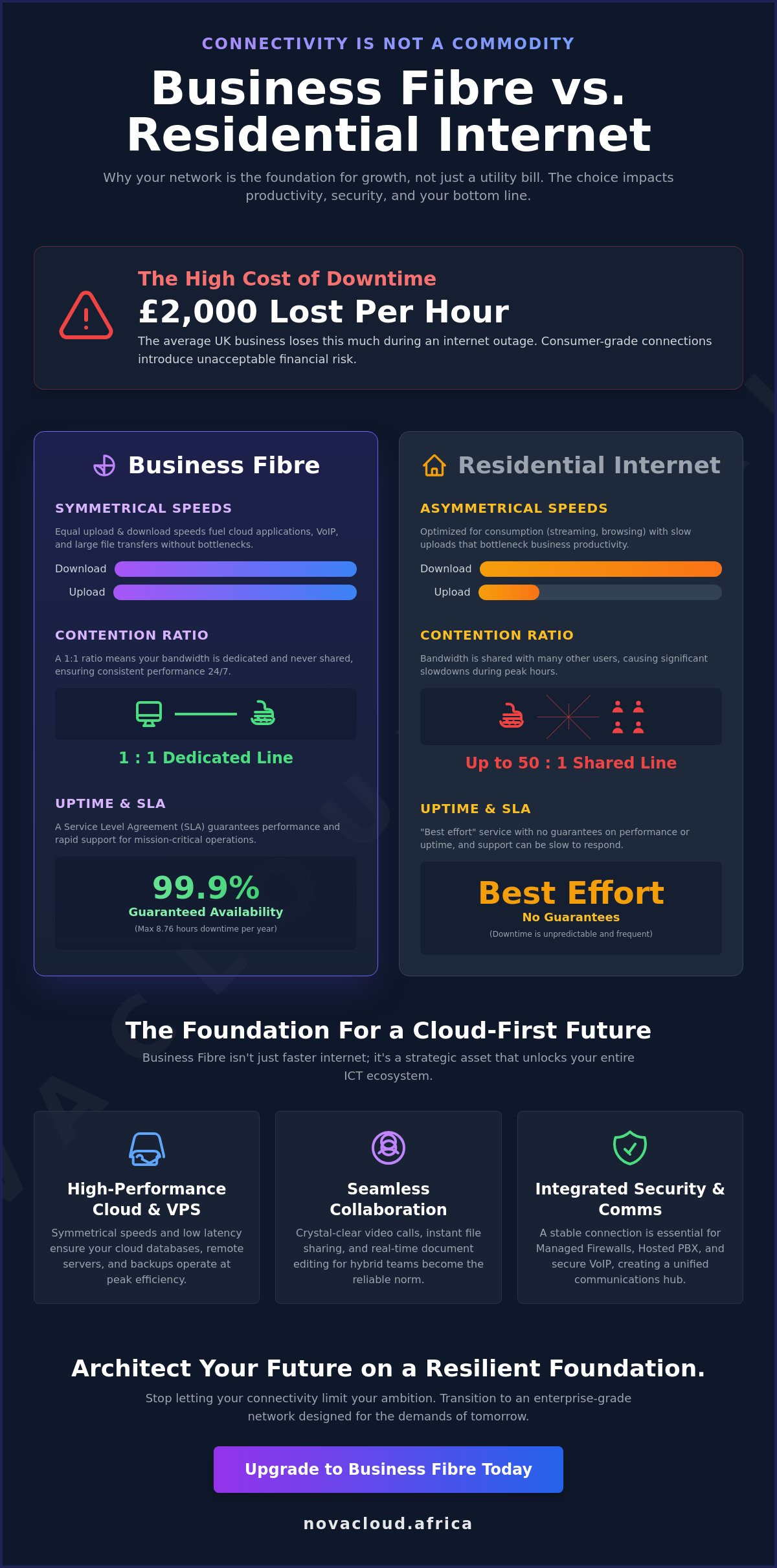
With the average UK business losing £2,000 every single hour during an internet outage, the choice between consumer-grade connectivity and dedicated Business Fibre isn't just about speed; it's a matter of operational survival. You've likely felt the frustration of a frozen video call during peak hours or waited for a vague SLA response while your team's productivity stalled. It's impossible to build a visionary cloud-first strategy on a network that wasn't designed for the rigorous demands of 2026. We believe your infrastructure should be the silent architect of your success, not a bottleneck that limits your ambition.
Discover how enterprise-grade Business Fibre serves as the resilient foundation for your digital transformation and cloud-first growth. This guide explores the impact of Ofcom's April 1, 2026, regulatory framework and the transition from retiring copper networks to a scalable architecture that guarantees uptime for your mission-critical applications.
Key Takeaways
- Recognize the fundamental shift from basic connectivity to a dedicated, high-capacity infrastructure designed specifically for commercial resilience and throughput.
- Master the symmetrical advantage to ensure your upload speeds match your download capabilities, fueling high-performance VPS solutions and real-time cloud collaboration.
- Evaluate how Business Fibre removes operational friction by utilizing 1:1 contention ratios and robust Service Level Agreements to guarantee mission-critical uptime.
- Integrate your network with Hosted PBX and managed firewalls to transform your connection into a secure, all-encompassing communication hub.
- Leverage an innovative architectural approach that aligns global technological standards with local expertise to scale your enterprise across the continent.
Defining Business Fibre: More Than Just a High-Speed Connection
Business Fibre represents the nervous system of a modern enterprise. It's a dedicated, high-capacity internet connection engineered specifically for the uncompromising demands of commercial reliability. Unlike shared consumer services, this infrastructure provides a direct, uncontended link to the digital world. It serves as the "Nova", the bright beginning where your company's digital infrastructure illuminates new possibilities for growth and efficiency. By adopting a national approach to connectivity, businesses ensure that their operations maintain consistent performance across every South African branch, from Cape Town to Johannesburg.
At its technical core, Fiber-optic communication uses light pulses to transmit data at near-instantaneous speeds. For an enterprise, this means more than just fast downloads. It means having the throughput necessary to handle hundreds of concurrent processes without the latency spikes that cripple productivity. This technology is the catalyst for transformative growth, allowing teams to collaborate across continents as if they were in the same room. It's the difference between merely being online and having a network that powers your entire strategic vision.
The Core Differences: Business vs. Residential Fibre
The primary distinction lies in the shift from "best-effort" services to guaranteed performance. Residential connections are often shared among dozens of households, leading to significant slowdowns during peak evening hours. In contrast, enterprise-grade setups utilize a 1:1 contention ratio. This ensures that the bandwidth you pay for is yours alone, 100% of the time. Residential fibre often fails under the weight of corporate cloud demands because it lacks the specialized support protocols and enterprise-grade routers required to manage complex traffic.
- Guaranteed Uptime: Business packages typically include Service Level Agreements (SLAs) targeting 99.9% availability, which limits potential downtime to just 8.76 hours per year.
- Dedicated Hardware: Enterprise routers handle thousands of simultaneous sessions, whereas consumer gear often overheats or drops packets under heavy corporate load.
- Priority Routing: Your data takes the most direct path through the network, minimizing the latency that causes lag in mission-critical applications.
The Evolution of Connectivity in the South African Market
The shift toward remote and hybrid work models has completely redefined bandwidth requirements for local firms. We've moved beyond simple web browsing into an era of data-intensive real-time synchronization. Modern South African operations now rely on constant streams of high-definition video, massive cloud backups, and instant database queries. Business fibre is the resilient foundation of a modern ICT architecture. This evolution ensures that your network isn't just a utility, but a strategic asset that scales alongside your vision for the future.
The Symmetrical Advantage: Fueling Cloud Infrastructure and Collaboration
Most traditional internet connections are built for consumption, not production. They offer vast download pipes but narrow upload channels, a design choice that works for browsing the web but fails the modern enterprise. In 2026, as 78% of premises have transitioned to full-fibre infrastructure, the expectation for performance has shifted. Symmetrical connectivity provides equal speeds for both downloading and uploading data, ensuring your network never becomes a one-way street. This balance is the architectural cornerstone of a truly responsive digital environment.
For businesses running high-performance VPS solutions, upload speed is the lifeblood of the operation. Every interaction with a cloud-based database or remote server depends on your ability to push data out as quickly as you receive it. Data from the FCC's Measuring Fixed Broadband report highlights that fibre optic services consistently meet or exceed advertised speeds, providing the reliable throughput required for these heavy cloud workloads. When your upload and download speeds match, you eliminate the invisible bottlenecks that often throttle transformative growth.
Why Upload Speeds Matter for Modern Cloud Operations
Upload bandwidth is no longer a secondary concern. It's the primary driver for seamless data redundancy and disaster recovery protocols. If your enterprise relies on real-time offsite backups, a narrow upload pipe will force a choice between data security and daily office performance. Symmetrical Business Fibre allows you to execute massive data transfers in the background without causing lag for your on-site team. It ensures that your recovery point objectives are met every single hour, keeping your mission-critical apps resilient and ready. You can explore our cloud-ready architecture to see how symmetry empowers these processes.
Enhancing Real-Time Communication and VoIP
The quality of your collaboration tools depends entirely on the stability of your upload stream. Symmetrical fibre eliminates the jitter and latency that turn professional video conferences into frustrating, disjointed experiences. By providing ample headroom for high-density voice traffic, it supports the growing needs of South African enterprises that utilize unified communications. This synergy between stable connectivity and crystal-clear VoIP ensures that every conversation feels human-centric and immediate, regardless of the physical distance between participants. It's about creating a workplace where technology fades into the background, leaving only the clarity of your team's collective vision.
Reliability and Performance: Understanding Contention Ratios and SLAs
Reliability isn't a vague promise; it's a measurable architectural standard. While symmetrical speeds provide the engine for your digital journey, the underlying reliability of your Business Fibre determines whether you reach your destination without interruption. For the modern enterprise, "best effort" connectivity is a liability that carries a heavy price tag. Considering that the average UK and Irish business loses £2,000 per hour during an internet outage, the cost of downtime is far too high to ignore. We believe in building networks that don't just work, but empower your team to excel without the fear of disconnection.
True enterprise performance relies on low-latency paths. Latency, the time it takes for data to travel from your office to the server and back, is non-negotiable for real-time applications. High latency turns sharp video calls into pixelated delays and causes cloud databases to lag. As discussed in The Future Of Fiber, the strategic advantage of this technology lies in its ability to offer superior security and scalability that traditional copper simply can't match. To safeguard these advantages, firms must implement strategic internet redundancy through resilient cloud architectures to ensure 24/7 operational continuity, even during unforeseen infrastructure damage.
Contention Ratios: Why Your Neighbours Shouldn't Slow You Down
Most residential connections operate on a 1:10 or even 1:50 contention ratio, meaning you share your bandwidth with dozens of other users. During peak business hours, this "digital traffic jam" throttles your speeds exactly when you need them most. The financial cost of these delays manifests in lost productivity and missed opportunities. A 1:1 contention ratio ensures your bandwidth is yours alone. This dedicated pool of resources means your performance remains consistent whether it's 9:00 AM on a Monday or midnight on a Sunday, allowing your team to maintain momentum without technical interference.
Deciphering the SLA: What Your Business is Actually Paying For
Service Level Agreements (SLAs) are the contractual backbone of business-grade internet. They move the conversation from "we'll try to fix it" to "we guarantee it". The most critical metric is the Mean Time to Repair (MTTR). While consumer support might leave you waiting for days, a business-priority channel often includes a four-hour fix time as standard. These agreements also specify uptime guarantees, usually targeting 99.9% availability. If these standards aren't met, financial penalties and service credits hold the provider accountable. This level of clarity is the Nova, the bright beginning of a network that never sleeps and always delivers on its promise of stability.
The ICT Ecosystem: Integrating Fibre with Security and Communications
Connectivity is never an isolated utility. It is the vital enabler that transforms a collection of hardware and software into a unified, resilient architecture. When you invest in Business Fibre, you aren't just buying speed; you're securing the foundation for your entire ICT ecosystem. This high-capacity pipeline allows for the seamless integration of sophisticated tools that drive modern growth. From crystal-clear voice traffic to ironclad perimeter security, your fibre line is the catalyst that makes these advanced services possible.
High-speed connectivity simplifies the management of Microsoft 365 Business Licensing and ecosystem collaboration. In an era where 87% of UK premises have access to gigabit-capable broadband, your team expects cloud applications to respond with local-drive speed. This level of performance is only achievable when your internal network is optimized to handle the throughput. By utilizing Ubiquiti network deployments, you ensure that every megabit of your external connection reaches the devices that need it most, eliminating internal bottlenecks before they start.
Unified Communications: Fibre as the Voice of Your Business
Legacy copper lines are rapidly becoming relics of the past. As Openreach targets a full copper switch-off by 2030, the transition to high-fidelity, fibre-based VoIP is a strategic necessity. When you deploy Hosted PBX systems, your voice traffic shares the same line as your data. This requires a network with deep Quality of Service (QoS) capabilities. Business-grade lines prioritize voice packets, ensuring that even during massive data transfers, your client calls remain crisp and uninterrupted. It's about maintaining a professional presence through high-volume traffic without compromising on throughput.
Security at the Edge: Managed Firewalls and Fibre
Securing the entry point of your network is paramount. Fast fibre requires a robust managed firewall to inspect traffic at wire speed. Real-time threat detection relies on consistent network performance to analyze incoming data without creating lag. By integrating FortiNet solutions at the edge, you protect your hybrid office with resilient, high-speed encrypted tunnels. These tunnels allow remote staff to access sensitive company resources as if they were sitting in the headquarters. This architectural synergy ensures that your growth is both rapid and secure.
Your digital transformation deserves a network that can keep pace with your vision. Consult with our expert architects to design a bespoke connectivity solution that empowers your enterprise to lead the African market.
Architecting Your Future: Why NovaCloud is the Strategic Choice for Fibre
NovaCloud Africa presents a sophisticated blend of technological authority and visionary optimism. We don't view your digital transformation as a mere transaction. Instead, it's a mission to empower your business with a resilient architecture that supports transformative growth. While 78% of premises reached full-fibre availability by July 2025, the real challenge in 2026 isn't just getting connected; it's ensuring that your connection serves as a catalyst for regional empowerment. We take pride in our role as enablers of the continent's digital future, providing a purposeful and dignified character to every project we undertake.
Choosing the right Business Fibre partner means looking beyond the monthly bill to the long-term strategic value of your network. We combine global standards with deep local expertise, ensuring your infrastructure is ready for the 90% full-fibre coverage projected by the end of 2027. This purposeful approach differentiates us from global, faceless competitors who often lack a commitment to the specific nuances of the African market. We act as your strategic ally, ensuring that even complex cloud architectures are presented in a digestible, logical manner that aligns with your business outcomes.
Beyond Connectivity: A Holistic ICT Partnership
We integrate your connectivity into a broader growth-oriented roadmap. This provides a single point of accountability for your entire digital stack, from high-performance VPS solutions to secure network perimeters. As your enterprise evolves into new markets, your connectivity must scale effortlessly to maintain momentum. We handle the transitions between high-level strategic concepts and granular technical details with a smoothness that reflects our internal expertise. By consolidating your services, you eliminate the friction of managing multiple vendors and gain a partner invested in your total success.
Taking the Next Step Toward Digital Resilience
Our consultative approach begins with designing a network that fits your specific operational goals. We don't believe in one-size-fits-all solutions. Instead, we architect a resilient foundation that anticipates future demands, such as the full copper network retirement targeted for 2030. The "Nova" promise represents a bright beginning, bringing illumination and clarity to your technical infrastructure. We move you from a state of uncertainty to one of readiness, ensuring your business is prepared for the next chapter of efficiency. Start your new chapter in business efficiency and illuminate your path to growth with NovaCloud's visionary connectivity solutions.
Illuminating Your Path to Digital Resilience
The move toward a full-fibre landscape isn't just a future projection; it's a current business necessity. You've explored how symmetrical throughput and 1:1 contention ratios eliminate the bottlenecks that stall modern collaboration. By integrating high-performance connectivity with Hosted PBX and secure cloud environments, you build a network that is both resilient and ready for the 2030 copper switch-off. These architectural choices protect your operations from the £2,000 hourly losses often associated with network downtime.
As your visionary ICT Architect, NovaCloud provides more than a simple connection. We offer a national South African support network designed to ensure your technology remains a silent partner in your success. Our approach ensures seamless integration with Hosted PBX and Cloud VPS, creating a unified ecosystem that scales alongside your ambition. It's time to move beyond the limitations of legacy systems and embrace a new chapter of clarity and efficiency.
Architect your enterprise's digital future with NovaCloud Business Fibre
Your growth is the heartbeat of the continent. We're here to ensure your network has the strength to sustain it.
Frequently Asked Questions
What is the main difference between business fibre and home fibre?
The primary distinction lies in the contention ratio and service level guarantees. While home connections share bandwidth with up to 50 other users, Business Fibre provides a dedicated link with a 1:1 ratio. This ensures your speeds remain consistent throughout the day, backed by a contractual commitment to uptime and priority repair times that residential plans don't offer.
What does 'symmetrical' speed mean for my business?
Symmetrical speed means your upload and download rates are identical. This is vital for modern enterprises that push large volumes of data to the cloud or host real-time video conferences. It prevents the common bottleneck where a slow upload channel throttles your cloud backups or causes jitter during high-stakes client presentations on VoIP platforms.
How does a contention ratio affect my daily internet speed?
Your contention ratio dictates how many other businesses share your local bandwidth pool. A high ratio, common in consumer-grade lines, results in significant slowdowns during peak office hours as everyone competes for the same resources. Choosing a dedicated 1:1 ratio ensures your performance stays at 100% capacity regardless of the activity in surrounding offices.
What is a Service Level Agreement (SLA) in the context of fibre?
An SLA is a binding contract that defines the performance standards your provider must meet. It typically guarantees 99.9% uptime and specifies a Mean Time to Repair (MTTR), often as short as four to six hours. These agreements provide financial recourse if standards aren't met, ensuring your connectivity remains a reliable foundation for your mission-critical applications.
Do I need a special router for business fibre?
Yes, enterprise-grade routers are necessary to manage the high-density traffic and security requirements of a corporate environment. Standard consumer hardware lacks the processing power to handle the simultaneous sessions required for Hosted PBX and managed firewalls. Specialized equipment ensures your internal network can distribute the full throughput of your fibre line without overheating or dropping packets.
Can business fibre improve my company's cloud backup performance?
Business Fibre dramatically improves cloud backup performance by providing the high upload speeds required for massive data transfers. Instead of backups taking days and slowing down your office, symmetrical lines allow services like Acronis Cloud to sync in the background. This ensures your data redundancy protocols are completed every hour without affecting your team's real-time productivity.
How long does the installation of business fibre typically take in South Africa?
Installation timelines in South Africa generally range from 15 to 45 business days depending on whether the building is already lit with fibre. If civil works or trenching are required to reach your premises, the process can take longer. We manage this transition as a strategic partner, ensuring your current connectivity stays active until the new resilient architecture is fully tested and ready.
Is business fibre more secure than residential fibre?
While the physical transmission is similar, business-grade connections are designed to integrate with managed firewalls and encrypted tunnels for superior security. These lines support the deployment of FortiNet perimeters and real-time threat detection that consumer packages ignore. This architectural approach protects your hybrid workforce by securing the entry point of your network against sophisticated cyber threats.
