


Symmetrical Fibre Benefits: Architecting Enterprise Resilience in 2026

In 2026, a lopsided internet connection is the single greatest threat to your enterprise resilience. While 49 percent of locations now have access to fiber according to FCC data, many organizations still struggle with legacy asymmetrical speeds that prioritize downloads over the critical data you send to the cloud. Understanding symmetrical fibre benefits is no longer optional for the modern architect; it's the mandatory foundation for any business operating in a real-time ecosystem. You've likely felt the frustration of a choppy video call during peak hours or watched a slow backup window disrupt your morning operations. These delays represent more than lost time. With downtime costing businesses between $137 and $427 per minute, your connectivity must be as ambitious as your vision for continental reach.
We agree that your digital transformation belongs in safe, expert hands that value local expertise and global standards. This article promises to show you how symmetrical connectivity eliminates cloud bottlenecks and provides the high-performance foundation your business requires for the digital era. We will preview how transitioning to 1 to 5 millisecond latency and dedicated bandwidth will future-proof your operations against the technology standards of 2026 and beyond.
Key Takeaways
- Understand why the 1:1 ratio between upload and download speeds has evolved from a premium feature into the mandatory architecture for 2026 enterprise resilience.
- Discover how to optimize your cloud workflows and virtual private servers by eliminating the data upload bottlenecks that traditionally stall real-time backups.
- Uncover the hidden symmetrical fibre benefits that prevent "bufferbloat" and ensure your download speeds aren't throttled by congested legacy upload channels.
- Identify the specific network audits and hardware upgrades required to integrate high-performance symmetrical connectivity into your existing infrastructure seamlessly.
- Explore how a strategic partnership with NovaCloud combines global connectivity standards with local African expertise to scale your digital future with confidence.
Redefining Connectivity: Why Symmetrical Fibre is the 2026 Business Standard
In 2026, the architecture of your business connectivity is no longer a backend detail; it's a strategic pillar of enterprise resilience. Symmetrical fibre provides a perfect 1:1 ratio between upload and download capacities. This means if your line is rated for 500 Mbps, you have 500 Mbps available to pull data from the web and 500 Mbps to push data back out. It's a significant departure from legacy asymmetrical lines like ADSL or traditional cable, where upload speeds are often restricted to a small fraction of the download speed. As of May 2026, this balance has shifted from a luxury to a mandatory requirement for any organization serious about digital transformation.
The 2026 business environment operates on the principle of synchronous productivity. Your team shouldn't have to wait for the network to catch up with their workflow. When your connectivity provides equal power in both directions, the artificial distinction between local and cloud based work disappears. To understand the physics behind this, one must look at the foundations of fiber-optic communication, which uses light pulses to transmit data with minimal degradation over long distances. Realizing the full symmetrical fibre benefits means your enterprise can finally move at the speed of thought, ensuring that your infrastructure never dictates the pace of your innovation.
The Evolution from Consumption to Contribution
The early internet was built for consumption. Users primarily downloaded static web pages, images, and videos. Today, the script has flipped. Modern businesses are contributors. You're pushing high-definition video streams, massive architectural renders, and continuous telemetry data to the cloud. In South Africa, the expanding digital economy has seen a surge in data creation that demands robust outbound bandwidth. We've moved past the era of just "browsing" the web. We're now building within it, and that requires a connection that supports heavy lifting in both directions.
Symmetrical vs. Asymmetrical: A High-Level Comparison
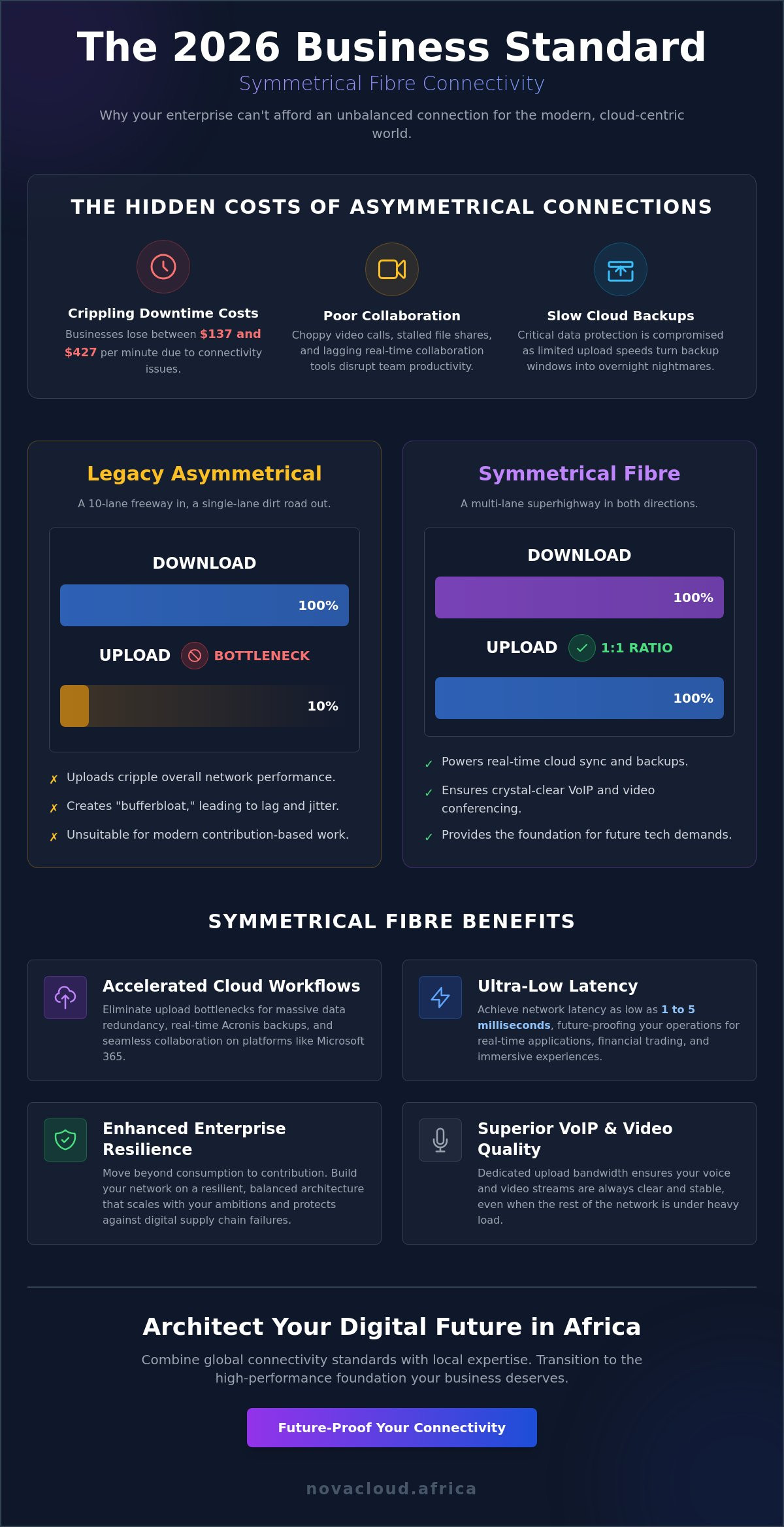
Think of your internet connection as a highway. An asymmetrical line is like a ten-lane freeway coming into the city but only a single-lane dirt track heading out. During peak business hours, this creates a digital traffic jam. Even if you have plenty of room to download files, your entire system slows down because the "request" packets and data uploads are stuck in a bottleneck. This is where asymmetrical lines fail the modern enterprise. They create a hidden ceiling on performance that results in choppy VoIP calls and stalled cloud workflows. Symmetrical fibre removes this ceiling by providing a wide, multi-lane highway in both directions, ensuring your data flows freely regardless of the volume or time of day.
By architecting your network around these symmetrical standards, you eliminate the most common point of failure in the digital supply chain. It's about more than just speed; it's about the quiet confidence that comes from a resilient, balanced architecture that scales with your ambitions.
The Mechanics of Momentum: How Symmetrical Speeds Power Cloud Workflows
Momentum in business isn't just about how fast you can receive information; it's about how quickly you can act on it. While older technologies prioritize the "pull" of data, symmetrical fibre benefits center on the "push." In a 2026 enterprise, this push powers everything from real-time Acronis Cloud backups to massive data redundancy protocols. When your upload speed matches your download, backup windows that used to disrupt overnight operations shrink to minutes. You're no longer hoping your data is safe; you're ensuring it is through constant, high-speed synchronization that keeps your most critical assets secure and available.
This balance is particularly vital for collaborative environments like Microsoft 365. When a team member uploads a 2GB presentation or a large CAD file, a symmetrical connection ensures they don't throttle the rest of the office's ability to work. It creates a seamless environment where collaboration happens in real time, rather than in "queue" time. By architecting your network with this level of balance, you empower your team to contribute without hesitation, turning your connectivity into a catalyst for growth rather than a bottleneck.
VPS and Remote Infrastructure Management
Managing a Virtual Private Server (VPS) requires a connection that feels local, even if the hardware is thousands of kilometers away. Symmetrical fibre provides the low-latency upload speeds necessary to make remote infrastructure management truly responsive. It effectively eliminates the command-to-execution lag that often plagues systems administrators working on asymmetrical lines. For South African businesses, utilizing local cloud infrastructure combined with symmetrical speeds ensures that your digital architecture remains resilient, responsive, and highly available.
Seamless Unified Communications
High-definition video conferencing has become the boardroom of 2026. Supporting 20 or more participants in a single HD call requires significant outbound bandwidth that asymmetrical lines simply can't provide. One of the core symmetrical fibre benefits is the prevention of jitter and dropped packets, which are the primary culprits behind "frozen" faces and robotic audio. This stability is why symmetrical lines are the non-negotiable foundation for crystal-clear Hosted PBX systems. Because fiber optics offer distinct advantages over copper wire, including immunity to electromagnetic interference and significantly higher bandwidth ceilings, your voice and video traffic remain pristine even during peak usage.
By removing the friction from your communication tools, you foster a culture of clarity and decisive action. If you're ready to modernize your infrastructure, you can explore our connectivity solutions to see how we bridge the gap between global standards and local needs.
Eliminating the Hidden Bottlenecks: Symmetrical Fibre vs. Legacy Connectivity
Speed is often sold as a single number, but for the modern enterprise, that number is only half the story. The true potential of your digital infrastructure lies in the balance between what you receive and what you send. Many organizations discover too late that their high-speed download plans are tethered to a restrictive upload channel, creating a "hidden bottleneck" that throttles performance during critical business hours. Realizing the full symmetrical fibre benefits means removing this artificial ceiling. In an era where AI processing and real-time data exchange are standard, your workflows depend on upload speed to maintain the fluid momentum your brand requires.
Investing in balanced architecture provides a clear return on investment. When you reduce time-waste by even 10 percent across a workforce of 50 people, the impact on output is transformative. It's about architecting a space where technology works at the pace of your vision, not the other way around. By choosing a connection that treats every byte with equal priority, you're not just buying bandwidth; you're securing the quiet confidence that comes from a resilient, high-performance foundation.
TCP Acknowledgements and the Upload Trap
There's a technical trap inherent in asymmetrical lines that often goes unnoticed until it's too late. For every packet of data you download, your system must send back a tiny "receipt" called a TCP Acknowledgement to confirm successful delivery. If your upload lane is congested by a background cloud backup or a high-resolution video stream, these receipts can't get out. This forces the sender to pause and wait, effectively stalling your download progress regardless of your advertised speed. In 2026, this trap is more common than ever as businesses handle increasingly dense media files. Symmetrical fibre solves this by providing equal breathing room for both data and its confirmation, ensuring your download lane stays clear and fast.
Latency, Jitter, and Business Continuity
Beyond raw throughput, the "ping" or latency of your connection determines how responsive your cloud tools feel. Symmetrical fibre offers a distinct advantage here, typically maintaining a low 1 to 5 millisecond latency that consumer-grade fibre simply can't match. Asymmetrical lines often suffer from "bufferbloat," where high traffic causes erratic performance and jitter, leading to dropped VoIP calls and lagging virtual environments. For an enterprise, this inconsistency is a risk factor. Maintaining business continuity requires more than just a fast primary line; it demands a strategy for internet redundancy to ensure 24/7 operations. When you pair consistent symmetrical speeds with a Managed Firewall, you ensure that your traffic remains both fluid and secure, illuminating a clear path for your digital future.
Strategic Implementation: Preparing Your Network for Symmetrical Integration
Deploying a high-speed line is only the first step in architecting a resilient digital environment. To truly unlock symmetrical fibre benefits, your internal hardware must be capable of processing traffic at the same speed the fibre delivers it. Many organizations find that 70 percent of their connectivity issues actually originate within their own local area network (LAN) due to outdated switches or underpowered routers. A comprehensive network audit is the starting point for any successful integration. This process identifies hardware limitations that could throttle your new connection, ensuring your high-performance routing and switching infrastructure acts as a catalyst rather than a bottleneck.
Implementing Quality of Service (QoS) rules is another critical layer of this strategy. By prioritizing mission-critical data streams, such as real-time voice traffic or cloud-based database synchronization, you ensure that high-bandwidth activities like large file transfers don't degrade essential services. This level of control transforms a simple internet connection into a sophisticated business tool that adapts to your operational priorities in real time.
Hardware Considerations for 2026
Most "off-the-shelf" routers are designed for residential consumption and buckle under the pressure of full symmetrical gigabit speeds. In 2026, corporate HQ deployments require more robust solutions that can handle thousands of simultaneous connections without overheating or dropping packets. This is why we recommend Ubiquiti networks as a scalable foundation for managing high-speed corporate traffic. Transitioning to Wi-Fi 6E or Wi-Fi 7 standards within the South African office is also vital. These standards provide the wireless overhead necessary to ensure that your mobile devices can actually utilize the symmetrical capacity provided by your fibre provider.
Security and the Managed Firewall
Opening up high-speed upload channels increases your data mobility, but it also requires a more vigilant security perimeter. A Managed Firewall is essential for inspecting high-speed symmetrical traffic without introducing significant lag. Using FortiNet infrastructure allows your business to perform deep packet inspection at line speed, ensuring that your symmetrical fibre benefits aren't compromised by security-related latency. Proactive threat hunting becomes a necessity in these high-bandwidth environments, where malicious data can move just as quickly as your legitimate business traffic. When your security architecture is as fast as your connectivity, you create a truly resilient foundation for growth.
If you're ready to modernize your office environment, you can request a comprehensive network audit from our expert technical team to identify and resolve your existing bottlenecks.
Architecting Your Digital Future with NovaCloud’s Business Fibre
Building a resilient digital future requires more than just a fast connection; it demands a strategic alliance with an Innovative Architect who understands the unique pulse of the African market. As we have explored, the transition to 2026 technology standards necessitates a departure from legacy thinking. By embracing the full spectrum of symmetrical fibre benefits, your enterprise moves from a state of connectivity uncertainty to a position of operational clarity. NovaCloud Africa stands at the intersection of global infrastructure standards and local technical expertise, ensuring your digital transformation is handled with precision and visionary optimism.
Our "Nova" concept represents a bright beginning for your business efficiency. It is about illuminating the path forward, removing the shadows cast by "bufferbloat" and lopsided bandwidth, and starting a new chapter where your infrastructure empowers rather than restricts. When you choose to partner with us, you aren't just selecting a vendor; you're choosing a team dedicated to regional empowerment and the transformative growth of your organization.
The NovaCloud Advantage: Beyond the Line
Modern enterprises shouldn't have to manage a fragmented web of service providers. We provide a sophisticated, multi-layered solution that integrates high-speed connectivity, robust cloud infrastructure, and advanced security perimeters. This unified approach ensures that your network remains a cohesive, resilient architecture. We pride ourselves on a human-centric philosophy that prioritizes local IT assistance and high-touch support over the cold, sterile experience of global, faceless competitors. Whether it is the rapid deployment of hardware or the fine-tuning of a Hosted PBX system, our technical executors are on the ground to ensure your momentum never falters.
Next Steps: Scaling with Confidence
The journey toward a future-proofed enterprise begins with a clear understanding of your current landscape. We invite you to request a custom connectivity audit to identify how symmetrical fibre benefits can specifically resolve your existing cloud bottlenecks. This audit evaluates your hardware readiness and explores how modern tools, such as Yealink IP technology, can complement your new high-speed lines to create a seamless communication environment. Our team is ready to guide you through every technical detail, from the initial network audit to the final integration of scalable cloud solutions. Don't let legacy connectivity dictate the limits of your growth. Consult with an Innovative Architect at NovaCloud Africa today and take the first step toward a more resilient, symmetrical future.
Illuminating Your Path to Synchronous Productivity
The shift toward 2026 connectivity standards isn't just about raw speed; it's about achieving a perfect balance. You've discovered how a 1:1 upload ratio eliminates the hidden bottlenecks that stall downloads and disrupt real-time collaboration. By architecting your network with 1 to 5 millisecond latency infrastructure, you ensure your team operates at the speed of thought. Realizing the full symmetrical fibre benefits means your organization is no longer just a consumer of digital services but a dominant contributor to the global cloud ecosystem.
It's time to move beyond legacy limitations and embrace a resilient, high-performance architecture. With our deep South African market expertise and an integrated cloud and security ecosystem, we provide the enterprise-grade resilience your brand deserves to scale with confidence. You don't have to navigate this digital transformation alone. Architect your business-grade connectivity with NovaCloud Africa and secure your place in the continent's bright digital future. Your new chapter of efficiency and clarity is ready to begin.
Frequently Asked Questions
What is the difference between symmetrical and asymmetrical fibre?
Symmetrical fibre offers identical speeds for both uploading and downloading data. In contrast, asymmetrical lines, which are common in residential setups, prioritize download speeds while restricting uploads to a small fraction of the total bandwidth. For a 2026 enterprise, this 1:1 ratio is essential because modern workflows involve sending as much data to the cloud as you receive from it.
Is symmetrical fibre better for remote work and video calls?
Yes, it is significantly better because high-definition video conferencing relies heavily on your outgoing data stream. While you download the video of others, you must simultaneously upload your own feed in real time. Symmetrical connectivity prevents the choppy audio and frozen screens that occur when an asymmetrical upload channel becomes congested during peak business hours.
Why do I need high upload speeds for my business cloud backups?
High upload speeds are critical because cloud backups are entirely outbound data transfers. Slow upload channels force backup windows to extend into the next business day, which can throttle your entire network's performance. One of the primary symmetrical fibre benefits is the ability to complete massive data redundancy tasks rapidly, ensuring your recovery points are always current without interrupting daily operations.
Does symmetrical fibre reduce latency for Virtual Private Servers (VPS)?
It reduces latency by providing a high-bandwidth, low-friction path for data packets. Fibre optics typically offer a latency advantage of 1 to 5 milliseconds, compared to the 10 to 25 milliseconds seen on older cable technologies. This responsiveness is vital for systems administrators who need real-time feedback when managing remote infrastructure or executing complex commands on a virtual server.
Can my existing router handle a symmetrical gigabit fibre connection?
Most consumer-grade routers lack the processing power to handle full symmetrical gigabit traffic. These devices often become a bottleneck because their internal CPUs cannot manage high-speed packet inspection at line rate. To fully utilize your connection, you should transition to enterprise-grade hardware, such as Ubiquiti or FortiNet, which is designed to handle thousands of simultaneous sessions without performance degradation.
Is symmetrical fibre available for businesses across South Africa?
Business-grade symmetrical fibre is now widely available across South Africa’s major metropolitan hubs and secondary industrial zones. While consumer fiber reaches approximately 49 percent of locations in some regions, enterprise lines often utilize dedicated infrastructure to guarantee higher uptime. You should conduct a site-specific audit to confirm the exact fibre providers and speeds available at your specific office coordinates.
How does symmetrical fibre impact the quality of Hosted PBX systems?
Symmetrical fibre provides the stable, balanced foundation required for crystal-clear VoIP communication. Since voice calls are two-way real-time interactions, your upload speed is just as important as your download speed for maintaining audio clarity. This connectivity ensures that your Hosted PBX system can support 20 or more concurrent high-definition calls without the jitter or packet loss that plagues lopsided connections.
Is symmetrical fibre worth the investment for a small business in 2026?
It is a mandatory investment because the cost of internet downtime for small businesses is now estimated between $137 and $427 per minute. Small teams that rely on cloud-based accounting, CRM, and collaboration tools can't afford the productivity losses caused by a lagging connection. Architecting your business with symmetrical speeds from the start ensures you can scale your digital operations without hitting an artificial performance ceiling.
