


Empowering the Human Firewall: Building a Data Security Culture in 2026

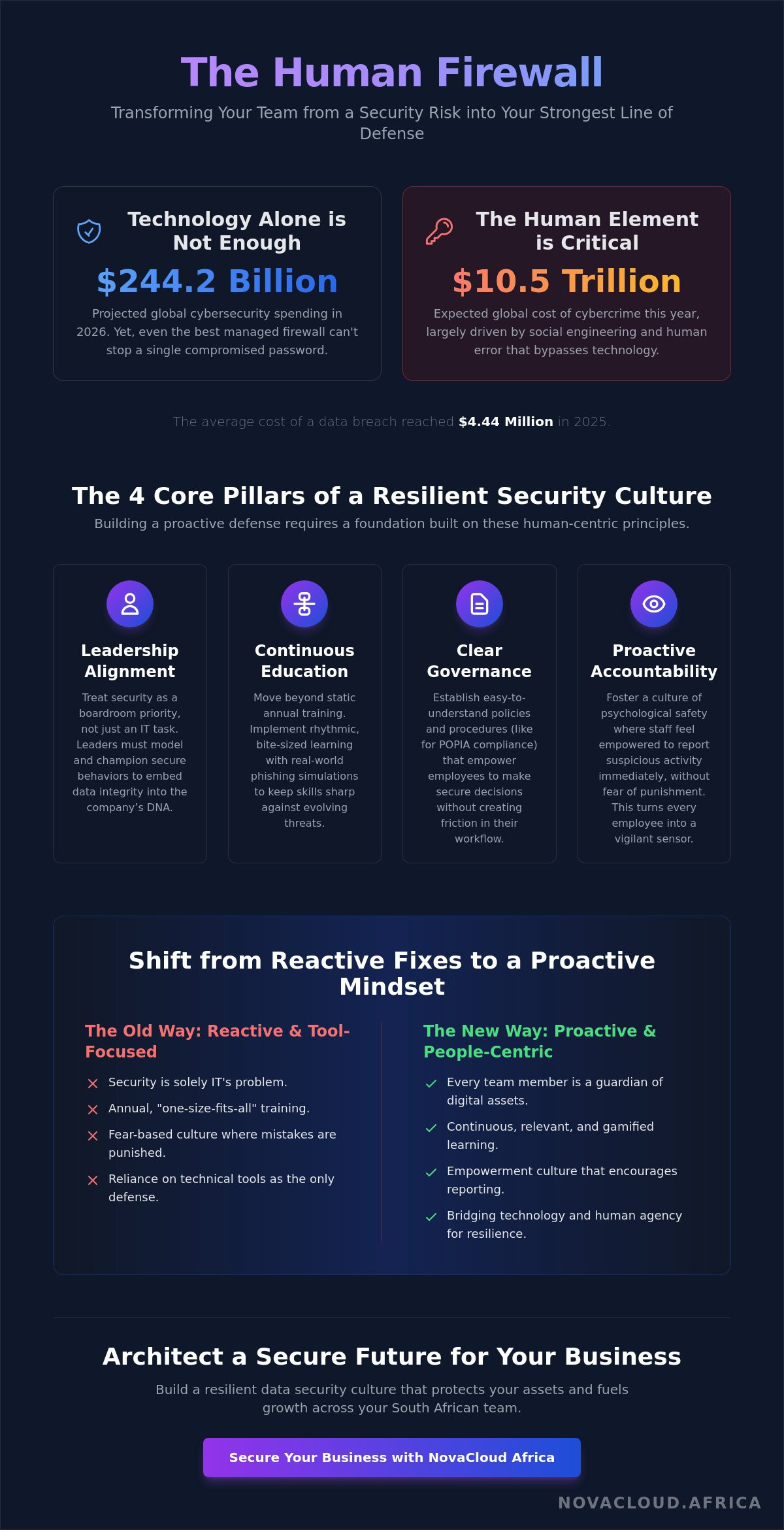
While global cybersecurity spending is projected to reach $244.2 billion in 2026, even the most sophisticated managed firewall cannot stop a single compromised password. With global cybercrime costs expected to hit $10.5 trillion this year, technology alone is no longer a silver bullet. You've likely felt the frustration of seeing high-end technical investments undermined by a simple human error or a deceptive phishing link. It's exhausting to balance complex POPIA compliance with the daily realities of a diverse workforce. We agree that your staff shouldn't be your greatest risk; they should be your strongest line of defense. By fostering a proactive data security culture, you can ensure that every team member acts as an empowered guardian of your digital estate.
This article reveals how to move beyond basic training to create a workforce that identifies threats before they escalate. You'll discover how to align tools like Acronis Cloud and Microsoft 365 with human behavior to slash the risk of a breach, which averaged $4.44 million per incident in 2025. We will explore practical steps to turn security from a technical hurdle into a shared mission that drives growth across your entire South African team.
Key Takeaways
- Shift from reactive IT fixes to a proactive organizational mindset where every team member serves as an empowered guardian of your digital estate.
- Identify the four core pillars of resilience, focusing on leadership alignment and continuous, rhythmic education over static annual training sessions.
- Understand why even the most advanced managed firewalls fail without addressing the social engineering tactics that target human psychology.
- Access South African-specific resources to simplify POPIA compliance through gamification and role-relevant training strategies for diverse teams.
- Discover how to bridge the gap between technical excellence and human agency to build a sustainable data security culture that fuels business growth.
What is Data Security Culture and Why is it the Ultimate Defense?
Data security culture represents the collective set of values, attitudes, and behaviors that determine how an organization protects its digital assets. It's not a static policy stored on a dusty server; it's the living, breathing operating system of your business. In 2026, as we integrate deeper into sophisticated cloud infrastructure, the boundary between technical tools and human action has effectively dissolved. This shift demands a move away from reactive IT department problems toward a model of proactive organizational responsibility that spans every department from finance to logistics.
True resilience begins with the "Human Firewall." This concept transforms every employee from a potential security vulnerability into a strategic asset. While global cybersecurity spending is set to hit $244.2 billion this year, technical tools alone cannot stop every threat. A robust Information security culture ensures that when a staff member identifies a suspicious AI-generated phishing attempt, their first instinct is to report it immediately. With global cybercrime costs projected to reach $10.5 trillion in 2026, having a workforce that acts as your first line of detection is the only way to maintain a competitive edge.
The Psychology of Security: Beyond Checkbox Compliance
Security protocols often fail because they conflict with human nature and the need for efficiency. Most employees don't bypass rules out of malice; they do it because they want to get their work done quickly. If a security measure adds friction to a task, people will naturally find a workaround. We must move from a culture of fear, where mistakes lead to punishment, to a culture of empowerment. When employees feel psychologically safe, they're far more likely to flag potential incidents before they escalate. This transparency is vital for stopping a breach before it spreads across your entire network architecture.
The Economic Impact of a Weak Security Culture
The financial consequences of a thin security culture go far beyond the initial ransom payment. Hidden costs include prolonged system downtime, permanent reputation damage, and the heavy weight of legal fees associated with compliance failures. Organizations with a strong data security culture significantly reduce their Mean Time to Detect (MTTD) a breach. Since the global average cost of a data breach reached $4.44 million in 2025, every hour saved in detection translates to significant capital protection. For South African SMEs, a resilient security culture provides a measurable ROI by significantly lowering the $4.44 million average breach cost through faster detection and reduced human error.
The 4 Core Pillars of a Resilient Security Culture
A resilient building requires a solid foundation; a data security culture is no different. With global cybersecurity spending projected to reach $244.2 billion in 2026, a 13.3% increase from the previous year, it's clear that organizations are investing heavily in protection. However, the most expensive tools remain ineffective if they aren't supported by human-centric pillars. We identify four essential areas that transform abstract security concepts into daily operational habits: leadership alignment, continuous education, clear governance, and proactive accountability.
Leadership alignment is the primary catalyst for change. When executives treat security as a boardroom priority rather than a checkbox for the IT department, the entire organization follows suit. This commitment involves Creating a Culture of Security where data integrity is woven into the company's DNA. Leaders must model the behaviors they expect to see, ensuring that security is discussed during strategic planning, not just after a breach occurs. This top-down approach signals that protecting information is a core value of the business.
Continuous education moves beyond the outdated "death by PowerPoint" model. In 2026, threats evolve too quickly for annual training sessions to be effective. Instead, teams need rhythmic, bite-sized learning opportunities that reflect the current threat landscape. This includes regular simulations and real-world examples that make the risks feel tangible. By providing consistent updates, you empower your staff to recognize sophisticated phishing attempts that bypass traditional filters. If you're looking to strengthen your team's technical foundation, our experts can provide tailored IT assistance to get you started.
Leadership as the Architect of Trust
Executive behavior serves as the ultimate signal for the importance of data integrity. When leaders integrate security KPIs into non-technical department goals, they demonstrate that everyone has a stake in the company's safety. This transparency is particularly vital for POPIA compliance. By openly discussing how data is handled and protected, leadership builds trust with both employees and clients, turning compliance from a legal burden into a competitive advantage in the African market.
Governance Frameworks for Modern Teams
Effective governance relies on "Living Documents" that employees actually use. These frameworks should simplify data classification, making it crystal clear what information is sensitive and who has permission to access it. Structured processes ensure that human agency is guided by clear boundaries, reducing the likelihood of accidental exposure. Integrating these governance standards with secure cloud backups ensures that even if a mistake happens, your business remains resilient and your data stays recoverable.
Finally, accountability must be balanced with recognition. While it's necessary to have clear consequences for negligence, it's equally important to reward positive security behaviors. Celebrating a team member who flags a suspicious link creates a positive feedback loop. This encourages others to remain vigilant, effectively turning your entire workforce into an active, engaged defense system.
Beyond the Managed Firewall: Why Tools Alone Fail
Technical solutions are essential, but they often create a dangerous "False Sense of Security." Organizations frequently assume that installing a Managed Firewall means the job is done. In reality, a firewall is only as effective as the users who operate behind it. While encryption protects data at rest, social engineering targets the individual's psychology to open the digital door from the inside. Research from the MIT Sloan School of Management suggests a Model of Organizational Cybersecurity Culture that emphasizes the interdependence of technical controls and human values. Without this alignment, even the most expensive security stack remains a hollow shell.
Phishing remains the primary driver of the most expensive breaches, which reached a record $10.22 million in the United States in 2025. These attacks don't break through code; they break through trust. A robust data security culture ensures that when an automated alert triggers, it isn't ignored by a fatigued employee. It creates a synergy where technical tools provide the data and humans provide the judgment. This collaboration is what allows a business to pivot from a state of constant vulnerability to one of resilient architecture. We believe that technology should empower people, not replace the need for their vigilance.
Managed Security as a Cultural Enabler
Technology shouldn't be a black box that operates in isolation. You can use technical reports from your security systems to educate your staff on real-world threats they actually faced that week. Seeing a report of 500 blocked intrusion attempts makes the threat feel immediate rather than theoretical. Automation also plays a key role by handling routine tasks, which significantly reduces the "security fatigue" that leads to human error. Our team provides the necessary IT assistance to help you translate these complex technical metrics into actionable insights for your non-technical departments.
Case Study: The Phishing Email that Bypassed the Perimeter
Imagine a scenario where a high-level executive receives an AI-generated voice note that sounds exactly like their CEO requesting an urgent fund transfer. No firewall can block a phone call or a convincing direct message on a personal device. This is where technology stops and culture starts. In a "no-blame" reporting environment, the executive feels empowered to verify the request through a secondary channel without fear of looking incompetent. When technical filters fail to catch a sophisticated 2026-era deepfake, a resilient data security culture acts as the final, unbreakable safety net that prevents a catastrophic financial loss.
Strategic Training Resources for South African Teams
Context is everything. While global security guides often focus on GDPR, South African businesses must navigate the unique complexities of the Protection of Personal Information Act (POPIA). Building a data security culture in this region requires more than generic advice; it demands a localized strategy that makes compliance feel relevant to the person on the ground. Whether your team is based in a central hub or working remotely via resilient cloud infrastructure, training must be rhythmic and role-specific to be effective.
One of the most efficient ways to deploy these resources is by leveraging your existing technology stack. For instance, Microsoft 365 Business Licensing provides built-in tools like Microsoft Purview and Defender, which offer automated training simulations. These tools allow you to run controlled phishing drills that build muscle memory without the risk. For those seeking external certification, programs like the Skillogic Cyber Security Course (priced at ZAR 11,890.01 in 2026) provide structured online learning that can be integrated into your broader development goals.
POPIA Compliance as a Cultural Foundation
Compliance shouldn't be a legal burden; it's a blueprint for trust. You can simplify the 8 conditions for lawful processing into a practical team checklist. This includes everything from purpose specification to security safeguards. Ensure your staff understands the role of the Information Officer, not as a "security cop," but as a strategic ally. When a sales consultant understands exactly how to handle a lead's phone number according to the openness principle, they're contributing to the organization's collective safety. This clarity reduces the anxiety often associated with regulatory jargon.
Building Your Internal Resource Toolkit
A sustainable data security culture thrives on consistency. We recommend implementing monthly security themes to keep the conversation fresh. A "Clean Desk Month" can encourage better physical and digital document management, while a "Password Health Week" can promote the use of multi-factor authentication. Use your internal newsletters to share "Security Wins" celebrating employees who caught suspicious emails or flagged unusual system behavior. Providing free templates for data handling or incident reporting empowers your team to act decisively when they spot a potential threat.
To ensure your infrastructure supports these human-centric efforts, explore our managed IT assistance for a seamless integration of policy and technology.
Architecting a Secure Future with NovaCloud Africa
Digital transformation is a human journey that requires a steady hand and a visionary architect. NovaCloud Africa bridges the gap between high-performance ICT and human agency. We understand that a resilient data security culture isn't built in a vacuum. It's the result of aligning sophisticated cloud infrastructure with your organization’s unique goals. By tethering global standards to our deep local expertise, we empower South African businesses to navigate a threat landscape where new regulations, such as the CIRCIA rule expected by May 2026, demand higher levels of transparency and reporting.
Our approach goes beyond simply deploying tools like FortiNet or Acronis Cloud. We serve as a strategic ally, helping you design a roadmap where technology and staff behavior move in perfect rhythm. This alignment ensures that your technical investments deliver a visible ROI. When your workforce is equipped with the right mindset and the right tools, the risk of a breach drops significantly. NovaCloud Africa takes pride in being an enabler of the continent’s digital future, providing the clarity you need to start a new chapter in business efficiency.
Unified Communications and Secure Culture
Modern work happens everywhere. Ensuring your remote teams remain secure on Hosted PBX systems is a critical component of a holistic security posture. Voice security and identity verification aren't just technical settings; they're cultural habits. NovaCloud Africa assists you in architecting communication flows that prioritize data integrity without sacrificing the seamless integration your teams expect. Whether it’s securing a VoIP call or managing a virtual private server, we ensure your connectivity remains a catalyst for growth rather than a point of vulnerability.
Your Partner in Digital Transformation
The "Nova" concept represents a bright beginning and total illumination. We believe in the power of clarity. Our partnership model moves away from the cold, sterile feel of traditional IT vendors. Instead, we offer a collaborative relationship built on trust and expert execution. A partnership with NovaCloud Africa means you aren't just buying a service; you're gaining a strategic ally dedicated to your long-term resilience. We provide the technical authority needed to protect your assets while maintaining a human-centric focus that excites your team about the possibilities of the cloud.
Your next step toward a resilient data security culture begins with a thorough assessment. It’s time to audit your current culture alongside your technical stack to identify hidden gaps. We invite you to contact us for a comprehensive security audit that will illuminate your path forward. Let’s build a future where your digital estate is protected by the most powerful defense available: an empowered, vigilant, and technologically enabled workforce.
Illuminate Your Path to Digital Resilience
Securing your business in 2026 requires a shift from viewing security as a technical burden to seeing it as a collective mission. With global cybercrime costs projected to reach $10.5 trillion this year, a robust data security culture transforms your workforce into a proactive defense layer. By aligning leadership vision with continuous education and clear governance, you build an architecture that's both resilient and growth-oriented. Technology provides the framework; your people provide the vigilance that makes your digital transformation truly secure.
You don't have to navigate this complex landscape alone. Our managed security experts provide the local South African support needed to ensure your infrastructure remains fully POPIA-compliant while driving transformative growth. We bridge the gap between high-level strategy and technical execution, giving you the clarity to focus on your core business objectives. It's time to move toward a future defined by confidence rather than uncertainty.
Architect your resilient future with NovaCloud Africa’s secure cloud solutions and turn your security posture into a strategic advantage today. Your journey toward a brighter, safer digital estate starts with a single, decisive step.
Frequently Asked Questions
What is the first step in building a data security culture?
Securing leadership alignment is the essential first step. When executives prioritize data integrity in the boardroom, it signals that protection is a core business value rather than just an IT task. This top-down commitment creates the psychological safety needed for employees to report threats without fear, establishing the foundation for a resilient data security culture across the entire organization.
How does POPIA affect our company’s security culture?
POPIA acts as a strategic blueprint for trust rather than a mere legal hurdle. It requires every team member to understand the eight conditions for lawful processing as part of their daily workflow. By integrating these regulatory standards into your culture, you move beyond basic compliance and demonstrate a commitment to protecting the privacy of your South African clients and partners.
Can small businesses afford to build a security culture?
Small businesses cannot afford to ignore it. Building a culture is primarily about shifting behaviors and habits, which costs significantly less than recovering from a breach. In 2025, organizations using AI and automation in their security paid 34% less per data breach than those without. Investing in a data security culture ensures your limited resources are protected by a vigilant, empowered workforce.
How often should we conduct security awareness training?
Training should be a rhythmic, continuous process rather than a static annual event. We recommend monthly themes or "Security Wins" to keep the conversation fresh and relevant. Threats evolve rapidly; global cybercrime costs are projected to reach $10.5 trillion in 2026. Regular, bite-sized updates ensure your team stays ahead of sophisticated AI-powered phishing attacks that bypass traditional filters.
What is the difference between security awareness and security culture?
Security awareness is about what your employees know, while security culture is about what they actually do. Awareness involves recognizing a phishing link; culture is the shared value system that ensures they report it immediately. Culture represents the living operating system of your business, where safe habits become the default behavior for every staff member regardless of their role.
How do we measure the success of our security culture efforts?
Success is measured through tangible behavioral metrics like the reporting rate of suspicious emails and the Mean Time to Detect (MTTD) an incident. You can also track the reduction in policy violations and the results of regular phishing simulations. These data points provide clarity on your team's readiness and help you identify specific areas where additional support or IT assistance is needed.
What happens if an employee refuses to follow security protocols?
Clear governance and accountability are necessary pillars of a secure environment. If an employee bypasses protocols, it's vital to determine if the friction was due to poor tool integration or intentional negligence. While retraining is often the first step, consistent refusal requires disciplinary action to protect the digital estate. A strong culture ensures that protocols are viewed as enablers, not obstacles.
Is remote work a threat to a strong security culture?
Remote work is only a threat if your culture doesn't extend beyond the physical office. By using secure tools like Hosted PBX and encrypted cloud backups, you can maintain a unified security posture across any distance. Empowering remote staff with the right identity verification habits ensures they remain a strong part of your human firewall, regardless of where they're logged in.
