


M365 Business Basic vs Standard: The Architect’s Strategic Comparison for 2026

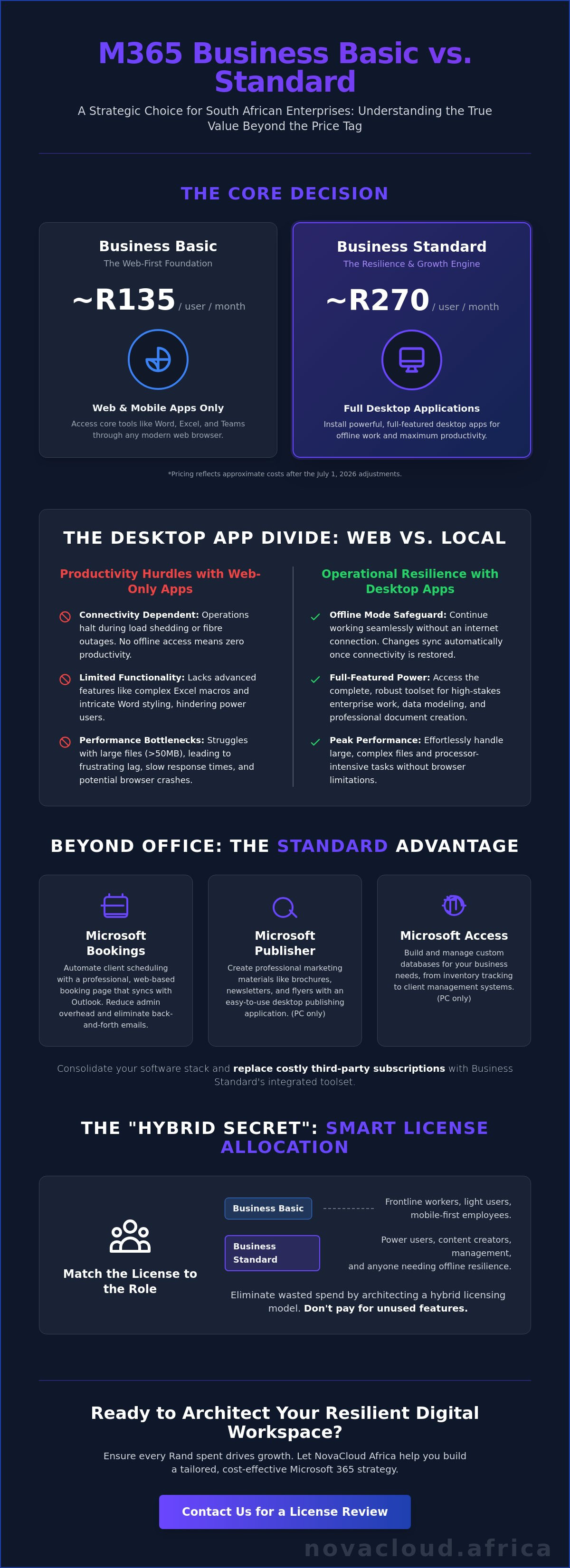
The most expensive license in your stack isn't the one with the highest monthly fee; it's the one that leaves your team stranded during a mid-morning connectivity drop. As we approach the July 1, 2026 price adjustments, the choice between M365 basic vs standard has evolved from a simple software comparison into a strategic decision about operational resilience. With Business Basic increasing to approximately R135 and Business Standard to R270 per user, South African enterprises must look beyond the invoice to the architectural impact on daily productivity.
You likely feel the tension between optimizing your ICT budget and providing the high-performance tools your team needs to thrive. We agree that license management shouldn't be a source of uncertainty, especially with the June 2026 rollout of 50GB extra storage and enhanced security features. This guide will bring clarity to your digital transformation, helping you master the critical differences between these tiers to ensure every Rand spent drives growth. We will provide a clear value breakdown and a roadmap for choosing the right license for every role in your organization.
Key Takeaways
- Understand why desktop-installed applications are the cornerstone of operational resilience during South Africa's connectivity fluctuations.
- Evaluate the true productivity cost of the M365 basic vs standard divide to ensure your ICT budget aligns with your team's actual workflow requirements.
- Learn how to leverage built-in security features and integrated cloud backups to maintain robust POPIA compliance across your digital estate.
- Discover the "Hybrid Secret" of mapping specific license tiers to employee roles to eliminate wasted spend on unused features.
- Explore how advanced tools like Microsoft Bookings can architect a more seamless, professional scheduling experience for your clients.
M365 Business Basic vs Standard: The Desktop App Divide
The architectural blueprint of your digital workspace begins with a choice between two distinct delivery models. While both tiers provide the essential Microsoft 365 ecosystem, the functional gap between M365 basic vs standard centers on where your applications actually live. Business Basic tethers your team to a web browser. Business Standard empowers them with full desktop installations. This isn't merely a preference; it's a strategic decision about how your team interacts with their primary instruments of growth. Choosing the right tier ensures your employees aren't fighting their tools while trying to build your vision.
Web-based applications are excellent for quick edits, but they often lack the depth required for high-stakes enterprise work. In the web versions of Excel, advanced macros and complex data modeling tools are frequently absent or restricted. Word's web interface can struggle with intricate document styling and large file sizes. For a South African enterprise aiming for transformative growth, these limitations can become a productivity tax that compounds every day across your workforce. When your team spends more time managing browser tabs than analyzing data, your operational efficiency suffers.
The Reality of Web-Only Productivity
Relying solely on a browser interface introduces a layer of friction that many SMEs overlook. When your team is forced to manage complex projects within browser tabs, they face significant performance bottlenecks. Local latency in South Africa can turn a simple spreadsheet update into a frustrating experience of waiting for cloud-only editing to catch up with keystrokes. Large files, specifically those exceeding 50MB, often trigger sluggish responses or browser crashes. This environment isn't conducive to the rhythmic, focused work required for scaling a business. It creates a fragmented experience that pulls employees away from their most important tasks.
Desktop Apps as a Connectivity Safeguard
In our local market, connectivity isn't always a guarantee. Load shedding and sporadic fibre outages can halt a web-dependent team in its tracks. Business Standard provides a resilient architecture through its Offline Mode. Employees can continue drafting reports or analyzing data without an active internet connection. Once power is restored or your Business Fibre link stabilizes, the desktop apps automatically sync changes to your cloud storage. This capability eliminates the panic of connectivity drops. It ensures that your operations remain purposeful and uninterrupted, regardless of external infrastructure challenges. Understanding this functional difference is key when evaluating M365 basic vs standard for a remote or hybrid workforce.
Beyond Office: Advanced Tools Included in Business Standard
Architecting a high-growth enterprise requires more than just word processing and spreadsheets. While the previous section highlighted the desktop app divide, the true strategic depth of the M365 basic vs standard comparison lies in the specialized tools that drive operational efficiency. Business Standard introduces a layer of automation and specialized data management that can replace several costly third-party subscriptions. By consolidating these functions into a single ecosystem, you don't just save money; you create a more cohesive digital environment for your team and your clients.
Many South African service firms currently juggle separate invoices for scheduling software, design tools, and database management. When choosing the right Microsoft 365 plan, it's vital to calculate the savings found in these "extra" applications. Business Standard provides the infrastructure to professionalize your brand without the complexity of managing multiple vendors. This consolidation is a key step toward a resilient architecture that supports both local expertise and global standards.
Microsoft Bookings for Professional Service Firms
Administrative overhead is a silent growth killer. Microsoft Bookings, included in the Standard tier, automates the appointment-setting process by providing a customizable web-based scheduling page. Your clients can book services based on real-time availability, which syncs instantly with your Outlook calendar. This self-service model reduces the back-and-forth emails that often plague local consultancies and medical practices. To create a truly seamless client journey, consider how this integrates with a hosted PBX system. While Bookings handles the digital schedule, your voice architecture ensures that no client inquiry goes unanswered, creating a unified front of technological authority.
PC-Only Power: Access and Publisher
Specialized roles often require specialized tools that web browsers simply cannot host. Microsoft Access provides a robust environment for building local database applications, which is essential for businesses managing complex inventory or proprietary client records. Similarly, Microsoft Publisher allows your team to create professional-grade marketing collateral, from brochures to newsletters, without the steep learning curve of high-end design software. These applications require a Windows PC to run, highlighting another critical distinction in the M365 basic vs standard evaluation. They empower your internal team to handle tasks that would otherwise be outsourced, keeping your intellectual property and creative control firmly within your organization.
Strategic ROI: Calculating the Value for Enterprise
Every line item in your ICT budget must justify its existence through measurable performance. While the raw monthly cost of a subscription is easy to track, the true financial impact of the M365 basic vs standard choice often hides in the minutes lost to inefficient workflows. For a South African enterprise with a 100-person team, a mere five minutes of daily frustration caused by web-app lag or browser-refresh cycles equates to over 40 hours of lost productivity every week. This "productivity tax" often exceeds the price difference between the tiers, turning a perceived saving into a hidden drain on your resources.
Investing in the right architecture means looking at the total cost of ownership. Beyond the apps themselves, Business Standard provides a foundation for professional branding and client trust that Basic struggles to match. When your team can seamlessly present complex data using high-performance desktop tools, your firm projects a level of technological authority that resonates with global partners. Analyzing M365 Business Basic vs. Standard reveals that the higher tier is often the more cost-effective choice for growth-oriented businesses aiming to scale their operations without increasing administrative friction.
Quantifying Employee Efficiency
Desktop applications offer a level of responsiveness that even the most optimized web interfaces can't replicate. Power users rely on complex keyboard shortcuts and multi-window multitasking to maintain their flow. In a browser-only environment, these shortcuts often conflict with browser commands, leading to errors and interrupted focus. By moving to Business Standard, you also reduce the load on your internal IT assistance team. Our data shows that web-only users frequently report issues related to browser cache conflicts and file-loading errors that simply don't exist in the desktop environment. True ROI exists at the intersection of tool performance and human output.
Consolidating Your Tech Stack
Strategic licensing is about more than just Office apps; it's about architecting a unified ecosystem. Business Standard includes tools like Microsoft Bookings and Forms that allow you to retire expensive third-party subscriptions for scheduling and data collection. Consolidating these functions into your M365 environment simplifies your billing and enhances your security posture by keeping all data within a single, managed perimeter. To maximize these benefits, you need a clear framework for M365 License Management. This approach ensures you aren't paying for redundant SaaS tools while your existing Microsoft 365 investment remains underutilized. As you prepare for the July 2026 price adjustments, this consolidation becomes a vital tactic for protecting your margins and empowering your workforce.
Security and Compliance: Ensuring Data Resilience
Security is the invisible architecture of trust. While the primary conversation around M365 basic vs standard often focuses on productivity tools, the data perimeter remains the most critical component of your digital estate. Both tiers provide a foundation of enterprise-grade security, including multi-factor authentication and data encryption at rest. Starting in June 2026, Microsoft is bolstering these plans further by adding URL time-of-click protection to both Basic and Standard subscriptions. This update ensures that your team is protected from malicious links in real-time, regardless of the license tier you choose. However, a license alone is not a strategy; it's a tool that requires expert calibration to meet South African regulatory standards.
A resilient workspace must account for more than just external threats. It must protect against data loss and ensure rapid recovery. Integrating Cloud backups into your M365 environment is essential for mitigating the risks of accidental deletion or ransomware. While Microsoft hosts your data, the responsibility for long-term retention and granular recovery rests with your business. By architecting a multi-layered defense, you transform your cloud environment from a simple storage solution into a resilient fortress that supports continuous growth.
POPIA Compliance in the M365 Ecosystem
Aligning with the Protection of Personal Information Act (POPIA) is a non-negotiable requirement for South African enterprises. Both M365 tiers offer tools to help you manage data residency and lifecycle policies. You can configure your environment to store data in specific regions, ensuring that sensitive information remains within compliant boundaries. Audit logs and discovery tools provide the transparency needed for legal readiness and internal accountability. It's important to remember that licensing is only the first step in a Managed Firewall protected environment. True compliance is achieved when your software policies are mirrored by a robust network security architecture.
Integrating Security with Managed IT
Identity management is the new perimeter. As your workforce becomes more mobile, managing who has access to what data becomes increasingly complex. Professional oversight is required to prevent data leaks and ensure that security settings aren't accidentally bypassed by employees seeking shortcuts. There is a powerful synergy between your M365 security posture and your Hosted PBX systems. When your voice and data architectures share a unified security philosophy, you eliminate the gaps that attackers often exploit. Proactive monitoring allows you to move beyond default settings, creating a customized security profile that reflects your specific business risks. To ensure your digital workspace is both secure and optimized, consult with our expert architects to design a resilient security roadmap.
The NovaCloud Africa Approach: Architecting a Hybrid Licensing Model
Most technology vendors present the M365 basic vs standard debate as an all-or-nothing proposition. They often suggest that you must license your entire organization at a single tier, which leads to significant wasted spend on features your frontline staff never touch. At NovaCloud Africa, we architect a more sophisticated solution: the hybrid licensing model. By mixing and matching licenses within a single tenant, you can optimize your ICT budget while ensuring every employee has the exact tools required for their specific mission. This surgical approach eliminates the redundancy that drains local enterprise resources and provides a clear path to transformative growth.
Choosing the right licensing architecture is just the first step in building a resilient digital estate. For businesses requiring high-performance computing alongside their productivity suite, integrating your licensing with high-performance VPS environments allows for a truly centralized cloud infrastructure. This combination ensures that your data remains secure and accessible, whether your team is working from a bustling branch office or a remote operational site. NovaCloud Africa helps you audit your current usage to identify where Business Basic is sufficient and where the desktop power of Standard is non-negotiable.
Role-Based Licensing Strategies
Effective license management starts with mapping software capabilities to specific employee roles. Your frontline workers or field staff, who primarily consume information or perform simple data entry, can often thrive on the web-based interface of Business Basic. Conversely, your finance, legal, and creative teams require the full desktop suite of Business Standard to handle complex modeling and high-stakes document production. Managing this mixed-tier environment doesn't have to be complex. NovaCloud Africa provides the administrative framework to ensure that as your headcount grows, your licensing scales with precision rather than guesswork. This ensures you don't pay for a single feature that isn't actively driving your business forward.
Partnering for Strategic Growth
Navigating the July 1, 2026 price adjustments requires a partner who understands the nuances of the South African market. An authorized licensing partner provides significantly better value than buying direct, offering localized support and strategic oversight that global vendors cannot match. Accessing expert IT assistance ensures that your migration to a hybrid model is seamless and that your security policies are correctly applied across all tiers. To truly empower this digital workspace, you must also consider the underlying infrastructure. Future-proofing your connectivity with Business Fibre ensures that your cloud-based tools perform with the speed and reliability your enterprise demands. Together, we can illuminate a new chapter of efficiency for your business.
Illuminating Your Path to Digital Resilience
The July 1, 2026 price adjustments are a catalyst for strategic change rather than a simple budgetary hurdle. Mastering the M365 basic vs standard divide allows you to build a resilient architecture that supports your team through every connectivity challenge. By adopting a hybrid licensing model, you eliminate wasted spend and empower your workforce with tools precisely mapped to their roles. This approach ensures your digital estate is both cost-effective and high-performing for the long term.
NovaCloud Africa stands as your strategic ally, offering the local expertise and South African ICT infrastructure necessary for transformative growth. As an authorized Microsoft 365 Business Licensing partner, we provide seamless integration with your existing Hosted PBX and VPS solutions. We're committed to helping you navigate these technical transitions with quiet confidence and precision. Architect your ideal M365 workspace with NovaCloud Africa and start a new chapter of business efficiency today. Your digital transformation is in safe, expert hands, and the future of your enterprise looks brighter than ever.
Frequently Asked Questions
Can I upgrade from M365 Business Basic to Standard later?
Yes, you can upgrade your licenses at any time through the Microsoft 365 admin center or your service provider. This scalability allows you to start with the foundational tools of Business Basic and move to the high-performance desktop suite of Standard as your operational needs expand. The transition is seamless, ensuring that your team's files and settings remain preserved throughout the architectural shift.
Do I need Business Standard to use Microsoft Teams?
No, Microsoft Teams is a core component of both the Business Basic and Business Standard plans. Both tiers allow you to host professional online meetings, video conferences, and collaborative chats with up to 300 participants. This ensures that your unified communications remain resilient, whether your team is using the web-based interface or the dedicated desktop application.
Can I mix Basic and Standard licenses within the same South African business account?
Yes, you can definitely mix and match licenses within a single South African business account. This strategy is essential for optimizing your ICT spend by mapping M365 basic vs standard licenses to specific employee roles. For example, your field workers might only need Basic, while your finance managers require the full desktop capabilities and advanced Excel features of Standard.
Is the 1TB cloud storage the same for both Basic and Standard?
Yes, both the Business Basic and Business Standard plans provide 1 TB of OneDrive cloud storage per user. This resilient storage architecture ensures that your data is always accessible and protected by enterprise-grade encryption. Additionally, starting in June 2026, both plans will receive an extra 50 GB of email storage to support the growing communication needs of your enterprise.
Do M365 desktop apps work on both Windows and Mac?
Yes, the desktop versions of Word, Excel, PowerPoint, and Outlook work perfectly on both Windows and Mac operating systems. Each Business Standard license allows a single user to install these high-performance apps on up to five PCs or Macs, five tablets, and five mobile devices. This cross-platform compatibility is vital for South African enterprises maintaining diverse hardware environments.
What happens to my data if I downgrade from Standard to Basic?
Your data remains safely stored in the cloud, but the way your team interacts with it will change significantly. Once you downgrade, users lose access to the desktop-installed software and must rely solely on web and mobile interfaces. This shift can impact productivity for power users who require the advanced features and offline capabilities that only the Standard tier provides.
How does M365 Business Standard help with POPIA compliance?
Business Standard aids POPIA compliance by offering robust data residency controls and encrypted storage solutions. The ability to use desktop apps ensures that employees don't resort to insecure third-party tools when web connectivity fluctuates. By centralizing your data within this managed environment, you gain the audit logs and transparency required for national regulatory readiness and data protection.
