


How Much Bandwidth Does a Small Business Need in 2026? A Strategic Guide

Your internet connection isn't just a utility; it's the strategic foundation of your entire digital presence. If you've ever dealt with frozen screens during a critical Teams meeting or watched cloud backups stall your morning workflow, you know that generic plans often fall short of real-world needs. It's frustrating to feel like your technology is working against you rather than empowering your team. Understanding how much bandwidth does a small business need is no longer about picking the cheapest tier; it's about ensuring your operations remain seamless as we move through 2026.
This guide provides a precise formula to calculate your requirements for Hosted PBX, M365, and VPS environments with absolute clarity. We'll show you how to move from unpredictable latency to a state of total connectivity confidence. You're about to learn how to future-proof your infrastructure to support expansion and guarantee zero downtime during your most critical operations. By the end of this article, you'll have a clear roadmap to transform your connectivity into a powerful catalyst for regional growth and digital resilience.
Key Takeaways
- Understand why 2026 digital standards prioritize symmetrical upload speeds over traditional download-heavy consumer plans for data-producing businesses.
- Learn the precise formula for determining how much bandwidth does a small business need by auditing core applications and accounting for peak concurrent users.
- Discover how to calculate the specific 'VoIP Overhead' required to ensure crystal-clear communications across your office phone systems.
- Identify the critical difference between best-effort residential lines and enterprise-grade Business Fibre in maintaining zero-downtime cloud operations.
- Gain the confidence to future-proof your infrastructure against evolving digital demands by architecting a scalable, capacity-first network.
Defining Bandwidth Requirements in the 2026 Cloud Era
In the 2026 cloud era, your network is the central artery of your business. It's the conduit through which digital evolution flows, enabling a fresh start for efficiency and regional growth. When leaders ask how much bandwidth does a small business need, they're often looking for a simple number. However, the answer lies in understanding that bandwidth is the foundation of your digital sovereignty. It's the capacity that allows your Hosted PBX to deliver crystal-clear audio and your Cloud backups to run silently in the background without interrupting your morning momentum. Without sufficient headroom, your sophisticated tools become liabilities rather than assets.
To architect a resilient system, we must first look at the technical definition of Bandwidth (computing). It represents the maximum rate of data transfer across a specific path. For South African enterprises, adopting a 'capacity-first' mindset is essential. We aren't just consumers of data anymore; we're producers. Whether you're hosting Virtual Private Servers or managing complex Microsoft 365 environments, inadequate capacity creates a hard ceiling. It limits your ability to adopt new technologies and slows your organizational trajectory. True progress requires a connection that scales with your ambition.
Speed vs. Throughput: The Architect's Perspective
There's a vital distinction between advertised speed and actual network throughput. Your 'advertised speed' is a theoretical peak, much like a speed limit on an empty highway. Throughput is the actual volume of data reaching your applications after accounting for network congestion and hardware bottlenecks. If your internal Ubiquity networks aren't aligned with your Business Fibre, you'll experience a performance gap. This discrepancy is why many businesses feel their 'fast' internet is actually sluggish during peak hours. A strategic partner looks beyond the sticker price to ensure your throughput matches your operational reality.
The Cost of Connectivity Friction
Connectivity friction carries a heavy price tag. When employees wait for files to sync or video calls to buffer, you're losing billable hours to idle time. Beyond the financial loss, there's a psychological impact. Digital lag erodes team morale and creates a sense of professional frustration. In a client-facing environment, a dropped VoIP call or a pixelated presentation damages your reputation. It signals a lack of technical authority. Investing in the right capacity isn't just an IT expense; it's a commitment to your team's empowerment and your brand's dignity. Clarity in your connection leads to clarity in your business outcomes.
Key Variables That Dictate Your Bandwidth Consumption
Calculating how much bandwidth does a small business need requires a fundamental shift from counting desks to analyzing peak data flows. Total headcount is a deceptive metric. What truly matters is peak demand, that specific window when your team is simultaneously hosting video calls, syncing large SharePoint folders, and pushing updates to production. This is the pulse of your digital operation. If your network isn't architected for these surges, your most critical tools will stutter when you need them most.
We must also account for the density of devices within your workspace. A single employee often introduces three active connections: a laptop, a smartphone, and a tablet. Beyond human users, your infrastructure itself acts as a constant consumer. Background updates, security patches from your Managed Firewall, and automated telemetry from Ubiquity networks create a steady baseline of traffic. Modern workflows built on Microsoft 365 Business Licensing turn every workstation into a high-demand node. Tools like Microsoft Teams and SharePoint are no longer optional extras; they're continuous data streams that require consistent, high-capacity pipes to function without friction.
User Density and Concurrent Session Management
Every active browser tab and background application consumes a slice of your available capacity. When you factor in guest Wi-Fi and Bring Your Own Device (BYOD) policies, the unmanaged load on your network can spike unexpectedly. It's vital to distinguish between light users, who primarily handle email, and power users in creative or technical roles. These power users often move gigabytes of data daily, requiring a more robust allocation to maintain productivity. If you're seeing performance dips, our experts can help you design a custom connectivity architecture that balances these competing demands.
Cloud Infrastructure and SaaS Ecosystems
Managing Virtual Private Servers demands dedicated, low-latency paths to ensure administrative control remains fluid and responsive. Hybrid office models further intensify this need, as remote access tools and VPNs often double the bandwidth load on your central office fibre. In this environment, your connection isn't just an internet line; it's the bridge to your entire cloud ecosystem. Ensuring this bridge is wide enough for your M365 and VPS management is the difference between a stalled workforce and a thriving, agile enterprise.
Symmetrical vs. Asymmetrical: Why Upload Speed is Now Critical
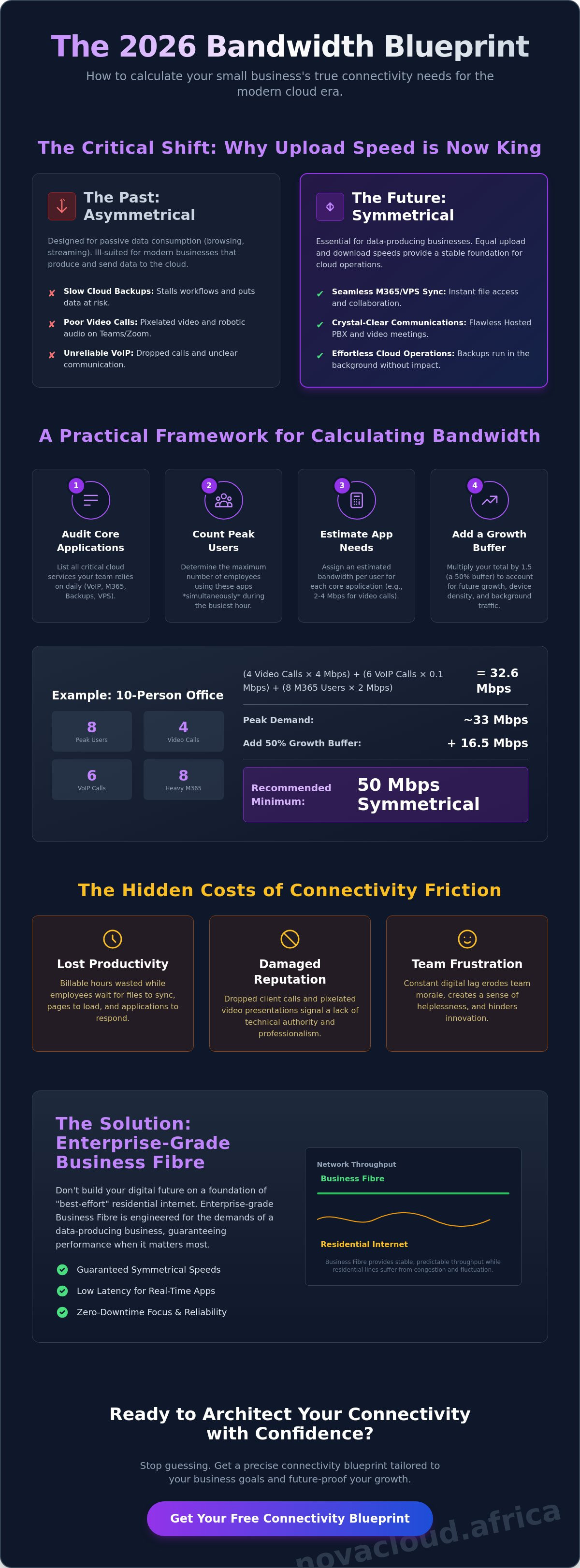
The traditional internet model was built for consumption. You downloaded more than you uploaded. But for a forward-thinking South African enterprise, that model is obsolete. When determining how much bandwidth does a small business need, the upload pipe is often the most overlooked variable. Consumer-grade ADSL or LTE lines are typically asymmetrical. They offer fast downloads but crawl when sending data. In contrast, Business Fibre provides symmetrical speeds, ensuring your upload and download capacities are equal.
In 2026, your business is a data producer. You aren't just browsing; you're pushing high-definition video streams, syncing massive databases, and maintaining real-time Cloud backups. Upload bottlenecks don't just slow down your outgoing mail. They cripple the efficiency of modern disaster recovery and cloud production. If your upload pipe is full, your entire digital workflow grinds to a halt. True digital sovereignty requires a connection that handles outgoing data with the same grace and speed as incoming traffic.
The Production Shift: Uploading to the Cloud
Saving files directly to cloud drives requires high-speed upstream capacity. Without it, your team spends more time waiting for "syncing" icons than actually working. High upload speeds are also vital for maintaining stable connections to remote VPS environments. Symmetrical lines prevent a technical phenomenon known as ACK suppression. This happens when your upload is so congested that your system can't send "acknowledgment" packets to the server, which ironically kills your download speed even if that pipe is technically empty.
VoIP and Unified Communications Stability
Voice traffic requires prioritized, symmetrical bandwidth to avoid jitter and packet loss. Your Hosted PBX systems rely on this stability to deliver crystal-clear audio. When your upload is saturated by a large file transfer, call quality is the first thing to suffer. By linking your Hosted PBX performance to dedicated, symmetrical fibre paths, you ensure every client interaction is professional and uninterrupted. It's about creating a foundation of clarity and empowerment for your team and your regional partners.
A Practical Calculation Framework for Small Business Bandwidth
Moving from a state of uncertainty to one of digital readiness requires a technical blueprint. Generic internet plans often fail because they don't account for the specific rhythmic demands of your unique operation. When you analyze how much bandwidth does a small business need, you must look past the total headcount. You need a formula that considers the weight of your cloud ecosystem and the professional standards of your communication. By following a structured calculation framework, you can ensure your connectivity acts as a catalyst for regional growth rather than a bottleneck.
Your journey toward network resilience begins with a four-step audit. First, identify every core application your team relies on. Second, calculate the specific overhead required for your VoIP and Hosted PBX systems. Third, account for the 'Cloud Sync' tax, which is the constant background pressure from real-time file sharing and automated telemetry. Finally, integrate a strategic growth buffer to ensure your infrastructure remains future-proof. This methodical approach replaces guesswork with technological authority, providing a fresh start for your business efficiency.
The Per-User Allocation Model
A sophisticated network design assigns specific Mbps values based on organizational roles. Administrative staff typically require 5 Mbps for standard tasks, while executives often need 15 Mbps to handle constant high-level collaboration. Creative teams or developers moving large assets should be allocated at least 25 Mbps to maintain momentum. High-definition video conferencing remains the single highest per-user consumer, with platforms like Microsoft Teams requiring up to 4 Mbps per participant for peak quality. The 'Growth Buffer' is a non-negotiable strategic allocation of 20 to 30 percent additional capacity, designed to prevent network exhaustion as your digital footprint expands throughout 2026.
Accounting for High-Load Operations
High-load tasks can silently drain your capacity if they aren't managed with precision. Scheduling Cloud backups during off-peak hours is a standard practice, but real-time replication requires a dedicated slice of your upload pipe. Massive software deployments or data migrations also create temporary surges that can disrupt standard workflows. Additionally, sophisticated security layers like a Managed Firewall perform deep packet inspection, which can slightly impact your effective throughput. Balancing these demands ensures your core operations remain seamless and your digital sovereignty remains intact. If you're ready to move toward a more resilient architecture, consult with our strategic partners to refine your connectivity requirements.
Architecting Your Connectivity with NovaCloud Business Fibre
Selecting a connection is a strategic decision that defines your organization's digital sovereignty. While many providers offer "best-effort" lines, true digital renewal requires enterprise-grade, dedicated connectivity. When you determine how much bandwidth does a small business need, the answer is only half the story. The other half is the quality and reliability of that pipe. Our Business Fibre is designed as a high-performance catalyst, ensuring that your team's potential is never throttled by inferior infrastructure. We blend international performance benchmarks with deep regional South African expertise to deliver a system that feels both global in scale and personal in service. This creates a fresh start for your efficiency, allowing your vision to expand across the territory without technical limitations.
A robust network is more than a simple data stream; it's a managed ecosystem where every packet is prioritized for stability. By integrating professional IT Assistance, we ensure your bandwidth is always optimized for your specific workloads. This proactive approach eliminates the friction of traditional tech support, positioning your business to lead in a cloud-first economy. We don't just provide internet. We architect the resilient ICT foundations that empower regional progress and provide celestial clarity to your complex operations.
Enterprise-Grade Reliability and Symmetrical Performance
Our commitment to your success is reflected in our 1:1 contention ratios. Unlike residential lines shared with hundreds of neighbors, your Business Fibre is a dedicated path for mission-critical operations. This ensures that when you calculate how much bandwidth does a small business need, you actually receive the full capacity you pay for. This symmetrical performance is essential for supporting the Yealink T31P IP Phone and complex VoIP ecosystems. With a 99.9% uptime target, we provide the quiet confidence that your business will remain online during even the most demanding operational windows.
Seamless Integration with Cloud and Security
Your connectivity strategy must evolve alongside your security requirements. A high-capacity line without a sophisticated security layer is a risk, not an asset. Linking our Business Fibre to high-performance Virtual Private Servers creates a unified environment where data moves with absolute clarity. Our dedicated support teams proactively monitor your network health, ensuring that your FortiNet Managed Firewall and Ubiquity networks are perfectly synchronized. This seamless integration transforms your IT from a cost center into a powerful engine for growth and renewal. It's about building a system that doesn't just work, but thrives under the pressure of modern digital demands.
Empower Your Digital Sovereignty Through Strategic Connectivity
The journey toward digital renewal begins with a connection that matches your ambition. We've established that the shift to cloud production and real-time collaboration makes symmetrical upload speeds non-negotiable. By moving away from generic user counts and focusing on peak demand and growth buffers, you ensure your infrastructure remains a catalyst for progress rather than a limitation. Understanding how much bandwidth does a small business need is the pivot point where technical planning meets visionary growth.
Building this foundation requires a strategic partner who understands both global benchmarks and the local landscape. With our Symmetrical 1:1 Business-Grade Fibre and integrated FortiNet Managed Security, your network becomes a secure, high-capacity artery for your entire operation. We provide 24/7 Expert IT Assistance to ensure your systems are always optimized for peak efficiency. It's time to step into a future of total connectivity confidence and regional empowerment. Architect your high-performance connectivity with NovaCloud Business Fibre today and secure your organization's digital evolution.
Frequently Asked Questions
What is the difference between bandwidth and speed for a business?
Bandwidth refers to the maximum capacity of your network connection, while speed is the actual rate at which data travels across that path. Think of bandwidth as the number of lanes on a highway and speed as the velocity of the vehicles. For a business, having high bandwidth ensures that multiple users can operate simultaneously without causing a bottleneck that slows down individual speeds.
Is 100 Mbps enough for a small business with 20 employees in 2026?
For a team of 20, 100 Mbps is generally insufficient to meet the digital standards of 2026. Modern cloud-based applications like Microsoft 365 perform best with at least 10 Mbps per user. When you calculate how much bandwidth does a small business need for a team of this size, you should target a minimum of 200 Mbps to 500 Mbps to support concurrent video calls and background cloud synchronizations.
Why does my business need symmetrical fibre instead of a home fibre line?
Symmetrical Business Fibre provides equal upload and download speeds, which is vital for businesses that produce and send data. Home fibre lines are typically asymmetrical and shared among many residential users, leading to congestion during peak hours. A dedicated business line ensures your Hosted PBX and cloud uploads remain stable regardless of residential traffic patterns, providing a foundation of digital sovereignty.
How does bandwidth affect the quality of our VoIP and Hosted PBX calls?
Bandwidth directly impacts call clarity by preventing packet loss and jitter during peak usage. VoIP and Hosted PBX systems require a small but prioritized slice of your connection to maintain high-definition audio. If your network is saturated by other tasks, your Yealink T31P IP Phone may experience dropped calls or audio lag, which undermines the professional image of your organization.
Can cloud backups slow down our internet during office hours?
Automated cloud backups can saturate your upload pipe if they aren't strategically managed. Solutions like Acronis Cloud are designed to run efficiently, but they still require a dedicated portion of your bandwidth to function. Scheduling these tasks for off-peak hours or utilizing a managed connection ensures your morning workflow remains uninterrupted and fluid, allowing for a fresh start each business day.
What happens to our bandwidth if we move all our servers to a VPS?
Moving your infrastructure to a Virtual Private Server (VPS) shifts the processing load to the cloud but increases your reliance on a stable internet line. You'll need sufficient capacity to manage these remote environments with low latency. This transition empowers your team with greater flexibility while requiring a more robust, enterprise-grade connection to handle continuous data exchange between your office and the cloud.
How much bandwidth does a single Microsoft Teams video call consume?
A single high-definition Microsoft Teams video call can consume up to 4 Mbps of both upload and download bandwidth. This requirement often spikes when users share their screens or participate in large group meetings with multiple video feeds. Planning for these concurrent peaks is a critical part of determining how much bandwidth does a small business need to ensure every collaborative session remains crystal clear.
Does a Managed Firewall reduce my overall internet speed?
A Managed Firewall, such as a FortiNet solution, performs deep packet inspection which can introduce a minor amount of overhead. However, modern enterprise-grade hardware is designed to handle high-throughput Business Fibre without noticeably reducing your effective speed. The security benefits of protecting your digital assets and maintaining network integrity far outweigh the negligible impact on your overall network performance.
