


Uncapped Business Fibre vs LTE Router: The 2026 Strategic Architect’s Guide

A single minute of connectivity failure can cost your organization up to $427, turning a minor technical glitch into a significant strategic setback for your digital evolution. When evaluating the uncapped business fibre vs LTE router debate, it's easy to focus solely on installation times, but the true architect looks at the structural integrity of the enterprise foundation.
You've likely experienced the friction of a hosted PBX system stuttering during a critical briefing or the anxiety of slow cloud backups failing during peak hours. We understand that these aren't just IT issues. They are barriers to your growth and operational momentum. This guide delivers the definitive technical insights needed to build a resilient network that ensures zero-latency access to your VPS and Microsoft 365 environments. We'll explore the critical performance benchmarks of 2026, comparing the symmetrical power of fibre with the agile resilience of LTE to help you design a system that scales with visionary confidence.
Key Takeaways
- Understand why modern enterprise connectivity has evolved from a simple utility into the core physical architecture that dictates your entire ICT stack's performance.
- Compare the technical nuances of an uncapped business fibre vs LTE router setup, focusing on the stability of glass-based light pulses versus shared radio frequencies.
- Discover why symmetrical upload bandwidth is now the critical priority for powering high-definition video conferencing and stable Hosted PBX systems.
- Learn how to architect a fail-safe network by using automated LTE failover to protect your primary business fibre lines from localized downtime.
- Align your connectivity strategy with sophisticated cloud infrastructure to ensure your digital foundation scales alongside your organization's growth.
The Architecture of Connectivity: Why Your Choice Matters in 2026
Connectivity has transitioned from a backend utility to the very foundation of digital sovereignty. In 2026, South African enterprises no longer view internet access as a simple commodity. It is the physical architecture that dictates the speed of your digital evolution. Whether you are balancing the trade-offs of an uncapped business fibre vs LTE router or designing a multi-layered hybrid network, your choice determines how effectively your organization can compete on a global stage. This isn't just about data. It is about empowering regional growth through a stable, mission-driven infrastructure that brings clarity to complex operations.
Your ICT stack is only as strong as the medium that carries it. High-performance software, from Hosted PBX systems to automated Cloud backups, relies on the underlying pipe to deliver results. When that pipe is congested or unstable, your digital investments lose their value. By choosing a robust foundation, you ensure that every tool in your arsenal performs at its peak potential, turning technology into a true catalyst for progress and regional empowerment.
The Digital Foundation: Beyond the Router
Think of your connection as the central nervous system of your business. Every millisecond of latency acts as a micro-friction point that erodes employee productivity and slows down critical decision-making. High-speed, low-latency access is the prerequisite for seamless Virtual Private Servers integration, ensuring your remote applications feel as responsive as local ones. Understanding how fiber-optic communication works reveals why it remains the gold standard for stability. By transmitting data as pulses of light through glass, it avoids the interference common in radio-based solutions, providing the clarity and speed required for a modern ICT stack.
Visionary Connectivity: Powering Future Growth
The enterprise landscape is shifting toward AI-integrated Microsoft 365 tools that demand constant, high-bandwidth streams. A network that barely meets today’s needs will buckle under the weight of tomorrow’s intelligent automation. Forward-thinking leaders don't just react to current demands; they architect for the future. By prioritizing a high-performance uncapped business fibre vs LTE router strategy, you position your brand as a leader in your territory.
This infrastructure supports remote-first workforce models with ease, allowing your team to collaborate across regions without the technical debt of dropped VoIP calls or sluggish syncs. It is a commitment to renewal and business efficiency that starts at the physical layer of your network. When your connectivity is designed with visionary optimism, it doesn't just support your business. It propels it into a new era of possibility.
Uncapped Business Fibre vs. LTE Routers: A Technical Comparison
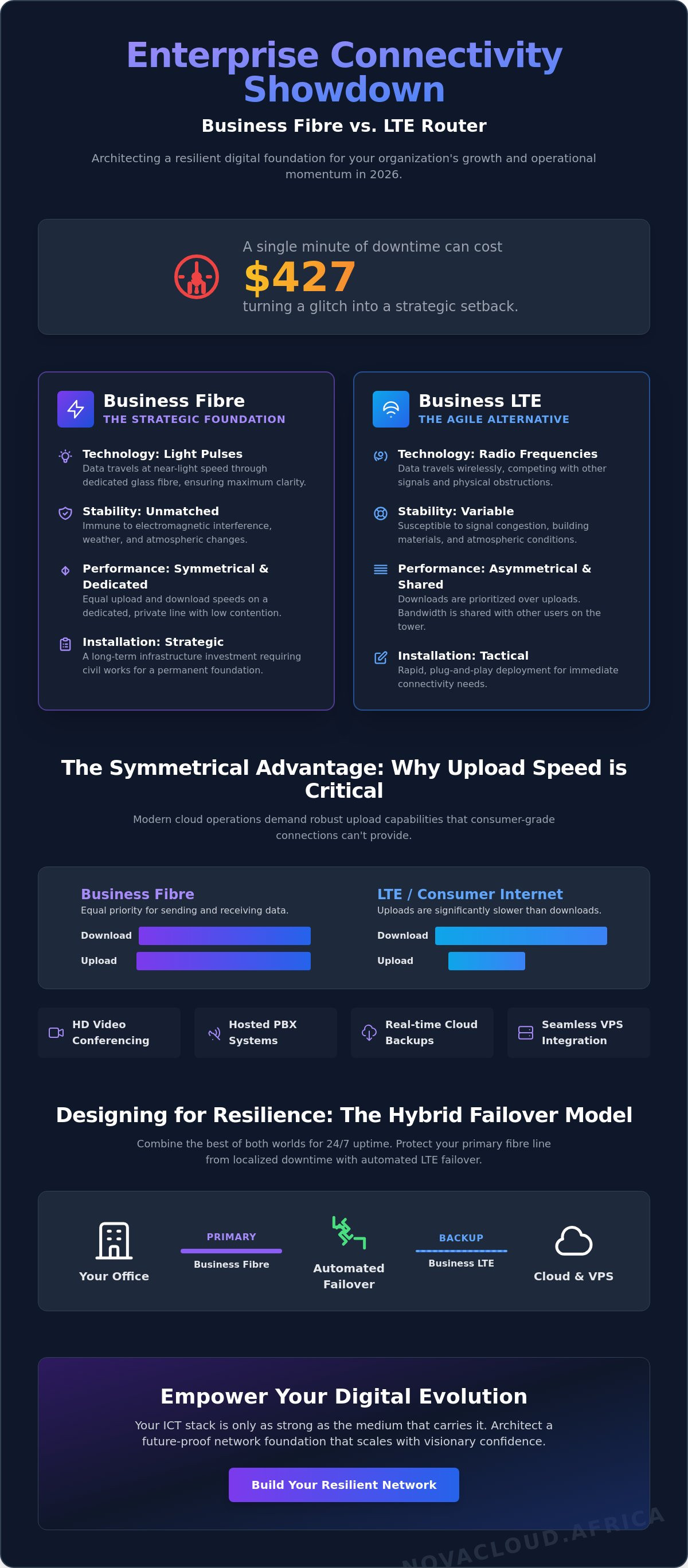
Choosing between uncapped business fibre vs LTE router technology is fundamentally a choice between two different physical laws. Business fibre relies on glass-based light pulses. These pulses travel at near-light speeds through dedicated conduits, remaining entirely immune to electromagnetic interference or the heavy summer rains common in South African afternoons. LTE, conversely, depends on radio frequency signals. These signals must penetrate walls, navigate atmospheric changes, and compete with every smartphone in the vicinity of the local tower. This physical distinction is why fibre provides a level of clarity that wireless solutions struggle to replicate.
Contention ratios define the true experience of an enterprise network. Mobile towers are shared assets. Bandwidth fluctuates based on the number of active users, meaning your connection speed is at the mercy of the crowd. Business-grade fibre provides a dedicated lane. It ensures that your mission-critical traffic doesn't stall during peak hours when local consumer demand spikes. It's the difference between a private thoroughfare and a congested public highway; one offers a guaranteed path, while the other offers a best-effort journey.
Installation timelines also reflect the strategic nature of these technologies. LTE is a tactical, instant setup. You plug in a router and gain immediate access. Fibre is a long-term strategic deployment. It requires physical civil works and precision splicing. While the lead time is longer, the result is a permanent piece of infrastructure that increases the value of your premises and your operational capacity. If you are looking for immediate stability while waiting for a permanent installation, exploring our managed connectivity options can provide the bridge your business needs.
The Mechanics of Speed and Stability
A 100Mbps fibre line feels significantly faster than a 100Mbps LTE connection because of jitter and latency. Jitter is the variation in the time it takes for data packets to arrive. In a mobile environment, jitter is high, leading to the stuttering you hear on VoIP calls. Fibre offers near-zero jitter. This stability is what allows your team to work with precision. The "uncapped" nature of fibre is also more absolute. Fixed lines don't suffer from the aggressive fair usage policies or "throttling" that mobile networks use to manage tower congestion during busy periods.
Hardware and Deployment Realities
The hardware involved in these setups dictates your long-term flexibility. Fibre utilizes an Optical Network Terminal (ONT), a robust device designed to convert light into data with minimal heat and maximum uptime. LTE routers are often limited by signal penetration. They frequently require external antennas to achieve a stable link, adding complexity to the deployment. Your Business Fibre choice is a five-year strategic decision. It's about building a foundation that won't require a hardware overhaul every time a new mobile standard is released. It's an architecture of permanence in an era of constant change.
The Symmetrical Advantage: Why Business-Grade Fibre Wins for Cloud Operations
The legacy belief that internet speed is measured solely by download capacity is a strategic blind spot. In a cloud-first enterprise environment, your organization is a producer of data, not just a consumer. When evaluating uncapped business fibre vs LTE router solutions, the most transformative technical difference lies in symmetry. Most LTE connections are asymmetrical, offering high download speeds but severely restricted upload pipes. Business fibre provides symmetrical bandwidth, ensuring your upload speed matches your download speed bit for bit.
This balance is the engine room of modern digital operations. Every high-definition video frame you transmit, every large file sent to a client, and every packet of data synced to the cloud relies on your upload capacity. Traditional objections often claim that "we only download files," but this ignores the reality of 2026 workflows. Without a strong upload pipe, your cloud applications become one-way streets, causing bottlenecks that ripple through your entire ICT stack. Symmetrical fibre turns these streets into multi-lane highways, enabling a fluid exchange of information that keeps your business agile and responsive.
Powering Unified Communications
Voice and video traffic are inherently two-way. For Hosted PBX systems to function with absolute clarity, they require dedicated, symmetrical bandwidth that prevents packet loss. If your upload speed is congested, the person on the other end of the call will experience robotic audio or dropped sentences, regardless of how fast your download speed is. By utilizing a symmetrical connection, you ensure that high-performance hardware, such as the Yealink T31P IP Phone, delivers the crystal-clear voice quality your professional image demands. It's about removing the technical friction that compromises human connection.
Cloud Infrastructure and Data Resilience
Data sovereignty and resilience are built on the back of consistent Cloud backups. Symmetrical fibre accelerates these syncs, allowing large datasets to reach offsite storage without interfering with daily operations. This high upload capacity is also vital for VPS performance; it reduces remote desktop lag and ensures that your offsite servers feel as local as a machine under your desk. In a landscape governed by POPIA requirements, having the bandwidth to maintain real-time data redundancy isn't just a convenience. It's a fundamental pillar of your organizational security and compliance strategy. Choosing the right uncapped business fibre vs LTE router configuration ensures your data is always exactly where it needs to be, when it needs to be there.
Designing for Resilience: Combining Fibre and LTE for 24/7 Uptime
A single minute of network failure can cost your organization up to $427, turning a brief outage into a significant financial drain. Designing for resilience means moving beyond a single point of failure. By architecting an "Always-On" framework that balances uncapped business fibre vs LTE router technology, you create a digital environment where downtime is a relic of the past. It's about ensuring your digital evolution remains uninterrupted, even when the external environment is in flux. This multi-layered approach ensures that your connectivity is a source of strength rather than a vulnerability.
Redundancy is the hallmark of a sophisticated system. While fibre provides the high-capacity primary link, LTE serves as the agile safety net. A 99.99% uptime guarantee allows for only 52 minutes of downtime per year, a target that is nearly impossible to hit without a secondary connection. By integrating both, you provide your enterprise with the structural integrity required to support complex cloud operations and high-stakes communication without the fear of sudden disconnection.
Automated Failover Strategies
A Managed Firewall acts as the intelligent conductor of this dual-stream setup. It detects a drop in the primary fibre line within milliseconds, instantly rerouting mission-critical traffic like VoIP and Microsoft 365 streams to the LTE backup. This transition must be seamless; your team shouldn't notice the switch. Maintaining a consistent static IP during this failover is vital for remote access and security protocols, ensuring your VPS remains reachable regardless of which pipe is active. Prioritizing VoIP traffic ensures that your voice quality remains stable even on the lower bandwidth of an LTE failover.
Connectivity in the Age of Load-Shedding
South Africa’s energy landscape adds a layer of complexity to network design. During Stage 4 load-shedding and beyond, mobile towers often face battery exhaustion, leading to degraded LTE signals or total tower blackouts. Fibre infrastructure is frequently more resilient if the provider's exchange is properly backed up. By powering your local ONT and router with an inverter or UPS, you maintain a high-speed link when the local mobile network is struggling. This creates a pocket of operational clarity and renewal in an otherwise dark window. Strategic architects don't just plan for speed; they plan for the survival of the system.
Architect a resilient connectivity foundation that ensures your business never sleeps.
Empowering Your Digital Evolution with NovaCloud Africa Connectivity
NovaCloud Africa positions itself as a visionary designer of systems, moving beyond the role of a traditional service provider to become your strategic ally. We don't just sell data pipes; we architect the digital sovereignty of South African enterprises. The choice between an uncapped business fibre vs LTE router is merely the entry point into a much deeper conversation about how your infrastructure supports your long-term expansion. By choosing NovaCloud Africa, you're partnering with an entity that understands the global technological landscape while remaining passionately committed to the specific needs of our regional market.
Our approach is defined by quiet confidence and a human-centric focus on growth. We understand that behind every bit of data is a business goal, a client interaction, or a mission-critical operation. This perspective allows us to deliver technical execution that isn't just reliable, it's transformative. We help organizations move from a state of connectivity uncertainty to one of architectural clarity, ensuring your digital evolution is in expert hands.
The NovaCloud Africa Integrated Ecosystem
Our fibre solutions are specifically engineered to enhance your experience within the cloud.novacloud.africa environment. High-speed, low-latency connectivity is the direct catalyst for the performance of our Virtual Private Servers and automated Cloud backups. When you pair our Business Fibre with pbx.novacloud.africa for unified communications, you're not just buying a phone system; you're securing a platform that thrives on symmetrical bandwidth. To ensure your deployment is flawless, our expert IT Assistance team provides the technical execution needed to turn complex network designs into operational realities. We ensure your hardware, from FortiNet firewalls to Ubiquity networks, works in perfect harmony with your primary link.
A Vision for Regional Empowerment
We believe that technology is a tool for regional renewal and economic growth. Our investment in South African business infrastructure is driven by a mission to provide organizations with the clarity they need to succeed in an increasingly digital world. NovaCloud Africa doesn't settle for best-effort solutions; we strive for technological authority that empowers your team. This commitment to visionary growth means we're always looking at international benchmarks to ensure our local clients receive world-class service. It's a fresh start for your business efficiency, anchored by a partner who takes pride in your progress and your territorial reach.
Moving from connectivity uncertainty to architectural clarity requires a strategic ally who understands that your network is the lifeblood of your digital presence. We invite you to step into a future where your connectivity is no longer a bottleneck but a launchpad for expansion. Partner with NovaCloud Africa and experience the power of a network designed by architects of digital progress.
Architecting Your Path to Connectivity Sovereignty
The transition from a simple internet connection to a high-performance enterprise foundation is a defining moment for any South African organization. By understanding the structural nuances of uncapped business fibre vs LTE router technology, you've moved from a state of uncertainty to one of architectural clarity. You now recognize that symmetrical bandwidth isn't a luxury; it's the engine powering your cloud syncs, Hosted PBX performance, and long-term data resilience.
True digital sovereignty is built on the combination of stability and agility. A resilient network doesn't just survive outages; it thrives through them by utilizing intelligent, automated failover systems that prioritize your mission-critical traffic. We stand ready as your strategic partner to execute this vision with precision and regional expertise, ensuring your infrastructure remains a catalyst for growth rather than a bottleneck.
Architect Your Enterprise Connectivity with NovaCloud Africa and leverage our enterprise-grade symmetrical fibre, automated failover solutions, and national South African support. It's time to build a foundation that doesn't just support your growth but actively accelerates it. Your digital evolution is in expert hands, and the future of your enterprise has never looked clearer.
Frequently Asked Questions
Is uncapped business fibre better than LTE for a remote workforce?
Uncapped business fibre is superior for a remote workforce because it provides the low latency and symmetrical bandwidth required for seamless video conferencing and cloud collaboration. While LTE offers mobility, it often suffers from tower congestion and high jitter. Fibre ensures that remote employees can access Virtual Private Servers and Hosted PBX systems with the same responsiveness as local office users. This creates a stable environment that eliminates technical friction and supports long-term productivity.
How long does it take to install business fibre in South Africa?
Installation timelines for business fibre typically range from two to six weeks, depending on the proximity of existing infrastructure and the complexity of physical civil works. This process involves cable trenching and precision splicing to ensure a long-term strategic connection. Because this is an architectural deployment rather than a tactical one, the lead time reflects the permanence and stability of the final enterprise-grade link for your organization.
Can I use an LTE router as my primary business internet connection?
You can use an LTE router as a primary connection, but it's generally recommended only for small offices or tactical, short-term setups. When comparing uncapped business fibre vs LTE router performance, LTE lacks the dedicated contention ratios and symmetrical speeds of fibre. For organizations reliant on constant cloud syncs or high-volume VoIP traffic, LTE's susceptibility to tower congestion makes it a less reliable primary foundation for digital growth.
What is the difference between home fibre and business fibre?
Business fibre differentiates itself through lower contention ratios, symmetrical upload and download speeds, and enterprise-level service level agreements (SLAs). Home fibre is often asymmetrical and shared among many residential users, leading to performance drops during peak hours. Business-grade lines provide dedicated bandwidth and priority support, ensuring that your mission-critical ICT stack remains operational without the fluctuations common in consumer-grade products or residential services.
Do I need a static IP for my business fibre connection?
A static IP is essential if your organization hosts local servers, utilizes secure VPNs for remote work, or manages a Hosted PBX system. Unlike dynamic IPs that change periodically, a static IP provides a permanent address on the internet. This consistency is vital for maintaining secure connections to your Virtual Private Servers and ensuring that external security protocols, such as those on a Managed Firewall, remain uninterrupted during daily operations.
How does load-shedding affect business fibre vs LTE?
Load-shedding affects these technologies differently, with fibre often proving more resilient during extended outages. Mobile towers rely on batteries that can fail during Stage 4 load-shedding, causing LTE signals to drop entirely. Fibre infrastructure remains active if the exchange is powered. By using a UPS or inverter to keep your local ONT and router running, you can maintain high-speed connectivity even when the local mobile network goes dark.
What is a symmetrical internet connection and why does it matter?
A symmetrical connection provides identical upload and download speeds, which is the gold standard for modern digital operations. This matters because cloud-first businesses are data producers. High upload capacity is required for crystal-clear video conferencing, stable VoIP calls, and rapid Cloud backups. Without symmetry, your upload pipe becomes a bottleneck that slows down your entire digital evolution and limits the performance of your remote applications and offsite servers.
Can I integrate my existing firewall with a new business fibre line?
Yes, you can integrate your existing firewall with a new business fibre line provided the hardware supports the required throughput. Most enterprise-grade devices, such as FortiNet or Ubiquity, are designed to handle various WAN inputs. Integrating your firewall allows you to manage the transition between your primary fibre and your secondary uncapped business fibre vs LTE router failover setup, ensuring your security protocols remain robust across all active links.
