


How to Protect Your Business from Phishing Attacks: A 2026 Strategic Guide

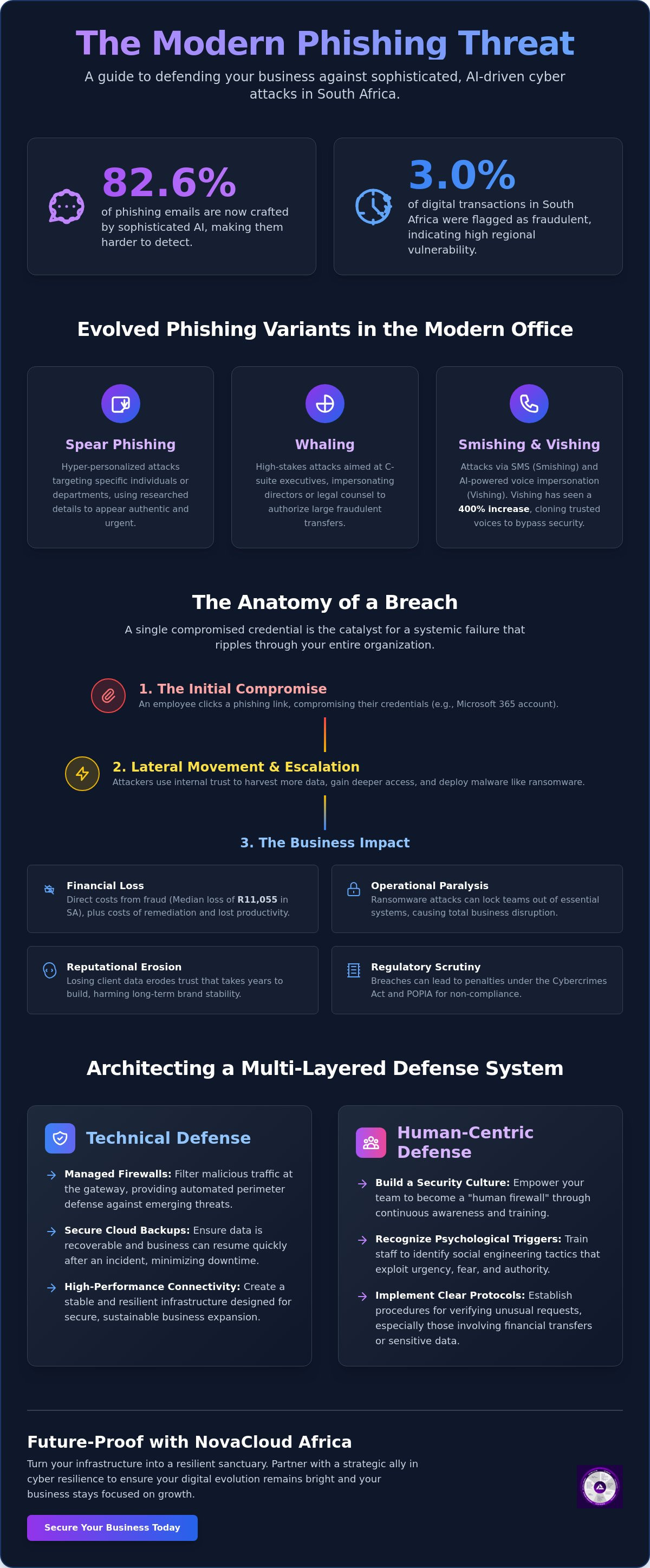
Did you know that 82.6% of phishing emails targeting your team are now crafted by sophisticated AI, making them nearly indistinguishable from legitimate communication? In South Africa, where 3.0% of digital transactions were flagged as fraudulent in 2025, the margin for error has never been thinner. You understand that a single employee click could trigger a chain reaction of financial loss and regulatory scrutiny under the Cybercrimes Act. It's natural to feel overwhelmed by the complexity of modern threats, yet this challenge also presents an opportunity to renew your digital strategy and bring fresh clarity to your operations.
This guide shows you exactly how to protect your business from phishing attacks by building a multi-layered defense system that acts as a catalyst for regional empowerment. We'll move beyond basic filters to architect a visionary framework that ensures POPIA compliance and shields your enterprise from sophisticated AI-driven schemes. You'll gain a clear roadmap for technical and human-centric defense, providing the strategic confidence you need to lead. We'll explore how to turn your infrastructure into a resilient sanctuary, ensuring your digital evolution remains bright and your business stays focused on its mission-driven growth.
Key Takeaways
- Understand the evolution of social engineering as attackers shift toward AI-generated deepfakes and coordinated voice phishing to compromise digital identities.
- Recognize that the impact of a breach involves more than just financial loss, affecting your brand's long-term reputation and operational stability.
- Learn how to protect your business from phishing attacks by architecting a multi-layered defense system that balances technical automation with a culture of security.
- Identify the critical role of Managed Firewalls in filtering malicious traffic at the gateway and automating perimeter defense against emerging threats.
- Discover how integrating security with cloud backups and high-performance connectivity creates a resilient infrastructure designed for sustainable business expansion.
What is Phishing and Why is it the Primary Threat to South African Enterprises?
Phishing is no longer a simple game of deceptive emails; it's a sophisticated architecture of social engineering designed to compromise digital identities. In 2026, the threat has evolved into a multi-dimensional challenge where AI-generated deepfakes and synthetic voices mimic trusted colleagues with haunting accuracy. For those seeking a comprehensive overview of phishing, it's clear the tactic has shifted from mass-volume spam to surgical, high-value strikes. South African businesses are particularly vulnerable, often serving as a testing ground for global cyber-syndicates due to our rapid digital adoption and high median fraud losses. To lead effectively, we must achieve a state of celestial clarity, illuminating these digital shadows before they ever reach our internal networks.
Learning how to protect your business from phishing attacks requires a deep understanding of how these threats manifest in a modern office. The goal isn't just to block an email, but to build a resilient system that empowers your team to see through the deception. By integrating secure communication platforms like Hosted PBX and robust cloud environments, you create a foundation where technical execution meets human-centric awareness.
Common Phishing Variants in the Modern Office
- Spear Phishing: These are tailored attacks where criminals research specific department heads to create hyper-personalized lures that feel authentic.
- Whaling: A high-stakes form of deception targeting C-suite executives, often using fake legal threats or financial director impersonations to authorize massive transfers.
- Smishing and Vishing: The rise of mobile-based SMS (smishing) and voice-impersonation (vishing) attacks. With vishing increasing by over 400% in recent months, attackers now use AI to clone voices during phone calls to bypass traditional security filters.
The Psychological Triggers of Social Engineering
Social engineering is the manipulation of human trust for illicit access. Attackers don't just hack code; they hack the human mind by weaponizing urgency, fear, and authority. They create scenarios where a busy employee feels they must act immediately to avoid a penalty or help a superior. This "single click" vulnerability is the weak point in every digital perimeter. While we trust our people, human intuition needs a technical safety net to ensure that a single moment of distraction doesn't lead to operational downtime or a data breach under the Cybercrimes Act.
The Anatomy of a Breach: How Phishing Impacts Business Continuity
A single compromised credential is often the spark that ignites a corporate wildfire. When we discuss how to protect your business from phishing attacks, we aren't just talking about blocking spam; we're talking about safeguarding the very continuity of your operations. A breach is a catalyst for systemic failure that ripples through your organization. It starts with one compromised Microsoft 365 account and quickly escalates as attackers move laterally, using internal trust to harvest more data. This isn't just an IT issue. It's a direct challenge to your digital sovereignty and your ability to serve your clients with confidence.
The long-term damage of a breach often centers on reputational erosion. Trust is a delicate asset that takes years to build but only seconds to lose. Following official CISA guidance is an excellent way to help your team identify the red flags of social engineering, but technical safeguards must back that awareness. When client data leaks, the difficulty of rebuilding that relationship can be insurmountable for many South African enterprises.
Financial and Operational Paralysis
The immediate financial fallout is often just the tip of the iceberg. While the median fraud loss in South Africa sits at R11,055, the long-term operational disruption can cost significantly more in lost productivity. When phishing leads to ransomware, your team is locked out of essential systems, resulting in total paralysis. Attackers frequently target the keys to your kingdom, gaining unauthorized access to Virtual Private Servers where your most critical data lives. The resources required for forensic investigation and system restoration are immense, often requiring weeks of dedicated effort to return to normalcy.
Legal Implications and POPIA Compliance
Beyond the financial hit, the legal landscape in South Africa demands a proactive stance. The Cybercrimes Act requires financial institutions and service providers to report breaches within 72 hours of discovery. Under POPIA, your responsibility to protect personal information is absolute, and the Information Regulator is increasingly focused on compliance. Implementing a strategy for Strategic Data Resilience ensures that even if a breach occurs, you have the immutable backups necessary to restore operations and demonstrate a commitment to security. Viewing cybersecurity as a strategic investment rather than a cost allows you to build a business that is both resilient and ambitious. To start architecting this resilience, you might look into how modern cloud backups can provide that essential layer of protection.
Architecting a Multi-Layered Defense: Technical Execution
Effective security requires a shift from reactive patching to a visionary architecture. You shouldn't just ask how to protect your business from phishing attacks; you should ask how to build a digital perimeter that thrives under pressure. A "Defense in Depth" strategy creates overlapping layers of protection, ensuring that if one layer is bypassed, others stand firm. This approach brings a sense of renewal to your digital infrastructure, turning complex security into a catalyst for growth rather than a hurdle. It's about achieving a state of clarity where every packet of data is accounted for and every user identity is verified.
The synergy between hardware and software is where true resilience lives. While many organizations focus solely on basic email filters, a comprehensive system integrates gateway protection with sophisticated endpoint security. Industry experts suggest many ways to Reduce Their Risk Of Successful Phishing Attacks, but the foundation always rests on a robust, professionally managed network perimeter. This technical execution provides the quiet confidence your organization needs to expand into new markets without the fear of a single click compromising your future.
The Managed Firewall: Your First Line of Defense
Modern threats require more than legacy hardware. Utilizing FortiNet infrastructure allows for real-time threat intelligence and deep packet inspection that identifies malicious intent before it ever enters your network. Transitioning to Managed Firewall solutions means you aren't just buying a box; you're investing in an automated system that actively hunts for threats. This rhythmic flow of security data automates the detection of known phishing domains and malicious attachments, freeing your team from the burden of constant suspicion. It's a fresh start in business efficiency, where technology acts as a reliable executor of your security policy.
Securing the Cloud Ecosystem
Your cloud environment is the heart of your modern office, and it requires specialized protection. Leveraging Microsoft 365 Business Licensing gives you access to Advanced Threat Protection (ATP), which uses AI to scan attachments and links for zero-day threats. Implementing Multi-Factor Authentication (MFA) and Conditional Access policies is no longer optional; it's a fundamental requirement for digital sovereignty. We also recommend proactive monitoring of your Virtual Private Server environments to detect anomalous login patterns that might signal a credential breach. Finally, the ultimate safety net lies in immutable Cloud backups. These backups ensure that even in a worst-case scenario, your data remains pristine and recoverable, shielding you from the catastrophic operational downtime that defines modern cybercrime.
5 Essential Steps to Secure Your Digital Perimeter
Determining how to protect your business from phishing attacks is a journey that moves from initial uncertainty to a state of strategic readiness. In the South African market, where the Information Regulator has increased focus on POPIA compliance in 2026, security isn't just a technical requirement. It's a foundational pillar of your brand's integrity. By following a structured roadmap, you can architect a system that doesn't just block threats but actively enables your digital evolution. This process brings a sense of renewal to your operations, ensuring your infrastructure is as ambitious as your business goals.
- Step 1: Conduct a Comprehensive Network Security Audit. You can't protect what you haven't mapped. A deep-dive audit identifies existing vulnerabilities in your architecture, ensuring you meet the cyber resilience requirements mandated for local financial and enterprise sectors.
- Step 2: Deploy a Managed Firewall. Automate your perimeter security by utilizing FortiNet infrastructure. This provides a reliable technical executor that performs real-time threat hunting, filtering malicious traffic at the gateway before it reaches your team.
- Step 3: Implement Rigorous Identity Hardening. Secure your Microsoft 365 environment with Multi-Factor Authentication (MFA) and conditional access. This ensures that even if a password is compromised, your digital sovereignty remains intact.
- Step 4: Establish Automated Offsite Backups. Use Acronis Cloud technology to create an immutable record of your data. This is your final line of defense, allowing for a fresh start in the event of a catastrophic breach.
- Step 5: Partner with Expert IT Assistance. Secure 24/7 monitoring to ensure that sophisticated, AI-driven attacks are identified and neutralized in real-time, providing the quiet confidence you need to lead.
Continuous Monitoring and Auditing
A "set and forget" approach to security is a significant liability in 2026. As global cyber-syndicates refine their tactics, your defense must be equally dynamic. Real-time visibility into network traffic and user behavior allows you to spot anomalies before they escalate into full-scale breaches. Regular audits are the celestial light that reveals hidden system shadows, ensuring your defense remains aligned with international benchmarks and localized South African regulations. This rhythmic oversight transforms security from a static barrier into a fluid, responsive system.
Fostering a Culture of Resilience
Technology is a catalyst, but your people are the heart of your defense. Shifting from basic awareness to a deep-rooted security culture empowers every employee to act as a guardian of the organization. When leadership prioritizes cybersecurity as a strategic pillar, it creates an environment where reporting suspicious activity is encouraged rather than feared. This human-centric approach ensures that your technical execution is supported by a vigilant, empowered workforce. To begin architecting your resilient future, you can consult with a strategic security partner today.
Future-Proofing with NovaCloud Africa: Your Strategic Ally in Cyber Resilience
Phishing is often dismissed as a mere "email problem," yet the reality of 2026 is that it's a profound infrastructure vulnerability. When you consider how to protect your business from phishing attacks, you must look beyond the inbox to the very architecture of your digital environment. NovaCloud Africa stands as the architect of secure, high-performance systems where connectivity, cloud, and security work as a single, rhythmic unit. We believe that true resilience comes from an integrated ICT strategy that treats your Managed Firewall, Business Fibre, and cloud environment as a cohesive sanctuary for your data.
Our commitment to regional empowerment drives us to deliver world-class technical execution tailored for the South African landscape. We don't just provide tools; we design systems that act as a catalyst for your growth. By aligning international security benchmarks with localized expertise, we offer a fresh start in business efficiency. This visionary approach ensures that your digital evolution is marked by clarity and stability, allowing you to focus on expansion while we manage the complexities of your defense.
Human-First IT Assistance
Rapid incident response requires more than just automated alerts; it requires a strategic partner who understands your specific operational context. Our IT Assistance team manages the intricate integrations of FortiNet and Acronis Cloud for you, ensuring your multi-layered defense is always optimized. Having a local ally who understands the nuances of POPIA and the Cybercrimes Act is critical when every second counts during a potential breach. We provide the quiet confidence of expert management, standing by as a reliable executor of your security vision.
Ready to Secure Your Future?
The roadmap to a phishing-resistant organization is clear. It begins with a comprehensive audit, moves through the deployment of Managed Firewalls and identity hardening, and finds its ultimate safety net in immutable backups. This strategic progression leads you from a state of uncertainty to one of total readiness. By architecting a multi-layered defense, you don't just stop attacks; you secure your digital future and empower your team to lead with ambition. It's time to embrace a new era of cyber resilience where your infrastructure is as resilient as your vision. Architect your secure business infrastructure today and experience the peace of mind that comes with expert-led digital sovereignty.
Lead Your Digital Evolution with Strategic Resilience
The transition from vulnerability to digital sovereignty requires a fundamental shift in perspective. As explored throughout this guide, modern phishing is a sophisticated challenge to your entire infrastructure, not just a series of deceptive emails. By architecting a defense that integrates technical execution with a human-centric culture, you build a foundation that thrives under pressure. Mastering how to protect your business from phishing attacks ensures your enterprise remains a beacon of stability in the South African market, protected by the celestial light of clarity and oversight.
True peace of mind comes from knowing your systems are designed by experts who understand both the global landscape and your specific regional needs. Our integration of FortiNet Security Fabric and Acronis Cloud Backup Resilience provides the multi-layered shield your data deserves, supported by 24/7 Expert IT Assistance. Secure your enterprise with NovaCloud Africa Managed Security and embrace a fresh start in operational efficiency. Your digital future is bright, and with NovaCloud Africa as your strategic ally, it's safer than ever before.
Frequently Asked Questions
Is a basic antivirus enough to protect my business from phishing?
No, basic antivirus software is insufficient because it primarily targets known malware signatures rather than the psychological manipulation used in social engineering. Modern phishing bypasses traditional file scanning by using malicious links or AI generated deepfakes. To truly understand how to protect your business from phishing attacks, you need a multi-layered architecture that includes identity hardening and perimeter security to catch threats that don't involve traditional viruses.
How does a Managed Firewall help specifically against phishing emails?
A Managed Firewall acts as a vigilant guardian by performing deep packet inspection and real-time threat intelligence filtering at your network gateway. It automatically blocks access to known malicious domains and identifies suspicious traffic patterns associated with phishing campaigns. This proactive technical execution ensures that even if a deceptive link is clicked, the connection to the attacker's server is severed before any sensitive data can be compromised.
What should I do immediately if an employee clicks a suspicious link?
You should immediately isolate the affected device from the network and reset the employee's credentials across all company platforms. Swift action prevents lateral movement within your infrastructure and limits the attacker's window of opportunity. Once the immediate threat is contained, your IT team can perform a forensic audit of system logs to ensure no persistent backdoors or unauthorized session cookies remain active within your environment.
Can phishing attacks affect my Hosted PBX or VoIP systems?
Yes, phishing attacks frequently target Hosted PBX and VoIP systems through a tactic known as vishing or voice impersonation. Attackers may attempt to harvest administrative credentials to commit toll fraud or intercept sensitive business communications. Securing these systems requires robust identity management and encrypted connectivity to ensure your voice infrastructure remains a reliable and secure catalyst for your regional operations and business growth.
How often should our business conduct cybersecurity audits?
We recommend conducting comprehensive cybersecurity audits at least once a year, though quarterly reviews are ideal for high-growth enterprises. Regular audits act as the celestial light that reveals hidden vulnerabilities in your evolving digital architecture. This rhythmic assessment ensures your defense strategies remain aligned with the latest international benchmarks and localized South African regulatory requirements, providing a fresh start in operational efficiency and security.
Why is Microsoft 365 Business Licensing better for security than the Home version?
Microsoft 365 Business Licensing provides advanced security features like Advanced Threat Protection and Conditional Access policies that are absent in consumer versions. These professional tools allow you to enforce Multi-Factor Authentication and manage mobile devices centrally. This level of technical authority is essential for any South African enterprise looking to maintain digital sovereignty and protect sensitive client data from sophisticated AI driven credential harvesting.
Does POPIA require my business to have specific phishing protections?
While POPIA doesn't explicitly name phishing, it mandates that businesses implement reasonable technical and organizational measures to prevent the loss or unauthorized access of personal information. Failing to protect your business from phishing attacks can lead to significant regulatory fines and mandatory breach notifications. Adopting a visionary security architecture demonstrates your commitment to data privacy and ensures your organization stays compliant with the Information Regulator's focus.
What is the role of cloud backups in a phishing defense strategy?
Cloud backups serve as your ultimate sanctuary and the final line of defense against catastrophic data loss. If a phishing attack leads to ransomware or accidental data deletion, having immutable offsite copies allows you to restore operations with minimal downtime. This resilience ensures that your digital evolution continues without interruption, providing the quiet confidence that your business can survive even the most sophisticated cyber syndicate strikes.
