


How WhatsApp Self-Service Enhances Business Efficiency

WhatsApp Self-Service: The Strategic Architect’s Guide to Unified Communications
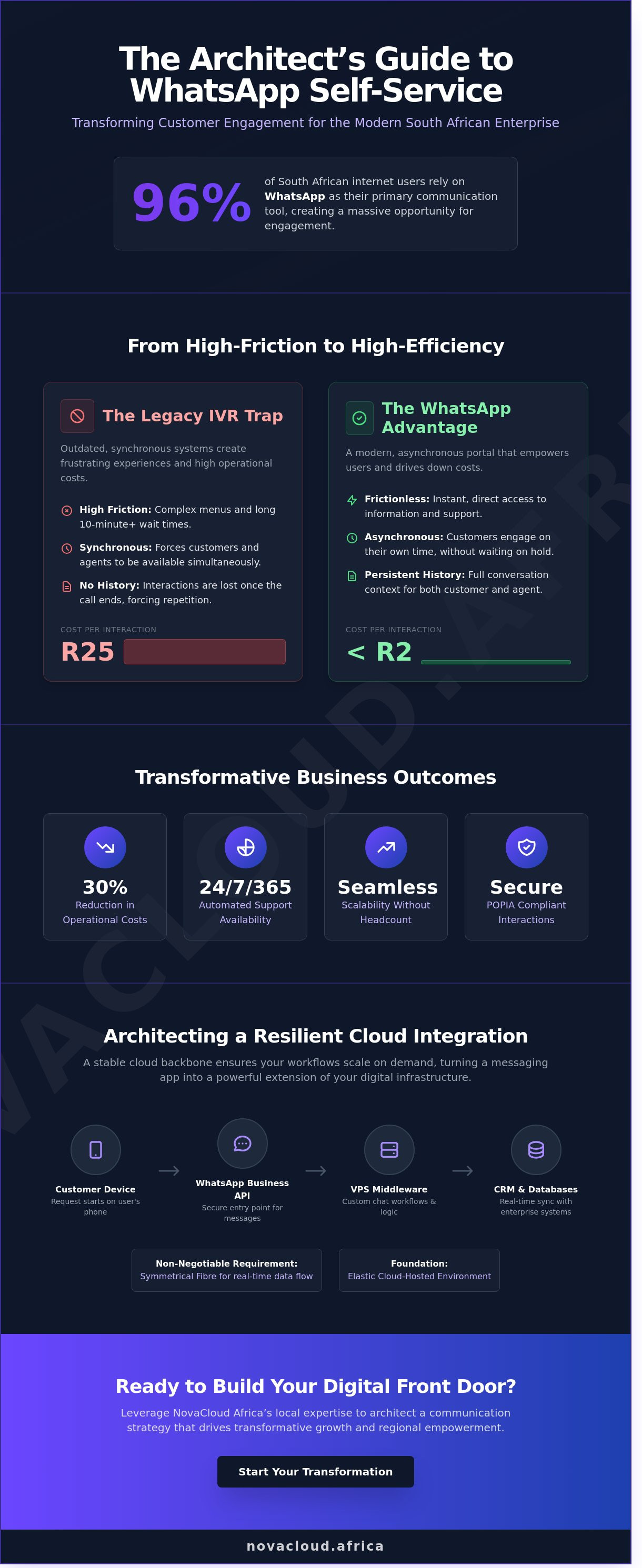
In a market where 96% of South African internet users rely on WhatsApp as their primary communication tool, why is your enterprise still forcing customers through a 10 minute IVR queue? You've likely realized that legacy systems are no longer sustainable, especially when high call volumes overwhelm your support staff and threaten the quality of your customer experience. It's a constant challenge to balance modern convenience with strict POPIA compliance, but staying stagnant is a risk your brand cannot afford.
This guide empowers you to transform your engagement strategy by integrating Whatsapp Self Service into your enterprise cloud architecture. You'll discover how to achieve a 30% reduction in operational costs while providing 24/7 automated support that feels human-centric and secure. We'll detail the roadmap for building a resilient communication infrastructure that allows for a seamless transition between intelligent bots and expert human agents. This ensures your digital transformation is both visionary and practical, positioning your business as a leader in the local digital landscape.
Key Takeaways
- Transition from outdated IVR systems to conversational AI that empowers customers with instant, asynchronous communication portals.
- Discover how to integrate a Whatsapp Self Service portal into your resilient cloud infrastructure for a seamless, unified voice-and-data experience.
- Scale your enterprise operations with 24/7/365 availability and automated document retrieval without the need to expand your support headcount.
- Follow a strategic deployment roadmap to identify high-impact use cases and select the right high-concurrency connectivity for your team.
- Leverage NovaCloud Africa’s local expertise to architect a communication strategy that drives transformative growth and regional empowerment.
The Evolution of Engagement: Defining WhatsApp Self-Service for the Modern Enterprise
WhatsApp Self-Service represents a fundamental shift in how South African organizations interact with their stakeholders. It's an automated, asynchronous communication portal designed to handle business-critical tasks without human intervention. While traditional methods relied on synchronous, high-friction channels, this new architecture allows customers to resolve queries on their own terms. In a market where mobile penetration sits at roughly 187% of the population, the platform has become the standard for digital interaction. It's no longer just a messaging app; it's a robust engine for transformative growth.
The journey from basic messaging to sophisticated enterprise tools is documented through the history and evolution of WhatsApp. For the modern enterprise, the distinction between available tools is vital. Small businesses often rely on the WhatsApp Business App, which is designed for manual, one-to-one communication. Conversely, the WhatsApp Business API enables resilient architecture and seamless integration with existing CRM and cloud systems. It's the driver behind scalable solutions that allow a single platform to serve millions of users simultaneously with quiet confidence.
Why Businesses are Migrating from Legacy IVR to Chat
The traditional IVR model, characterized by the "Press 1 for Sales" loop and repetitive on-hold music, is failing the modern consumer. Chat provides a frictionless experience that respects the user's time. Unlike a phone call that disappears once the line drops, WhatsApp maintains a persistent chat history. This continuity empowers both the customer and the agent, providing a clear audit trail of every interaction. From a budgetary perspective, the shift is transformative. Moving a routine query from a voice call to Whatsapp Self Service can reduce the cost-per-interaction from R25 to less than R2, based on local industry benchmarks. The efficiency gains are immediate and measurable.
The Role of WhatsApp in a National ICT Strategy
Digital transformation in South Africa requires solutions that account for varying connectivity speeds and high data costs. WhatsApp Self-Service aligns with national ICT goals by providing a low-bandwidth, accessible entry point for essential services. It bridges the gap between sophisticated global tech standards and the specific needs of the African market. Whether it's checking a municipal balance or tracking a delivery, the platform ensures that no citizen is left behind due to technical barriers. This local expertise ensures that digital infrastructure remains inclusive. WhatsApp Self-Service serves as the digital front door to modern business, offering a welcoming and efficient entry point for every customer.
Architecting the Integration: Connecting WhatsApp to Your Cloud Infrastructure
Building a robust Whatsapp Self Service solution requires more than just a front-end interface; it demands a resilient cloud backbone. This architecture must handle high-concurrency traffic, especially during peak retail periods where South African businesses see massive spikes in consumer engagement. A stable cloud-hosted environment provides the elasticity needed to scale resources on demand, ensuring that your automated workflows never stutter when the volume of queries rises. It's about creating a foundation that supports growth without compromising the user experience.
The engine room of this integration is the Virtual Private Server (VPS). These servers host the middleware responsible for processing custom chat workflows and logic. To maintain real-time synchronization between these chat databases and your CRM systems, symmetrical fibre is a non-negotiable requirement. This ensures that data flows at equal speeds in both directions, allowing customer information to update across your enterprise the moment a user interacts with the chat interface. This level of technical precision turns a simple messaging tool into a powerful extension of your digital infrastructure.
The Technical Stack: API, Middleware, and Database
A request begins on a user's phone, travels through the WhatsApp Business API, and lands in your local middleware hosted on a VPS. Hosting this entire stack locally in South Africa is a strategic decision that slashes latency by up to 80% compared to routing traffic through European data centers. This speed is what makes a digital interaction feel human. We integrate redundant backups at the database level to ensure that chat logs and user preferences are never lost, maintaining a continuous thread of customer history that informs every future interaction.
Bridging the Gap Between Chat and Voice
True efficiency is found in the "Human Handoff," where a digital session transitions into a vocal one. When a query exceeds the capabilities of automation, the system can trigger an immediate VoIP call via integrated Hosted PBX systems. Agents manage these interactions through unified dashboards, allowing them to view the preceding WhatsApp conversation while they speak to the customer. This synergy between data and voice is a core component of modern strategy, as explored in the Hosted PBX Providers in South Africa: The 2026 Strategic Business Guide. By removing the silos between communication channels, you empower your team to solve problems faster.
If you are ready to build a more resilient communication architecture, consider how a tailored cloud solution can stabilize your digital transformation journey.
Strategic Benefits: Why Your Enterprise Needs a WhatsApp Portal
Efficiency isn't just about working faster; it's about working smarter through architectural precision. Transitioning to a Whatsapp Self Service model allows your enterprise to transcend the limitations of traditional office hours. While a standard call center might struggle with peak volumes at month-end, a digital portal remains steady. It offers 24/7/365 availability without the overhead of a massive graveyard shift. This constant presence ensures that a customer in Cape Town or a logistics manager in Polokwane gets answers at 2 AM without waiting for a 9 AM opening bell.
The operational impact is measurable and immediate. By automating routine interactions, businesses see a sharp decline in Average Handle Time (AHT). When a bot manages the first five minutes of data gathering, human agents only step in for high-value problem solving. This shift can reduce AHT by as much as 40%, allowing your team to focus on complex queries that require a human touch. Consider these core functional advantages:
- Instant Document Retrieval: Customers can request and receive PDF invoices, BEE certificates, or account statements in seconds.
- Unmatched Scalability: A single cloud-hosted bot manages thousands of simultaneous conversations, a feat impossible for physical infrastructure.
- Reduced Operational Friction: Digital automation removes the "hold music" experience, replacing it with immediate, actionable results.
Security and POPIA Compliance in the Chat Ecosystem
Protecting data is a cornerstone of digital trust in South Africa. Every interaction within the WhatsApp ecosystem utilizes end-to-end encryption, ensuring that sensitive business intelligence remains private. Compliance with the Protection of Personal Information Act (POPIA) is baked into the workflow through explicit opt-in mechanisms. We secure backend servers behind managed firewalls, ensuring that customer interaction data is stored with the same level of rigor as your primary financial records. It's a resilient architecture designed for a high-stakes regulatory environment.
Enhancing Customer Loyalty Through Empowerment
Control is the new currency of customer satisfaction. When users solve their own problems through a Whatsapp Self Service portal, they experience a sense of empowerment that builds long-term loyalty. This proactive approach extends to outbound communication. Instead of waiting for a client to call about a delay, the system sends automated delivery updates or service outage alerts directly to their pocket. By integrating these workflows with Microsoft 365, your staff can monitor these automated journeys from the familiar interface of Teams or Outlook. This creates a seamless loop between automated efficiency and human oversight, sparking a new chapter in your brand's growth story.
Implementation Roadmap: Deploying WhatsApp Self-Service for Your Team
Deploying a robust Whatsapp Self Service portal requires a strategic shift from reactive support to proactive digital architecture. Success begins by identifying the five most frequent queries that consume your team's time. In the South African context, these typically include order tracking, account balance checks, branch locations, invoice requests, and basic troubleshooting. By automating these high-volume, low-complexity tasks, you free your human capital for high-value strategic work.
The technical foundation requires the official WhatsApp Business API rather than the standard business app. You'll need to host your logic on a high-performance VPS to ensure zero latency during peak traffic. Managed IT support plays a vital role here; they ensure your self-service portal remains online 24/7, maintaining the resilient architecture your customers expect from a modern enterprise.
Mapping the User Journey
Designing the conversation flow is where your strategy meets the user's reality. You must choose between a tree-based menu, which uses structured numerical options, and a Natural Language approach that leverages AI to understand intent. While tree-based menus offer 100% predictability for simple tasks, AI provides a more human-centric experience for complex interactions. Regardless of the choice, an "Exit to Agent" option is essential. This prevents user frustration by providing a safety net when the automation reaches its limit. The Golden Path of a self-service interaction is the most efficient, frictionless route a user takes from their initial greeting to a confirmed resolution without needing human intervention.
Connectivity and Uptime Requirements
For real-time API responses, a business-grade fibre connection is non-negotiable. If your server takes more than three seconds to respond, users will abandon the chat, often reverting to more expensive voice channels. Reliability is the cornerstone of trust in digital transformation. If your automation relies on team collaboration during complex handoffs, integrating your communication stack is vital. For businesses deciding on their underlying productivity suite, this Microsoft 365 vs Google Workspace: The 2026 Strategic Guide for SA Businesses provides clarity on which ecosystem best supports seamless agent transitions.
Before a full-scale launch, you must test and iterate. Use analytics to pinpoint exactly where users drop off. If 40% of users quit at the "Enter Account Number" stage, the prompt might be unclear or the verification process too cumbersome. Once refined, promote the channel using QR codes on physical packaging and links in email signatures to drive adoption. Moving your customers to Whatsapp Self Service isn't just a technical upgrade; it's an invitation to a more empowered digital future.
Ready to build a resilient, automated communication strategy for your business?
Explore NovaCloud’s Scalable Infrastructure SolutionsIlluminating the Path: How NovaCloud Africa Powers Your Digital Future
NovaCloud Africa positions itself as the Innovative Architect of your digital ecosystem. We don't just provide tools; we build the foundational cloud and connectivity that turn a simple messaging app into a robust WhatsApp Self Service engine. By weaving together Hosted PBX, Cloud Backups, and intelligent API integration, we create a unified communication strategy that empowers your team and delights your customers. This isn't just about technology. It's about a bright beginning, a "Nova" journey, for your operational efficiency and brand reputation.
Seamless Infrastructure for Scalable Growth
Your WhatsApp Self Service portal is only as reliable as the ground it stands on. NovaCloud provides high-performance Virtual Private Servers (VPS) and dedicated business Fibre solutions that ensure your automated scripts and APIs remain responsive during peak traffic periods. When your customer base grows by 25% or 50% in a single quarter, our infrastructure scales with you. Having a single partner for connectivity, security, and communication eliminates the friction of managing multiple vendors. Our 24/7 IT assistance means that if a technical hurdle arises at midnight, our local experts are already working on a resolution. We maintain a 99.9% uptime standard to ensure your automated customer service never goes offline, keeping your business accessible every hour of the year.
The NovaCloud Advantage: African Context, Global Standards
We understand the South African market because we operate within its unique challenges and opportunities. Our commitment to local data residency ensures your business remains fully compliant with POPIA regulations, keeping sensitive customer data within our borders while utilizing global-tier infrastructure. Unified communications shouldn't feel cold or clinical. We take a human-centric approach to ICT, ensuring that every cloud backup and PBX route serves a real, tangible business outcome.
The synergy of our services transforms fragmented processes into a streamlined, resilient machine. By integrating your communication channels, you gain a 360-degree view of customer interactions that was previously impossible. It's time to illuminate your business potential with a partner that values your growth as much as you do. We invite you to step out of the digital shadows and into a future defined by clarity and speed.
Illuminating Your Communication Architecture
The shift toward unified communications is no longer a distant vision; it's a present reality for South African enterprises seeking to dominate their market. By integrating WhatsApp Self Service into a resilient cloud architecture, your business transforms from a reactive service provider into a proactive strategic leader. You've seen how connecting this interface to local cloud infrastructure reduces latency and secures data according to the POPIA Act of 2013. Implementation requires a roadmap that balances global technical standards with the nuances of the South African ICT landscape.
NovaCloud Africa provides the high-performance local VPS hosting and expert South African support needed to bridge this gap. Our infrastructure ensures your data stays within borders while your reach expands across the continent. It's time to move beyond fragmented tools and embrace a cohesive digital ecosystem. Architect your unified communication strategy with NovaCloud Africa. The future of enterprise engagement is bright, and it's built on the foundations of clarity and local expertise.
Frequently Asked Questions
Is WhatsApp Self-Service POPIA compliant for South African businesses?
Yes, WhatsApp Self Service is fully POPIA compliant when implemented through official business API channels. We ensure that your customer data remains protected via end-to-end encryption and secure cloud protocols. Since the Information Regulator began enforcing POPIA on 1 July 2021, South African businesses must secure personal information. Our architecture keeps your communication resilient and legally sound within the local regulatory framework.
How does WhatsApp Self-Service integrate with my existing Hosted PBX?
Your portal integrates seamlessly with existing Hosted PBX systems through specialized API bridges. This creates a unified communication hub where voice and messaging data converge into a single stream. You can trigger automated WhatsApp notifications based on call outcomes or route customers from a voice IVR to a chat interface. This synergy ensures your digital infrastructure remains cohesive and scalable as your enterprise expands.
Do I need a dedicated phone number for WhatsApp Self-Service?
You need a dedicated mobile or landline number that isn't currently linked to a personal WhatsApp account. We recommend using your existing South African business landline to maintain brand consistency across all touchpoints. This allows customers to save one number for both voice calls and automated chat services. Once verified via the API, this number becomes the resilient anchor for your entire digital customer journey.
Can WhatsApp Self-Service handle document uploads and downloads?
WhatsApp Self Service handles a variety of file formats including PDFs, JPEGs, and PNGs for instant document sharing. Customers can download monthly invoices or upload proof of payment directly within the chat interface. This functionality eliminates the 24 hour delay often associated with traditional email correspondence. It transforms a simple chat into a powerful tool for administrative efficiency and rapid service delivery.
What happens if the automated bot cannot answer a customer’s question?
The system automatically triggers a seamless handoff to a live agent if the bot encounters a query it can't resolve. We configure specific keywords or sentiment triggers to ensure customers never feel stranded in a loop. Statistics show that 80% of routine queries are solved by automation, but the remaining 20% receive immediate human attention. This hybrid approach ensures your business maintains a professional and supportive presence at all times.
What is the difference between the WhatsApp Business App and the WhatsApp Business API?
The WhatsApp Business App is designed for small retail shops with limited message volumes and manual responses. In contrast, the WhatsApp Business API is a scalable solution built for medium to large South African enterprises requiring complex automation and multiple user access. While the app is a standalone tool, the API offers advanced features like automated workflows and deep integration with your CRM. It's the engine behind true digital transformation.
How much data does a customer need to use a WhatsApp self-service portal?
A typical text interaction on a WhatsApp portal consumes less than 10KB of data per message. Even with document exchanges, the data footprint remains significantly lower than browsing a traditional mobile website. This accessibility is crucial in the South African market where data costs impact consumer behavior. It ensures your services remain reachable for the 22 million active WhatsApp users across the country without financial strain.
Can I use WhatsApp Self-Service for internal employee support?
You can absolutely deploy these portals for internal functions like HR queries or IT support tickets. Employees can check leave balances or report technical issues through a familiar interface they already use every day. This internal application of cloud technology boosts operational efficiency and streamlines corporate communications. It's a visionary way to empower your workforce using the same resilient tools you provide to your customers.
