


Managing Multiple Business Locations with Cloud PBX: A Strategic 2026 Guide

What if the physical distance between your regional offices was no longer a barrier to operational clarity? For many growing enterprises, managing multiple business locations with cloud PBX has shifted from a technical luxury to a strategic necessity. You've likely felt the friction of fragmented systems; the administrative burden of juggling different telco contracts and the frustration of high costs for calls between your own branches. It's a disjointed experience that often leaves customers feeling like they're dealing with separate companies rather than a unified brand.
You know that true growth requires a communication architecture that's as agile as your vision. We're here to help you move beyond the limitations of legacy hardware and the 90-day copper retirement notices that are currently accelerating the digital shift. This guide explores how to transform your distributed operations into a seamless, high-performance network. You'll discover how a centralized dashboard and serverless infrastructure can provide 99.99% uptime while ensuring a uniform brand experience. We'll walk through the technical evolution of UCaaS, the impact of 2026 regulatory shifts like the FCC's new KYC rules, and the path to a scalable future where adding a new location is as simple as clicking a button.
Key Takeaways
- Discover how to replace fragmented telco contracts with a single centralized dashboard for total visibility over your national communication network.
- Learn to eliminate inter-office billing and legacy hardware maintenance by leveraging the borderless nature of SIP Trunking and virtualized voice.
- Master the strategic balance of global oversight and local autonomy when managing multiple business locations with cloud PBX to empower your regional managers.
- Follow a proven, phase-by-phase implementation roadmap that ensures zero downtime during your transition to a modern cloud-first architecture.
- Understand how a virtualized voice network serves as a scalable engine for business growth, allowing for instant deployment at every new branch opening.
The Complexity of Multi-Site Communication: Beyond Geographic Boundaries
Scaling a business across provincial or national borders is a testament to your vision, yet it often introduces a silent friction: the emergence of communication silos. When branches operate on independent, legacy systems, they become isolated islands of data. This fragmentation doesn't just hinder internal collaboration; it actively erodes customer trust. A client calling your Johannesburg office expects the same level of insight and brand personality they experienced in Port Elizabeth. When they don't get it, the brand feels disjointed and unreliable.
Managing multiple business locations with cloud PBX represents a shift from merely maintaining local hardware to orchestrating a unified digital presence. In the current 2026 landscape, where the FCC has reduced copper retirement notice periods to just 90 days, the move toward Cloud communications has become a matter of strategic survival. It's about creating a single, seamless constellation where every touchpoint is aligned, regardless of the physical distance between offices. This alignment ensures that your brand's voice remains clear and consistent, no matter where the call is answered.
The Fragmentation Trap in National Operations
Separate systems inevitably lead to data leakage. When call logs, customer interactions, and team availability aren't synchronized, high-value opportunities often slip through the cracks. Beyond the technical loss, there's a psychological weight to isolation. Teams that can't easily reach their counterparts in other regions often feel disconnected from the central mission. Transitioning to a proactive national strategy ensures that every employee, whether in a flagship city or a remote satellite office, feels like a vital part of the whole. It's about replacing reactive local fixes with a resilient, shared architecture that empowers every branch to perform at its peak.
Economic Realities of Traditional Telco Models
Legacy PABX systems are a significant drain on capital and operational resources. Between multiple line rentals, ongoing maintenance contracts, and hardware that depreciates the moment it's installed, the "hidden" costs are substantial. These systems also impose a scalability ceiling. Rapid expansion becomes an administrative nightmare when every new branch requires its own physical infrastructure and separate telco negotiations. By adopting Hosted PBX solutions, you remove these barriers, allowing your infrastructure to grow as fast as your market reach. The geographic tax on South African SMEs is the compounded cost of maintaining redundant, disconnected hardware across provincial borders while paying for inter-branch calls that should be free.
How Cloud PBX Architectures Unify Distributed Business Environments
Imagine a communication system where physical hardware no longer dictates your operational boundaries. Cloud PBX is a virtualized phone architecture that lives in secure, high-availability data centers, accessible from any branch with a stable internet connection. When you're managing multiple business locations with cloud PBX, you're essentially installing a single, powerful digital 'brain' that manages every call for every site. This centralized logic means that whether a customer calls your Durban storefront or your Cape Town warehouse, the system processes that interaction with the same intelligence and routing rules.
The magic behind this borderless network is SIP Trunking. It acts as the bridge between your digital infrastructure and the traditional phone network, allowing for a seamless flow of voice data without the need for physical lines at every location. To maintain this level of performance, it's vital to build on business-grade cloud infrastructure. This foundation ensures 99.9% uptime, providing the stability your enterprise needs to remain always-on and always-reachable. It's about creating a resilient environment where your communication tools are as ambitious as your growth targets.
The Virtualised Advantage: One System, Infinite Reach
A single national number can now serve as the gateway to your entire organization. You can route calls to any branch based on the time of day or staff availability, ensuring that no customer is left waiting. Cloud-based queuing effectively eliminates the dreaded 'busy tone', replacing it with professional, brand-aligned wait experiences. For your team on the ground, integrating this system with hardware like the Yealink T31P IP Phone provides the executive-level clarity and reliability required for high-stakes business communication. It's a professional setup that scales instantly as you open new doors.
Quality of Service (QoS) and Latency Management
Crystal-clear voice quality across a distributed network isn't an accident; it's a result of deliberate architecture. Symmetrical Business Fibre serves as the backbone of this ecosystem, providing the consistent upload and download speeds necessary for high-definition voice. By utilizing local server placement, we significantly reduce voice lag, ensuring that conversations feel natural and immediate. We also implement strict packet prioritization, which means your voice traffic never has to compete with large file downloads or background data updates. If you're ready to align your branches into a single, high-performance constellation, you might want to explore how Hosted PBX can redefine your reach.
Centralised Management vs. Local Autonomy: Finding the Strategic Balance
The true power of modern digital infrastructure lies in its ability to offer total visibility without descending into micromanagement. When managing multiple business locations with cloud PBX, executives gain access to a "single pane of glass." This unified dashboard displays the live pulse of the entire national network, from the busiest urban hubs to the quietest regional satellites. This centralized view doesn't strip local managers of their agency. Instead, it provides them with site-specific reporting that allows them to optimize their own local operations. It's a collaborative model where data flows upward to inform global strategy while empowering local teams to act with precision.
Standardization acts as the anchor for brand identity in a distributed world. You can enforce a uniform "Customer Greeting" across every branch, ensuring that the brand experience remains identical whether a caller reaches a satellite office or the headquarters. This coherence builds deep customer trust. Beyond aesthetics, this centralized "brain" enables dynamic call routing that maximizes human resources. If your Johannesburg office is overwhelmed during a peak period, the system can automatically shift the call load to an idle team in the Western Cape. This fluid orchestration ensures that no call goes unanswered and every customer interaction receives the attention it deserves.
Global Visibility: Real-Time Analytics for the Modern Architect
Real-time analytics transform how architects of business growth make decisions. By tracking call volumes and response times across the national footprint, you can identify "dead zones" where customer service may be lagging. This isn't about surveillance; it's about empowerment. With precise data from centralized logs, you can justify staffing levels at specific sites. It allows you to move away from guesswork and toward a model where resources are allocated based on documented demand and regional performance metrics.
Security and Compliance Across the Network
In a distributed network, security must be handled as a unified front. Ensuring compliance with regulations like POPIA for call recordings across all branches becomes a streamlined administrative task rather than a regional nightmare. It's also vital for meeting the 2026 FCC "Know-Your-Customer" (KYC) requirements, which demand rigorous verification of customer information across all high-volume accounts. Protecting multi-site VoIP traffic requires a Managed Firewall to act as a digital shield for your entire communication constellation. Centralized security updates mean a single patch protects every location simultaneously, ensuring no branch remains a weak link.
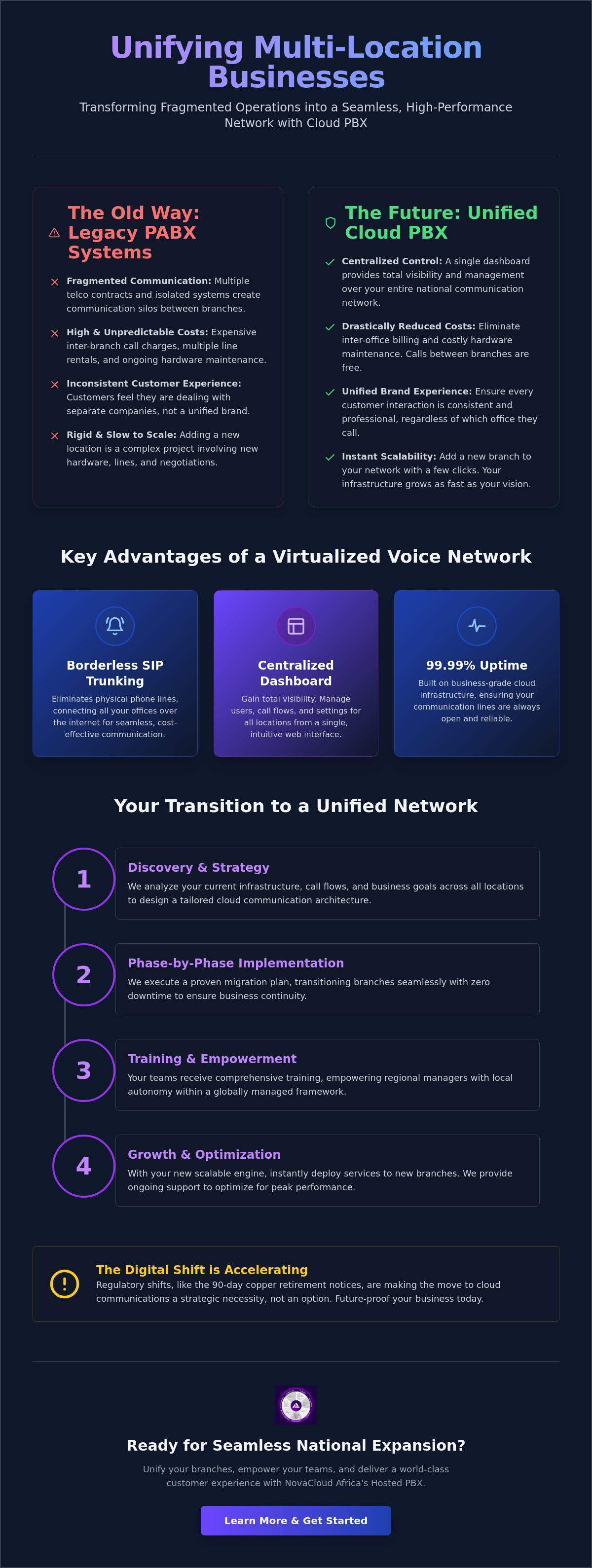
Implementation Roadmap: Transitioning Your Multi-Branch Network
A successful transition to a unified voice network requires a meticulous roadmap that prioritizes business continuity. When managing multiple business locations with cloud PBX, the goal is to shift your entire national footprint toward a more resilient architecture without disrupting daily operations. This isn't a single event but a coordinated series of strategic moves. We begin by auditing your existing infrastructure to ensure every branch is ready for the digital leap. By moving in calculated waves, you can verify the success of each migration before proceeding to the next, maintaining a steady pulse across your organization.
Training your teams on these new unified communication tools is just as critical as the technical setup. A workforce that understands how to leverage centralized features will drive the ROI of your digital evolution. We also prioritize the testing of failover mechanisms. In an era where 99.99% uptime is the expected standard for cloud infrastructure, ensuring that your business remains online even if a local link drops is non-negotiable. This proactive approach transforms a potentially complex rollout into a smooth, empowering journey toward national connectivity.
Step 1: The Connectivity Foundation
The strength of your voice network is entirely dependent on the quality of your underlying connection. We start by verifying symmetrical upload and download speeds at every physical site. This ensures that voice packets travel with the same priority and speed in both directions. To provide robust in-office signal distribution, we implement Ubiquiti networks, creating a stable environment for every device. Establishing redundant links is the final piece of this foundation, preventing "dark sites" during unexpected local outages and keeping your communication constellation bright. If you're ready to audit your current infrastructure, you can request a connectivity assessment today.
Step 2: Unified Configuration and Deployment
Once the foundation is secure, we focus on the logic of your network. This involves configuring Hosted PBX auto-attendants and ring groups to match your brand's specific workflow. We deploy pre-configured Yealink T31P hardware, which allows for a true plug-and-play setup at each branch. Zero Touch Provisioning simplifies national rollouts by allowing devices to automatically download their specific configurations the moment they are connected to the internet, removing the need for on-site technical expertise.
NovaCloud Africa Hosted PBX: Your Catalyst for Seamless National Expansion
Expanding your national footprint should feel like a natural evolution, not a logistical burden. At NovaCloud Africa, we position our Hosted PBX systems as the high-performance engine of modern business growth. We understand that managing multiple business locations with cloud PBX is about more than just routing calls; it's about architecting a system that reflects your vision for a unified, professional enterprise. Our approach merges deep technological authority with a human-centric support model, ensuring that while your systems are advanced, your experience remains personal and grounded.
Scalability is the hallmark of our architecture. In the legacy world, opening a new branch meant weeks of waiting for physical line installations and hardware configurations. With the cloud-first model provided by NovaCloud Africa, you can add a new location to your network in minutes. This agility allows you to respond to market opportunities with unprecedented speed. We don't just provide a service; we act as a strategic ally, designing communication ecosystems that evolve alongside your business goals. It's a partnership built on the promise of stability and the excitement of future possibilities.
Why South African Enterprises Choose NovaCloud Africa
Our strength lies in the juxtaposition of deep local expertise with international infrastructure benchmarks. We understand the specific challenges of the South African market, from connectivity nuances to regional regulatory requirements. The 24/7 technical assistance from NovaCloud Africa isn't a distant call center; it's a dedicated extension of your own team, ready to ensure your operations never miss a beat. We are committed to what we call "celestial clarity." This involves maintaining the highest standards of voice quality and system uptime, ensuring your business communication is always luminous, reliable, and professional.
Ready to Align Your Business Constellation?
The transition from legacy Telkom lines or aging on-premise PABX setups is often the first step toward true operational renewal. We invite you to a strategic consultation with NovaCloud Africa to explore how your multi-site network can be unified into a single, seamless constellation. Our migration process is designed for ease, handling the technical complexities so you can focus on your core mission. It's time to move beyond the fragmentation of the past. Embrace a fresh start in business efficiency where every branch, every team, and every customer interaction is guided by the clarity of the cloud.
Unifying Your National Voice for a Scalable Future
The transition toward a unified communication architecture is more than a technical upgrade; it's a strategic commitment to national agility. We've explored how moving beyond fragmented silos allows for a "single pane of glass" dashboard that provides total visibility over your entire network. By leveraging centralized logic and borderless SIP trunking, your enterprise can eliminate the "geographic tax" of legacy telephony while ensuring a uniform brand experience for every customer interaction.
Successfully managing multiple business locations with cloud PBX requires a balance of centralized oversight and local empowerment. This approach ensures that your organization remains resilient in the face of 2026 regulatory shifts and infrastructure changes. With our specialized Yealink T31P IP Phone integration and a commitment to 99.9% uptime on Hosted PBX infrastructure, your digital evolution is in expert hands. Our team provides the expert Managed IT assistance necessary for smooth national rollouts, allowing you to focus on your core mission of expansion.
Architect your unified communication strategy with NovaCloud Africa
Your path to a more connected, efficient, and luminous business future starts with a single, strategic step toward digital clarity.
Frequently Asked Questions
How does Cloud PBX handle calls if one branch loses internet connectivity?
Cloud PBX ensures business continuity by automatically rerouting calls to mobile devices or alternative branches if a local internet connection fails. Because the system's intelligence resides in a high-availability data center rather than a physical closet, your communication flow remains uninterrupted. This failover mechanism is a core component of managing multiple business locations with cloud PBX, providing a resilient safety net that legacy systems simply cannot match.
Can I keep my existing local branch numbers when moving to a Cloud PBX?
You can absolutely retain your existing local branch numbers through a process called geographic number porting. This allows you to maintain your established local presence and customer trust while gaining the benefits of a unified national network. Your customers will continue to dial the numbers they know, but your team will answer them on a modern, high-performance digital platform that spans all your locations.
What is the minimum internet speed required for high-quality multi-site VoIP?
High-quality voice calls typically require approximately 100kbps of symmetrical bandwidth per concurrent call. However, for a robust multi-site environment in 2026, we recommend a dedicated Business Fibre connection to ensure consistent Quality of Service (QoS). This prevents voice traffic from competing with heavy data transfers, ensuring that every conversation remains crystal clear across your entire provincial or national network.
Is it possible to have different office hours and greetings for different locations?
Yes, the centralized dashboard allows you to configure unique office hours, public holiday schedules, and custom greetings for each specific branch. This flexibility ensures that a Cape Town office can operate on a different schedule than a Johannesburg hub while still remaining part of the same communication constellation. It's the perfect blend of global brand consistency and local operational autonomy.
How much can a multi-site business expect to save by switching to Cloud PBX?
Businesses typically see a substantial reduction in operational expenses by eliminating inter-branch call charges and the high cost of maintaining legacy PABX hardware. While specific savings vary based on call volume, the transition to a per-user monthly model removes the "geographic tax" of traditional telephony. Managing multiple business locations with cloud PBX turns communication from a capital-heavy burden into a predictable, scalable operational asset.
Do I need to buy new hardware for every branch when migrating to NovaCloud Africa?
Migrating to NovaCloud Africa doesn't always require a complete hardware overhaul, as the system supports a wide range of IP-enabled devices and softphones. However, integrating specialized hardware like the Yealink T31P IP Phone ensures your team can access the full suite of advanced features with executive-level clarity. We work with you to audit existing equipment and determine the most efficient path for your national rollout, ensuring your investment is both strategic and sustainable.
How does Cloud PBX improve the customer experience for a national business?
Cloud PBX creates a seamless, professional interaction by replacing busy tones with intelligent queuing and brand-aligned greetings. Customers experience a unified brand voice regardless of which branch they call, and intelligent routing can direct them to the most available expert in your company. This level of responsiveness builds deep trust and positions your business as a sophisticated, customer-centric national entity.
Is Cloud PBX secure enough to handle sensitive customer data across multiple sites?
Security is baked into the architecture through encrypted voice traffic and integration with a Managed Firewall at each site. Our systems are designed to help you meet rigorous 2026 standards, including POPIA compliance for call recordings and the FCC's "Know-Your-Customer" verification rules. This multi-layered defense ensures that sensitive customer data remains protected as it moves across your distributed digital infrastructure.
