


POPIA Requirements for Data Backup and Recovery: A 2026 Strategic Guide

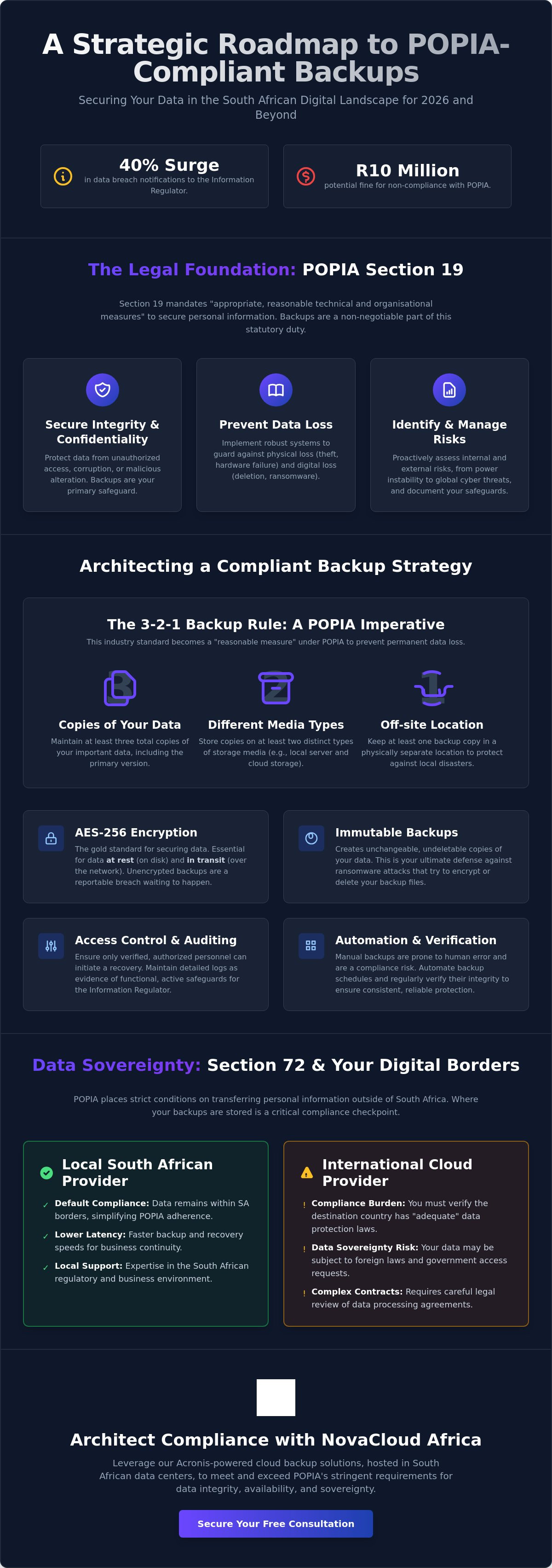
With data breach notifications to the Information Regulator surging by 40% in 2026, the margin for error in South African digital infrastructure has vanished. You've likely felt the weight of the potential R10 million fine hanging over your operations, wondering if your current systems actually meet the specific POPIA requirements for data backup and recovery or if they're just basic insurance against a server crash. It's a common anxiety to feel caught between the need for global cloud scale and the strict mandates of local data sovereignty.
We're here to bring clarity to that complexity. By mastering the technical and legal intersections of the act, you can transform your backup strategy into a powerful catalyst for regional growth. This guide provides a strategic roadmap for 2026, including a checklist of compliant features and a clear look at the legal necessity of disaster recovery. You'll gain the confidence to partner with a South African provider like NovaCloud Africa to secure your data while fueling your business's next chapter of renewal and expansion.
Key Takeaways
- Decode Section 19 to understand why resilient backups are a legal mandate for maintaining data integrity and organizational stability.
- Master the specific POPIA requirements for data backup and recovery by integrating AES-256 encryption and the strategic "3-2-1" rule into your architecture.
- Secure your digital borders by verifying that your cloud storage strategy meets the Section 72 adequacy test for international data transfers.
- Transform your disaster recovery plan into a compliant framework that guarantees data availability through precise Recovery Time Objective metrics.
- Discover how a localized approach using Acronis Cloud technology provides the immutable protection necessary for the modern South African business landscape.
The Legal Foundation: Section 19 and Security Safeguards
Section 19 of the Protection of Personal Information Act (POPIA) is the cornerstone of modern data protection. It mandates that organizations implement appropriate, reasonable technical and organisational measures. This isn't a vague suggestion. It's a specific legal instruction to protect the integrity and confidentiality of personal information. For any modern business, understanding POPIA requirements for data backup and recovery starts with this legal foundation. You aren't just saving files; you're fulfilling a statutory duty to ensure that data remains accurate, accessible, and shielded from harm.
The act demands a dual approach. You must prevent the physical or digital loss of data while simultaneously preventing unauthorised access to that data. Backups are the primary safeguard for data integrity because they provide a clean point of truth. If a primary database is corrupted or deleted, the backup is the only way to restore the information to its original, lawful state. Without a resilient backup architecture, you can't guarantee the integrity that the law requires.
POPIA Section 19 serves as the definitive technical benchmark for South African data resilience, requiring responsible parties to secure the integrity and confidentiality of personal information through proactive risk management.
Identifying Internal and External Risks
Compliance begins with a clear-eyed assessment of your current storage environment. In the South African context, reasonable measures must account for unique physical threats like prolonged power instability or hardware theft, alongside global digital threats like ransomware. You need to evaluate where your data lives and who can touch it. Encryption is no longer optional in this framework. Implementing strong encryption for data at rest ensures that even if a physical drive is stolen or a cloud bucket is breached, the personal information remains unreadable and protected.
Maintaining Integrity and Confidentiality
True security involves more than just copying data. It requires maintaining the state of that data. Immutable backups are a vital tool here; they ensure that once data is written to the backup, it cannot be altered or deleted for a set period. This prevents unauthorised personnel or malicious software from tampering with your records. Access control is equally critical. You must ensure only verified, authorised individuals have the permissions to initiate a recovery process. Finally, POPIA requirements for data backup and recovery include regular auditing of your backup logs. These logs serve as your evidence to the Information Regulator that your safeguards are active and functional.
POPIA Requirements for Data Backup Configuration
Moving from legal theory to technical execution requires a shift in how you view your digital archives. Architecting a compliant environment goes beyond simply purchasing high-capacity drives; it's a commitment to stability and technical precision. To meet the POPIA requirements for data backup and recovery, your configuration must prioritize modern standards like AES-256 bit encryption. Relying on basic passwords in 2026 isn't just risky. It's a failure of your duty to protect data subjects. Strong encryption ensures that your data remains a private asset, even if the underlying hardware is compromised.
The classic 3-2-1 backup rule takes on a new level of importance through a regulatory lens. You should maintain three copies of your data on two different media types, with at least one copy stored off-site. This redundancy is a "reasonable measure" that prevents the permanent loss of personal information. Manual backups represent a significant compliance risk because they're prone to human error. Automation brings the clarity and consistency needed to ensure no data is left behind. However, automation without proof is invisible to the law. You must maintain detailed documentation of your backup schedules to remain accountable. Referencing the Information Regulator's guidance notes can help you align your internal records with official expectations for transparency.
Encryption and Data Masking
End-to-end encryption is essential for any data bound for the cloud. It's not enough to encrypt the file at rest; it must be shielded during transit to prevent interception. Key management is the heart of this process. If you don't hold the power to unlock your own data, you haven't fully secured it. Unencrypted backups are essentially reportable breaches waiting for a trigger. If an unauthorized party gains access to an unencrypted archive, the exposure is immediate and absolute. Implementing robust cloud backups with built-in encryption can provide a fresh start for your business efficiency and peace of mind.
Verification and Testing
The law requires that your technical safeguards are regularly verified for effectiveness. There's a massive gap between a successful backup and a verifiable recovery. A backup is just a saved file, but a recovery is a restored business process. You must set a strict cadence for restoration tests to prove that your systems actually work when needed. These tests satisfy the Information Regulator that your "availability" mandate is being met. Regular testing sheds light on hidden risks in your infrastructure, allowing you to fix vulnerabilities before they become liabilities. It's about moving from the hope of recovery to the certainty of total data resilience.
Data Sovereignty and Section 72: Where is Your Backup?
In a world without borders, your data still has a home. For many South African organizations, the physical location of their backup servers remains a mystery. This ambiguity is a significant risk under Section 72 of the Protection of Personal Information Act (POPIA). This specific section dictates how and when personal information can leave our borders. Understanding these rules is essential to meeting the broader POPIA requirements for data backup and recovery. You must be certain that your data's destination doesn't compromise its legal protection.
Section 72 establishes what is known as the "Adequacy" test. You can't simply move data to any cloud; the recipient country must offer a level of protection that matches South African standards. If the country doesn't meet this bar, you need a binding agreement or explicit consent from the data subject. This creates a complex web of legal paperwork that can stall your digital momentum. Choosing local South African cloud hosting eliminates this friction. It keeps your data within the jurisdiction of the Information Regulator, simplifying your compliance journey and ensuring your infrastructure remains a stable foundation for growth.
Your relationship with a backup provider must be governed by a clear, written contract. Under the law, the provider acts as an "Operator" while you remain the "Responsible Party." This contract must mandate that the operator maintains the same security standards you've committed to. It's about building a chain of trust that extends from your local office to the server rack. When your provider is local, these contractual obligations are easier to enforce and audit.
The Risks of International Cloud Storage
When you store data internationally, you're often subject to the laws of that host nation. Some jurisdictions allow government access to data without the level of oversight we enjoy locally. This can compromise your control over sensitive records. It's vital to distinguish between your role and the provider's role. A deep dive into business-grade cloud infrastructure reveals how these relationships should be structured to protect your interests. Without this clarity, your international backups might satisfy a technical need while creating a massive legal liability.
The Advantage of Local Data Residency
Local data residency isn't just about rules; it's about performance. Storing backups in South African data centres significantly reduces latency, making recovery energetic and purposeful. This proximity also supports the "right to access" and the "right to be forgotten." When data is local, fulfilling a subject's request to view or delete their information is straightforward and verifiable. You must ensure your provider is a registered "Operator" under South African law. This alignment ensures that your technical executor is fully aware of their domestic obligations, helping you satisfy the POPIA requirements for data backup and recovery through localized expertise.
Disaster Recovery: Meeting the "Availability" Mandate
Condition 7 of the Protection of Personal Information Act focuses on specific security safeguards, but it carries a heavy implication for your daily business continuity. It mandates that personal information must remain accessible so that data subjects can exercise their legal rights without delay. If your systems fail and you can't produce records because your infrastructure is offline, you've likely failed to meet the POPIA requirements for data backup and recovery. Having a copy of your data is only the first step. True compliance is found in your proven ability to restore that data within a timeframe that respects the law's intent.
Recovery Time Objective (RTO) serves as a vital compliance metric in this framework. It defines the maximum tolerable duration of an outage before it causes significant harm or results in a regulatory breach. A backup without a tested recovery plan is merely a collection of silent files; it offers no protection against the fallout of a prolonged service disruption. Under the Act, the continuous availability of personal information is a fundamental right that ensures data subjects maintain control over their digital identity at all times.
RPO and RTO in the Compliance Framework
Defining how much data loss is "reasonable" depends heavily on your specific industry and the sensitivity of the information you handle. A healthcare provider might require an RPO of mere minutes to ensure patient safety, while a professional services firm might tolerate a few hours. You must balance the cost of high-speed recovery against your legal obligations to ensure your POPIA requirements for data backup and recovery are met with precision. Proactive network defense is your best first line of support. Integrating a Managed Firewall helps neutralize threats like ransomware before they ever force you into a recovery crisis.
The Disaster Recovery Plan (DRP)
A robust DRP is a mandatory element of your compliance architecture that turns technical hope into operational certainty. It should clearly outline the step-by-step procedures for restoring critical systems and designate specific roles for your response team. Your Information Officer plays a pivotal role here, acting as the strategic bridge between technical execution and legal accountability during a recovery crisis. For a deeper look at how to build these resilient systems, explore our guide on Strategic Data Resilience. It's time to move beyond the uncertainty of basic backups and toward the quiet confidence of a fully resilient organization.
Ensure your business remains operational and compliant by securing your infrastructure with our professional cloud backups today.
Architecting Compliance with NovaCloud Africa Cloud Backups
Achieving total compliance requires a transition from fragmented tools to a unified architecture. NovaCloud Africa Cloud backups are meticulously engineered to satisfy the rigorous POPIA requirements for data backup and recovery within the unique South African regulatory environment. We don't just provide storage; we design systems of stability that empower your organization to look toward the future with quiet confidence. By utilizing Acronis Cloud technology, we ensure your data remains immutable and shielded by the highest standards of encryption, creating a fresh start for your digital efficiency.
Working with a local strategic ICT partner like NovaCloud Africa offers a distinct advantage. We understand the nuances of the Information Regulator's expectations because we operate in the same territory. This geographic presence means your data sovereignty is never in question. We bridge the gap between international benchmarks and localized context, ensuring your technical execution is as sophisticated as your business strategy. It's about clarity. It's about readiness. We provide the technical authority needed to turn compliance from a burden into a competitive strength.
Acronis Cloud: The Technical Compliance Vehicle
Acronis Cloud serves as the definitive technical vehicle for your compliance journey. It integrates AI-based threat detection that identifies and neutralizes ransomware before it can compromise your archives. This proactive stance is essential for maintaining the integrity mandated by Section 19. Additionally, granular recovery options allow you to fulfill "Right to Erasure" requests with surgical precision, removing specific data points without destabilizing your entire backup set. This level of control is a core component of modern POPIA requirements for data backup and recovery. Automated compliance reporting simplifies internal audits, providing the clarity needed to prove your resilience at a moment's notice.
Empowering Your Digital Evolution
Compliant backups are more than a legal safety net. They are the launchpad for a scalable, visionary enterprise. When your foundation is secure, you can innovate with speed and purpose. Professional IT Assistance ensures that your digital evolution remains in expert hands, allowing your leadership to focus on growth rather than vulnerability. This is your moment to move beyond the fear of non-compliance and embrace a future of renewal. You have the opportunity to lead your sector by demonstrating a commitment to data dignity and regional progress.
Architect your POPIA-compliant backup strategy with NovaCloud Africa today.
Empowering Your Digital Future Through Strategic Resilience
The path to total compliance is paved with technical precision and a deep commitment to data dignity. By aligning your architecture with the specific POPIA requirements for data backup and recovery, you transition from a state of uncertainty to one of visionary readiness. You've mastered the necessity of Section 19 safeguards and the critical importance of keeping your data sovereign within South African borders. True resilience isn't just about preserving archives; it's about guaranteeing the availability of information through tested, purposeful recovery frameworks.
This digital evolution requires a strategic ally who understands the specific needs of our regional market. We invite you to secure your business with POPIA-compliant Cloud Backups from NovaCloud Africa. Our systems leverage high-performance Acronis Cloud integration and guaranteed South African data residency to keep your operations stable and legally sound. Supported by our expert IT Assistance, your journey toward a more efficient and compliant future is in the hands of NovaCloud Africa. Embrace the clarity of a fresh start and lead your organization into its next chapter of growth with absolute confidence.
Frequently Asked Questions
Is data backup a mandatory requirement under POPIA?
Yes, data backup is a mandatory component of your technical safeguards under Section 19. While the Act doesn't use the word "backup" explicitly, it requires you to secure the integrity of personal information against accidental loss or destruction. Implementing robust POPIA requirements for data backup and recovery ensures you can restore a clean point of truth if your primary systems fail. It's a foundational step toward building a resilient digital architecture.
How long must I retain backup data according to POPIA requirements?
POPIA requires that you don't retain personal information longer than necessary to achieve the original purpose of collection. This applies to your backup archives just as much as your active databases. You must align your backup rotation and deletion cycles with your organization's primary data retention policy. Maintaining a clear schedule ensures you don't inadvertently store "ghost data" that increases your legal liability during an audit or breach.
Does POPIA allow me to store my backups on servers outside of South Africa?
You can store backups internationally only if you satisfy the strict conditions of Section 72. The recipient country must provide an adequate level of data protection, or you must have a binding agreement in place with the provider. Many organizations find that local South African cloud hosting is the most efficient path. It eliminates the complexity of cross-border legal checks and ensures your data residency remains firmly under local jurisdiction.
What happens if my backup is breached by ransomware?
A ransomware breach of your backup is a reportable security compromise under Section 22. You're legally required to notify the Information Regulator and the affected data subjects as soon as reasonably possible. This event highlights why immutable backups are essential. If your archives are encrypted and unchangeable, you can recover your systems without paying a ransom, significantly reducing the impact of the breach on your organizational stability and reputation.
Is a simple external hard drive backup POPIA compliant for a business?
A simple external hard drive is rarely sufficient to meet the technical standards required by the Act. These devices often lack essential features like automated AES-256 encryption, granular access controls, and off-site redundancy. To satisfy the POPIA requirements for data backup and recovery, your solution must be professional and verifiable. Relying on manual, unencrypted hardware introduces human error and physical theft risks that the Regulator likely won't consider "reasonable" protection.
What is the role of an Information Officer in data backup and recovery?
The Information Officer serves as the strategic architect of your compliance framework. They're responsible for ensuring that backup policies are not only written but actively followed across the enterprise. In a recovery crisis, they manage the communication flow and ensure that all actions align with the Disaster Recovery Plan. Their role is to transform technical recovery efforts into a coordinated response that protects the rights of every data subject involved.
How often does POPIA require me to test my data recovery systems?
POPIA mandates that technical measures are regularly verified and evaluated for effectiveness. While the Act doesn't specify a weekly or monthly cadence, industry standards for high-impact sectors often require quarterly restoration tests. You must be able to prove that your backups actually function when needed. Regular testing provides the clarity required to identify vulnerabilities in your recovery process before they escalate into a full-scale compliance failure.
Can I be fined if I have a backup but no disaster recovery plan?
You can certainly face penalties if your lack of a disaster recovery plan prevents data from being available. Condition 7 emphasizes that personal information must be accessible to data subjects. If a system failure occurs and you have no plan to restore services, you've failed the "availability" mandate. The Regulator can issue enforcement notices or fines of up to R10 million for serious failures to protect the rights and access of data subjects.
