


Ransomware Protection in 2026: Myth-Busting the Architecture of Cyber Resilience

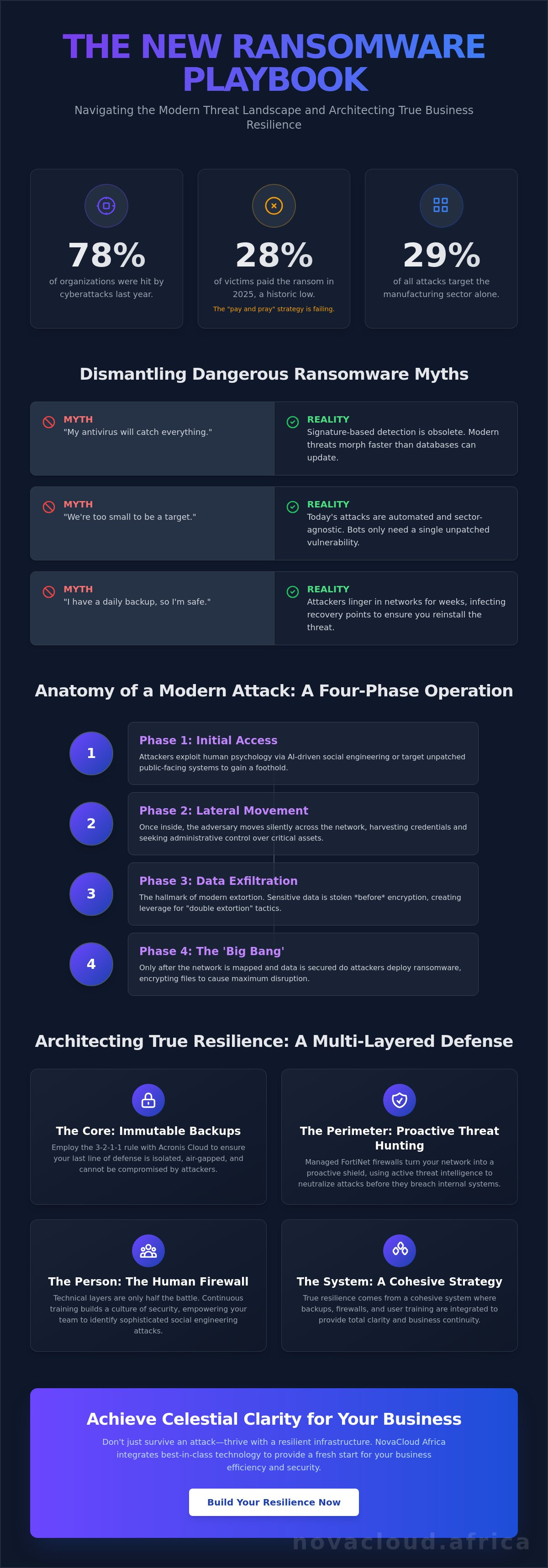
Did you know that while 78% of organizations were hit by attacks last year, the percentage of victims who actually paid the ransom dropped to just 28% in 2025? This shift proves that the old playbook of pay and pray is dead, replaced by a sophisticated need for true ransomware protection that prioritizes business continuity over mere survival. You likely feel the mounting pressure of POPIA compliance and the sting of rising cyber insurance premiums, wondering if your current backups are actually enough to withstand an AI-driven phishing campaign. It's a valid concern when the manufacturing sector alone accounts for 29% of all attacks.
We will dismantle the dangerous myths surrounding modern extortion and show you how to architect a multi-layered defense that keeps your operations running, even when The Gentlemen or other decentralized groups come knocking. This article provides a roadmap to integrate your security layers into a single, resilient system. You will discover how combining Acronis Cloud backups with FortiNet managed firewalls creates a landscape of clarity for your digital infrastructure, turning potential chaos into a catalyst for regional empowerment and a fresh start for your business efficiency.
Key Takeaways
- Modern extortion targets your reputation through data leaks; it's no longer just about locked files. You'll learn why traditional antivirus can't keep pace with these evolving threats.
- Effective ransomware protection requires an architecture of immutability. We'll show you how the 3-2-1-1 rule prevents attackers from compromising your last line of defense.
- Active threat hunting is the new standard for network security. Discover how managed firewalls and FortiNet technology turn your perimeter into a proactive shield.
- Technical layers are only half the battle. You'll gain strategies to build a human firewall that identifies sophisticated social engineering before it bridges your network.
- True resilience comes from a cohesive system. See how integrating Acronis Cloud backups and VPS infrastructure provides the clarity needed for a fresh start in business efficiency.
Ransomware Myths vs. Reality: Why Your Current Strategy Might Fail
The digital horizon has shifted. In 2026, relying on a static defense is like building a lighthouse that only shines in one direction. To understand the current threat, we must first answer the fundamental question: What is Ransomware? While it began as simple file encryption, it has matured into a multi-headed beast of data exfiltration and psychological warfare. If your current strategy assumes the enemy just wants to lock your doors, you've already lost the keys. Modern attackers don't just stop at encryption; they silently vacuum up your sensitive data to use as leverage long after the initial breach.
Many organizations still cling to outdated assumptions that leave them vulnerable. Let's dismantle the most common misconceptions:
- Myth #1: "My antivirus will catch everything." Signature-based detection is largely obsolete. Modern threats morph faster than databases can update, making traditional antivirus feel like checking for yesterday's weather when a storm is already overhead.
- Myth #2: "We are too small to be a target." This logic is a relic of the past. Today's attacks are automated and sector-agnostic. Bots don't care about your company's mission; they only care about finding a single unpatched vulnerability.
- Myth #3: "I have a daily backup, so I'm safe." Daily backups provide a false sense of security if they aren't isolated. Attackers often linger in networks for weeks, infecting your recovery points so that when you try to restore, you simply reinstall the threat.
The Evolution of the Extortion Economy
The rise of Ransomware-as-a-Service (RaaS) has industrialized cybercrime. It has lowered the barrier to entry, allowing even low-level actors to deploy sophisticated tools once reserved for elite groups. We now see "Triple Extortion" tactics becoming the standard. Criminals encrypt your data, steal sensitive files, and then harass your clients or stakeholders to ensure payment. Standard perimeter security is merely the first step in a much larger journey toward resilience. You need a deeper architecture that anticipates these moves before they paralyze your operations.
Why 'Good Enough' Security is a Dangerous Fallacy
The cost of a single hour of downtime often dwarfs the investment in high-tier defense. Legacy systems create "shadow" vulnerabilities that act as open invitations for modern exploits, yet many businesses wait for a crisis to upgrade. True ransomware protection is a continuous process of renewal that transforms security from a static barrier into a dynamic catalyst for growth. By integrating advanced Cloud backups and proactive monitoring, you move from a state of uncertainty to one of absolute clarity and readiness.
The Anatomy of a 2026 Attack: How Resilience is Tested
Understanding the architecture of a modern breach is the first step toward building a truly resilient defense. A common mistake is viewing an attack as a single, explosive event. In reality, a 2026 ransomware incident is a patient, four-phase operation designed to bypass standard ransomware protection by operating under the radar. By the time the "Big Bang" occurs, the battle has often been raging silently for weeks. It's a calculated progression that tests every layer of your infrastructure, from the perimeter to the core.
- Phase 1: Initial Access. Attackers exploit human psychology through AI-driven social engineering or target unpatched vulnerabilities in public-facing systems. Using Official Ransomware Guidance helps teams identify these entry points before they're compromised.
- Phase 2: Lateral Movement. Once inside, the adversary doesn't immediately strike. They harvest credentials and move horizontally across the network, seeking administrative control over your most sensitive assets.
- Phase 3: Data Exfiltration. This is the hallmark of the modern era. Attackers steal your sensitive information before any encryption begins, creating leverage for "double extortion" even if you can restore from backups.
- Phase 4: The Big Bang. Only after the data is stolen and the network is fully mapped does the simultaneous encryption of all accessible servers and local backups occur.
Vulnerability Management in a Hybrid World
Hybrid work environments have expanded the attack surface, leaving many organizations with a sprawling, unmanaged perimeter. Every home office becomes a potential gateway for intrusion. Transitioning critical workloads to Virtual Private Servers provides a more controlled, isolated environment than relying on aging on-premise hardware. This centralized approach simplifies patching cycles, which is vital in a 24/7 digital economy where a delay of even 48 hours can be fatal. If you're concerned about your current exposure, our team can provide targeted IT assistance to tighten your digital perimeter.
Lateral Movement: Stopping the Spread
Think of network segmentation as a digital firebreak. Without it, a single compromised endpoint can lead to a total site-wide blackout. Managed Firewalls play a pivotal role here; they don't just block external traffic but actively hunt for unusual internal patterns that signal a breach in progress. When combined with rigorous identity management, these layers ensure that even if an attacker gains entry, they remain trapped in a single, harmless segment. Integrating these defensive layers into a cohesive ransomware protection strategy ensures that your business remains operational, turning a potential catastrophe into a manageable incident. You can explore how Cloud backups act as the ultimate safety net during these critical moments.
Architecting the Core: Immutable Backups and Data Sovereignty
In the wake of the "Big Bang" attack described previously, your only path to renewal lies in the integrity of your data core. If an adversary can delete your history, they control your future. This is why modern ransomware protection must move beyond simple storage to embrace immutability. Immutability is a "write-once-read-many" architecture that ensures once data is written to the backup, it cannot be modified, encrypted, or deleted by any user or malicious process for a set period. It acts as a celestial anchor, holding your business steady when the storm of extortion hits.
To achieve this level of resilience, we implement the 3-2-1-1 rule. This strategy builds upon traditional methods by requiring three copies of your data on two different media types, with one copy stored offsite and one copy maintained in an immutable or offline state. Adhering to the CISA #StopRansomware Guide provides a solid foundation, but local execution is what defines your success. For South African organizations, local server placement is not just a technical preference; it is a requirement for POPIA compliance and data sovereignty. Keeping your data within regional borders ensures that your recovery is governed by local laws and optimized for the speed of our domestic infrastructure.
You can explore the broader implications of this approach in our Strategic Data Resilience Pillar, which details how to align your storage with long-term growth.
Legacy Backups vs. Modern Immutable Cloud Storage
| Feature | Legacy Backups | Immutable Cloud Storage |
|---|---|---|
| Vulnerability to Deletion | High (Admin access) | Zero (Locked via WORM) |
| Encryption Risk | Vulnerable if mounted | Protected by isolation |
| Recovery Speed | Manual and slow | Rapid, orchestrated |
By integrating Cloud backups through Acronis technology, you create a safety net that bridges the gap between local speed and global security. This modern approach often utilizes a digital air-gap, where cloud-to-cloud connectivity is strictly managed to prevent the spread of infection while maintaining the accessibility required for a fast-moving economy.
The Recovery Time Objective (RTO) Reality Check
Simply having your data isn't enough if it takes weeks to restore it to a functional state. In a 2026 environment, the cost of downtime can escalate within minutes, making your Recovery Time Objective the heartbeat of business continuity. High-performance cloud infrastructure allows for the near-instantaneous restoration of mission-critical systems, ensuring that your ransomware protection strategy delivers more than just safety. It delivers a fresh start and the clarity needed to resume your mission without delay.
The Perimeter and the Person: Layering Your Defense
While immutable backups provide the ultimate safety net, preventing the initial breach requires a dynamic perimeter and an educated workforce. Effective ransomware protection is not a single product but a synchronized dance between sophisticated machinery and human intuition. By hardening the edges of your network, you reduce the noise that attackers use to hide their lateral movements. This multi-layered approach ensures that your infrastructure doesn't just survive an attack but actively repels it before it reaches your data core.
Managed Firewall: The Sentinel at the Gate
Traditional firewalls often act as static gates, but in 2026, we require active sentinels. Utilizing FortiNet infrastructure allows for the deep inspection of encrypted traffic, identifying malicious patterns before they take root. This level of visibility requires a robust foundation; symmetrical Business Fibre is essential to handle the real-time security telemetry needed for active threat hunting. A strategic ICT partner provides the oversight necessary to turn these technical signals into actionable intelligence, ensuring your perimeter remains a source of clarity rather than a blind spot. Monitoring your environment 24/7 transforms your network from a passive target into a resilient fortress.
This security extends to your communication channels. Protecting VoIP and Hosted PBX systems from intercept is a vital component of a modern defense strategy. When your voice and data travel over secure, monitored lines, you close the loops that sophisticated social engineers often exploit. Integrating your communication tools with your broader security architecture provides a unified front against intrusion, ensuring that every Yealink T31P IP Phone on your desk is a secure endpoint rather than a vulnerability.
Building a Culture of Data Integrity
Even the most advanced firewall can be bypassed by a single misplaced click. The "Human Firewall" is often your most cost-effective security layer, yet it's frequently the most neglected. Implementing simple protocols and regular training can reduce phishing success rates significantly. Industry data from early 2026 suggests that organizations with a strong security culture are 70% less likely to fall victim to initial access attempts. You can learn more about this in our guide on Empowering the Human Firewall.
Tools like Microsoft 365 Business Premium play a massive role here by enforcing multi-factor authentication (MFA) across all endpoints. This single step creates a significant barrier for attackers who've harvested credentials during the initial phases of an operation. Regular security audits further reinforce this by fostering a sense of shared responsibility among your team. It transforms ransomware protection from a technical chore into a collective mission of regional progress and business renewal. Ready to harden your perimeter? Get expert IT assistance to audit your current layers today.
Achieving Celestial Clarity: The NovaCloud Approach to Resilience
NovaCloud acts as the architect of your digital renewal, clearing the clouds of cyber uncertainty to reveal a landscape of stability and growth. True ransomware protection isn't found in a single software license but in the harmonious synergy of a cohesive ecosystem. By integrating Cloud backups, high-performance Virtual Private Servers, and Managed Firewalls, we create a single, unbreakable unit of resilience. This architecture ensures that if one layer is challenged, the others stand ready to maintain your business continuity, providing a fresh start for your operational efficiency.
Choosing a local, human-first ICT partner offers a distinct advantage over faceless global providers. We understand the specific nuances of the South African market and the critical importance of regional data sovereignty for POPIA compliance. Our mission-driven focus means we're not just a vendor; we're a strategic ally invested in your regional progress. The roadmap for 2026 involves moving away from a state of fear and into a position of empowered readiness, where your technology serves as a catalyst for expansion rather than a source of anxiety.
Integrated Infrastructure for Seamless Protection
NovaCloud's ecosystem is designed so that every layer communicates with the next, creating a fluid defense that adapts to shifting threats. Our Acronis Cloud integration ensures that your backups aren't just stored but are actively protected within a secure, immutable framework. Navigating the complex compliance landscape requires more than just tools; it requires expert IT assistance to ensure your security policies align with international benchmarks and local legal mandates. This collaborative approach brings celestial light to your digital strategy, replacing the fog of technical uncertainty with the clarity of tangible business outcomes.
Next Steps: Your Resilience Audit
The journey toward total resilience begins with a top-to-bottom review of your existing backup policies. It's not enough to assume your systems are safe; you must verify them through rigorous analysis. Testing your disaster recovery plan before a crisis occurs is the only way to ensure your Recovery Time Objective remains realistic and reliable. We invite you to move beyond the "good enough" fallacy and embrace a sophisticated architecture that prioritizes your business's long-term health.
It's time to transition your operations into a state of absolute readiness where every endpoint, from your Ubiquity networks to your Hosted PBX systems, is a pillar of strength. Finalize your strategy by building a foundation that supports expansion without compromising security. Partner with NovaCloud Africa for a secure digital future and let us help you design a ransomware protection system that thrives in the face of any challenge.
Illuminating the Path to Absolute Business Resilience
The landscape of 2026 demands a fundamental shift from passive defense to active, architectural resilience. We've explored how modern extortion now targets your data's integrity and confidentiality, requiring a core built on immutability and a perimeter that never sleeps. By aligning your infrastructure with South African data sovereignty and the 3-2-1-1 rule, you transform your organization from a potential victim into a pillar of regional progress. It's about more than just surviving; it's about creating a foundation for uninterrupted growth.
Comprehensive ransomware protection thrives on the synergy between advanced technology and human intuition. Through Acronis Cloud integration and FortiNet managed security, we provide the tools to repel threats before they take root. Our expert IT assistance ensures that your digital evolution remains compliant and secure, allowing you to focus on your mission with quiet confidence. This is your moment to embrace a fresh start and bring celestial clarity to your digital strategy.
Secure your enterprise with NovaCloud's Strategic Resilience Solutions. Let's design a future where your business remains operational, no matter what the digital horizon holds.
Frequently Asked Questions
Is paying the ransom a viable strategy for South African businesses?
Paying the ransom is never a viable long-term strategy for local organizations. It offers no legal guarantee that your data will be returned or that the attackers won't return for a second extortion attempt. In 2025, the percentage of companies paying dropped to 28%, reflecting a nationwide shift toward building resilient architectures instead of funding criminal enterprises. Focus on recovery through immutable backups rather than negotiations.
What is the difference between standard cloud storage and immutable cloud backups?
Standard cloud storage allows files to be modified or deleted, making them vulnerable if an attacker gains administrative credentials. Immutable cloud backups use a "Write-Once-Read-Many" architecture that prevents any changes for a specified duration. This ensures your data remains a pristine source of truth, even if the primary network is compromised by sophisticated extortion tactics. It's the difference between a simple storage box and a digital vault.
Does Microsoft 365 include sufficient ransomware protection out of the box?
Microsoft 365 provides foundational security, but it requires strategic configuration to offer comprehensive ransomware protection. Licensing levels like Microsoft 365 Business Premium are necessary to enforce multi-factor authentication and advanced threat protection across your ecosystem. Relying on default settings often leaves gaps that attackers exploit through social engineering and lateral movement within your tenant. Specialized configuration is the key to closing these loops.
How does POPIA affect how I should handle a ransomware data breach?
POPIA mandates that you notify the Information Regulator and any affected data subjects as soon as reasonably possible after a breach. Because modern attacks prioritize data exfiltration, a ransomware incident is almost always a reportable event. Maintaining local data sovereignty through South African server placement simplifies this process by ensuring your recovery aligns with domestic legal frameworks and regional standards. It provides the clarity needed for regulatory compliance.
Can ransomware infect my Hosted PBX or VoIP systems?
Ransomware can indeed target Hosted PBX and VoIP systems, often using them as entry points for lateral movement or to disrupt mission-critical communications. Modern attackers target any network-connected device to maximize their leverage. Securing these endpoints with managed firewalls and ensuring your Yealink T31P IP Phones operate on segmented networks is vital to maintaining operational clarity during an incident. Every device is a potential pillar of your defense.
How often should our business conduct ransomware recovery drills?
Your business should conduct recovery drills at least twice a year to ensure your disaster recovery plan remains effective. Testing your Recovery Time Objective in a controlled environment reveals bottlenecks before a real crisis occurs. These exercises foster a culture of data integrity and empower your team to act with confidence when your resilience is tested. Regular testing transforms your ransomware protection from a theoretical plan into a functional reality.
What is the first thing we should do if we suspect a ransomware infection?
The first step is to isolate the suspected device from the network to prevent the infection from spreading horizontally. Disconnect the Business Fibre or disable the Wi-Fi immediately without shutting down the machine, as volatile memory may contain evidence for incident response. Once isolated, seek professional IT assistance to begin a structured recovery process from your immutable Acronis Cloud backups. Swift isolation is the catalyst for a successful recovery.
Will a Managed Firewall stop all ransomware attempts?
No single tool can stop every attempt, but a Managed Firewall utilizing FortiNet technology acts as a proactive sentinel. It identifies and blocks known malicious traffic while providing visibility into encrypted data streams. For total protection, this perimeter defense must be paired with immutable backups and a well-trained workforce to create a multi-layered architecture. This integrated approach ensures your business remains operational regardless of the threat landscape.
