


Remote IT Support: The 2026 Strategic Guide for South African Businesses

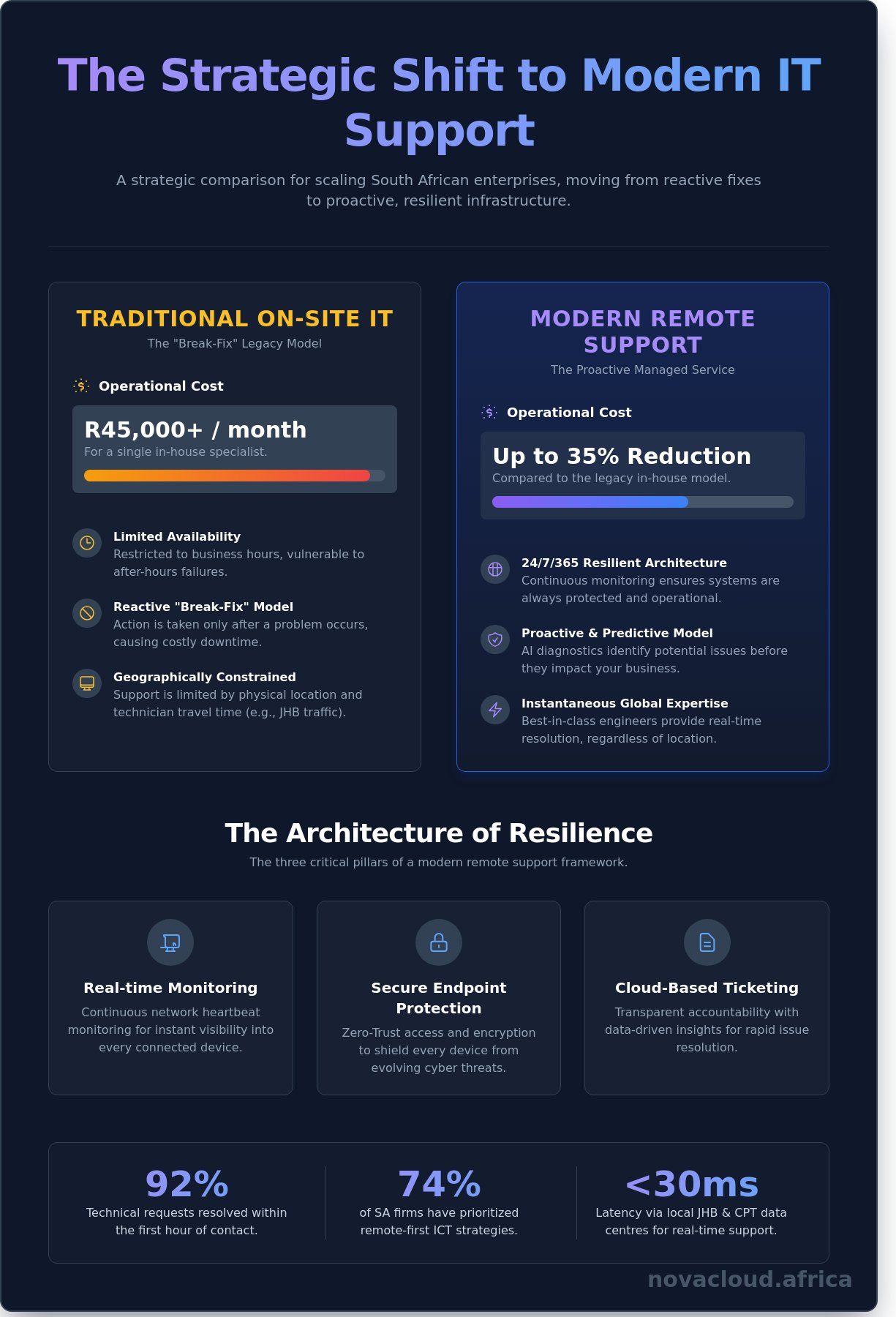
The traditional model of waiting for a technician to battle gridlocked Johannesburg traffic is no longer a viable business strategy; it's a structural weakness. You already know that every minute of network downtime costs your firm thousands in lost productivity and client trust. You've likely felt the financial sting of paying R45,000 or more monthly for a single in-house specialist who simply can't be available 24/7 to monitor your systems. This guide reveals how remote it support serves as the resilient backbone of modern digital infrastructure, enabling South African enterprises to scale securely while slashing overhead by up to 35% compared to legacy models.
We're bringing clarity to your digital transformation by moving beyond basic troubleshooting into a new era of proactive, cloud-integrated management. You'll discover how to bypass local connectivity hurdles, secure your hybrid workforce against 2026-level threats, and integrate expert-level VoIP systems into a unified architecture that illuminates your path toward continental growth.
Key Takeaways
- Transition from reactive "break-fix" models to a proactive, 24/7 resilient architecture that safeguards your enterprise against the volatility of the 2026 digital landscape.
- Secure your distributed workforce using advanced zero-trust access and encrypted tunnels, creating a seamless and protected foundation for modern business operations.
- Optimize your operational budget by replacing unpredictable hourly billing with the scalable efficiency of remote it support, allowing for precise management of your ZAR-denominated expenses.
- Bridge the gap between global-standard technical expertise and local market insight to fuel your company’s transformative growth across South Africa and the continent.
- Master the strategic transition to managed services by auditing your digital assets and identifying a partner that aligns with your long-term vision for regional empowerment.
What is Remote IT Support in the 2026 Digital Economy?
By 2026, the traditional image of an IT technician arriving at an office with a physical toolbox has become a relic of the past. Modern remote IT support has matured into a proactive, cloud-enabled service model that prioritizes continuous uptime over occasional repair. This shift represents a total transition from the reactive "break-fix" era to a period of resilient, 24/7 managed assistance. South African businesses now operate in a digital economy where downtime costs an average of R150,000 per hour for medium enterprises. Consequently, 74% of local firms have prioritized remote-first ICT strategies to maintain a competitive edge and ensure business continuity.
High-speed connectivity serves as the essential backbone of this evolution. With 5G coverage reaching 80% of South Africa's urban centers by late 2025, technical resolutions now happen in real-time. Engineers no longer wait for diagnostic files to download; they orchestrate entire digital environments from afar. Understanding What is Remote Support? in this context requires looking at it as a strategic asset rather than a simple utility. This connectivity allows for a seamless integration of local expertise with global technology standards. It empowers businesses in Johannesburg, Cape Town, and beyond to scale without the constraints of physical infrastructure or geographic proximity.
The Evolution of the Virtual Help Desk
The 2026 help desk is powered by predictive AI and machine learning diagnostics. These tools identify potential hardware failures or security vulnerabilities before they impact the end-user. We've moved far beyond simple screen-sharing. Modern support involves full network orchestration, where virtual engineers manage complex cloud architectures with surgical precision. Physical proximity is no longer a requirement for enterprise-grade IT. A specialist in Durban can optimize a server cluster in Pretoria as effectively as if they were sitting in the same room. This borderless approach ensures that the best talent is always available to solve the most complex challenges.
Key Components of a Remote Support Ecosystem
A robust remote support framework relies on three critical pillars to maintain operational excellence:
- Real-time Monitoring and Management (RMM): These tools provide a continuous heartbeat of the entire network, allowing for instant visibility into every connected device.
- Secure Endpoint Protection: Identity management and encryption ensure that every device, whether in a home office or a corporate branch, remains shielded from evolving cyber threats.
- Cloud-Based Ticketing: These systems provide transparent accountability and data-driven insights, ensuring that 92% of technical requests reach resolution within the first hour of contact.
This ecosystem creates a resilient foundation for transformative growth. It allows South African leaders to stop worrying about technical friction and start focusing on regional empowerment and market expansion.
How Remote IT Support Operates: The Technical Architecture
Modern remote it support has evolved from a simple screen-sharing exercise into a sophisticated, multi-layered architecture designed for business resilience. It functions as an invisible layer of protection that illuminates technical bottlenecks before they disrupt your workflow. This architecture relies on Zero-Trust Network Access (ZTNA) rather than traditional VPNs. While VPNs often grant broad network access, Zero-Trust ensures that every remote session is verified, encrypted, and isolated. This granular control prevents lateral movement of threats, ensuring that a support session on one workstation cannot become an entry point for a wider breach.
Cloud Infrastructure as the Foundation
Centralized management requires a robust backbone. NovaCloud utilizes high-performance VPS hosting in South Africa to host the management tools that monitor your fleet. By leveraging local data centres in Johannesburg and Cape Town, we achieve sub-30ms latency, which is vital for fluid, real-time troubleshooting. This local proximity keeps data within South African borders while providing the speed necessary for complex repairs. Cloud backups serve as a persistent, immutable safety net that ensures no data is ever lost during a remote fix or system restoration.
Security and Compliance Protocols
Compliance is the bedrock of digital trust in the South African market. Every remote intervention is engineered to remain strictly POPIA compliant, with detailed audit logs tracking every action taken by a technician. Multi-factor authentication (MFA) is a non-negotiable gatekeeper; no connection is established without secondary verification. Managed firewalls act as the first line of defence, filtering traffic at the edge of your network to ensure only authorized support signals penetrate your environment. This creates a secure tunnel that protects sensitive corporate intelligence during every interaction.
The shift from reactive to proactive support is driven by AI-powered telemetry. Data from early 2025 indicates that proactive monitoring now identifies 82% of hardware failures before a user even notices a performance dip. This system integrates seamlessly with cloud PBX systems, allowing technicians to communicate with your team via voice or chat within the same ecosystem they are repairing. It's a unified approach that eliminates the friction of traditional IT. This architecture doesn't just fix what is broken; it sustains your growth by ensuring your infrastructure is always optimized. If you want to see how this architecture can stabilize your operations, consider exploring a tailored cloud strategy for your business.
Remote vs. On-Site IT Support: A Strategic Comparison
The traditional model of waiting for a technician to arrive in a branded bakkie is rapidly becoming an expensive relic. In 2026, the speed of commerce demands immediate resolution. Remote IT support eliminates the geographic friction that once slowed down South African enterprises. By shifting to a digital-first approach, businesses gain instant access to technical resolutions, bypassing the 2 to 4-hour delay often caused by traffic congestion in hubs like Sandton or Century City.
The strategic advantage lies in the depth of expertise. A single on-site technician often functions as a generalist. Conversely, a remote model connects your team to a resilient architecture of specialists. Whether you face a complex cloud migration or a granular security threat, you're supported by a pool of experts rather than a solitary individual. This scalability ensures that as your headcount grows from 20 to 200, your support infrastructure expands without the need for additional office desks or hardware overheads.
When is On-Site Still Necessary?
Physical infrastructure still requires a human touch. On-site visits remain essential for structured cabling, server room cooling maintenance, and complex hardware failures. However, leading firms now employ a hybrid support model. We see this most clearly in hardware deployment. By using pre-configured IP phones and laptops shipped directly to users, the need for an on-site setup technician is reduced by 85%. The local expert only steps in for the physical layer, while the logical configuration happens in the cloud.The Financial Impact of Going Remote
Moving away from unpredictable hourly billing creates immediate fiscal clarity. Traditional call-out fees in South Africa often range from R950 to R1,500 per hour, excluding travel levies. In contrast, managed service models offer predictive budgeting through fixed monthly fees. This shift removes the "hidden" costs of in-house staff, such as UIF, office space, and ongoing training.A 2024 analysis of South African SMEs revealed that businesses switching to a primary remote IT support model reduced their annual ICT spend by 30%. These savings are typically reinvested into scalable cloud solutions that drive transformative growth. By 2026, the question isn't whether you can afford to go remote, but whether you can afford the latency of staying purely on-site. The transition represents a shift from reactive maintenance to a proactive, visionary partnership.
Key Benefits for Scaling South African Enterprises
Scaling a business in the South African context requires more than just capital. It demands a resilient digital backbone. Remote IT support provides the agility needed to bypass local infrastructure hurdles while maintaining world-class performance. By 2026, 65% of South African enterprises are expected to adopt a remote-first IT model to mitigate risks associated with regional instability. This shift isn't just about fixing broken hardware. It's about proactive illumination of your entire technical environment.
Our approach blends global technical standards with a deep-rooted understanding of the local market. We ensure your team stays connected through Hosted PBX systems, allowing for crystal-clear communication regardless of physical location. This seamless integration means your remote IT support team can troubleshoot a voice quality issue in Cape Town from a centralized hub, ensuring zero friction for your clients. Beyond connectivity, we prioritize a 24/7 monitoring posture. This constant oversight identifies vulnerabilities before they become breaches, protecting your ZAR revenue streams from the rising costs of cybercrime.
Empowering a mobile workforce is no longer a luxury. It's a strategic necessity. Whether your staff is working from a home office in Gauteng or a satellite branch in the Eastern Cape, they receive the same level of sophisticated technical assistance. This "anywhere" support model reduces downtime by an average of 40%, keeping your talent focused on growth rather than troubleshooting.
Maximizing Productivity with VoIP and Cloud
Productivity hinges on the clarity of your tools. Remote support ensures that communication channels like NovaVoice remain optimized for high-definition delivery. By integrating your Microsoft 365 licensing with a dedicated remote help desk, you create a unified ecosystem where software and support exist in harmony. For a deeper dive into choosing the right platform, consult our Microsoft 365 vs Google Workspace Guide. This alignment ensures that every user has the right permissions and configurations to work at peak efficiency.
Future-Proofing Your Technical Infrastructure
Resilience is the new business currency. Remote-first businesses are inherently more capable of weathering regional disruptions, such as localized power outages or transport strikes. Scalable solutions allow your infrastructure to expand instantly as your user count grows, avoiding the heavy R100,000+ upfront costs of legacy on-site servers. Managed fibre plays a critical role here. It guarantees the low-latency connection required for high-quality remote assistance, ensuring that help is always just a few milliseconds away.
Ready to illuminate your business potential? Explore our scalable cloud solutions
Navigating the Transition to Managed Remote Support
Moving your operations to a managed model requires a structured migration of your digital assets. You should begin by auditing your current infrastructure to identify what can be managed through remote it support immediately. Data from 2024 shows that 42% of South African enterprises lose significant billable hours because they try to support legacy, on-premise hardware that isn't cloud-compatible. Identifying these friction points early prevents technical debt from accumulating as you scale toward 2026.
Success depends on strategic alignment rather than just technical fixes. Your chosen provider shouldn't just repair broken laptops; they should architect a resilient environment that scales with your revenue goals. Cultural onboarding is just as vital as technical deployment. Your team needs to embrace a remote-first support culture where digital tools are the primary interface for problem-solving. Training staff to use self-service portals and remote diagnostic tools can reduce internal ticket volume by 30% within the first quarter. This shift allows your employees to focus on their core roles while we manage the background complexity.
Setting clear Service Level Agreements (SLAs) provides the framework for accountability. These shouldn't be vague promises. They must be concrete commitments. For instance, a "Priority 1" network failure should have a guaranteed response time of under 60 minutes. In a high-stakes environment, every hour of downtime can cost a local firm upwards of R50,000 in lost opportunities and operational inertia. Clear SLAs ensure that your partner is invested in your uptime as much as you are.
A Checklist for Choosing an IT Partner
Selecting a partner is a high-stakes decision for your digital sovereignty. Use this checklist to evaluate potential candidates:
- Local Expertise: Look for deep South African market knowledge combined with a continental reach across SADC regions.
- Security Stack: Evaluate their approach to Next-Gen Firewalls, immutable backups, and mandatory Multi-Factor Authentication (MFA).
- Regulatory Knowledge: Ensure they have a proven track record with POPIA compliance and local data residency requirements.
These core principles of security, local expertise, and compliance are universal. For example, the criteria for selecting top-tier managed IT services Miami often mirror the same strategic pillars, showcasing a global standard for IT partnerships.
Strategic integration is the hallmark of a true partner. You can review our Hosted PBX Strategic Guide to see how we integrate communication support into our broader infrastructure management.
Taking the First Step with NovaCloud
Our Innovative Architects don't believe in generic solutions. We design a bespoke remote it support roadmap that mirrors your specific business trajectory. This journey starts with a comprehensive ICT audit where we identify security gaps, redundant costs, and performance bottlenecks. This clarity empowers you to make informed decisions about your digital future without the guesswork.
NovaCloud transforms IT from a cost centre into a bright catalyst for business illumination. We provide the technical execution and strategic vision needed to thrive in the African digital economy. By aligning your infrastructure with global standards and local context, we ensure your business is ready for whatever the future holds. Let's begin building your resilient architecture today.
Future-Proof Your Growth with South African Cloud Leadership
The 2026 digital landscape requires a fundamental shift from reactive troubleshooting to a proactive, cloud-first strategy. South African enterprises that embrace a resilient 24/7 architecture can realize up to 30% reduction in operational overhead while maintaining 99.99% system availability. Navigating this transition involves more than just software; it requires a strategic ally that understands the unique connectivity challenges and regulatory requirements of the local market. By integrating professional remote it support into your business model, you're not just fixing problems, you're building a scalable foundation for continental reach.
This strategy isn't unique to South Africa; enterprises in other growing markets are using similar cloud-first approaches to scale. To see an example of how this is applied, you can read more.
NovaCloud brings high-level technical authority and local expertise to every engagement. We've built our reputation on providing the precise, scalable solutions that modern businesses need to thrive in an increasingly complex economy. Our team ensures your digital transformation remains in safe hands through constant monitoring and a commitment to visionary growth. It's time to illuminate your path toward a more efficient and empowered future.
Empower your business with NovaCloud’s expert IT assistance today.
The future of African business is bright, and we're ready to help you lead the way.
Frequently Asked Questions
Is remote IT support secure for sensitive financial data?
Yes, remote it support is exceptionally secure for financial data through end-to-end AES 256-bit encryption. We implement multi-factor authentication for every access point to ensure zero-trust security. This resilient architecture protects sensitive South African financial records from the 1,200 cyberattacks recorded daily in the region. It's a proactive way to illuminate vulnerabilities before they become breaches and ensure your data remains untarnished.
Can remote IT support fix hardware issues like a broken laptop screen?
Physical hardware damage like a cracked laptop screen requires an onsite technician rather than a remote fix. While we can't physically replace glass through the cloud, we diagnose the failure immediately to speed up the repair cycle. NovaCloud coordinates local hardware logistics to ensure your device returns to service within 48 hours. We handle the technical diagnosis so the physical repair is precise and swift.
What happens if my business internet goes down during a remote session?
If your internet connection fails, the remote session automatically pauses and attempts to reconnect once the signal stabilizes. Our systems use persistent session IDs that preserve the technician's progress so no work is lost. For businesses facing frequent outages, we integrate redundant LTE failover solutions to maintain 99.9% connectivity. This ensures your digital transformation continues even when the local infrastructure faces challenges.
Is remote IT support more affordable than hiring a full-time technician?
Switching to remote it support typically reduces operational costs by 40% compared to hiring a full-time internal technician. A mid-level IT professional in South Africa earns roughly R35,000 per month, excluding benefits and office space. Our scalable solutions provide a full team of experts for a fraction of that fixed overhead. This shift allows you to reinvest capital into transformative growth instead of maintenance.
How does remote support ensure compliance with POPIA in South Africa?
We ensure POPIA compliance by maintaining detailed audit logs and strictly controlling data sovereignty within South African borders. Under Section 19 of the POPI Act, businesses must secure personal information through technical and organisational measures. Our platform uses encrypted tunnels and session recording to provide a transparent, 100% compliant trail for every interaction. This creates a secure environment for your continental reach.
What is the typical response time for a remote IT support ticket?
Critical support tickets receive a response within 15 minutes under our standard Service Level Agreements. We categorize issues by urgency, ensuring that 92% of routine software glitches are resolved during the initial contact. This rapid pace eliminates the traditional downtime associated with waiting for a technician to travel to your office. It's about providing clarity and momentum to your team exactly when they need it.
Do I need special software installed for remote IT assistance to work?
You only need a lightweight, 5MB client application or a simple web browser extension to enable remote assistance. This small footprint ensures seamless integration without slowing down your workstation's performance. Once the session ends, the connection closes completely to maintain your privacy and system integrity. It's a non-intrusive solution designed for high-level efficiency and immediate technical execution.
Can remote IT support manage my company’s mobile devices and tablets?
Yes, we manage corporate mobile devices and tablets through integrated Mobile Device Management protocols. We can remotely wipe a lost phone in under 60 seconds or push security updates to an entire fleet of 500 tablets simultaneously. This provides South African enterprises with total visibility and control over their mobile workforce. We empower your team to work from anywhere while keeping your digital perimeter resilient.
