


South African Data Centers: The Backbone of Your Digital Strategy in 2026

Your digital strategy in 2026 shouldn't be held hostage by a 9,000 kilometer round trip to a server in London or Dublin. You've likely felt the friction of high latency when accessing critical apps, or the anxiety of ensuring every byte of customer data stays within borders to satisfy the 2021 POPIA mandate. It's a reality where high-performance south african data centers aren't just an IT choice; they're the foundation of business resilience.
Prioritizing local infrastructure offers more than just a speed boost. It provides a resilient architecture that keeps your operations online even when the national power grid fluctuates. This guide demonstrates how local hosting secures your legal standing and reduces application response times by up to 80%. We'll examine the technical benefits of regional empowerment and show you how to build a cloud presence that's both globally capable and locally grounded.
Key Takeaways
- Understand how local infrastructure acts as a catalyst for performance, eliminating the 150ms lag of international hosting to deliver a seamless user experience.
- Navigate the complexities of POPIA with confidence by leveraging south african data centers to ensure your sensitive data remains within national borders and fully compliant.
- Discover the resilient architecture required to bypass grid instability and load shedding, securing your business with the industrial-grade redundancy of Tier III facilities.
- Learn how to bridge the gap between raw technical power and transformative growth by aligning your digital strategy with scalable, local cloud solutions.
What are South African Data Centers and Why Do They Matter?
Digital infrastructure in South Africa has undergone a radical transformation over the last decade. Gone are the days when a data center meant a dusty, repurposed server room in the back of an office building. Today, modern south african data centers represent high-availability hubs designed for colocation and sophisticated cloud hosting. These facilities serve as the vital gateway to the African digital economy, providing the resilient architecture needed for SMEs to compete globally. Since the massive subsea cable expansions around 2010, the local landscape has matured into a network of world-class Tier III and Tier IV facilities.
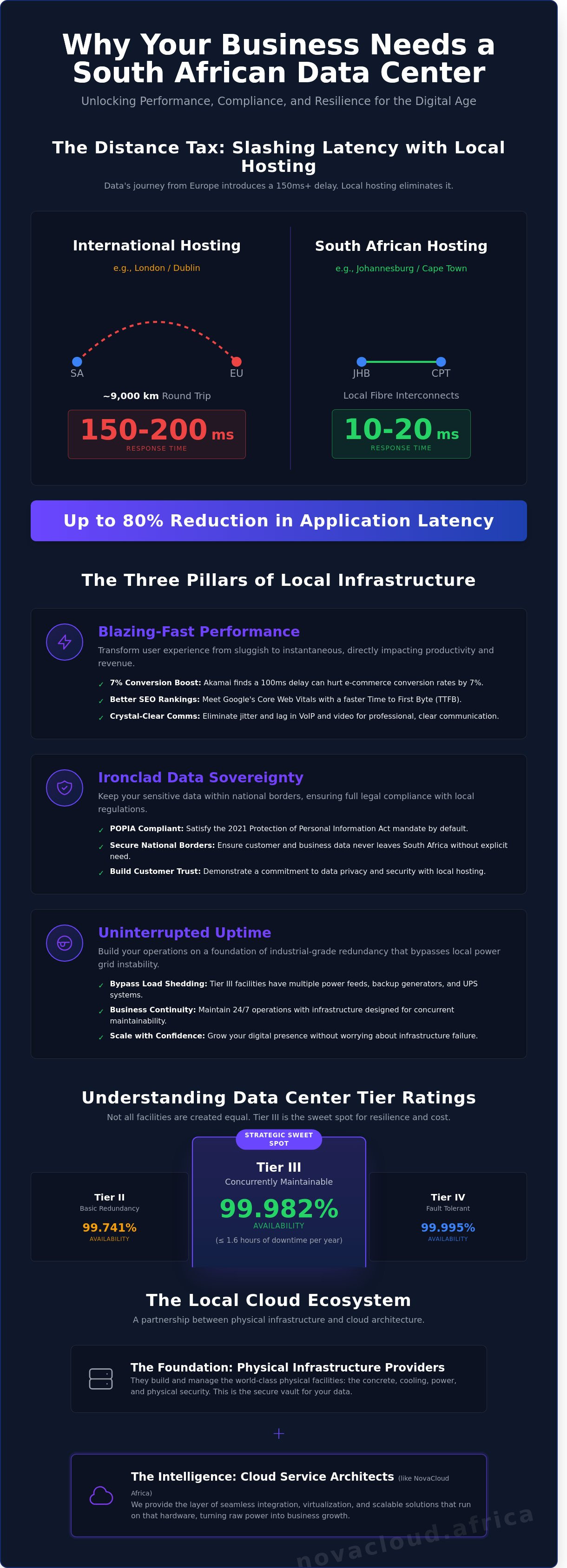
Understanding the ecosystem requires a clear distinction between physical infrastructure providers and cloud service integrators. While physical providers like Teraco Data Environments build the concrete, cooling, and power systems, NovaCloud Africa acts as the strategic architect. We provide the layer of seamless integration and scalable solutions that sit atop that hardware. One provides the secure vault; the other provides the intelligent systems that make your data work for you. This partnership illuminates a new chapter in business efficiency for local firms.
The Role of Carrier-Neutral Facilities
Carrier-neutrality is a cornerstone of modern connectivity. It means the facility isn't owned by or tied to a single telecommunications provider. For your SME, this translates to competitive pricing and diverse connectivity options. Having multiple fibre on-ramps is critical for business continuity in the local market. These hubs house national internet exchange points (IXPs), such as NAPAfrica, which keep local traffic within South African borders. This reduces latency and ensures that a customer in Johannesburg accessing your data doesn't have to wait for a signal to travel to Europe and back.
Tier Ratings: Understanding Reliability Standards
Reliability is measured through international Tier ratings. Tier II facilities offer basic redundancy, but they often lack the concurrent maintainability required for 24/7 operations. Tier IV represents the pinnacle of fault tolerance, though the costs are often prohibitive for smaller enterprises. Tier III has emerged as the strategic sweet spot for south african data centers, balancing high-level resilience with cost-effective ZAR pricing. Tier III uptime requirements demand 99.982% availability, allowing for no more than 1.6 hours of unplanned downtime per year. This standard ensures your transformative growth isn't stunted by infrastructure failures, giving you the quiet confidence to scale without limits.
The Performance Advantage: Latency and User Experience
Distance is the invisible tax on your digital operations. When you host applications in London or North America, your data must traverse thousands of kilometres of undersea cables. Light in fibre optics travels fast, but the 10,000km gap to Europe is a physical barrier that code cannot bypass. This journey imposes a minimum round-trip delay of 150ms to 200ms. By migrating to south african data centers, you slash that response time to a crisp 10ms or 20ms. This transition transforms a sluggish interface into a fluid, responsive tool that empowers your team to work at the speed of thought.
Latency: The Silent Killer of Productivity
For an e-commerce site, speed is direct revenue. Research from Akamai indicates that a 100ms delay can hurt conversion rates by up to 7%. Local hosting enables edge computing, where data processing happens closer to your customers in Johannesburg, Cape Town, or Durban. While navigating Eskom's challenges requires resilient infrastructure, local facilities offer the high-speed fibre interconnects necessary for modern business. These local nodes ensure your website meets Google's Core Web Vitals. This directly boosts your search engine rankings by reducing Time to First Byte (TTFB) and improving the overall user experience.
Optimising VoIP and Unified Communications
Voice and video traffic are incredibly sensitive to geographical distance. High latency causes "jitter" and packet loss; this leads to dropped words and robotic audio during critical client calls. NovaCloud utilizes local infrastructure to ensure our Hosted PBX solutions deliver crystal-clear quality. By keeping your communication traffic within the national network fabric, we eliminate the lag associated with international routing. This local approach provides your remote teams with a stable Virtual Private Server (VPS) environment. It ensures that shared applications remain snappy and collaborative sessions stay productive. It is about creating a seamless digital workspace that feels as immediate as an in-person conversation.
Data Sovereignty: Navigating POPIA and Legal Compliance
Since the Protection of Personal Information Act (POPIA) became fully enforceable on 1 July 2021, data residency is no longer a choice. It's a strategic necessity. For a South African SME, the legal landscape demands a clear understanding of where your customer information lives. Storing sensitive records in foreign jurisdictions introduces hidden liabilities. If a country has weaker privacy laws than our own, you risk non-compliance and fines that can reach R10 million. Using south african data centers eliminates these risks by keeping your digital assets under local jurisdiction.
Is Your Data Safe Beyond Our Borders?
Section 72 of POPIA creates a complex framework for cross-border data transfers. You can't simply move personal info across borders unless the recipient is subject to laws that provide a similar level of protection. Researching South Africa's data center market shows that local residency is the simplest path to total compliance. By keeping your data on home soil, you bypass the friction of international legal assessments. This local approach also shields your operations from geopolitical disruptions that could lock you out of your own systems.
Building Trust with Transparent Data Residency
Trust is the new currency for B2B service providers. When you tell a client that their data never leaves the country, you're offering a premium level of security. This transparency is vital for the 15% of South African SMEs operating in the financial and medical sectors, where auditing requirements are rigorous. Local hosting simplifies these audits by providing a physical, verifiable location for every byte of information.
NovaCloud designs cloud architectures that prioritize this local-first mindset. We ensure your business backups are housed in premier south african data centers, providing the resilience your brand needs to scale. You'll know exactly which facility holds your data. It's about moving from uncertainty to total clarity. We transform compliance from a burden into a competitive edge, allowing you to focus on growth while we handle the technical execution of your data sovereignty strategy.
Resilience and Power: Securing Uptime in the National Grid
South African SMEs face a unique challenge: the fragility of the national grid. In 2023, South Africa experienced 335 days of load shedding, making power consistency a luxury for most corporate office parks. Top-tier south african data centers transform this vulnerability into a competitive advantage. Unlike a standard office that relies on a single backup generator, these facilities are engineered for perpetual operation. They provide a resilient architecture that shields your digital assets from the volatility of Stage 6 outages, offering a new chapter of clarity for your IT strategy.
Security at a data center goes far beyond a perimeter fence. It's about securing the flow of electrons. While a typical business might lose connectivity when a generator fails to start, a professional facility uses industrial-grade fuel reserves and onsite teams to ensure continuity. This level of investment ensures that your digital presence remains illuminated even when the surrounding city goes dark.
The Anatomy of Power Redundancy
Reliability isn't accidental. It's the result of N+1 and 2N redundancy models. In an N+1 setup, there's always one extra component ready to take over if a primary system fails. 2N takes this further by mirroring every piece of hardware, ensuring a complete secondary path for electricity. Massive battery arrays act as the immediate bridge, engaging within milliseconds to prevent even a flicker of downtime during grid transitions. Tier III facilities must have at least 72 hours of independent power storage to maintain their certification.
Cooling and Environmental Controls
South Africa's diverse climate, from Gauteng's dry heat to the coastal humidity, demands sophisticated thermal management. Efficient cooling systems do more than protect hardware; they reduce the carbon footprint and lower operational costs for cloud hosting. Precision cooling maintains temperature within a 2 degree range, while advanced filtration systems eliminate dust that often plagues office-based servers. This meticulous control extends the life of your hardware and prevents the thermal throttling that slows down business applications.
The future of south african data centers is increasingly green. Leading facilities are now integrating solar PV arrays and wheeling agreements to bypass coal-heavy grid reliance. This shift ensures that your digital transformation is both stable and sustainable. Choosing a local facility means your SME benefits from industrial-grade infrastructure that most businesses can't afford to maintain independently. It's a strategic move toward regional empowerment and operational peace of mind.
Empowering Your Business with NovaCloud’s Local Infrastructure
NovaCloud Africa transforms the raw utility of south african data centers into a cohesive engine for sustainable growth. While global providers offer vast, impersonal resources, we focus on technical precision. We align high-performance compute power with the practical realities of the local business environment. By integrating local VPS hosting with dedicated Business Fibre and proactive Managed Security, we create a resilient digital ecosystem. This synergy ensures that your applications don't just run; they thrive under conditions optimized for the Southern African region. You aren't just buying space on a server; you're securing a foundation that supports 100% of your digital touchpoints.
Choosing a local partner means moving beyond the frustration of "self-service" portals and automated chat bots. You gain direct access to engineers who understand the nuances of the local grid and regional connectivity patterns. This human-centric approach allows your SME to scale operations without the friction typically associated with digital transformation. We provide a bridge between complex infrastructure and the business-ready solutions your team needs to stay competitive.
A Strategic Partnership for Digital Growth
NovaCloud remains committed to delivering ICT solutions that reflect the pulse of the South African market. We act as a single point of accountability for your VoIP, hosting, and security needs. This consolidated approach eliminates the vendor finger-pointing that often stalls progress. Our local expertise helps you navigate specific challenges, such as ensuring POPIA compliance and maintaining 99.99% uptime during regional infrastructure shifts. We provide the architectural clarity needed to turn complex cloud transitions into predictable business outcomes. We position ourselves as the innovative architects of your digital future, ensuring your stack is as ambitious as your business goals.
Getting Started: Your Journey to the Local Cloud
The path to modernization begins with a clear assessment of your legacy systems. Most South African businesses find that migrating to a local VPS reduces latency from 150ms on international servers to under 20ms. This 85% improvement in response time directly impacts user productivity and customer satisfaction. Start by identifying performance bottlenecks in your current setup and mapping out a phased migration that minimizes downtime. Our team assists in this transition, ensuring that every byte of data is moved securely, efficiently, and with total transparency.
Architecting Your Competitive Edge for 2026
Success in the next digital era depends on more than just high-speed connections; it requires a foundation built on trust and resilience. By 2026, sub-20ms latency will be the minimum requirement for competitive local user experiences, making the proximity of south african data centers a critical strategic asset. Navigating the complexities of the POPIA framework requires a partner that understands the legal landscape of our nine provinces, ensuring your data remains sovereign and secure within our borders. Resilience is equally vital. Your business needs a 99.99% uptime guarantee to thrive despite the ongoing challenges of the national power grid.
NovaCloud Africa provides the local expertise needed to turn these technical requirements into transformative growth. Our POPIA-compliant cloud architecture and high-performance VPS solutions deliver the local latency advantages your users demand. Backed by enterprise-grade security and 24/7 technical support, we're here to ensure your digital transformation stays on track. It's time to illuminate new possibilities for your business with infrastructure designed specifically for the African market.
Discover Resilient Local Cloud Hosting with NovaCloud Africa
The future of African enterprise is bright, and your journey toward a scalable, resilient digital presence starts today.
Frequently Asked Questions
What is the main difference between a South African data center and a global one?
The primary difference between South African data centers and global ones lies in physical proximity and data sovereignty. When you host locally, your data remains within our borders, which simplifies legal compliance and reduces the distance information travels. This proximity cuts latency from 180 milliseconds for European servers to under 20 milliseconds for local connections. It's the difference between a sluggish interface and a seamless digital experience for your customers.
Does POPIA require all business data to be stored in South Africa?
POPIA doesn't strictly mandate that all data stays in South Africa, but it imposes rigorous conditions on cross-border transfers. Section 72 of the Protection of Personal Information Act (Act 4 of 2013) requires that the recipient country has adequate data protection laws. By using local infrastructure, you bypass these complex legal hurdles entirely. It provides a clear, safe path for your SME’s compliance journey while ensuring your digital transformation remains secure.
How do South African data centers handle load shedding?
South African data centers manage load shedding through industrial grade redundancy architectures, specifically N+1 or 2N configurations. These facilities utilize massive Uninterruptible Power Supply (UPS) banks and diesel generators that kick in within seconds. Most Tier III facilities maintain 48 hours of fuel on-site at all times. This ensures your business stays online even during Stage 6 outages, providing a level of resilience that standard office setups simply cannot match.
Will my website load faster if I host it in a local data center?
Your website will load significantly faster for local users if you choose a South African data center. Hosting in London or New York adds thousands of kilometers to every data request, often resulting in a Time to First Byte (TTFB) of 300 milliseconds. Local hosting drops this to roughly 30 milliseconds. Faster speeds improve your Google search rankings and keep your customers engaged instead of waiting for a page to load.
What is a carrier-neutral data center and why should I care?
A carrier-neutral data center is a facility that allows you to connect with any network provider you choose. This independence prevents vendor lock-in and gives you the power to negotiate the best rates from over 50 different fiber providers. It creates a competitive environment that drives down your monthly connectivity costs. For an SME, this flexibility is a vital catalyst for scalable and cost-effective growth in a shifting market.
Can small businesses afford to use high-tier South African data centers?
High-tier South African data centers are remarkably affordable for small businesses because of modern multi-tenant cloud models. You don't need to rent an entire rack; instead, you pay only for the virtual resources you consume. Entry-level cloud hosting for a small business can start as low as R450 per month. This allows you to access world-class infrastructure that would otherwise cost millions of Rand to build and maintain privately.
How does latency affect my VoIP or Hosted PBX system?
Latency is the single biggest factor in the quality of your VoIP or Hosted PBX system. High latency causes jitter, which sounds like broken speech or delayed responses during a call. While international servers might have a delay of 200 milliseconds, local infrastructure keeps it under 20 milliseconds. This crisp, clear communication ensures your team maintains a professional image during every client interaction and avoids the frustration of dropped calls.
What happens to my data if a local data center loses power?
If a local data center loses utility power, a sophisticated failover sequence begins instantly to protect your hardware and data. Battery backups sustain the load for the first few seconds until the diesel generators reach full speed. This transition happens in under 10 milliseconds, meaning your servers never actually reboot or lose connectivity. Your digital assets remain illuminated and active, regardless of the state of the national grid or local power failures.
