


The 2026 Backup Compliance Checklist: Architecting Data Integrity for South African Enterprise

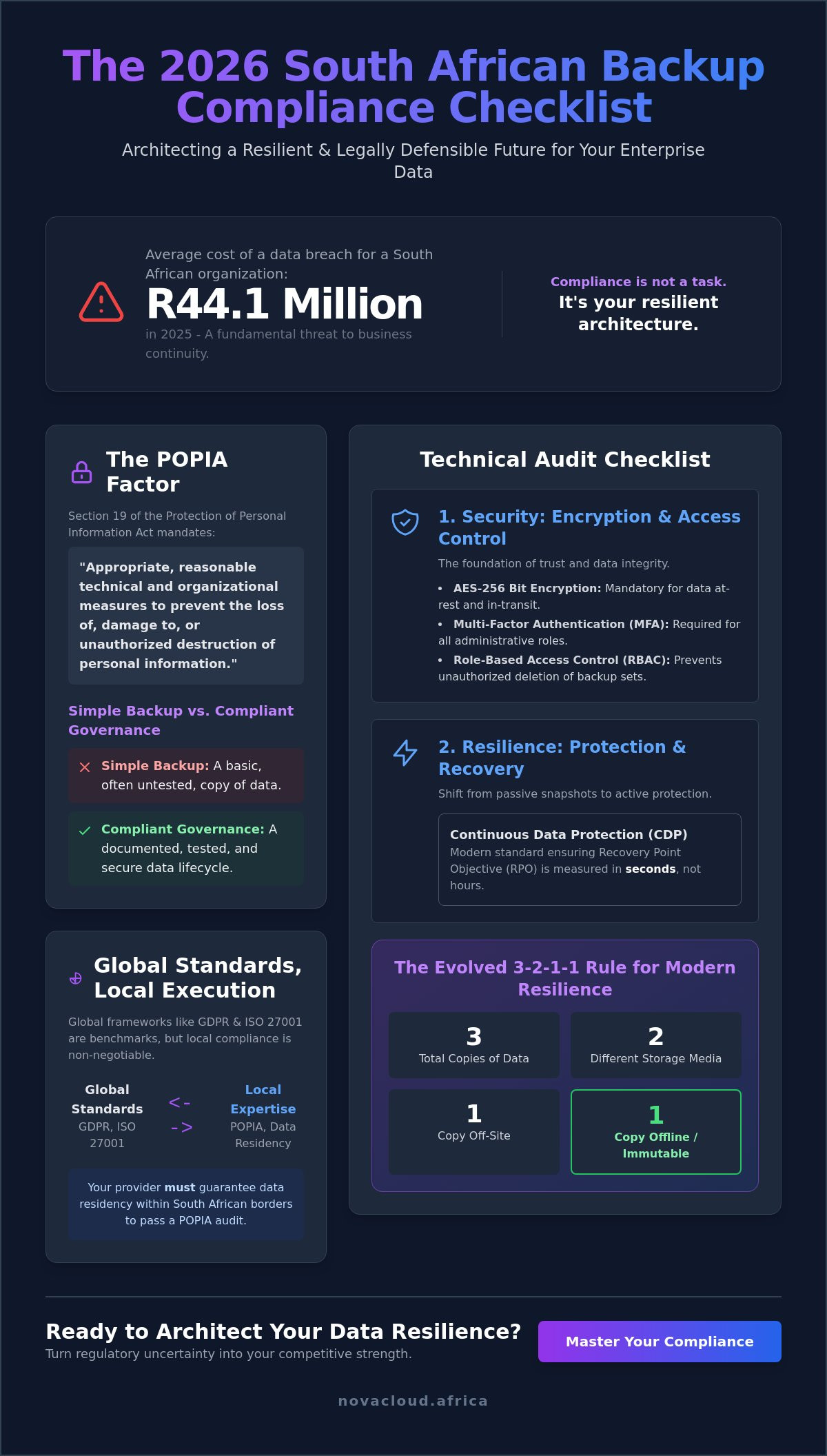
Did you know that the average cost of a data breach for a South African organization reached R44.1 million in 2025? For many enterprises, this figure represents more than just a financial hit; it's a fundamental threat to the continuity of your digital mission. As the Information Regulator intensifies enforcement for the 2026 financial year, maintaining rigorous backup compliance is no longer a back-office task. It is the resilient architecture that illuminates and protects your business's most valuable asset.
You likely feel the pressure of managing complex hybrid environments while worrying about where your data actually lives. It's a heavy burden to ensure every byte aligns with the April 2025 POPIA amendments. We're here to turn that uncertainty into a source of competitive strength. This guide provides a definitive checklist to help you master regulatory data protection, ensuring your cloud backups meet both local and global standards. We will explore the technical safeguards required by Section 19 of POPIA and provide a clear roadmap for audits that protects your reputation and your bottom line. Get ready to architect a future where your data is not just stored, but truly resilient.
Key Takeaways
- Understand why data integrity has shifted from a technical checkbox to a strategic boardroom priority for South African leaders in 2026.
- Discover the essential technical audit requirements for modern backup compliance, moving from traditional daily snapshots to resilient continuous data protection.
- Learn how to bake security into your digital infrastructure by integrating managed firewalls and automated validation to ensure data remains immutable.
- Master the evolved 3-2-1-1 rule to optimize your data retention and testing strategies, ensuring your business remains operational during any disruption.
- Leverage the synergy of global standards and local expertise to simplify complex regulatory governance across hybrid cloud environments.
Defining Backup Compliance for the Modern African Enterprise
In 2026, the digital heartbeat of a South African enterprise pulses through its data. We've moved far beyond the era where saving a file to an external drive was sufficient. True backup compliance represents the sophisticated intersection of technical capability and legal obligation, ensuring that your recovery systems aren't just functional, but legally defensible. It's the difference between merely surviving a system failure and thriving through a rigorous regulatory audit. For the modern boardroom, data resilience has become a primary pillar of corporate governance, driven by the reality that information is both a business's most valuable asset and its most significant liability.
Distinguishing between simple backups and compliant data governance is vital for growth. A simple backup is a copy; compliant governance is a documented, tested, and secure lifecycle. Backup compliance is the strategic orchestration of automated data recovery systems and legal governance frameworks that ensures sensitive information remains accessible, immutable, and physically located within specific jurisdictional boundaries to satisfy data sovereignty requirements. When you architect your systems with this definition in mind, you transform IT from a cost center into a resilient shield.
The POPIA Factor: South Africa’s Regulatory Anchor
The Protection of Personal Information Act (POPIA) serves as the definitive guide for data handling in our region. Following the amendments that became effective on April 17, 2025, the Information Regulator has intensified its focus on how organizations manage data redundancy. Section 19 of the Act is particularly clear. It mandates that every responsible party must implement appropriate, reasonable technical and organizational measures to prevent the loss of, damage to, or unauthorized destruction of personal information. Implementing robust off-site data protection is no longer just a best practice; it's a legal necessity under these frameworks. Your compliance score depends heavily on your ability to prove that data is stored securely and remains retrievable even during a catastrophic event.
Global Standards vs. Local Execution
While frameworks like GDPR and ISO 27001 provide excellent global benchmarks, they often lack the nuance required for South African business operations. Many global cloud providers fail the local compliance test because they cannot guarantee data residency within our borders. This is where the role of the Innovative Architect becomes essential. By bridging the gap between international security standards and local legal requirements, we ensure that your cloud backups aren't just stored in a nameless data center, but are anchored in a way that respects continental reach and local expertise. We don't just follow global trends; we adapt them to empower the African digital future with precision and pride.
The 2026 Backup Compliance Checklist: Technical Audit Requirements
Achieving total backup compliance requires a shift from passive storage to active, resilient architecture. In 2026, the primary pillars of a successful audit are Security, Accessibility, and Accountability. We've seen a definitive move away from traditional daily snapshots toward Continuous Data Protection (CDP). This transition ensures that your recovery point objective (RPO) is measured in seconds, not hours. Your checklist must align with internal risk management frameworks to ensure that every technical control serves a specific business outcome. For a deeper look at the strategic side of this shift, explore our guide on Strategic Data Resilience: The 2026 Guide to Cloud Backups for South African Business.
Phase 1: Encryption and Access Control
Security is the foundation of trust. To meet modern standards, your architecture must utilize AES-256 bit encryption for data at rest and in transit. This ensures that even if a packet is intercepted, the information remains unreadable. Access must be restricted through Multi-Factor Authentication (MFA) for every administrative role. We also require granular Role-Based Access Control (RBAC). This prevents a single compromised account from having the authority to delete entire backup sets, creating a vital layer of internal protection.
Phase 2: Data Sovereignty and Location
Where your data lives matters as much as how it's protected. Under POPIA, you must maintain verifiable documentation of the physical location of your cloud data. The Consequences of POPIA Non-Compliance are too severe to ignore; especially regarding cross-border data transfer rules. Compliant South African enterprises prioritize local data centers. This ensures both legal alignment and symmetrical connectivity, allowing for rapid restoration when every minute of downtime impacts your bottom line.
Phase 3: Immutability and Ransomware Defense
Immutability is your final line of defense against modern cyber threats. Your checklist should include the implementation of WORM (Write-Once-Read-Many) storage for your most critical data sets. This ensures that once data is written, it cannot be altered or deleted by ransomware. Pair this with logically isolated or air-gapped copies to ensure a clean recovery point exists. We now utilize AI-driven tools to perform proactive threat hunting within backup archives, identifying dormant malware before it's ever restored to your production environment.
Transforming these requirements into a functional reality requires a partner who understands the local terrain. You can explore our resilient cloud backup solutions to see how we automate these technical audit requirements for you.
Architecting Security: Features that Validate Compliance
True resilience isn't a product you buy; it's a standard you build. For the modern South African enterprise, compliance features must be baked into the infrastructure from the first line of code. Bolting on security as an afterthought creates friction and leaves dangerous gaps. When security is integrated, it becomes a catalyst for growth rather than a hurdle for IT teams to clear. We view this as the NovaCloud Africa approach. It starts with clarity and ends with a business that's ready for any challenge.
The synergy between Managed Firewalls and backup integrity is a perfect example of this integrated architecture. Your firewall acts as a vigilant gatekeeper. It ensures the data stream between your local environment and your backup vault remains untainted by unauthorized lateral movement. By leveraging Acronis Cloud, we merge advanced cyber-protection with traditional recovery. This creates a unified shield that defends against zero-day threats while simultaneously securing your archives. Automated auditing features streamline the validation process by instantly verifying data integrity, which significantly reduces the manual oversight required from your IT staff.
Automated Compliance Reporting
The days of manual logs and dusty spreadsheets are over. Regulators now expect real-time visibility. Moving toward automated compliance dashboards allows your leadership to see the health of your digital assets at a glance. These systems generate audit-ready reports tailored specifically for POPIA requirements, providing transparency without the administrative headache. Perhaps most importantly, these platforms offer "proof of recovery" certificates. These documents serve as definitive evidence that your data isn't just stored, but is fully functional and ready to be restored within your defined timelines. This level of backup compliance transforms a technical necessity into a badge of operational excellence.
The Shared Responsibility Model
Many businesses mistakenly believe that moving to the cloud offloads all legal risk. This is a dangerous assumption. While global providers secure the physical cloud hardware, you remain responsible for the data within it. This is especially true for SaaS platforms like Microsoft 365. Your backup compliance framework must explicitly cover these environments to prevent data loss from accidental deletion or internal threats. Whether you're architecting high-performance VPS for scalable enterprise or managing a complex hybrid cloud, you must own the governance of your information. NovaCloud Africa acts as your strategic ally, helping you navigate these responsibilities with technical precision and continental reach.
Operationalizing Compliance: Retention, Testing, and Documentation
Moving from technical architecture to daily operations is where your strategy meets the real world. In 2026, the gold standard for resilient data management is the 3-2-1-1 rule. This modern evolution of the classic backup strategy mandates three copies of your data, stored on two different media types, with one copy off-site and one copy kept in an immutable or air-gapped state. Implementing this rigorous cycle ensures that your backup compliance isn't just a theoretical concept but a practical shield against total data loss. It's about creating a cadence of reliability that echoes through every level of your organization.
Success requires more than just software. Integrating a data security culture into your daily IT operations transforms your staff into a vigilant human firewall. When your team understands the "why" behind the protocols, compliance becomes a shared mission rather than a list of chores. We believe that an untested backup is functionally equivalent to no backup at all; it offers only the illusion of safety. True peace of mind comes from knowing that your systems can withstand the pressure of a real-world crisis.
Retention Policies and Data Lifecycle Management
A formal Retention Policy is a legal necessity for POPIA compliance, providing a documented framework that justifies why data is held and ensures its timely, secure disposal. Under Section 14 of POPIA, you can't keep personal information longer than necessary to achieve the original purpose of collection. We help you automate these protocols, ensuring that "right to be forgotten" requests are handled with technical precision. You can balance cloud backups and savings by utilizing tiered storage. This moves older, less critical data to lower-cost archives while keeping mission-critical records instantly accessible for legal hold periods.
The Testing Cadence: Disaster Recovery Simulation
Auditors don't just want to see your backups; they want to see your results. We recommend a monthly restoration testing cadence for your most vital systems, with quarterly full-scale disaster recovery simulations for the broader enterprise. During these sessions, you must document your Recovery Time Objective (RTO) and Recovery Point Objective (RPO) to prove you can meet your service level agreements. Training your team to respond to these simulated data loss events ensures that when a real emergency strikes, the response is calm, methodical, and effective. It's time to validate your resilience and get started with our managed backup services to ensure your operations are audit-ready today.
NovaCloud’s Resilient Architecture: Your Partner in Data Governance
NovaCloud Africa represents a departure from the cold, sterile experience of traditional IT firms. We don't just sell software; we architect ecosystems where your data can thrive safely and your business can scale without limits. By combining the global power of Acronis Cloud and FortiNet with our localized expertise, we ensure your backup compliance strategy is both world-class and deeply relevant to the South African market. This dual-layered approach provides the quiet confidence you need to lead your industry, knowing your digital assets are protected by a resilient architecture that never sleeps.
Choosing a strategic ICT ally is far more effective than simply hiring a software vendor. A vendor gives you a tool; an architect gives you a vision. We take the burden of technical execution off your shoulders, allowing you to focus on transformative growth while we handle the complexities of regulatory alignment. Our mission is to illuminate the path to digital maturity, turning the dark corners of IT uncertainty into a bright beginning for your enterprise efficiency. With NovaCloud Africa, you aren't just checking a box; you're starting a new chapter in operational excellence.
Acronis Cloud Integration for SA Enterprise
Migrating to a compliant environment shouldn't feel like a leap into the dark. We offer a seamless transition for your data, ensuring that every backup set is managed with technical precision and legal rigor. Our dedicated IT assistance team provides localized support that global, faceless competitors simply cannot match. When you explore NovaCloud Africa's cloud infrastructure, you'll find a platform built for national operations that require high availability and local data residency. We ensure your recovery points are always accessible, providing a safety net that empowers your team to innovate with courage.
Unified Communications and Data Security
A common oversight in many compliance frameworks is the exclusion of communication data. Your Hosted PBX systems and voice records are just as subject to POPIA and global standards as your financial spreadsheets. We bring these disparate threads together into a single, unified net of protection, ensuring that every interaction is archived and secured. This holistic view is the hallmark of the NovaCloud Africa promise: clarity, resilience, and a commitment to your long-term success. We help you bridge the gap between high-level strategy and granular technical details with a smoothness that reflects our internal expertise.
The era of administrative uncertainty is over. It's time to replace the fear of regulatory fines with the empowerment of a professional, audit-ready strategy. We invite you to join the new era of business efficiency by scheduling a comprehensive compliance audit with our team today. Let's architect a future where your digital transformation is in safe, expert hands and your data integrity is never in question.
Illuminating the Path to Resilient Governance
The journey to total data resilience is a strategic transformation. We've explored how technical audit requirements like AES-256 encryption and immutable storage form the bedrock of a secure enterprise. By operationalizing the 3-2-1-1 rule and maintaining a rigorous testing cadence, you ensure that your backup compliance is a living, breathing part of your business strategy. This isn't just about avoiding penalties; it's about building a foundation of trust that enables transformative growth across the continent.
NovaCloud Africa stands as your Innovative Architect in this complex digital landscape. As an Acronis Cloud Gold Partner with POPIA-aligned local data centers, we provide the technical precision your governance requires. You don't have to navigate these complexities alone when you have 24/7 dedicated South African IT assistance at your side. It's time to turn regulatory challenges into a competitive advantage and start a new chapter of efficiency. Secure your digital future with a NovaCloud Africa compliance audit today. Your journey toward a clearer, more resilient digital future begins now.
Frequently Asked Questions
Is cloud backup mandatory for POPIA compliance in South Africa?
Cloud backup isn't explicitly mandatory, but Section 19 of POPIA requires every organization to implement reasonable technical measures to prevent data loss. For modern enterprises, cloud-based redundancy is the most effective way to satisfy these legal safeguards. It provides the resilient architecture needed to ensure that personal information remains protected against unauthorized destruction or accidental loss while maintaining operational continuity.
What is the difference between data backup and data archiving for compliance?
Data backup is designed for rapid restoration and business continuity, while data archiving focuses on long-term storage for legal and historical discovery. To achieve full backup compliance, your strategy must distinguish between these two functions. Backups protect your current operations from system failure; archives ensure you meet specific retention periods for records that are no longer in daily use but remain legally significant.
How long must a South African business retain backup data for legal reasons?
Section 14 of POPIA mandates that records shouldn't be retained for longer than is necessary to achieve the purpose for which they were collected. While there isn't a single mandated period for all data, other South African laws like the Companies Act or tax regulations often require retention for five to seven years. Your policy should reflect these specific legal horizons to remain audit-ready.
Can using a global cloud provider like AWS or Azure make me non-compliant with POPIA?
Using global providers can lead to non-compliance if data sovereignty and cross-border transfer rules aren't properly managed under POPIA. While hyperscalers offer high security, you're responsible for ensuring the data residency aligns with local regulations. Partnering with a provider that offers local data centers ensures your sensitive information stays within South African jurisdiction, providing the legal clarity your enterprise needs.
How often should we test our backup restoration process to remain compliant?
You should test your restoration process at least monthly for mission-critical systems and quarterly for your entire infrastructure. Regular testing is the only way to validate your Recovery Time Objectives (RTO) and ensure your data is actually retrievable. Documentation of these successful tests is a key requirement for auditors who need proof that your continuity plan is functional rather than just theoretical.
What are the specific encryption standards required for backup compliance in 2026?
In 2026, the industry standard for backup compliance is AES-256 bit encryption for data both at rest and in transit. This level of protection ensures that your information remains unreadable to unauthorized parties during every stage of the lifecycle. Additionally, Multi-Factor Authentication (MFA) must be enforced for all administrative roles to prevent credential theft from compromising your entire backup repository.
What happens if a business fails a backup compliance audit?
Failing a compliance audit can result in administrative fines of up to R10 million or even criminal prosecution under POPIA. Beyond the financial impact, the reputational damage can be catastrophic, eroding customer trust and hindering your growth. The Information Regulator has intensified proactive enforcement for the 2026 financial year, making it essential to address gaps before they become liabilities for your brand.
Does Microsoft 365 automatically back up my data for compliance purposes?
Microsoft 365 doesn't automatically provide a comprehensive backup that meets all regulatory standards. While it offers geo-redundancy to keep the service running, it doesn't protect you from accidental deletion or internal threats in the same way a dedicated solution does. You must implement a third-party solution to ensure your SaaS data is archived and retrievable according to your specific governance requirements.
