


Yealink Hardware Integration: A Strategic Review of Unified Communications in 2026

Your desk phone shouldn't be the weakest link in your digital evolution. While many South African organizations struggle with the high latency of international cloud platforms, a new era of clarity is emerging through localized precision. Achieving a seamless Yealink hardware integration is no longer just about connecting devices; it's about anchoring your virtualized business in a physical infrastructure that prioritizes speed and reliability. You likely feel that communication should be a source of empowerment rather than a series of dropped calls and configuration hurdles.
This strategic review illuminates how integrating Yealink’s latest hardware with local cloud infrastructure transforms your voice services into a high-performance asset. We'll explore how to navigate the June 2026 end-of-service dates for legacy models while leveraging AI-powered noise cancellation and centralized management. Discover how to achieve crystal-clear voice quality over local fibre and ensure your team enjoys a fresh start in operational efficiency through a system designed for regional growth. It's time to move beyond the complexity of the past and embrace a communication architecture that works as hard as you do.
Key Takeaways
- Learn how professional Yealink hardware integration serves as a high-performance ICT node, bridging the gap between local SIP endpoints and cloud telephony for superior stability.
- Evaluate the strategic differences between the T3 series for high-volume office tasks and the T5 series for executive-level audio and video performance.
- Discover the auto-provisioning workflows that slash deployment times and maximize the long-term ROI of your Hosted PBX investment.
- Master a five-step deployment strategy designed to optimize South African business fibre connections for high-density, multi-site hardware fleets.
- Understand how dedicated IT Assistance simplifies the hardware lifecycle, ensuring your communication infrastructure remains a resilient strategic asset.
The Architecture of Modern Voice: Why Yealink Hardware Integration Matters in 2026
The traditional office desk is undergoing a profound metamorphosis. By 2026, the concept of a standalone telephone has dissolved. In its place sits an intelligent ICT node, a critical gateway that connects your physical workspace to the expansive potential of the cloud. This evolution relies entirely on a robust Yealink hardware integration, which serves as the high-fidelity handshake between SIP-based endpoints and your broader digital ecosystem. It's the difference between a fragmented tool and a unified strategic asset that empowers every conversation with celestial clarity.
For those reviewing a Yealink company overview, it's clear why they lead the global market. Their hardware isn't just about making calls; it's designed to be a catalyst for regional empowerment. In South Africa, where connectivity can be a hurdle, the physical hardware acts as a stabilizer. By placing local servers at the heart of the integration, organizations can eliminate the frustrating lag often found on international platforms, ensuring that every word is delivered with the precision your business demands.
Bridging the Gap Between Global Hardware and Local Cloud
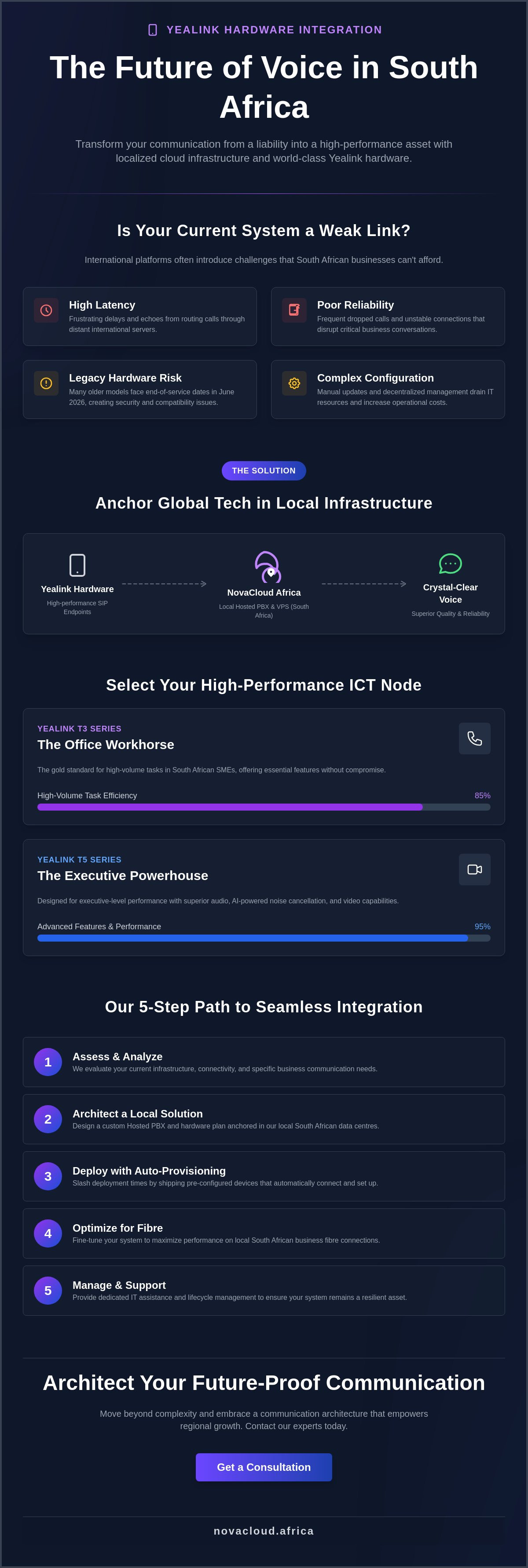
A successful communication strategy requires more than just premium devices. It demands a symbiotic relationship between those devices and the infrastructure supporting them. When Yealink endpoints interact with high-performance Virtual Private Servers provided by NovaCloud Africa, the result is a resilient system that prioritizes uptime and security. This local alignment is essential for South African data sovereignty, ensuring that your sensitive voice data remains within regional borders and complies with local regulations. Hardware is the tactile interface of your digital strategy, requiring precise alignment with local infrastructure. By anchoring global technology in local soil, you create a foundation for growth that is both stable and visionary.
The Evolution of SIP: From Legacy to Unified Ecosystems
The era of heavy, inflexible PBX systems tucked away in dusty server rooms is over. Modern Hosted PBX systems have redefined the landscape, turning static hardware into intelligent endpoints that adapt to your needs. Moving beyond legacy systems allows your organization to leverage a Yealink hardware integration that supports advanced features like AI-driven noise cancellation and seamless video handovers. In a managed environment, firmware updates are no longer a manual burden; they are orchestrated to ensure your fleet is always protected against emerging threats. This transition from "just a phone" to a unified ICT node ensures your office remains future-proof, energetic, and ready for the challenges of tomorrow.
Evaluating the Yealink T3 and T5 Series: A Strategic Hardware Review
The hardware sitting on your desk is the physical anchor of your digital presence. In 2026, selecting the right model is a strategic decision that affects long-term operational costs and employee satisfaction. High-quality endpoints are vital for maintaining service quality in hybrid environments, as noted in the Gartner Unified Communications market analysis. Yealink’s use of industrial-grade polycarbonate ensures these devices withstand the rigors of a busy South African office. This build quality offers a longevity that cheaper consumer-grade alternatives simply can't match. Central to this efficiency is Power over Ethernet (PoE) support. This technology simplifies modern office cabling by delivering power and data through a single cable. It reduces clutter, lowers installation costs, and ensures your phones remain powered even during localized electrical maintenance if connected to a central UPS.
The Yealink T31P: The Workhorse of the Modern Office
For many South African SMEs, the Yealink T31P represents the gold standard of entry-level communication. It doesn't compromise on essentials, offering dual-port 10/100M Ethernet and support for EHS35 wireless headsets. The real magic lies in the audio engineering. Yealink’s Smart Noise Filtering technology identifies and suppresses background distractions like keyboard clicking or air conditioning hum. This ensures your voice remains the focal point of every interaction. It's a foundational element of any successful Yealink hardware integration, providing a reliable entry point that doesn't sacrifice clarity for cost.
Premium Performance: When to Scale to the T5 Smart Business Series
While the T3 series handles high-volume tasks with ease, certain roles demand a more sophisticated interface. The T5 Smart Business Series is the logical step up when your team requires built-in Bluetooth and Wi-Fi for cord-free flexibility. These models feature adjustable high-resolution displays that improve ergonomics, allowing users to find the perfect viewing angle to reduce neck strain. Video integration becomes a reality at this level, turning a desk phone into a compact conferencing hub. When evaluating the ROI over a 5-year lifecycle, the T5 series often pays for itself through increased productivity and reduced need for additional peripherals. Scaling to this level is a clear signal of organizational maturity. If you are ready to elevate your workspace, choosing the right Yealink hardware integration partner like NovaCloud Africa can help you map these devices to your specific business growth stages.
Engineering the Perfect Sync: Integrating Yealink with Hosted PBX and VPS
Precision engineering meets cloud agility when you synchronize high-end hardware with a robust telephony platform. The true power of a Yealink hardware integration lies in its ability to become a plug-and-play extension of your digital office. By automating the handshake between the physical device and the software layer, organizations can eliminate the manual configuration errors that often lead to dropped calls or intermittent connectivity. This technical synergy ensures that your communication remains a reliable strategic asset rather than a source of IT frustration. When these elements align, the resulting Cloud PBX savings are realized through reduced deployment times and a significant drop in support tickets.
Managing multi-line business environments requires a sophisticated approach to SIP account allocation. Each Yealink handset acts as a dedicated portal, capable of handling multiple simultaneous calls while maintaining individual extension identities. This interplay between the device firmware and the PBX software layer allows for complex call routing and hunting groups that feel instantaneous to the end user. It's a system designed for clarity and momentum, ensuring your team stays focused on growth rather than troubleshooting.
SIP Compatibility and Zero-Touch Provisioning
The journey from unboxing a Yealink phone to making the first call should be measured in seconds, not hours. Through zero-touch provisioning, the hardware automatically reaches out to a redirection service upon connecting to the internet. It then pulls its specific configuration from your hosted platform. This workflow is secured by MAC-based authentication, where each device’s unique hardware address serves as a digital fingerprint. This ensures that only authorized handsets can access your secure network. For hybrid workforces, this means a remote employee can take their desk phone home, plug it into their local router, and remain a seamless part of the corporate ecosystem without manual intervention.
Leveraging Local VPS for Crystal-Clear Voice Quality
To achieve the highest performance, hosting your telephony on a Virtual Private Server located within South African borders is non-negotiable. Physical distance is the enemy of voice quality. By keeping the PBX software close to the hardware, you effectively mitigate "jitter" and "packet loss," the two primary culprits of robotic or garbled audio. For professional-grade VoIP, the latency threshold must remain below 150 milliseconds to prevent noticeable speech overlap. A localized Yealink hardware integration ensures that data packets travel the shortest possible path, resulting in a communication experience that feels as natural as a face-to-face conversation. This regional focus is what differentiates a high-performance system from a generic global solution.
Deployment Strategies: Navigating the Technical Landscape of Hardware Integration
Deploying a multi-site Yealink hardware integration requires a roadmap that balances speed with technical precision. It's not just about plugging in devices; it's about architecting a resilient environment where voice traffic flows without friction. A structured five-step approach ensures your transition is seamless and professional:
- Conduct a comprehensive network audit to assess current bandwidth load.
- Secure a dedicated Business Fibre connection to ensure symmetrical throughput.
- Configure your security layer with VLAN tagging and firewall rules.
- Execute zero-touch provisioning for rapid device onboarding across all branches.
- Fine-tune Quality of Service (QoS) settings to prioritize voice packets over generic data.
A common concern for growing South African firms is whether their existing internet can handle a fleet of 50 or more IP phones. The answer depends entirely on the quality of your backbone. While residential lines often struggle with lopsided upload speeds, professional-grade connectivity ensures every call remains crystal clear, even during peak operational hours. By prioritizing voice traffic through your router's QoS settings, you give your hardware the "express lane" it needs to perform at its peak.
Overcoming Network Latency with Symmetrical Connectivity
The performance of your hardware is tethered to the quality of your link. Unlike residential services, business-grade fibre provides identical upload and download speeds, which is vital for maintaining two-way voice integrity. When calculating your needs, consider that a high-quality G.711 codec requires roughly 80 to 100 Kbps per concurrent call, while a compressed G.729 codec uses about 30 Kbps. Before your hardware arrives, ensure your local area network (LAN) is ready by verifying PoE switch capacity and testing for latency spikes. If your current link feels sluggish, it's time to upgrade your business connectivity to support your digital evolution.
Security Protocols: Managed Firewalls and Voice Integrity
In an era of increasing cyber threats, protecting your communication endpoints is a strategic necessity. A Managed Firewall acts as a sentinel, shielding your handsets from SIP-vicious attacks and unauthorized access attempts. By implementing VLAN tagging, you isolate voice traffic into its own secure lane, preventing data-heavy office tasks from interfering with call quality. For ultimate peace of mind, we employ encrypted voice traffic through TLS and SRTP protocols. These standards ensure that your conversations remain private and your network remains a fortress of stability.
Architecting Your Future with NovaCloud Africa: The Ultimate Yealink Integration Partner
Realizing the full potential of a digital workspace requires more than just high-end devices; it demands a partnership that bridges the gap between global innovation and local operational realities. Choosing NovaCloud Africa as your strategic ally ensures that your Yealink hardware integration is treated as a core component of your broader business evolution. We act as both a high-level visionary and a reliable technical executor, anchoring your physical infrastructure in a foundation of regional expertise. By aligning your desk phones with our South African cloud ecosystem, we transform your communication setup into a unified asset that drives momentum and growth.
Our approach integrates these high-fidelity endpoints into a comprehensive ICT strategy. Whether you are leveraging Microsoft 365 Business Licensing for deeper collaboration or securing your voice data with resilient cloud backups, NovaCloud Africa ensures your hardware serves as the primary gateway to these services. This holistic view prevents the common pitfall of treating telephony as an isolated silo, instead positioning it as the physical anchor for a truly virtualized enterprise. It's a system designed for stability, enabling you to scale your digital footprint with quiet confidence.
Beyond the Box: Managed IT Assistance for Hardware Lifecycles
A successful hardware investment doesn't end at deployment; it requires continuous oversight to maintain peak performance. Through our dedicated IT Assistance, we manage the entire lifecycle of your Yealink fleet. We don't just facilitate a purchase; we provide ongoing monitoring of hardware health and firmware status from our local operations center. This proactive stance allows us to address security vulnerabilities before they impact your workflow. Our "Human-First" approach to technical troubleshooting ensures that your team is supported by experts who understand the specific nuances of the South African business landscape, providing a level of care that faceless global providers cannot match.
Scaling Your Digital Footprint with Unified ICT Solutions
A seamless Yealink hardware integration is often the catalyst for a total digital renewal. The synergy between high-performance VoIP for business and local cloud infrastructure provides the stability needed to explore more advanced unified communication features. As your organization matures, your communication tools must adapt, offering the clarity and efficiency required to compete on an international stage while remaining deeply rooted in regional progress. We invite you to architect your communication strategy with NovaCloud Africa. Let us help you turn your technical infrastructure into a source of empowerment, bringing celestial clarity to every interaction and ensuring your business is ready for the vast possibilities of 2026 and beyond.
Empowering Your Organization with Precision Telephony
The digital landscape of 2026 demands a communication architecture that is as resilient as it is visionary. We've explored how moving beyond legacy systems to a professional Yealink hardware integration turns every desk phone into a high-performance ICT node. By anchoring these intelligent endpoints in local South African cloud infrastructure, your business eliminates the friction of latency and secures a future of crystal-clear clarity. Whether you're deploying the workhorse T31P or the executive T5 series, the focus remains on empowering your team through technical excellence and rhythmic efficiency.
As an Authorized Yealink Hardware Partner with enterprise-grade South African cloud infrastructure, NovaCloud Africa is ready to serve as your strategic ally. Our dedicated national IT support ensures that your digital evolution remains in expert hands, allowing you to focus on regional growth. It's time to move toward a system that reflects your organization's maturity and ambition. Architect your unified communication strategy with NovaCloud Africa today and embrace a fresh start in business efficiency. Your journey toward a more connected and empowered future starts with a single, precise decision.
Frequently Asked Questions
How does Yealink hardware integration improve call quality compared to softphones?
Yealink hardware integration improves quality by using a dedicated Digital Signal Processor (DSP) to manage audio traffic independently of your computer’s background tasks. This eliminates the "jitter" often caused by high CPU usage on softphones. Dedicated handsets also feature acoustic shields and AI-driven noise filtering that specifically target office distractions, providing a level of clarity that software-only solutions struggle to replicate.
Can I use Yealink T31P phones with any Hosted PBX provider in South Africa?
You can use the Yealink T31P with any provider that supports the open SIP standard, which includes most major South African Hosted PBX operators. While basic calling is universal, advanced features like remote directory sync and zero-touch provisioning require your provider to have specific configuration templates for that model. It's best to verify compatibility to ensure you get the full benefit of your Yealink hardware integration.
What are the network requirements for a Yealink hardware deployment?
Successful deployment requires a stable internet backbone, preferably symmetrical Business Fibre, to handle simultaneous voice streams. Each concurrent call using a high-quality G.711 codec needs approximately 100 Kbps of bandwidth. You should also ensure your local network supports Quality of Service (QoS) and VLAN tagging to prioritize voice data over standard web traffic, preventing audio dropouts during heavy data transfers.
How do I handle Yealink firmware updates across multiple office locations?
Managing updates across multiple branches is handled through a centralized auto-provisioning server or a dedicated management platform. This allows IT teams to push firmware patches and security updates to every device in the fleet simultaneously without visiting individual desks. Managed IT assistance ensures these updates are scheduled during off-peak hours to prevent operational downtime across your national footprint.
Is Power over Ethernet (PoE) mandatory for Yealink hardware integration?
Power over Ethernet is not mandatory, but it's the preferred method for modern office environments. If your network switches don't support PoE, you can use traditional 5V power adapters for your Yealink handsets. However, using PoE simplifies your cabling architecture and allows you to centralize your power backup, keeping your phones active during localized power failures if your main switch is on a UPS.
What happens to my Yealink phones if the cloud PBX goes offline?
If the cloud PBX loses connectivity, the phones will lose the ability to make or receive external calls. However, a well-designed Yealink hardware integration often includes failover strategies, such as redirecting incoming calls to mobile applications or secondary SIP trunks. This ensures your business remains reachable even if your primary cloud server experiences a temporary interruption.
Can Yealink hardware integrate with Microsoft 365 for business?
Yealink offers a specific range of handsets that are fully certified for Microsoft 365 and Teams environments. These devices synchronize with your business calendar, status presence, and corporate directory, allowing for a seamless transition between your desktop apps and your physical phone. This integration turns your desk phone into a collaborative hub that mirrors your digital workspace and enhances team synergy.
What is the typical ROI period for a Yealink hardware upgrade?
Most organizations see a full return on investment within 12 to 24 months after a hardware upgrade. These gains are realized through significantly lower maintenance costs, improved employee efficiency, and the elimination of expensive legacy line rentals. By moving to a unified system, you reduce the total cost of ownership while gaining a more resilient and scalable communication asset for your regional operations.
