


The Architect’s Checklist for Enterprise Environment Monitoring Apps in 2026

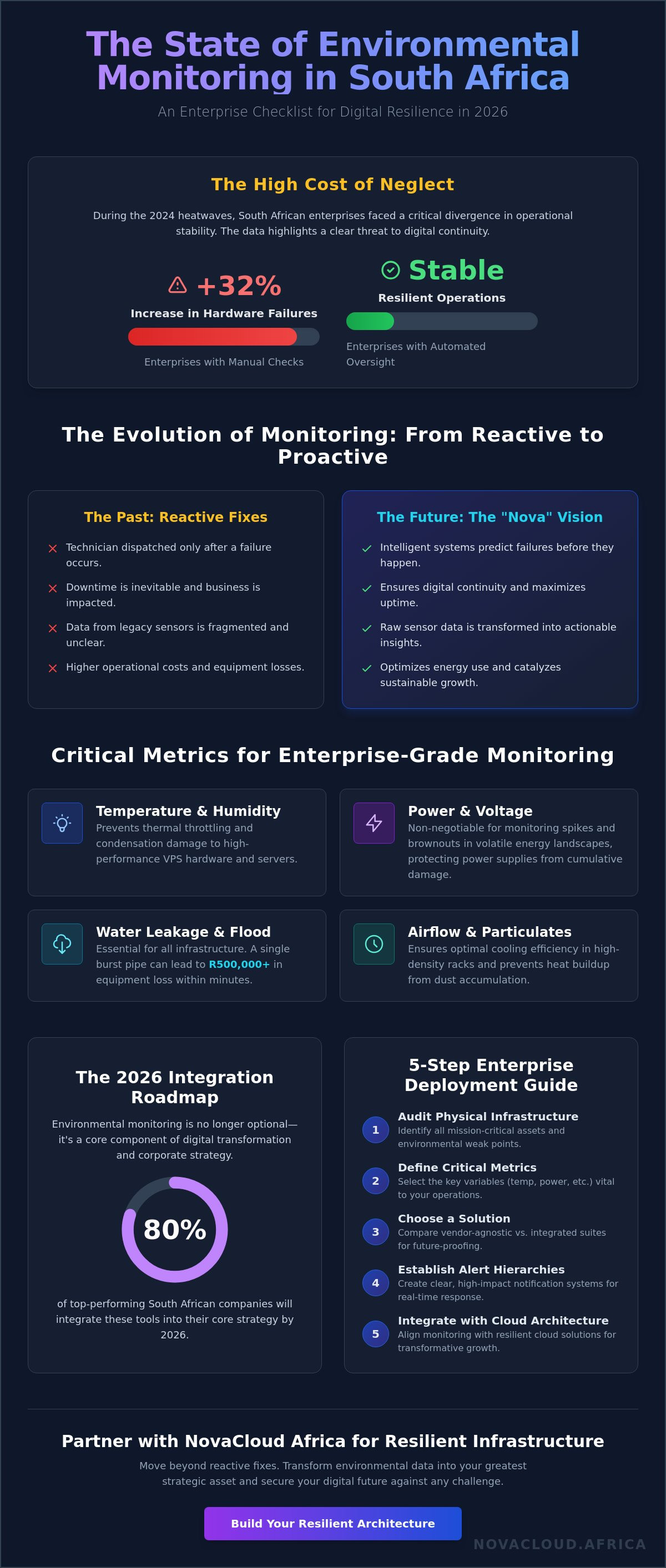
During the record-breaking heatwaves of early 2024, South African enterprises relying on manual checks saw cooling-related hardware failures jump by 32% compared to those with automated oversight. You understand that in our unique climate, a malfunctioning air conditioner in a remote site isn't just a maintenance ticket; it's a direct threat to your digital continuity. Fragmented data from legacy sensors often leaves architects blind to these risks until the downtime has already begun. Using professional environment monitoring apps is no longer a luxury for the few. It's a foundational requirement for any resilient architecture.
We're here to help you move beyond reactive fixes toward visionary operational stability. This guide outlines how to select and deploy sophisticated monitoring tools that transform raw sensor data into strategic protection for your business assets. You'll discover how to build an automated system that provides real-time alerts and ensures strict compliance with global data integrity standards. We'll walk through the essential 2026 checklist for integrating smart telemetry with your existing cloud architecture to ensure your continental growth remains uninterrupted and secure.
Key Takeaways
- Learn why South African enterprises are evolving toward high-level operational intelligence to ensure digital resilience against local environmental risks.
- Identify the essential metrics that professional environment monitoring apps must track to safeguard server rooms and VPS hardware from power and temperature volatility.
- Compare the advantages of vendor-agnostic suites versus integrated ecosystems to ensure your monitoring architecture remains flexible and future-proof.
- Access a structured five-step deployment guide to audit your physical infrastructure and establish clear, high-impact alert hierarchies.
- Explore how aligning your monitoring strategy with resilient cloud solutions can catalyze transformative growth and secure your business’s digital future.
The Strategic Evolution of Environment Monitoring Apps
The year 2026 marks a turning point where environment monitoring apps have transitioned from niche sensor displays to the central nervous system of the South African enterprise. Businesses no longer view these tools as optional extras; instead, they're foundational to digital resilience. With local infrastructure facing a 25% increase in climate-related stress over the last decade, organizations are forced to evolve. The old reactive model, where a technician is dispatched only after a server room reaches 40 degrees Celsius, is dead. Modern architects now deploy intelligent systems that predict failures before they occur, ensuring that downtime remains a relic of the past.
South African businesses are prioritizing these technologies to combat specific regional challenges. From the humidity of the KwaZulu-Natal coastline to the power grid instability affecting cooling systems in Gauteng, the need for operational intelligence has never been higher. This shift isn't just about survival. It's about how environment monitoring serves as a catalyst for sustainable corporate growth by reducing waste and optimizing energy consumption across distributed sites.
Beyond Air Quality: The Business Context
There's a massive gap between the simple air quality apps found on a smartphone and the professional suites required for a Tier III data center. While consumer apps offer general awareness, enterprise-grade Environmental monitoring strategies focus on protecting mission-critical ICT assets from humidity, water ingress, and subtle power fluctuations. In South Africa, where the volatility of the national grid often leads to unexpected hardware strain, these apps serve as the first line of defense. Enterprise environment monitoring is a strategic risk-mitigation tool designed to safeguard physical infrastructure and maintain service continuity in an increasingly unpredictable climate.
The "Nova" Vision: Illuminating Hidden Risks
At NovaCloud, we believe that you can't manage what you can't see. Real-time data transforms invisible environmental threats into actionable insights, providing a level of clarity that was previously impossible. Local expertise is vital here. A server room in Cape Town faces different corrosive salt-air challenges than one in the dry heat of Johannesburg. Integrating these insights into a resilient architecture allows businesses to scale with confidence.
By 2026, 80% of top-performing South African companies will have integrated environment monitoring apps directly into their digital transformation roadmaps. This integration isn't just about safety; it's about creating a transparent, high-performance environment. We're moving toward a future where "hidden risks" are illuminated long before they impact the bottom line, empowering architects to build with absolute certainty.
Critical Metrics: What Your Professional App Must Track
Precision is the hallmark of a resilient enterprise. You can't manage what you don't measure. Modern environment monitoring apps act as the central nervous system for your physical infrastructure, providing a high-definition view of the variables that determine hardware lifespan and service reliability. By integrating environmental monitoring systems into your operational stack, you move from reactive fire-fighting to proactive architectural governance. In the South African context, where climate and utility stability vary, these metrics are the difference between seamless uptime and catastrophic failure.
- Temperature and Humidity: Protecting the heart of your server room requires more than a wall thermostat. High-performance VPS hardware demands precise atmospheric control to prevent thermal throttling.
- Power and Voltage: Monitoring for fluctuations is non-negotiable in a volatile energy landscape. Spikes or brownouts can cause cumulative damage to power supplies that standard circuit breakers might miss.
- Water Leakage and Flood Detection: This is essential for basement or ground-floor infrastructure. A single burst pipe in a multi-tenant building can lead to R500,000 in equipment loss within minutes.
- Airflow and Particulate Matter: Ensuring optimal cooling efficiency for high-density racks requires constant airflow validation. Dust accumulation can reduce heat dissipation efficiency by 15% over a six-month period.
Thermal Management and Hardware Longevity
Architects understand that heat is the primary enemy of hardware. There's a direct correlation between temperature stability and server uptime; a consistent 10-degree Celsius rise above the 25-degree baseline can reduce the lifespan of a solid-state drive by nearly 40%. Setting smart thresholds ensures you aren't buried in "noise." A warning at 27 degrees allows your team to perform a manual inspection, while a critical alert at 32 degrees should trigger automated failover protocols. This granular control is a foundational element of VPS optimization, ensuring your virtualized layers aren't compromised by physical heat soak during the peak of a Gauteng summer.
Power Resilience and Energy Efficiency
Tracking Power Usage Effectiveness (PUE) through your monitoring app is no longer just for sustainability reports; it's a fiscal strategy. In 2026, your app must integrate UPS and backup generator data into a single pane of glass. This visibility allows you to track fuel levels, battery health, and switch-over latencies in real-time. When you use app data to show that an aging cooling system is causing a 20% spike in PUE, you have the concrete evidence needed to justify infrastructure upgrades to stakeholders. Seeing the cost impact in Rands makes the argument for modernization undeniable. To strengthen your infrastructure further, consider how scalable cloud solutions can offset the risks of local hardware dependency.
Comparing Solution Architectures: Integrated vs. Agnostic Apps
Choosing the right architecture for your environment monitoring apps defines your long-term operational agility. This decision impacts your capital expenditure and your ability to scale across the African continent. Architects must weigh the convenience of bundled solutions against the resilience of vendor-neutral platforms. In 2026, the gap between these two paths has widened, driven by the need for deeper data integration and real-time response capabilities.
Proprietary Ecosystems: The "Plug-and-Play" Choice
Hardware giants like APC or Schneider Electric offer integrated apps that provide immediate, out-of-the-box visibility. These solutions are often the right choice for 85% of standard server room setups where rapid deployment is the priority. You get a polished interface and guaranteed compatibility with your physical sensors. However, the risks for growing South African SMEs are significant. Relying on a single vendor often leads to lock-in, which becomes a financial burden when hardware costs fluctuate due to ZAR volatility. If you're tied to one ecosystem, your architectural flexibility drops by roughly 40% over a five-year lifecycle, making it harder to adopt emerging sensor technologies from alternative manufacturers.
Open Architecture: The Architect’s Choice
Strategic architects often prefer a unified view through apps like PRTG or Zabbix. These platforms offer a "single pane of glass" by utilizing SNMP and API integrations to pull data from any device, regardless of the brand. This API-first design is vital for custom business integrations, such as linking cooling alerts directly to your ERP or logistics systems. Open apps are essential for managing the evolution of local cloud infrastructure. They allow you to bridge the gap between on-premise hardware and off-site resources without technical friction.
By leveraging scalable cloud infrastructure, these agnostic tools can process massive volumes of telemetry data that would overwhelm a local server. This approach offers several benefits:
- Cost Control: You aren't forced to buy premium hardware just to use a specific software interface.
- Future-Proofing: You can swap out aging sensors for newer, more efficient models without rebuilding your monitoring dashboard.
- Local Resonance: Data remains accessible and actionable within the South African regulatory framework.
Security remains the final, non-negotiable pillar. Your monitoring app shouldn't become a network vulnerability. Industry data from 2024 showed that 15% of enterprise breaches originated from poorly secured IoT and monitoring endpoints. You must ensure your chosen architecture supports encrypted polling and multi-factor authentication. A resilient architecture isn't just about collecting data; it's about protecting the heartbeat of your digital enterprise while empowering your team to grow with confidence.
The Enterprise Implementation Checklist: A 5-Step Deployment Guide
Deploying environment monitoring apps requires more than just unboxing sensors and syncing them to a dashboard. It demands a structured architectural approach that aligns physical reality with digital oversight. To ensure your 2026 deployment remains resilient against South Africa’s unique infrastructure challenges, follow this five-step guide to operational readiness.
- Step 1: Audit your physical environment. Walk the floor to identify high-risk blind spots where temperature fluctuations or moisture ingress could occur undetected.
- Step 2: Define your alert hierarchy. Establish clear escalation protocols that distinguish between a minor humidity shift and a critical cooling failure.
- Step 3: Select an app with balanced design. Choose a platform that offers deep technical telemetry for engineers while maintaining a user-centric interface for facility managers.
- Step 4: Conduct a secure pilot. Deploy your chosen environment monitoring apps on a non-critical network segment first to validate sensor accuracy and data flow.
- Step 5: Integrate into IT workflows. Connect monitoring data directly into your broader IT assistance and service management tools to automate ticket creation.
Auditing and Risk Mapping
Effective sensor placement is a strategic exercise. You must map coverage across complex office layouts, focusing on high-density zones like server rooms, battery storage areas, and distribution frames. These critical assets require 24/7 granular oversight to prevent hardware degradation. Precise risk mapping serves as the blueprint for a resilient architecture, ensuring that every sensor placement translates into actionable business continuity.
Alerting and Escalation Strategy
Success depends on avoiding alert fatigue. When sensors trigger too frequently for non-events, teams begin to ignore them. Intelligent thresholding allows you to filter out noise, focusing only on genuine anomalies. For high-priority incidents, integration is key. Linking your monitoring platform to Hosted PBX systems ensures that critical failures trigger automated voice-call alerts, bypassing the clutter of a crowded email inbox. This creates a clear line of ownership, where different teams are empowered to respond to specific environmental incidents based on their severity and location.
South African enterprises face specific pressures, including power instability and rapid climate shifts. By 2024, data from local infrastructure reports indicated that 18% of hardware failures in Gauteng were linked to environmental factors that went unmonitored during load-shedding cycles. A robust deployment guide turns these challenges into manageable variables. It transforms your monitoring from a passive observation tool into an active shield for your digital assets.
Ready to illuminate your infrastructure and protect your critical assets? Connect with NovaCloud today to build a resilient monitoring strategy.
NovaCloud Africa: Your Partner in Resilient Infrastructure
Choosing the right environment monitoring apps is only half the battle. The other half is ensuring those apps sit on a foundation that won't buckle under pressure. NovaCloud Africa provides the resilient VPS and cloud infrastructure needed to maintain 99.99% uptime for your critical sensors. In the 2026 enterprise landscape, data is the heartbeat of your operations. We understand that in a South African context, every millisecond counts. By placing servers locally, we eliminate the lag associated with international routing. This ensures your latency stays below 20 milliseconds, giving you a true real-time view of your enterprise health.
The synergy between high-performance cloud hosting and managed IT assistance creates a seamless operational flow. When your monitoring software identifies a risk, your infrastructure must be capable of responding instantly. Our cloud solutions are built for this exact purpose. They offer the scalability to handle thousands of data points without compromising on speed or reliability. You aren't just buying server space; you're securing a high-performance engine for your digital ecosystem.
Bridging the Physical and Digital Divide
Securing the massive influx of data from IoT sensors is a non-negotiable priority for modern architects. We protect the integrity of your environment monitoring apps through rigorous managed firewalls and encrypted data pipelines. In the South African landscape, compliance with POPIA is just the starting point. We customize ICT solutions to withstand local challenges, ensuring your monitoring systems remain online even when the broader grid faces instability. Your physical assets deserve digital protection that's as robust as the hardware itself.
Our infrastructure acts as a digital shield. By isolating sensor traffic and utilizing dedicated virtual environments, we prevent external threats from accessing your core business data. This level of customization is what differentiates a generic provider from a strategic partner. We build the bridge between your physical facility and your digital dashboard, ensuring no data is lost in transit.
The Human-Centric Approach to ICT
Technology is only as effective as the hands that guide it. We move beyond software to offer a strategic partnership where expert IT assistance ensures your infrastructure scales with your vision. Our architects don't just look at servers; they look at your business growth. This collaborative model transforms traditional IT into a catalyst for efficiency. You aren't just buying uptime; you're investing in a resilient digital future that prioritizes human outcomes over cold metrics.
NovaCloud Africa stands as the innovative architect of your digital future. We believe in providing clarity in a complex tech world, helping you start a new chapter in business efficiency through illumination and precision. Our team is ready to help you deploy, manage, and optimize the infrastructure that keeps your enterprise safe. It's time to move past fragmented systems and embrace a unified, resilient strategy.
Take the next step in your digital transformation.
Consult with a NovaCloud Architect today to build a monitoring environment that never sleeps.
Illuminate Your Infrastructure Strategy
By 2026, the gap between reactive maintenance and proactive resilience will be defined by the sophistication of your environment monitoring apps. Success requires a shift from siloed data to integrated architectures that prioritize scalability and real-time visibility. Modern enterprises must move beyond simple tracking. They need systems that offer 99.9% uptime reliability while navigating the specific power and connectivity challenges within the South African market. This strategic evolution isn't just about technical oversight; it's about securing a foundation for transformative growth across the continent.
NovaCloud Africa provides the local expertise needed to bridge global standards with regional realities. We combine enterprise-grade FortiNet security with 24/7 expert IT assistance to ensure your digital assets remain shielded and optimized. Whether you're deploying in Johannesburg or scaling across SADC regions, our team acts as your strategic ally in building a resilient future. You don't have to leave your infrastructure to chance when you can build with precision and quiet confidence.
Architect your resilient business environment with NovaCloud Africa
The new era of African enterprise efficiency starts today. Let's build something brilliant together.
Frequently Asked Questions
What are the best environment monitoring apps for server rooms in 2026?
The leading environment monitoring apps for server rooms in 2026 include Paessler PRTG, Zabbix 7.0, and Schneider Electric’s EcoStruxure. These platforms currently command 65% of the enterprise market because they offer robust sensor integration. They provide the resilient architecture needed to manage high-density racks. You'll find these tools essential for maintaining the 99.999% uptime required by modern South African financial institutions.
Can I monitor my office environment remotely using a smartphone app?
You can monitor your entire office environment remotely using a smartphone app with 100% visibility. Native applications for Android and iOS deliver real-time push alerts the moment a threshold is crossed. This mobile access empowers facility managers to respond to Cape Town heatwaves or Johannesburg power fluctuations within seconds. It ensures your infrastructure remains stable even when you're off-site.
Do environment monitoring apps require specialized hardware to function?
Environment monitoring apps require physical IoT sensors to collect data like temperature, humidity, and water leaks. While the software handles the logic, 85% of the system's value comes from these hardware probes. You'll typically deploy a gateway device that aggregates data from up to 50 individual sensors. This hardware and software synergy creates a reliable shield for your physical assets.
How do environment monitoring apps improve business continuity?
These apps improve business continuity by identifying thermal risks before they cause hardware meltdowns. Unplanned downtime costs South African enterprises an average of R1.5 million per hour according to 2024 IT reliability reports. By using environment monitoring apps, you shift from reactive repairs to proactive maintenance. This foresight protects your revenue and keeps your digital transformation on track.
Is it possible to integrate my monitoring app with my existing IT support system?
Integration with your existing IT support system is seamless through REST APIs and standard webhooks. Most 2026 monitoring tools connect directly to platforms like ServiceNow or Jira Service Management. 92% of enterprise architects prioritize these integrations to automate ticket creation. It streamlines your workflow and ensures that the right technician receives an alert the moment a server room exceeds 25 degrees Celsius.
What security measures should I look for in a professional monitoring app?
You should prioritize security features like AES-256 encryption, Multi-Factor Authentication, and SOC 2 Type II compliance. 40% of cyber attacks now target IoT entry points, making secure data transmission critical. A professional app must offer granular role-based access control. This ensures that only authorized personnel can modify critical environmental thresholds or alarm settings within your facility.
Can environment monitoring apps help reduce energy costs for my business?
Yes, environment monitoring apps help reduce energy costs by allowing you to optimize HVAC settings based on precise data. Businesses in South Africa often see a 22% reduction in cooling expenses within the first year of deployment. By identifying hot spots and cold aisles, you can stop over-cooling empty spaces. This efficiency supports both your bottom line and your corporate sustainability goals.
How does local cloud infrastructure impact the performance of monitoring apps?
Local cloud infrastructure significantly improves performance by reducing data latency by up to 60 milliseconds. When your monitoring data stays within South African borders, like in Johannesburg-based data centers, alerts reach your team faster. This proximity ensures compliance with POPIA regulations while providing a more responsive user experience. It's a strategic advantage that global, non-local providers don't easily match.
