


Strategic Internet Redundancy: A 2026 Resilience Checklist for South African Enterprises

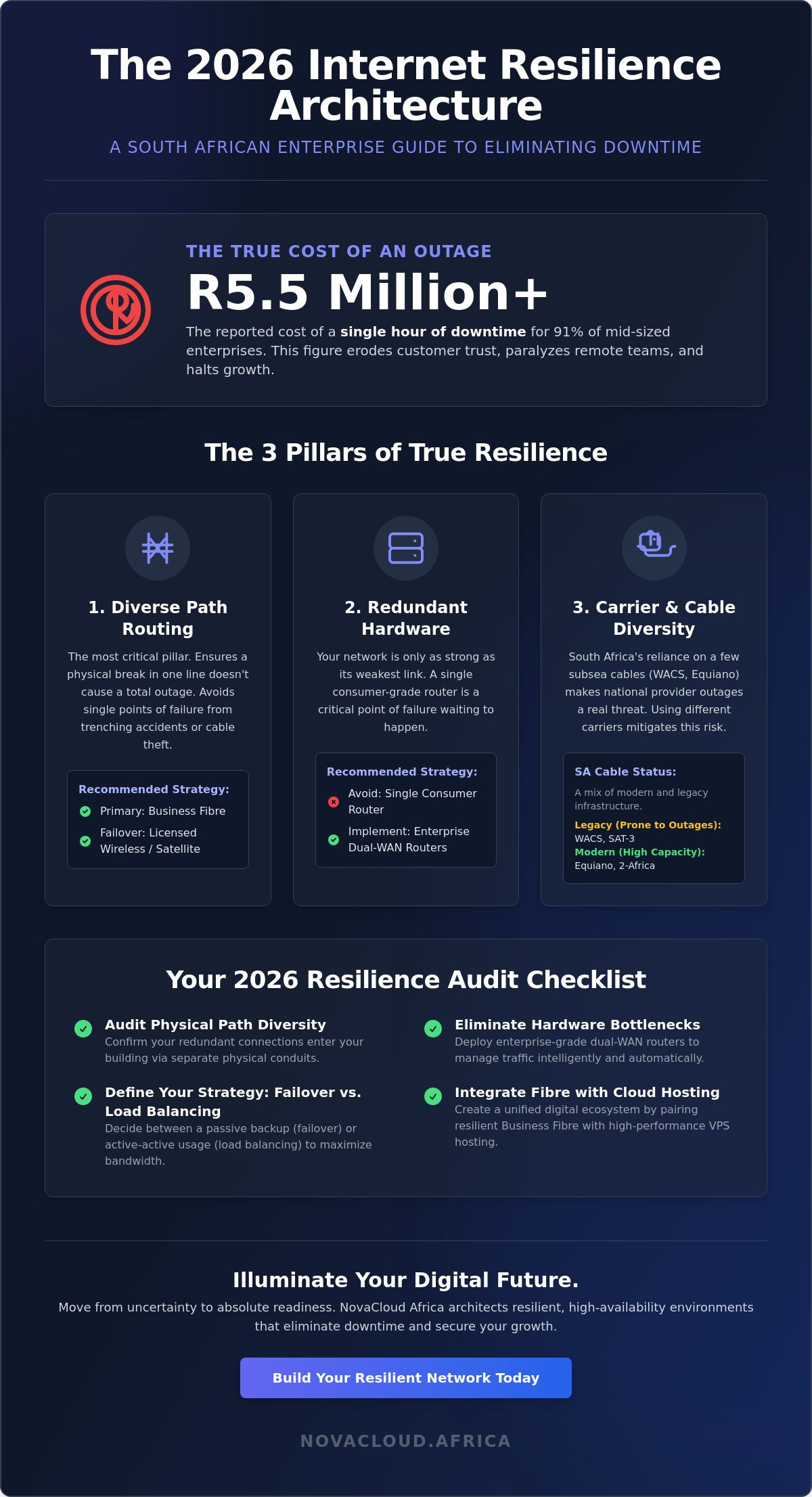
In 2024, industry research from ITIC confirmed that a single hour of downtime costs 91% of mid-sized enterprises more than R5.5 million. For South African organizations, this reality is often compounded by local infrastructure instabilities that make internet redundancy a strategic necessity rather than a technical luxury. You've likely felt the frustration of a fragmented connectivity policy where a single undersea cable break or a localized power failure brings your entire cloud-dependent team to a standstill. It's an expensive silence that erodes client trust and stalls your transformative growth.
We believe your digital journey deserves a more resilient foundation. This guide promises to help you master the architecture of uninterrupted connectivity through a comprehensive 2026 resilience checklist designed to eliminate downtime. We'll provide a clear roadmap for your network investments, moving you away from the complexity of managing multiple ISPs toward a streamlined, high-availability environment. You're about to discover how to secure zero-interruption workflows and gain total confidence in your cloud application availability across the South African market.
Key Takeaways
- Quantify the true cost of downtime and discover how a "Nova" perspective transforms connectivity into a catalyst for business illumination and growth.
- Identify critical vulnerabilities in your infrastructure by auditing physical path diversity and eliminating single points of failure within your hardware.
- Master the strategic choice between automatic failover and load balancing to maximize your bandwidth and ensure seamless continuity during disruptions.
- Implement a future-proof internet redundancy checklist designed to safeguard South African enterprises against the evolving digital demands of 2026.
- Learn how to integrate resilient Business Fibre with high-performance VPS hosting to create a unified, scalable digital ecosystem across the continent.
The Architecture of Uptime: Why Redundancy is Non-Negotiable
Connectivity is the pulse of the modern South African enterprise. It isn't merely a utility. At NovaCloud, we view connectivity as a catalyst for business illumination. It's the light that allows your digital strategy to shine. When that light fades, growth stalls. True resilience requires shifting from reactive fixes to a proactive architecture. This starts with a fundamental understanding of Redundancy (engineering), ensuring your network remains operational even when primary links fail. By designing for failure, you actually architect for success.
The Economic Impact of Disruption
Downtime is a silent thief. For a digital enterprise in Johannesburg or Cape Town, the cost of a single minute of disconnection can exceed R30,000. This figure accounts for more than just lost sales. It includes the erosion of customer trust and the total paralysis of remote teams relying on cloud architectures to perform daily tasks. Relying solely on a single Business Fibre line isn't a complete strategy. It's a gamble. 2026 demands a multi-layered approach to internet redundancy that protects your brand reputation in a 24/7 global economy. When your systems go dark, your customers don't wait. They find a competitor whose lights are still on.
The South African Connectivity Landscape
South Africa sits at a critical junction of global data. We rely heavily on subsea cables like WACS, Equiano, and 2-Africa. The massive, simultaneous cable breaks in March 2024 proved how vulnerable our regional stability can be. When these international arteries fail, local infrastructure bottlenecks often amplify the crisis. National ICT providers are working to architect better regional stability, but individual businesses can't wait for systemic changes. You must own your resilience. Internet redundancy is no longer a luxury for the top 1% of firms. It's a baseline requirement for any organization that intends to thrive in the African digital ecosystem.
- WACS and SAT-3: Older legacy cables that remain prone to outages from undersea landslides.
- Equiano and 2-Africa: Modern, high-capacity cables that provide the backbone for 2026 growth.
- Last-Mile Vulnerability: Local trenching accidents or power failures that can sever your connection regardless of sea cable health.
Moving toward 2026, the goal is seamless integration. Your network should feel like a single, unbreakable thread. By integrating diverse backhaul paths and local failovers, you move from a state of uncertainty to one of absolute readiness. This proactive stance is what separates the market leaders from those left in the dark.
The Pillars of Connectivity Resilience: Path, Hardware, and Carrier
True resilience is an architectural choice, not a product you buy off a shelf. For South African enterprises, internet redundancy must be viewed as a multi-layered shield designed to withstand everything from localized cable theft to national power instability. It's about ensuring that your digital pulse remains steady even when individual components fail. This requires a strategic alignment of physical paths, robust hardware, and diverse carrier logic.
Diverse Path Routing
Physical diversity is the most overlooked element of a resilient strategy. Many businesses mistakenly believe they're protected because they have two fibre contracts, yet both lines often enter the building through the same conduit or run through the same municipal trench. If a trenching team severs those cables, your redundancy evaporates instantly. Last-mile diversity requires using different physical routes or entirely different mediums. We recommend integrating a high-capacity wireless failover, such as licensed microwave or low-earth orbit satellite, to ensure that a physical break in the fibre doesn't result in a total blackout. This ensures your data has a literal "plan B" through the air when the ground is compromised.
Eliminating Hardware Bottlenecks
Your connection is only as reliable as the box managing it. Relying on a single consumer-grade router creates a dangerous single point of failure. Enterprise resilience demands dual-WAN routers, such as those from FortiNet, which can intelligently swap traffic between links in milliseconds. Internal distribution also matters; deploying Ubiquiti networks allows for a scalable, mesh-capable environment that maintains connectivity across your campus even if one node fails.
In the South African context, power is the silent killer of connectivity. During the 6,947 hours of load shedding recorded in 2023, businesses learned that a router without a dedicated UPS or inverter is just a paperweight. Your redundancy strategy must include a power audit for every piece of networking equipment. Building a resilient cloud ecosystem starts with ensuring these physical foundations stay powered during grid instability.
Carrier redundancy serves as the final layer of protection. Using multiple ISPs protects you from logical failures within a provider's core network. A 2022 report by the U.S. Government Accountability Office highlighted that resilient internet architecture requires addressing both physical and logical vulnerabilities to prevent widespread outages. This is where SD-WAN becomes transformative. It acts as the intelligent conductor of your connectivity orchestra, constantly monitoring the health of each carrier and routing critical applications like VoIP or ERP traffic over the most stable path available. It turns a collection of separate links into a single, high-performance fabric that empowers your team to work without the fear of disconnection.
Failover vs. Load Balancing: Choosing Your Strategy
Selecting a strategy for internet redundancy isn't merely a technical box to tick. It's a fundamental decision about how your business maintains its pulse during an infrastructure crisis. In South Africa, where connectivity can be influenced by everything from municipal maintenance to international undersea cable breaks, the way you manage your backup links determines your competitive edge and operational resilience.
The Active-Passive Model
The Active-Passive approach, commonly known as automatic failover, keeps your secondary line in a state of constant readiness. It only engages when the primary connection fails. This transition is usually triggered by specific thresholds, such as 3% packet loss or a total heartbeat failure. It's the preferred choice for businesses relying heavily on VoIP and Hosted PBX systems. These applications require a single, stable path to maintain call quality and session persistence without the risk of dropped packets during a mid-call switch.
However, this model faces the brownout challenge. A total blackout is easy for hardware to detect, but a degraded connection that's still technically up can trap your traffic in a loop of poor performance. Modern SD-WAN controllers solve this by setting aggressive performance metrics. They ensure your team switches to the backup before the user even notices a dip in quality. It's a conservative but highly reliable method for maintaining business continuity.
The Active-Active Model
Load balancing, or the Active-Active approach, utilizes all available connections simultaneously. Instead of leaving a secondary line idle, you distribute traffic across multiple links to maximize your total throughput. This strategy is transformative for enterprises managing high-demand Virtual Private Servers. It allows for seamless data synchronization and ensures that cloud-hosted workloads aren't throttled by the limitations of a single pipe.
- Optimized Throughput: You can combine a 100Mbps Fiber line with a 50Mbps Microwave link for a total functional capacity of 150Mbps.
- Latency Management: Intelligent routers can route time-sensitive ERP data through the lowest-latency link while pushing large background backups through the secondary path.
- Granular Control: You gain the ability to prioritize specific applications, ensuring that customer-facing portals always have the cleanest path to the web.
Analyzing the ROI requires looking beyond the monthly subscription cost. For a mid-sized Johannesburg enterprise, the cost of a two-hour outage can easily exceed R30,000 in lost productivity and missed opportunities. While Active-Active setups often require more sophisticated hardware, the ability to utilize 100% of your paid bandwidth every day offers a faster path to technological maturity. Your choice should align with your mission-critical applications. If your priority is absolute session stability for voice, Active-Passive is the answer. If you're scaling a data-intensive cloud environment, Active-Active is your engine for growth.
The 2026 Internet Redundancy Audit Checklist
Resilience isn't a static state; it's a rigorous practice of verification. For South African enterprises, the 2026 landscape demands a move away from "hope-based" connectivity toward a validated internet redundancy framework. This checklist serves as your technical blueprint for absolute uptime, ensuring your digital presence remains unshakable even when the local infrastructure falters.
- Step 1: Map physical entry points. Trace your fibre paths. If both your primary and secondary links enter your building through the same northern trench, a single municipal maintenance error could sever both connections simultaneously.
- Step 2: Audit hardware for single points of failure. Ensure you aren't running two diverse links into a single edge router. A hardware failure there renders your redundancy moot; you need dual-homed configurations or high-availability router pairs.
- Step 3: Test failover speed. Aim for sub-second switching. Your goal is stateful connection retention, where active sessions like ERP syncs or video calls don't drop during the transition between providers.
- Step 4: Verify power backup duration. With the persistent threat of grid instability, your UPS and inverter systems must power all network equipment for at least four hours to survive extended Stage 6 load shedding windows.
- Step 5: Review SLA agreements. Look for "Mean Time to Repair" (MTTR) clauses rather than just uptime percentages. A 99.9% uptime guarantee still allows for nearly nine hours of downtime per year, which is unacceptable for modern digital operations.
The Physical and Logical Audit
True internet redundancy requires architectural diversity. Ask your ISP which subsea cables they prioritize. With the 2024 arrival of the 2Africa cable, your traffic should ideally be split between different international routes like WACS and Equiano to avoid a total blackout during undersea breaks. We recommend a "mixed-media" approach. Combining terrestrial fibre with a high-capacity Microwave link ensures that even a major metropolitan cable theft won't silence your operations. Logically, check your DNS settings. Use secondary DNS providers to ensure your domain remains reachable if your primary provider faces a DDoS attack.
Testing and Maintenance Protocols
Static configurations decay over time. Schedule quarterly "pull-the-plug" tests after hours to confirm that your automated failover actually triggers under pressure. Use proactive monitoring tools to track the health of your secondary link; it's useless if it fails silently weeks before you need it. You should also update firewall policies to prioritize Business voice and critical cloud traffic during an outage. This ensures that even on a constrained backup link, your most vital human-centric communications remain crystal clear and functional.
Illuminating Your Digital Future with NovaCloud Africa
NovaCloud Africa doesn't just provide bandwidth; we architect resilience. In a South African market where connectivity can be unpredictable, a single fibre line represents a single point of failure. We integrate high-capacity Business Fibre with managed security protocols to ensure your data remains protected while it flows. This creates a fortified digital perimeter where internet redundancy isn't an afterthought; it's the core architecture. By pairing resilient connectivity with our high-performance VPS hosting, we eliminate the latency gaps that often plague businesses relying on offshore servers. Your applications stay responsive, and your data stays within reach, regardless of local infrastructure strain.
Local expertise is the ultimate fail-safe. Global providers often lack the "boots on the ground" insight needed to navigate South African grid instability or specific subsea cable maintenance cycles. NovaCloud acts as your strategic ally and technical executor. We understand the nuances of the regional telecommunications grid, allowing us to design failover systems that actually trigger when the pressure is on. This proximity ensures that your business is positioned as a market leader, maintaining superior digital uptime while competitors struggle with intermittent outages. We turn your connectivity into a competitive advantage.
Unified Resilience: PBX and Cloud
Communication is the heartbeat of your enterprise. Our systems ensure your Hosted PBX never misses a critical client call due to local exchange issues or line faults. By utilizing redundant internet paths, we protect your Microsoft 365 Business Licensing investment, ensuring that Teams calls and cloud collaborations remain fluid. NovaCloud bridges the gap between global standards and local technical execution. We provide the sophisticated tools used by multinational corporations, tailored specifically for the African business environment.
Next Steps for Your Infrastructure
Transitioning from a vulnerability audit to a robust implementation roadmap is the first step toward total peace of mind. It's time to stop reacting to downtime and start preventing it. You can consult with an Innovative Architect at NovaCloud to design a custom redundant stack that mirrors your growth ambitions. We look at your entire network holistically, from the primary link to the last-mile backup. Don't wait for the next major outage to test your limits. Contact NovaCloud today for a comprehensive network review and secure your place in South Africa's digital future.
Illuminate Your Path to 2026 Operational Resilience
The transition from basic connectivity to a sophisticated, multi-layered architecture is the defining move for South African enterprises entering 2026. True internet redundancy demands a focus on path diversity and hardware resilience to ensure that a single cable break doesn't paralyze your operations. By balancing failover strategies with active load balancing, your business maintains its momentum even when external infrastructure falters. Industry reports from 2024 suggest that connectivity disruptions can cost large organizations upwards of R1 million per hour, making a resilient network the foundation of your digital sovereignty.
NovaCloud Africa serves as your strategic ally, delivering symmetrical high-speed connectivity backed by local expertise. We integrate enterprise-grade FortiNet security into every architecture, ensuring your uptime never comes at the expense of your integrity. With our South African based technical support, you have a partner that's as committed to the continent's growth as you are. It's time to move beyond the fear of downtime and toward the clarity of a connected future.
Architect your resilient network with NovaCloud Business Fibre
Your digital transformation deserves a foundation that's as ambitious as your vision for the future.
Frequently Asked Questions
What is the difference between internet redundancy and a simple backup connection?
Internet redundancy involves multiple active connections working in a seamless architecture to ensure zero downtime, whereas a backup is a reactive secondary line. True redundancy uses diverse paths and automated orchestration to maintain sessions without human intervention. In 2026, South African enterprises prioritize this approach to avoid the 15-minute productivity loss typically associated with manual backup switches.
Does internet redundancy protect my business from load shedding?
Redundancy protects your connectivity, but it requires a dedicated power strategy to remain effective during Stage 6 load shedding. While 92% of South African fibre nodes now feature battery backups, these often fail during consecutive power cycles. Combining redundant links with an Uninterruptible Power Supply (UPS) ensures your digital architecture remains illuminated when the local grid falters.
Is it possible to have 100% internet uptime in South Africa?
Achieving 100% uptime is statistically impossible, but a resilient internet redundancy strategy can reach 99.99% availability. This "four nines" standard limits total annual downtime to less than 53 minutes. By 2026, the integration of diverse terrestrial fibre and Low Earth Orbit (LEO) satellite links brings local businesses closer to this ideal than any single-provider solution ever could.
How does SD-WAN improve internet redundancy for branch offices?
SD-WAN revolutionizes internet redundancy by treating multiple connections as a single, intelligent pool of bandwidth. It identifies critical application traffic and routes it over the most stable path in real-time. This technology reduces branch downtime by 70% compared to traditional routing, ensuring your remote teams stay connected to the cloud without the frustration of dropped sessions or lag.
Can I use two different fibre providers for redundancy in the same building?
You can use two providers, but you must verify they don't share the same physical trench or entry point. If both providers utilize the same "last mile" infrastructure, a single construction accident could sever both links simultaneously. Strategic redundancy requires confirming that your providers use distinct undersea cables and separate local exchange points to ensure true path diversity.
What is the minimum failover time required for VoIP calls to stay active?
VoIP calls require a failover time of less than 1,000 milliseconds to prevent the session from dropping. If your switchover takes longer than 3 seconds, the call will terminate and your team will lose the connection. Advanced edge devices now achieve sub-second steering, which maintains voice clarity and session persistence even if a primary fibre link fails mid-conversation.
How much does implementing professional internet redundancy typically cost?
Implementing professional redundancy typically increases your monthly connectivity spend by 30% to 50% depending on the chosen medium. While a secondary business fibre line might start at R1,500 per month, the total investment includes managed hardware and orchestration software. This cost is minimal compared to the R50,000 hourly loss many South African firms report during total network outages.
Do I need a managed firewall to handle multiple internet connections?
A managed firewall or an SD-WAN edge device is essential to orchestrate multiple connections effectively. Without this centralized brain, your network won't know how to distribute traffic or when to trigger a failover. These devices provide the visibility needed to monitor link health, ensuring your security policies remain consistent across every active connection in your resilient architecture.
