


The Ultimate VPS Security Hardening Checklist for 2026: Architecting Resilient Infrastructure

With confirmed exploitation of critical vulnerabilities surging by 105% this year, the shadow cast by cyber threats has never been longer. You likely feel the weight of this reality every time you deploy a new instance, wondering if your default provider settings can truly withstand an AI-accelerated assault. It's a valid concern because the digital landscape of 2026 demands more than just basic perimeter defense; it requires a complete architectural renewal. We understand that the complexity of maintaining POPIA compliance while managing diverse virtual environments can feel overwhelming, especially with new regulations for health data now in full effect.
This vps security hardening checklist 2026 is designed to be your catalyst for change, shifting your posture from reactive defense to visionary resilience. We'll show you how to master the technical steps needed to secure your infrastructure, ensuring your systems reflect the stability and expansion your business deserves. You'll gain a clear, actionable roadmap that reduces your attack surface without sacrificing the performance your regional growth depends on. From implementing OpenSSH 10.3p1 protocols to aligning with the latest NIST CSF 2.0 framework, we're providing the clarity you need to lead your organization into a secure, empowered future.
Article Highlights
- Architect a resilient digital fortress by moving beyond default configurations to counter AI-driven vulnerability scanning.
- Secure your server entry points by replacing traditional passwords with cryptographic identities and disabling direct root access.
- Strengthen your perimeter using a "Default Deny" strategy that combines host-based rules with a professional Managed Firewall.
- Follow this vps security hardening checklist 2026 to maintain POPIA compliance through automated patch management and robust data encryption.
- Transition from DIY management to a secure ecosystem by leveraging expert IT assistance for your digital evolution.
The 2026 VPS Threat Landscape: Why Default Configurations are High-Risk
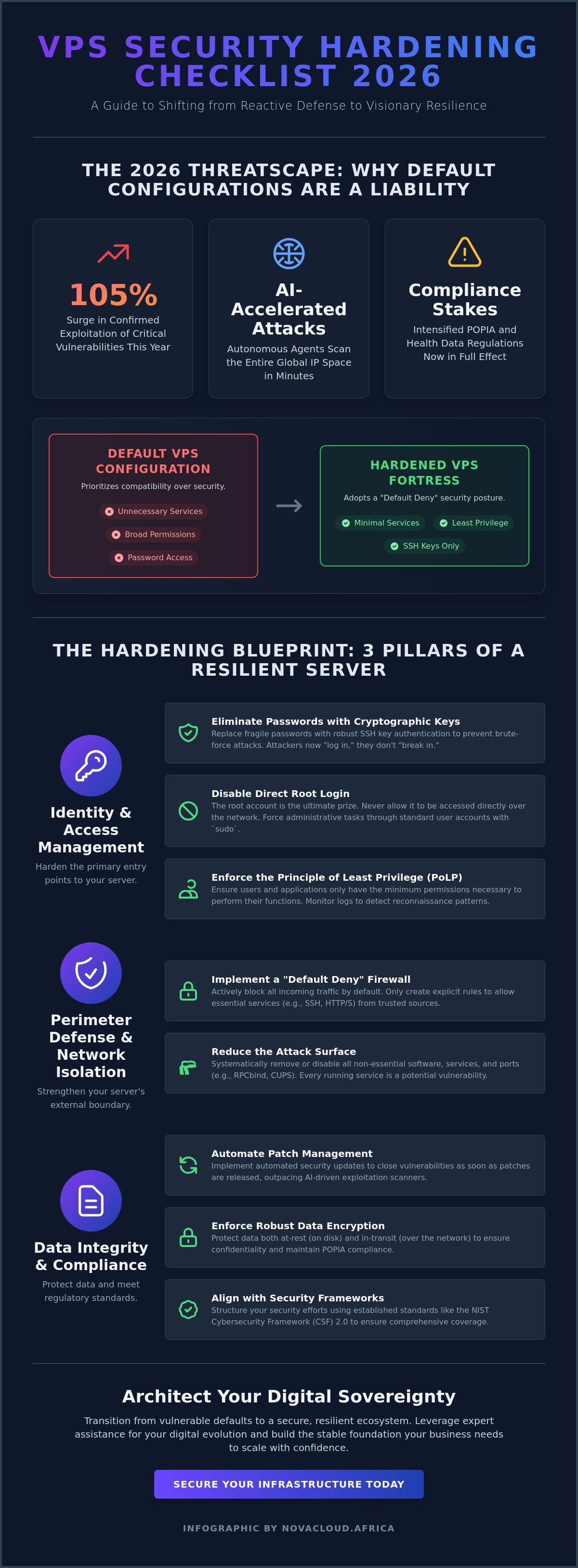
Hardening a server is the art of digital restraint. It is the systematic process of reducing its attack surface by removing every unnecessary vulnerability, service, and entry point. In 2026, the speed of exploitation has reached a breaking point. Threat actors now use autonomous AI agents to scan the entire global IP space in minutes, identifying unpatched systems before a human administrator even sees the security advisory. This vps security hardening checklist 2026 serves as your blueprint for transforming a generic virtual instance into a resilient, mission-critical asset.
Most "out-of-the-box" VPS configurations are designed for maximum compatibility. Providers want your software to run immediately without technical friction, so they ship images with broad permissions and multiple active services. While this makes the initial setup easy, it prioritizes convenience over the uncompromising security required to protect South African enterprise data. We view security not as a restrictive barrier, but as a catalyst for regional digital empowerment. A hardened server provides the stable foundation your business needs to scale with confidence.
The Technical Liability of Default OS Images
Standard operating system images often carry hidden technical debt in the form of pre-installed services. Legacy protocols like RPCbind or print services like CUPS frequently run in the background, creating unnecessary listening ports that attract botnet attention. These predictable user structures and default ports are the first targets for AI-driven brute force attacks. You must embrace the shared responsibility model. While your provider secures the physical hardware and hypervisor, the integrity of the operating system depends entirely on your proactive hardening efforts. It's a shift from "breaking in" to "logging in," where attackers exploit these default weaknesses to gain a foothold.
The Business Impact of a Compromised Virtual Environment
A compromised VPS is a liability that extends far beyond your server's uptime. If your infrastructure is hijacked for crypto-mining or spam relaying, your IP address will be blacklisted globally, crippling your ability to communicate with clients. The financial stakes are equally high. With the average cost of a data breach reaching $4.4 million according to N-able's June 2026 data, the price of negligence is unsustainable.
Legal ramifications under South African frameworks have also intensified. The "Regulations Relating to the Processing of Data Subjects' Health Information," which came into force on March 6, 2026, leave no room for error. Negligent server management can now lead to immediate enforcement actions from the Information Regulator. Adopting a rigorous security posture is essential to the Architecting High-Performance VPS philosophy, ensuring your digital evolution remains both fast and secure.
Identity and Access Management: Hardening the VPS Entry Points
Identity is the cornerstone of your digital architecture. In 2026, relying on traditional passwords is no longer a viable strategy for South African enterprises aiming for true resilience. Attackers now focus on "logging in" rather than "breaking in," making your authentication methods the most critical component of this vps security hardening checklist 2026. By shifting toward cryptographic identity, you replace fragile strings of characters with robust mathematical proof. This transition aligns with industry-accepted system hardening standards, ensuring that your infrastructure isn't just functional, but fundamentally resilient.
The root account represents the ultimate prize for any adversary. It should never be used for direct remote access. Instead, we architect a hierarchy where administrative tasks are performed by authenticated individuals with specific, limited permissions. Implementing the Principle of Least Privilege (PoLP) across your team ensures that users only have the access necessary for their specific roles. Monitoring your access logs allows you to spot the subtle light of reconnaissance patterns, such as repeated failed attempts from unusual geographic locations, before they escalate into full-scale intrusions.
Mandatory SSH Hardening Protocol
Your Secure Shell (SSH) configuration is the primary gatekeeper of your virtual environment. Follow these steps to secure the gateway:
- Generate Ed25519 SSH Keys: Move away from legacy RSA. Ed25519 offers faster performance and superior security per bit, making it the modern standard for 2026.
- Disable PasswordAuthentication: Force the system to require cryptographic keys. This effectively eliminates the threat of brute-force password attacks.
-
Restrict Root Access: Set
PermitRootLoginto "no" in yoursshd_config. This forces administrators to log in as standard users first. - Modify the Default Port: Shifting from port 22 to a high-numbered, non-standard port reduces the background "noise" from basic automated scripts.
- Enable Multi-Factor Authentication (MFA): Adding a second layer of identity verification ensures that even a compromised key remains useless without a secondary token.
Sudo Access and User Privilege Separation
Privilege Separation is the practice of isolating system tasks to minimize the impact of a single-account compromise. You should create dedicated non-root users for specific application environments, ensuring that a vulnerability in a web service doesn't grant an attacker keys to the entire kingdom. Regularly audit your sudoers file to verify that no unauthorized privilege escalation paths exist. If you feel uncertain about designing these complex permission structures, our team offers expert IT assistance to help you architect a secure and compliant user hierarchy.
Perimeter Defense: Strategic Firewall Implementation and Network Isolation
Perimeter defense is the first manifest of a system’s resilience, acting as the clear boundary for traffic seeking entry to your digital territory. While identity hardening secures the entry points, your firewall strategy defines the very limits of your infrastructure. A critical component of any vps security hardening checklist 2026 is the transition from a passive stance to a rigorous "Default Deny" philosophy. This means your architecture assumes all traffic is hostile until proven otherwise, opening only the specific ports essential for your application’s survival. It's a shift that brings immediate clarity to your network traffic and ensures that no stray service remains exposed to the automated scanning agents of the modern web.
Controlling the perimeter isn't just about blocking incoming threats. Egress filtering, the management of outbound traffic, is equally vital for maintaining the integrity of South African enterprise systems. If a server is compromised, egress rules prevent malware from communicating with its Command and Control (C2) servers, effectively neutralizing the threat before it can exfiltrate sensitive data. While host-based tools provide a necessary foundation, integrating a Managed Firewall provides the enterprise-grade control required to architect a truly resilient environment.
Configuring Host-Based Firewalls for Linux and Windows
Your server’s internal firewall acts as the final line of local defense. For Linux environments, Uncomplicated Firewall (UFW) provides a streamlined way to enforce strict rules. A hardened web server should typically only permit traffic on ports 80 and 443, alongside your previously configured custom SSH port. In Windows environments, the focus shifts to securing Remote Desktop Protocol (RDP). Restricting RDP access to specific source IP ranges prevents broad-spectrum scanning from reaching your login prompt. To automate this vigilance, we recommend Fail2Ban. This service monitors logs for signs of brute force and automatically shuns malicious IPs, creating a self-healing perimeter that adapts in real-time to emerging threats.
Leveraging Managed Firewall Infrastructure
Relying solely on host-based firewalls places the heavy lifting of security processing on your server’s primary CPU. By leveraging FortiNet-backed infrastructure, you offload this burden to a dedicated network appliance. This allows for deep packet inspection, which looks beyond simple port numbers to analyze the actual content of the traffic for hidden signatures of an attack. This architecture also enables sophisticated network segmentation. You can isolate your database VPS within a private subnet, ensuring it remains invisible to the public internet while communicating securely with your web-facing instances. This multi-layered approach transforms your network from a single point of failure into a sophisticated, segmented fortress that supports your long-term digital evolution.
Data Integrity and Compliance: POPIA-Ready Resilience Strategies
Data is the lifeblood of your digital evolution, yet it remains the primary target for increasingly sophisticated ransomware variants. In the South African context, securing this data is not just a technical preference but a legal mandate under the Protection of Personal Information Act (POPIA). This vps security hardening checklist 2026 emphasizes that "appropriate technical measures" must include the preservation of data integrity and availability. By architecting a server that protects data at rest through filesystem encryption, you ensure that even if a physical or hypervisor-level breach occurs, your information remains a cryptic, unreadable void to unauthorized eyes. This layer of defense brings a sense of quiet confidence to your compliance journey, transforming regulatory pressure into a competitive advantage.
Resilience in 2026 is defined by how quickly your systems can recover from the unforeseen. The shift toward immutable backups ensures that once your data is stored, it cannot be altered or deleted by malicious actors, providing a definitive shield against modern encryption-based attacks. Aligning your technical hardening with these standards allows your organization to move from a state of uncertainty to one of readiness. It’s about creating a system that doesn't just survive an incident but thrives through it, maintaining the mission-driven focus your primary regional market expects.
Automating the Update Lifecycle
Manual patching is a relic of a slower era. To maintain a hardened posture, you must implement automated patch management using tools like unattended-upgrades on Ubuntu to prioritize security-critical updates. We recognize the challenge of "update fatigue," where the fear of a broken service prevents necessary maintenance. However, balancing stability with security requires a rhythmic, automated approach that removes the element of human error. Security patches in 2026 must be applied within 24 hours of release to mitigate zero-day exploits that are now identified and weaponized by AI agents in record time.
Strategic Backups and Disaster Recovery
A hardened server without a recovery plan is a fortress built on shifting sand. We advocate for the 3-2-1 backup rule, integrated through Strategic Cloud Backups, to ensure your data exists in multiple locations and formats. Utilizing Acronis Cloud provides your infrastructure with encrypted, off-site redundancy that guarantees business continuity even in catastrophic scenarios. Regularly testing your restoration procedures is the only way to verify that your hardened data is truly recoverable when it matters most. To ensure your organization is fully protected against the threats of tomorrow, explore our Cloud backups solutions and secure your digital legacy today.
Architecting Digital Sovereignty: The NovaCloud Africa Managed Security Framework
Digital sovereignty is the ultimate objective for every South African enterprise. It represents the moment you gain absolute control over your digital destiny. While the technical configurations in this vps security hardening checklist 2026 provide a robust defense, true resilience is found in the transition from solitary DIY management to a professional Managed VPS ecosystem. This shift allows you to move beyond the manual labor of locking doors and into a strategy of continuous, automated evolution. We believe that security should be a foundation for expansion, not a weight that holds your team back. By partnering with NovaCloud Africa, you transform your infrastructure from a vulnerable asset into a secure, POPIA-compliant fortress.
The synergy within a modern digital ecosystem is what truly drives regional empowerment. A secure VPS doesn't exist in isolation; it works in tandem with high-speed Business Fibre and secure Hosted PBX systems to create a unified communications platform. This holistic architecture ensures that your digital evolution is empowered by clarity and renewal. When your core systems are hardened and managed by NovaCloud Africa, your business gains the freedom to innovate without the constant fear of a data breach. It's a fresh start for business efficiency, where international benchmarks meet localized expertise.
Why Managed Infrastructure Outperforms DIY Hardening
Managed infrastructure provides a level of vigilance that individual administrators simply cannot replicate. By leveraging business-grade cloud foundations, you gain access to enterprise-level threat intelligence and specialized software licenses, including FortiNet security and Microsoft 365 Business Licensing. This approach significantly reduces the operational burden on your internal team. Instead of spending your days fire-fighting vulnerabilities, you can focus on the growth and stability that define your mission-driven goals. You aren't just buying a server; you're investing in a pre-hardened environment designed to withstand the AI-accelerated threats of 2026.
Your Roadmap to a Hardened Cloud Environment
The NovaCloud Africa "Human-First" philosophy ensures that your journey isn't just about code and configurations. It's about having a technical executor who understands your specific business outcomes. Your roadmap starts with a comprehensive audit of your current virtual assets to identify hidden liabilities. From there, engaging with Strategic IT Assistance helps bridge the technical gaps between your current state and a hardened fortress. We invite you to explore the full suite of NovaCloud Africa Virtual Private Servers for your next deployment, where security is architected into the very DNA of the platform.
Embrace the Future of Resilient Infrastructure
Architecting a secure virtual environment is more than a technical necessity; it's a commitment to your organization's long-term stability and regional impact. By implementing the strategies within this vps security hardening checklist 2026, you've moved beyond the uncertainty of default configurations toward a state of empowered readiness. You now possess the strategic roadmap to secure identity, isolate your network perimeter, and ensure your data remains resilient under the clear light of POPIA compliance. These are the fundamental pillars of a digital evolution that prioritizes both rapid growth and uncompromising protection.
The path from a vulnerable server to a managed fortress is one we walk together as strategic allies. With infrastructure powered by FortiNet and Acronis Cloud security, you gain enterprise-grade performance backed by expert South African technical support. It's time to step into a future where your technology acts as a catalyst for renewal and business efficiency. Architect your secure future with NovaCloud Africa Virtual Private Servers and lead your business with quiet confidence. Your journey toward digital sovereignty starts today.
Frequently Asked Questions
Is VPS hardening a one-time task or an ongoing process?
Hardening is a continuous cycle of renewal rather than a single event. Because threat actors use automated AI agents to weaponize vulnerabilities within hours of disclosure, your security posture must evolve alongside these emerging risks. Regular audits and automated patching ensure your infrastructure remains a resilient fortress instead of becoming a static, predictable target for modern exploits.
Will hardening my VPS negatively affect its performance or speed?
Proper hardening typically enhances performance by eliminating resource-heavy background services that serve no business purpose. By following a vps security hardening checklist 2026, you remove bloatware like legacy print drivers or unused RPC binds. This streamlined architecture allocates more CPU and RAM to your core applications, resulting in a faster and more stable environment.
How does POPIA affect how I should secure my South African VPS?
POPIA mandates that South African enterprises implement "appropriate technical and organizational measures" to protect personal information. This means filesystem encryption and strict identity management aren't just technical preferences; they are legal necessities. Hardening your server ensures your infrastructure meets the Information Regulator’s proactive enforcement standards and protects you from the high costs of non-compliance.
Can I use a free firewall instead of a Managed Firewall for my business?
While free host-based firewalls offer a necessary foundation, a Managed Firewall provides enterprise-grade deep packet inspection that software alone cannot replicate. Offloading security processing to specialized hardware like FortiNet appliances prevents your VPS from slowing down during an attack. It offers a sophisticated layer of perimeter defense that is essential for mission-critical business operations.
What is the difference between a standard backup and an immutable backup?
Standard backups can be encrypted or deleted if an attacker gains administrative access, while immutable backups are locked against any modification for a set period. This "write once, read many" architecture ensures that your recovery points remain untouched even during a ransomware event. It provides the ultimate insurance for business continuity and data integrity in a volatile digital landscape.
Is it safe to change the default SSH port on my production server?
Changing the default SSH port is a safe and highly effective way to reduce the background "noise" of automated brute-force attempts. While it isn't a complete security solution on its own, it prevents your system logs from being overwhelmed by thousands of failed login scripts. Just ensure your firewall rules are updated to allow the new port before you restart the service.
How often should I audit my VPS security settings in 2026?
You should conduct a comprehensive security audit at least quarterly to maintain your resilient posture. Given the speed of zero-day exploitation in 2026, more frequent reviews are recommended after any major software deployment or configuration change. This rhythmic approach ensures that no new vulnerabilities have crept into your environment, maintaining the clarity and strength of your defense.
Do I need to harden my VPS if I am using a Managed VPS service?
Managed services provide a pre-hardened foundation, but you still maintain responsibility for your specific applications and user permissions. While your provider secures the hypervisor and the core OS baseline, you must still apply the vps security hardening checklist 2026 to your unique software stack. It is a collaborative partnership where both parties work together to achieve total digital sovereignty.
