


VoIP for Business: The Strategic 2026 Guide to Unified Communications

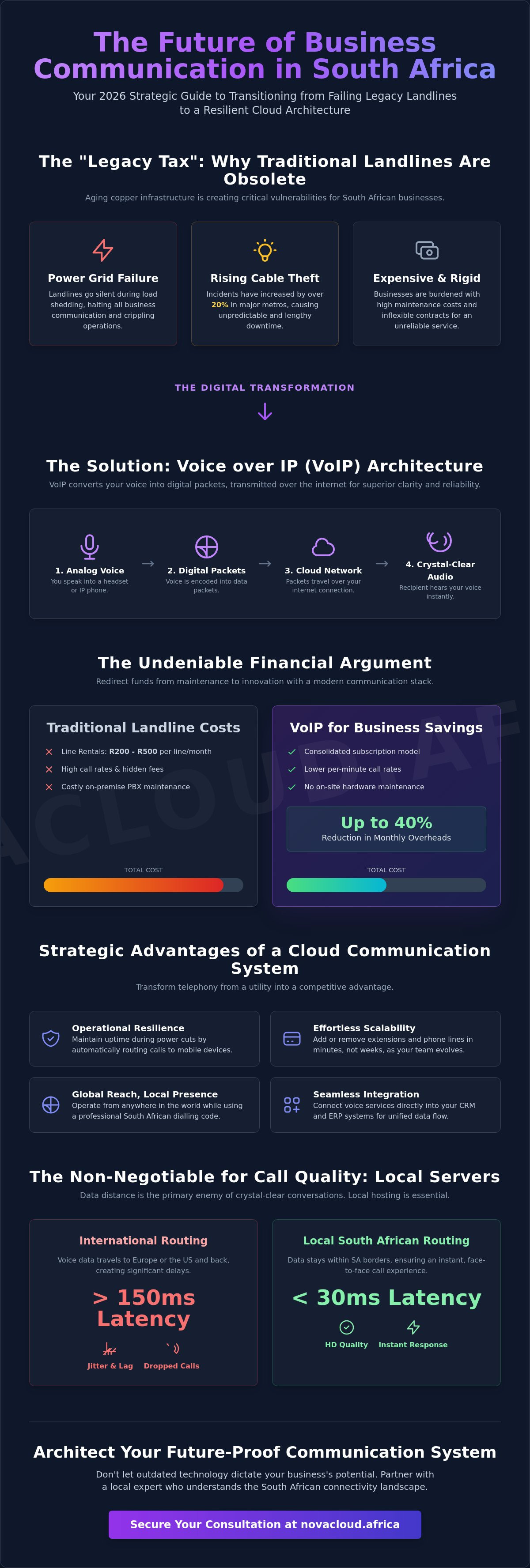
Why is your South African business still paying a "legacy tax" for a landline that goes silent the moment the power grid trips? You’ve likely noticed that traditional copper infrastructure is failing, with cable theft incidents increasing by over 20% in major metros since early 2023. Implementing VoIP for business isn't just a technical upgrade; it's a strategic move to bypass the instability of aging physical lines. You deserve a communication architecture that remains resilient regardless of the current load shedding stage.
We’re here to help you transition from brittle hardware to a sophisticated, visionary strategy. This 2026 guide shows you how to architect a cost-effective communication system that empowers your organization to scale without limits. By moving your voice traffic to the cloud, you'll secure crystal-clear audio quality and reduce your monthly telephony overheads by a substantial margin. We’ll preview the technical steps to integrate your mobile devices with Microsoft 365, ensuring your team stays connected and productive from Cape Town to the rest of the continent.
Key Takeaways
- Understand the transition from legacy copper to digital voice packets, positioning your enterprise for a resilient future in the 2026 landscape.
- Learn how VoIP for business transforms basic telephony into a strategic asset by unifying voice, video, and messaging within a single, scalable framework.
- Identify the critical infrastructure requirements, from SIP management to Fibre bandwidth, necessary to maintain high-definition call quality across South Africa.
- Architect a communication ecosystem that eliminates hidden costs and technical silos by partnering with a local strategic ally for your PBX and connectivity needs.
What is VoIP for Business and Why is it Essential in 2026?
Communication is the pulse of every enterprise. By 2026, the transition from legacy copper wires to digital frameworks has reached its final peak. Voice over IP (VoIP) represents the shift from physical, limited hardware to a fluid, cloud-based architecture. It transforms voice signals into digital data packets, allowing your business to transmit calls over the internet with surgical precision and crystal clarity. This isn't just a phone system; it's a catalyst for business agility.
The South African market has undergone a radical transformation. With the decommissioning of traditional copper infrastructure by major providers, 100% digital connectivity is the new baseline. For the Innovative Architect, VoIP for business serves as the foundation for a resilient architecture that supports transformative growth. It replaces the rigid, expensive landlines of the past with a scalable solution that grows alongside your vision. This shift provides the illumination businesses need to navigate an increasingly complex global economy.
The Evolution from PBX to Hosted Cloud Systems
The era of heavy, on-premise hardware is over. Historically, businesses relied on physical Private Branch Exchange (PBX) boxes that required constant maintenance and expensive site visits. 2026 marks the final obsolescence of these analogue switchboards as companies embrace the flexibility of Hosted PBX solutions. Hosted PBX is a virtualised communication hub hosted in the cloud that eliminates the need for physical on-site hardware while providing enterprise-grade features. This transition ensures that your communication remains uninterrupted, regardless of your physical location or local infrastructure challenges.
Economic and Operational Drivers for Modern Enterprises
The financial argument for digital voice is undeniable. Traditional landline rentals in South Africa often cost between R200 and R500 per month per line before a single call is made. In contrast, cloud-based subscription models consolidate these costs, often reducing monthly overheads by up to 40% for mid-sized firms. These savings are redirected into innovation rather than maintenance. Beyond the balance sheet, VoIP for business empowers the permanent hybrid work culture that has defined the South African professional landscape since 2024.
- Global Reach, Local Presence: Use South African dialling codes while operating from any continent.
- Seamless Integration: Connect your voice services directly into CRM and ERP systems for better data flow.
- Resilient Architecture: Maintain uptime even during local power disruptions through cloud-based routing to mobile devices.
- Scalable Solutions: Add or remove extensions in minutes, not weeks, as your team size fluctuates.
Choosing a digital framework isn't just about making calls. It's about positioning your brand as a modern, accessible, and efficient partner. Local expertise remains vital. While global platforms exist, a partner who understands the specific nuances of the African connectivity landscape ensures your digital transformation is handled with precision. This strategic alignment turns a simple utility into a competitive advantage.
How Does Business VoIP Work? Understanding the Architecture
The transition to VoIP for business represents a fundamental shift from physical copper wires to a sophisticated data architecture. It starts the moment you speak into your headset. Your analog voice signal is instantly converted into digital packets. These packets don't travel aimlessly; they're managed by the Session Initiation Protocol (SIP), which acts as the digital conductor for your communication. SIP handles the setup, teardown, and signaling of every call, ensuring that data reaches the correct destination across the global IP network.
Distance is the primary enemy of call quality. If your voice data must travel to London or New York before returning to South Africa, you'll experience "jitter" or noticeable lag. A 2024 analysis of regional network performance showed that latency exceeding 150ms can derail professional conversations. This is why local server placement within South African borders is a non-negotiable requirement for modern firms. By keeping data local, latency stays below 30ms, which creates the "instant" feel of a face-to-face meeting. Businesses that prioritize this architecture often Improve Productivity With VoIP by removing the friction of dropped calls and audio delays.
The Role of SIP Trunking in Modern Business
SIP trunking serves as the digital bridge between your internal private branch exchange (PBX) and the public switched telephone network (PSTN). It replaces expensive, rigid ISDN lines with flexible "channels" delivered over your internet connection. This system allows you to scale your capacity instantly. If your call volume spikes during a seasonal promotion, you can add channels in minutes rather than waiting weeks for a physical installation. This agility is fueled by integration with resilient cloud infrastructure, which provides a layer of redundancy that traditional landlines simply can't match.
For businesses looking to optimize this digital bridge with flexible infrastructure, you can learn more about SolaaS Limited and their tailored IT and telecommunications solutions.
Essential Hardware: The Yealink T31P and Beyond
While software-based softphones offer incredible mobility for remote teams, dedicated IP phones remain the anchor of the professional office. The Yealink T31P has emerged as a 2026 industry favorite because it bridges the gap between cost and high-end performance. It delivers HD voice clarity and features dual-port Ethernet with Power over Ethernet (PoE), which eliminates the clutter of extra power bricks. For companies managing national rollouts, the "Zero Touch Provisioning" capability is a game-changer. It allows a central IT team to ship a phone to any branch in the country; the device automatically downloads its configuration the moment it's plugged in. It's a seamless way to modernize your workspace without the need for on-site technicians at every location.
The true power of VoIP for business lies in the synergy between this hardware and flexible software. Your desk phone and your mobile app function as a single identity. This unified architecture ensures that whether you're at a desk in Sandton or working remotely in Durban, your business presence remains consistent and professional.
Key Features of VoIP That Drive Business ROI
VoIP for business isn't a mere replacement for copper wires; it's a strategic platform that consolidates your entire communication stack into a single, resilient architecture. By 2026, unified communications (UC) will have shifted from a technical luxury to a baseline requirement for South African enterprises. It merges voice, video, and instant messaging into one interface, eliminating the "toggle tax" where employees lose up to 40% of their daily productivity switching between fragmented apps. Real-time call analytics provide the precision needed to optimize customer service, highlighting exactly where callers drop off or wait too long. For a deeper dive into the financial gains of this transition, explore this guide on Cloud PBX Savings.
Advanced Call Management and Automation
First impressions happen in seconds. Interactive Voice Response (IVR) and automated attendants ensure South African callers reach the right department without manual transfers, creating a professional image that rivals global competitors. In high-volume settings, call queuing and hunting groups prevent the dreaded busy signal, ensuring every lead is captured. These tools are the foundation of high-performance inbound call centers. They turn a chaotic switchboard into a streamlined engine of growth, allowing your team to handle 25% more inquiries without increasing headcount.
- Smart IVR: Directs customers to the correct expert instantly.
- Hunting Groups: Distributes calls across a team so no phone rings unanswered.
- Time-of-Day Routing: Ensures after-hours calls reach on-call staff or clear voicemail instructions.
Integration with the Modern Digital Ecosystem
Integration is where VoIP for business delivers its most transformative growth. When your phone system talks to your CRM, agents see customer history pop up before they even say hello. This context can reduce average handle time by 30 seconds per call. Integrating VoIP with Microsoft 365 creates a "single pane of glass" experience, allowing teams to launch calls directly from their inbox or share files during a video conference seamlessly.
AI-driven features are the newest frontier in ROI. Real-time transcription and sentiment analysis now detect if a customer's tone is frustrated, allowing managers to intervene before a R10,000 contract is lost. These tools don't just record data; they provide actionable intelligence that empowers your team to lead with clarity and confidence in a competitive market.
Preparing Your Business for a Seamless VoIP Migration
Migration isn't a simple plug and play event; it's a strategic transition that begins with your infrastructure. In the South African landscape, where connectivity can be volatile, an infrastructure-first approach ensures that your voice quality remains crystalline regardless of external pressures. Successful VoIP for business adoption requires a deep audit of your current digital environment before the first handset is even connected.
Fibre and Connectivity: The Bedrock of Voice
High-definition audio requires stability that traditional broadband often fails to provide. Symmetrical Business Fibre is the non-negotiable standard for 2026 voice requirements because it provides equal upload and download speeds. This balance prevents the choppy audio or "jitter" caused by saturated asynchronous lines. To maintain professional standards, 100kbps per concurrent call is the benchmark for HD audio quality.
Beyond raw speed, Quality of Service (QoS) settings are vital. These configurations on your network hardware ensure that voice packets receive priority over standard data traffic. Without QoS, a large software update or a file transfer could easily degrade a critical board meeting call. It's about creating a dedicated lane for your conversations on the digital highway.
Resilience Planning for 24/7 Availability
Load shedding remains a persistent variable for local enterprises, making power resilience a top priority. Building a resilient architecture means your VoIP for business system shouldn't live or die by the office plug point. Cloud-native PBX features allow the "brain" of your phone system to remain active in secure data centres even if your physical premises go dark. This ensures you never miss a client touchpoint.
- Mobile Failover: Calls automatically route to mobile applications if the primary office link drops.
- Secondary Data Links: Implementing automated failover to business-grade LTE or 5G provides a vital safety net.
- Managed Firewalls: These protect your voice traffic from the rising tide of DDoS attacks, ensuring that your communication lines stay open and secure.
You don't have to sacrifice your established identity during this shift. Porting existing geographic numbers, such as 011, 021, or 031, to the cloud is a regulated and straightforward procedure. This process typically takes between 7 to 14 days and allows you to keep your professional legacy while embracing modern flexibility. It's the final step in tethering your business to a future-proof platform.
Ready to build a resilient communication foundation? Explore our Cloud PBX solutions designed for the African business landscape.
Choosing NovaCloud as Your Strategic Communication Partner
NovaCloud Africa doesn't just sell software; we architect resilient ecosystems. For South African enterprises, the transition to VoIP for business is often clouded by fragmented service providers and technical friction. We eliminate that complexity by unifying your digital foundation. By consolidating your VPS, high-speed Fibre, and Hosted PBX under a single, resilient architecture, you gain a singular point of accountability. This integration ensures that your voice traffic receives the priority it deserves, backed by a network designed for 99.9% uptime.
Our commitment to "Human-First" IT assistance sets us apart from faceless global competitors. We understand that technology is a tool for people, not a replacement for them. Our local expertise means we're intimately familiar with the South African business landscape, from the regulatory nuances of Pretoria to the infrastructure demands of Cape Town. We act as your strategic ally, ensuring your digital transformation is handled with quiet confidence and expert precision.
The NovaCloud Advantage: Beyond the Dial-Tone
True communication agility requires more than just a working phone line. It demands scalability that matches your ambition. With NovaCloud, you can add new users or departments in minutes. There's no need to wait weeks for physical hardware installations or technician site visits. Your growth is limited only by your vision, not your infrastructure.
- Scalability: Deploy seats instantly to meet seasonal demands or rapid expansion.
- Security: Our systems ensure POPIA-compliant data handling for all recorded communications, a critical requirement since the Act's full enforcement in July 2021.
- Local Reach: Benefit from national support that understands South African connectivity challenges while maintaining global technological standards.
We provide the clarity you need to lead. By securing your communications within a resilient cloud environment, we protect your intellectual property and your customer relationships simultaneously.
Next Steps: From Legacy to Luminary
The journey toward a modernized workplace begins with an honest look at your current infrastructure. Many South African businesses lose thousands of ZAR every month to "leaks" in legacy systems, such as unused landlines, inflated maintenance contracts, and inefficient routing. We help you identify these inefficiencies and replace them with a streamlined, cost-effective alternative.
It's time to move beyond the limitations of the past. You can start by booking a consultation for a customized Hosted PBX system tailored to your specific operational flow. We'll help you audit your current spend and design a roadmap that empowers your team through crystal-clear connectivity. Let's illuminate the path forward for your business. Your digital future is ready; we're here to help you lead it with confidence.
Illuminate Your Communication Strategy for 2026
By 2026, legacy copper systems will be entirely obsolete. Modernizing your infrastructure isn't just about switching to digital voice; it's about building a resilient foundation for growth. Adopting VoIP for business ensures your team remains connected through a unified ecosystem that scales with your ambitions. You've seen how the right architecture drives ROI and how a seamless migration prevents costly downtime. This shift represents a new chapter in efficiency for the African market.
NovaCloud stands as your strategic ally in this transformation. We combine global standards with deep local expertise to deliver high-impact results. As a Yealink Certified Hardware Partner, we provide the premium tools your team needs to thrive. Our POPIA compliant cloud infrastructure protects your data according to South African regulations, while our national support network ensures you're never left in the dark. We're ready to help you navigate the complexities of digital transformation with confidence and clarity.
Architect your future with NovaCloud Hosted PBX solutions today
The future of South African business is bright, and your digital evolution starts with a single, clear connection.
Frequently Asked Questions
Is VoIP reliable for business use in South Africa given load shedding?
VoIP for business is exceptionally resilient against South African power challenges when paired with a mobile-first strategy. Since the PBX infrastructure lives in the cloud, your system stays active even if your office power fails. You can maintain 100% uptime by using mobile softphone applications on 5G devices or powering your router with a small UPS. This architectural resilience ensures your clients always reach you, regardless of the local grid status.
Can I keep my existing business telephone numbers when switching to VoIP?
You can absolutely keep your existing South African telephone numbers when transitioning to a modern cloud system. This process, known as Geographic Number Portability (GNP), is governed by ICASA regulations and typically takes 10 to 15 business days. We manage the entire migration process to ensure your brand identity remains intact while you unlock the benefits of scalable, visionary unified communications and local technical expertise.
What is the minimum internet speed required for a high-quality VoIP call?
A high-quality voice call requires approximately 100 Kbps of dedicated bandwidth for both upload and download. For a small office with 10 concurrent callers, a stable 2 Mbps connection is sufficient to ensure crystal-clear audio. We recommend using a fiber connection with a 99.9% uptime guarantee to eliminate jitter. This ensures your professional communication remains uninterrupted and reflects the high standards of your digital infrastructure.
How much can a business typically save by switching from landlines to Hosted PBX?
South African businesses typically reduce monthly telecommunications spend by 40% to 60% after migrating from traditional landlines to a Hosted PBX. These savings stem from the elimination of physical line rentals and significantly lower per-minute call rates. Industry data from 2024 shows that a mid-sized firm can save over R5,000 monthly just by optimizing their trunking and utilizing free inter-branch calling across their continental reach.
Do I need to buy new desk phones to use a VoIP system?
You don't need to purchase new desk phones to leverage a modern VoIP for business solution. Most companies now choose to use softphone applications on laptops or mobile devices, which empowers a hybrid workforce without hardware costs. If you prefer physical handsets, existing analog phones can be converted using an ATA adapter. This flexible approach allows for transformative growth without requiring a massive initial capital outlay for equipment.
Is business VoIP secure enough to meet POPIA compliance requirements?
Business VoIP systems meet POPIA compliance requirements through end-to-end encryption and secure South African data centers. Our architecture utilizes TLS and SRTP protocols to protect voice data from interception during transmission. By choosing a provider that stores call recordings and metadata locally within South Africa, you ensure your data processing aligns with the Protection of Personal Information Act. It's a secure way to empower your regional digital transformation.
What happens to my phone system if the office internet goes down?
Your phone system remains fully operational in the cloud even if your primary office internet connection fails. Advanced platforms automatically reroute incoming calls to your team's mobile apps or a secondary LTE link within milliseconds. This seamless failover capability means your business stays connected to the world. It provides a level of resilient architecture that traditional copper lines simply cannot match in today's fast-paced market.
How long does it take to set up a new business VoIP system?
A standard cloud-based system can be fully operational within 24 to 48 hours for new numbers and virtual extensions. If you're porting existing numbers from another provider, the regulatory process adds 10 to 14 days to the timeline. Our team handles the technical configuration and network optimization in parallel. This ensures a smooth transition that minimizes downtime and provides a bright beginning for your company's digital communication strategy.
