


Strategic Data Resilience: The 2026 Guide to Cloud Backups for South African Business

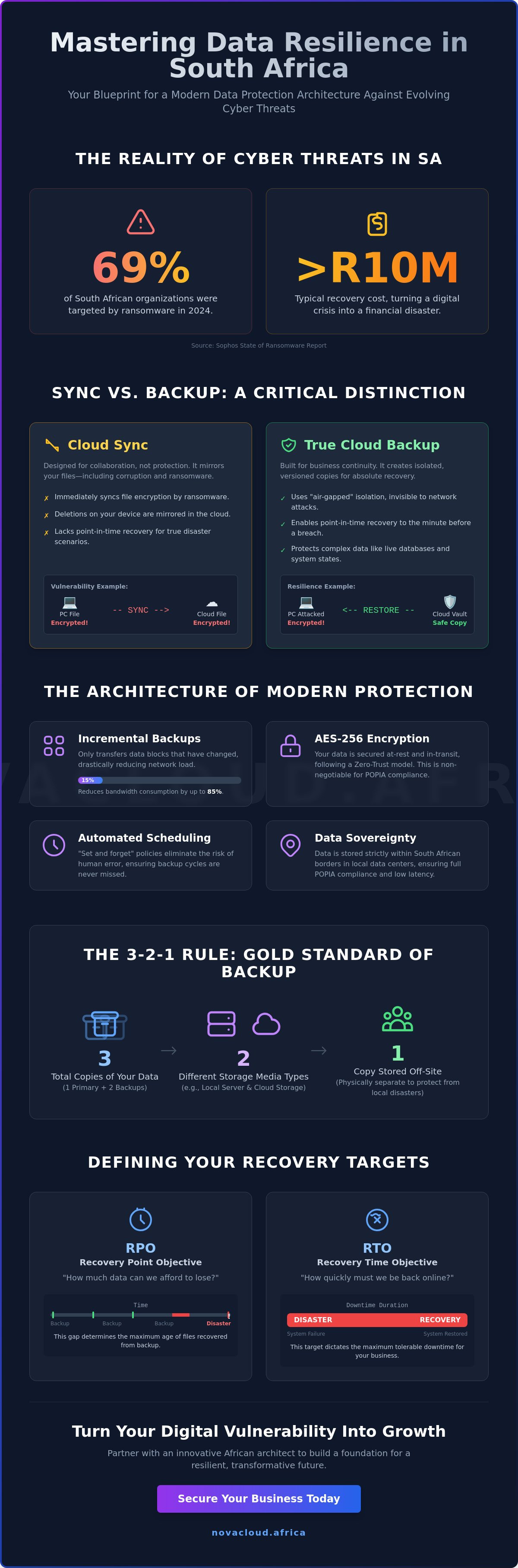
Did you know that 69% of South African organizations were targeted by ransomware in 2024, with recovery costs frequently climbing above R10 million according to the Sophos State of Ransomware report? It's a sobering reality that makes the traditional approach to data security obsolete. You already understand that your enterprise's survival depends on digital continuity, yet the overlapping pressures of POPIA compliance and fluctuating storage expenses often create more questions than answers. Implementing robust cloud backups is no longer just a technical checkbox; it's a strategic necessity for any business aiming to thrive in our local economy.
We're here to help you move from a state of uncertainty to one of absolute readiness. This guide provides the blueprint to master a modern data protection architecture, ensuring your infrastructure remains resilient against evolving cyber threats. You'll gain a clear understanding of the 3-2-1 backup rule and the peace of mind that comes from storing data strictly within South African borders. We'll outline a scalable roadmap for disaster recovery that turns your digital vulnerability into a foundation for transformative growth.
Key Takeaways
- Distinguish between simple file syncing and professional cloud backups to ensure your business continuity is never compromised by evolving cyber threats.
- Explore the technical architecture of modern protection, utilizing AES-256 encryption and incremental data transfers to maximize security without draining bandwidth.
- Align your data strategy with South Africa’s POPIA mandates and understand why data sovereignty is non-negotiable for local corporate compliance.
- Implement the gold-standard 3-2-1 rule and define precise RTO and RPO targets to minimize downtime during a digital crisis.
- Discover how a strategic partnership with an innovative African architect can turn your data protection into a foundation for transformative growth.
What are Cloud Backups? Defining Strategic Data Resilience
Data isn't just information; it's the lifeblood of South African enterprise. To understand What are Cloud Backups? in a 2026 context, we must look beyond simple storage. True cloud backups are automated, encrypted offsite data duplications designed specifically for absolute business continuity. They represent a strategic shift from reactive recovery to proactive resilience. In a year where 72% of local firms report sophisticated cyber-attacks, having a static copy of your files is no longer sufficient.
The "Nova" concept serves as our guiding light in this landscape. It represents the transition from the murky uncertainty of data vulnerability to a state of absolute clarity. We view Cloud backups as a catalyst for regional empowerment. By illuminating the dark corners of your digital infrastructure, we ensure your growth remains uninterrupted by local power fluctuations or global cyber threats. It's about starting a new chapter where your data works for you, safely and predictably.
Cloud Sync vs. Cloud Backup: The Critical Distinction
Many businesses confuse synchronization with protection. Tools like OneDrive or Google Drive are excellent for collaboration, but they're dangerous when used as a primary safety net. If ransomware encrypts a file on your laptop, a sync service immediately mirrors that corruption to the cloud. You've effectively backed up your own disaster. True backup solutions, like those powered by Acronis or NovaCloud, utilize versioning and air-gapped isolation. This means your data is stored in a way that remains invisible to the ransomware attacking your primary network. Point-in-time recovery allows you to roll back your entire environment to the exact minute before an accidental deletion or breach occurred.
Why Business-Grade Infrastructure Matters
Consumer-grade storage solutions often crumble when faced with enterprise requirements. They struggle with open files, such as active SQL databases or live system states, often leading to corrupted recovery points. Business-grade solutions handle these complex structures with ease. They ensure that even while your team works, your data is being captured with surgical precision. Business-Grade Cloud Backup is a high-performance, resilient architecture designed to protect complex enterprise ecosystems without compromise.
- Automated scheduling eliminates human error in the backup cycle.
- End-to-end encryption ensures POPIA compliance remains a standard, not a struggle.
- Local South African data centers reduce latency and keep data sovereignty within our borders.
By choosing a Business-Grade Cloud Backup, you're not just buying space on a server. You're investing in a sophisticated shield. This architecture handles the heavy lifting of data management, allowing your leadership to focus on transformative growth rather than digital survival.
The Architecture of Protection: How Modern Backups Work
Modern cloud backups aren't just digital filing cabinets; they're active, intelligent ecosystems designed to safeguard every byte of your enterprise. In the South African context, where connectivity costs and power stability remain operational hurdles, the architecture must be lean. It's no longer about moving massive files. It's about precision. By 2026, the standard for resilience has shifted toward block-level incremental updates. This mechanism identifies only the specific data segments that have changed since the last successful cycle, reducing bandwidth consumption by over 85% compared to traditional methods. It's a vital strategy for businesses navigating the constraints of local infrastructure while maintaining global standards of data integrity.
Data is heavy. Moving it shouldn't be. This efficiency is amplified when integrated with Virtual Private Servers, creating a seamless loop where your hosted infrastructure and backup protocols share the same high-speed backbone. Through the Acronis Cloud management interface, NovaCloud centralizes this complexity. You gain a single pane of glass to monitor health, verify restores, and manage retention policies across your entire South African footprint. This unified approach eliminates the friction of managing fragmented tools, allowing your IT team to focus on growth rather than troubleshooting broken syncs.
Encryption and the Zero-Trust Model
Security is the foundation of the architecture. We utilize AES-256 encryption both while your data sits at rest and as it travels across the web. The "Zero-Knowledge" framework ensures that you're the sole custodian of the encryption keys. If you don't hold the key, the data remains an unreadable cipher, even to the service provider. This level of privacy is essential for POPIA compliance. Secure handshakes validate every connection point during the upload process, while Managed Firewalls act as the final, impenetrable barrier in the backup pipeline, neutralizing threats before they reach your storage vault.
Compression and Deduplication Technologies
Storage costs in ZAR can escalate quickly without optimization. Smart agents solve this by performing deduplication at the source, ensuring that redundant data blocks aren't uploaded or billed for twice. This technology works silently in the background, maintaining system performance without interrupting your team’s workflow. To maximize these backup windows, many local firms leverage symmetrical Business Fibre, which provides the necessary upload speeds to complete massive data synchronizations in minutes rather than hours. It's about building a system that works for you, not against your resources. If you're looking to fortify your digital perimeter, you can explore our resilient architecture options today.
Compliance and Sovereignty: The South African POPIA Landscape
Compliance isn't a hurdle; it's the foundation of digital trust. In South Africa, the Protection of Personal Information Act (POPIA) defines how businesses must handle the data that fuels our economy. Under this framework, cloud backups are no longer just a technical safety net. They are a legal imperative. The Information Regulator has increased its oversight in 2024, signaling that "appropriate technical measures" are non-negotiable for any entity processing personal data. Without a resilient backup strategy, a business isn't just risking its operations; it's risking its legal standing.
POPIA Section 19: The Security Safeguards
Section 19 of POPIA requires every responsible party to secure the integrity and confidentiality of personal information. This means you must prevent the loss of, damage to, or unauthorized destruction of data. Offsite cloud backups directly satisfy this "prevention of loss" clause by ensuring that a secondary, immutable copy of your data exists outside your primary environment. If a ransomware attack or hardware failure strikes, the ability to restore data quickly preserves the "availability" requirement of the Act. POPIA compliance is a continuous architectural state, not a one-time check.
To maintain this state, your backup solution must provide detailed audit trails. These logs prove to regulators that data is being protected, encrypted, and monitored in real time. In the event of a breach, having a verified recovery point can be the difference between a manageable incident and a catastrophic fine from the Information Regulator.
The Advantage of Local Data Centers
Data sovereignty is a critical strategic consideration for 2026. Storing sensitive South African corporate data in foreign jurisdictions often complicates your compliance profile. Section 72 of POPIA restricts the transfer of personal information outside the borders of the Republic unless the recipient country offers "adequate" protection. By using local infrastructure, you bypass these jurisdictional headaches entirely. You ensure your data remains under the protection of South African law, providing absolute legal peace of mind.
The benefits of keeping data on South African soil extend beyond legalities:
- Reduced Latency: Local data centers in regions like Gauteng and the Western Cape offer latency as low as 10 to 20 milliseconds. This is vital when you need to restore terabytes of data quickly.
- No "Compliance Tax": Using pre-vetted, local infrastructure reduces the cost of legal audits and international data transfer assessments.
- Direct Support: Global, faceless cloud providers often rely on automated bots. Local expertise means you have a partner who understands the specific challenges of the South African business environment, including the logistical realities of local infrastructure.
When a major restoration event occurs, the ability to pick up the phone and speak to a local expert who understands your specific architecture is invaluable. It transforms a crisis into a structured recovery process. By aligning your digital infrastructure with the local landscape, you turn regulatory compliance into a competitive advantage for your brand.
Building Your Resilience Strategy: A Practical Framework
Resilient architecture isn't just about building for today; it's about ensuring your business endures through tomorrow's unforeseen disruptions. The 3-2-1 rule remains the gold standard for South African enterprises aiming for total data sovereignty. This framework requires you to maintain three copies of your data, stored on two different media types, with one copy kept offsite. In a modern context, that offsite copy is synonymous with cloud backups. This strategy creates a fail-safe that protects your operations from hardware failure, theft, or localized disasters.
Integration is the key to seamless execution. By aligning your backup strategy with Microsoft 365 Business Licensing, you can automate much of this redundancy. This approach ensures that your productivity data is constantly synced to a secure, offsite cloud environment. It moves your business away from manual, error-prone processes toward a state of visionary readiness where data protection is baked into the very fabric of your digital workspace.
Calculating RTO and RPO for Your Business
Precision is the hallmark of a sophisticated strategy. You must define your Recovery Point Objective (RPO) and Recovery Time Objective (RTO) with absolute clarity. RPO determines how much data loss your business can survive in terms of time. If your RPO is four hours, you need cloud backups to trigger at least every four hours. RTO is the duration of downtime you can afford before the financial impact becomes critical. Use this checklist to categorize your data:
- Mission-Critical: Real-time customer transactions and ERP data. Target RTO: Under 2 hours.
- Operational: Active project files and internal communications. Target RTO: 4 to 8 hours.
- Archival: Historical financial records and compliance documentation. Target RTO: 24+ hours.
The Disaster Recovery Drill
A backup is only as valuable as its last successful restore. For ICT managers across Africa, scheduled restore tests are no longer optional; they are a mandatory component of governance. You should simulate a ransomware attack at least bi-annually to verify the immutability of your data. This process proves that your backups cannot be encrypted or deleted by malicious actors. Documenting these drills serves a dual purpose. It provides a clear training manual for your staff and offers a verifiable audit trail for insurance and regulatory compliance. When your team knows exactly how to trigger a recovery, panic is replaced by purposeful action.
Empower your business with a resilient digital foundation. Consult with NovaCloud on your backup architecture today.
The NovaCloud Advantage: Empowering the African Digital Future
NovaCloud stands as the Innovative Architect of your digital transformation. We recognize that South African businesses in 2026 face a unique set of challenges, from infrastructure volatility to stringent data sovereignty regulations. We don't just offer tools; we provide a strategic partnership that aligns your technological capabilities with your long-term vision. By serving as a unified ICT partner, we streamline everything from high-speed connectivity to secure hosting, removing the friction often found in complex digital environments.
Our Cloud Backups provide a bright beginning for business growth by securing the very foundation of your operations. We believe in regional empowerment through world-class technical execution. This means bringing global standards of data protection to the local market, ensuring that every byte of your intellectual property is stored within a resilient, high-performance framework. We've built our reputation on quiet confidence and the ability to turn technical complexity into business clarity.
Seamless Integration Across the Stack
Data doesn't exist in a vacuum, and neither should your protection strategy. Our backup solutions are designed to complement your existing Hosted PBX and VPS environments perfectly. This integration ensures that communication logs, server configurations, and critical application data are captured in a single, manageable stream. You won't struggle with mismatched software or manual transfers. Our team provides dedicated IT assistance to help you design a custom backup policy that fits your specific workflow. Whether you're a startup or a maturing enterprise, your storage needs can scale dynamically. This ensures your costs remain optimized while your security posture stays ironclad as you expand across the continent.
Your Next Step Toward Data Certainty
The transition from uncertainty to clarity begins with a professional audit of your current digital assets. We've seen that many firms lack a tested recovery plan, a gap that we're here to close. By initiating a consultation for a resilient ICT architecture, you're choosing a path of proactive defense rather than reactive panic. We provide the roadmap to ensure your business remains operational regardless of external disruptions. Our experts work alongside you to map out every data point, ensuring nothing is left to chance. It's time to leave the shadows of data vulnerability behind and start your Nova chapter in data security.
Secure Your Digital Legacy in the 2026 Landscape
The 2026 digital landscape demands more than simple storage; it requires a resilient architecture that turns data protection into a competitive advantage. By aligning your strategy with South Africa's POPIA regulations and leveraging local data sovereignty, you eliminate the legal risks inherent in international data transfers. Modern cloud backups have evolved into sophisticated defense systems that ensure your operations remain uninterrupted, even when facing complex cyber threats. This strategic shift protects your bottom line and builds trust with every client you serve across the continent.
NovaCloud provides the foundation for this transformative growth. Our Acronis-powered infrastructure keeps your mission-critical data within South African borders, ensuring full compliance and lightning-fast recovery speeds. You're never alone in this journey. Our expert ICT team provides 24/7 assistance to keep your systems peak-performing and secure. It's time to move beyond basic survival and start building for a bold, empowered African future. We're ready to help you illuminate the path forward with clarity and technical precision.
Architect your business resilience with NovaCloud's Secure Backups
Frequently Asked Questions
Is cloud backup the same as cloud storage like Google Drive?
No, cloud backup and cloud storage serve different strategic purposes. While Google Drive synchronizes files for active collaboration, cloud backups create a secure, immutable copy of your entire digital estate. This ensures that if a file is deleted or corrupted on your local device, a historical version remains protected in a separate repository. NovaCloud’s architecture focuses on this total resilience, providing a safety net that simple file sharing platforms can't match.
How much bandwidth do cloud backups use for a typical SME?
Most South African SMEs consume between 10% and 20% of their total bandwidth for daily incremental backups. Modern systems use deduplication to only upload changed data blocks, which significantly reduces traffic. If your business generates 5GB of new data daily, an optimized system only transmits the unique changes. We schedule these processes during off-peak hours to ensure your primary fiber line remains dedicated to core operations during the 08:00 to 17:00 window.
Are cloud backups secure enough to meet POPIA requirements?
Yes, our cloud backups are designed specifically to align with the Protection of Personal Information Act (POPIA). We utilize AES-256 bit encryption for data at rest and in transit, meeting the technical safeguards required by Section 19 of the Act. Because NovaCloud prioritizes local data sovereignty, your sensitive information stays within South African borders. This geographical control simplifies your compliance audits and ensures you meet the Information Regulator’s standards for cross-border data transfers.
What happens if my internet goes down during a backup?
Your backup will pause and resume automatically once the connection is restored. The system uses checkpoint restart technology to identify exactly where the transmission stopped, so it doesn't need to start the process from the beginning. This is vital in the South African context where load shedding or fiber breaks can disrupt connectivity. Your data integrity remains intact because the partial file isn't committed to the final archive until the full checksum is verified.
How long should my business retain backup versions?
South African businesses typically follow the 3-2-1 rule, retaining daily backups for 30 days and monthly archives for 7 years. This 7-year benchmark aligns with the Companies Act and SARS requirements for financial record keeping. We help you build a tiered retention policy where older data moves to lower-cost storage layers. This strategy balances your regulatory obligations with cost efficiency, ensuring you don't pay for high-performance storage on decade-old files.
Can cloud backups protect against all types of ransomware?
Cloud backups offer a critical defense through air-gapped, immutable storage that ransomware cannot encrypt or delete. While no software provides a 100% guarantee against infection, having a clean off-site copy allows you to restore your entire environment to a point in time before the 2024-style polymorphic attacks took hold. This capability reduces your recovery time objective from days to hours. It's the ultimate insurance policy against the growing wave of cyber-extortion targeting the African continent.
Is it difficult to migrate my existing backups to NovaCloud?
Migration is a streamlined, three-stage process managed by our local engineering team. We begin with a full data audit, followed by a seeded initial backup to handle large volumes without straining your network. Most businesses complete their transition within 72 hours. We act as your strategic ally, handling the technical heavy lifting so your team can focus on growth. This move marks a bright beginning for your infrastructure's reliability, illuminating a path toward seamless digital growth.
