


When to Upgrade from Shared Hosting to VPS: The 2026 Strategic Architect’s Guide

If your digital architecture is still competing for resources on a crowded shared server, you aren't just saving money; you're actively throttling your organization's growth. You likely chose shared hosting as a sensible starting point for your vision, but as your traffic scales and modern PHP 8.5 applications demand more overhead, the limitations become visible. When you start seeing frequent 503 errors or inconsistent loading times, it's a clear signal that your foundation is under strain. Understanding exactly when to upgrade from shared hosting to VPS is the difference between a business that reacts to failure and one that architects for expansion.
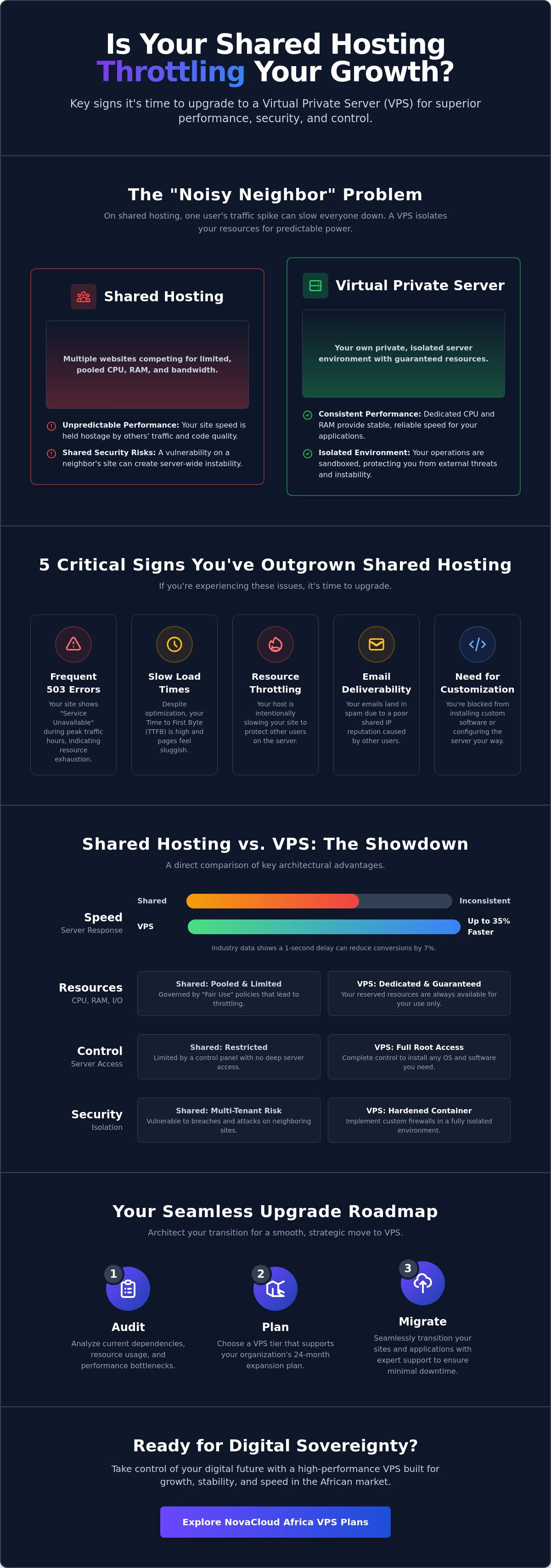
You deserve a digital environment that reflects your professional standards, where "noisy neighbors" don't compromise your stability. Industry data confirms that VPS-hosted sites often load 15% to 35% faster than their shared counterparts, which is vital since a single second of lag can reduce conversions by 7%. This guide provides the clarity you need to transition toward true digital sovereignty. We'll examine the specific performance triggers, security requirements, and resource thresholds that signal it's time to claim your dedicated space. It's time to move beyond reactive management and embrace a scalable foundation that acts as a catalyst for your regional progress.
Key Takeaways
- Recognize how the "noisy neighbor" effect on shared servers creates an unpredictable performance ceiling that limits your digital growth.
- Pinpoint the precise technical triggers, such as persistent 503 errors and resource exhaustion, that signal exactly when to upgrade from shared hosting to VPS.
- Gain full architectural control over your environment through root access and dedicated resources that aren't shared with other users.
- Follow a strategic roadmap to audit your current dependencies and choose a VPS tier that supports your organization's 24-month expansion plan.
- Leverage localized infrastructure to minimize latency and provide a faster, more stable experience that empowers your regional market presence.
The Performance Ceiling: Why Shared Hosting Eventually Constrains Enterprise Growth
Shared hosting serves as an excellent starting point for many organizations, acting as a digital "starter home" that provides the basics at an accessible entry point. However, this ecosystem relies on a pooled resource model where CPU cycles, RAM, and bandwidth are divided among hundreds of users. This structure eventually creates an invisible barrier to growth. The most pervasive challenge is the "noisy neighbor" effect. If a neighboring website on your shared server experiences a sudden traffic surge or runs poorly optimized scripts, it can consume a disproportionate share of the server's capacity. In the context of the South African market, where local latency is a critical competitive advantage, having a neighbor hog the server's "pipe" can lead to frustrating delays for your local customers.
The performance ceiling manifests in several ways that impact your bottom line:
- Inconsistent server response times during peak regional traffic hours.
- Restricted access to server-side caching mechanisms that improve load speeds.
- Limited ability to run modern, resource-heavy PHP 8.5 applications efficiently.
Digital reputation is another critical factor often overlooked in shared environments. Because you share an IP address with hundreds of other entities, their behavior directly impacts your email deliverability. If a neighbor is flagged for spamming, your legitimate business communications may end up in junk folders. Deciding when to upgrade from shared hosting to VPS becomes a strategic necessity when your brand's professional image requires the stability and isolation that only dedicated resources can provide. Your growth shouldn't be held hostage by someone else's technical debt.
The Myth of "Unlimited" Shared Resources
Marketing materials frequently promise "unlimited" bandwidth or storage, yet technical hardware always has finite limits. These plans are governed by Fair Usage Policies (FUP) that act as a safety net for the provider. When your application begins to scale, you'll encounter strict constraints on CPU and RAM usage. Instead of supporting your growth, the server may implement resource throttling, intentionally slowing your site to protect the rest of the shared ecosystem. Your reputation suffers when users encounter a sluggish interface. This leads to the very performance bottlenecks that drive leaders to ask when to upgrade from shared hosting to VPS to ensure their infrastructure matches their ambition.
Security Risks in a Multi-Tenant Environment
Operating in a multi-tenant environment introduces inherent security variables. While modern hosting providers implement isolation layers, a severe breach on a neighboring site can still cause server-wide instability or downtime. Shared hosting environments rarely allow for custom firewall configurations, forcing you to rely on a "one size fits all" security posture. In contrast, a Virtual Private Server (VPS) offers a hardened, isolated container. This architectural shift allows for the implementation of advanced security measures, such as a Managed Firewall or FortiNet solutions, ensuring your enterprise data remains protected from the vulnerabilities of others. It's about moving from a state of vulnerability to one of controlled, strategic sovereignty.
Identifying the Critical Triggers: Technical Signs It Is Time to Upgrade
Recognizing the precise moment to transition requires moving beyond gut feelings and looking directly at your server's telemetry. If you've already optimized your images, minified your CSS, and implemented a Content Delivery Network, yet your site still feels sluggish, you've likely hit the physical limits of your shared environment. Identifying when to upgrade from shared hosting to VPS is a matter of auditing specific performance bottlenecks that no amount of code optimization can fix. Time to First Byte (TTFB) serves as the ultimate indicator of server readiness, measuring the latency between a user's request and the first byte of data received from the server. When your TTFB consistently exceeds 600ms, your shared server is struggling to process requests efficiently.
Technical triggers often manifest as visible failures for your users. Frequent "503 Service Unavailable" errors are the most common red flag, indicating that your account has exhausted its allocated concurrent connection limits. This isn't just a minor glitch; it's a sign that the server is actively dropping traffic to protect its own stability. Additionally, modern business applications often require specific software environments, such as the latest PHP 8.5 release or specialized Python and Node.js versions, which are rarely supported in restrictive shared ecosystems. Gaining the freedom to configure these environments is a primary catalyst for architectural evolution.
Monitoring Resource Exhaustion
Your control panel provides a window into your application's health. Regularly check your cPanel or dashboard for spikes in CPU usage and Physical Memory. Database-heavy applications, particularly WooCommerce stores, place immense strain on shared RAM during checkout processes or inventory updates. If your memory usage consistently hovers above 80%, your site is at risk of crashing during a routine task. Implementing proactive environment monitoring allows you to predict a failure before it impacts your customer experience. For those seeking rock-solid stability, exploring a high-performance Virtual Private Server ensures your resources are always available when you need them most.
The Traffic Threshold
Every shared plan has a tipping point where daily unique visitors transition from an asset to a liability. While a few hundred visitors a day might be manageable, seasonal spikes or successful marketing campaigns can instantly overwhelm a shared server's capacity. If you're planning a significant expansion, your backend infrastructure must be ready to handle the surge. This stability is equally dependent on your external connectivity; integrating Business Fibre ensures that your office-to-cloud operations remain seamless during high-traffic events. Knowing when to upgrade from shared hosting to VPS ensures that a "good day" for your marketing team doesn't become a "bad day" for your technical stability.
Strategic Sovereignty: The Architectural Advantages of a VPS
Transitioning to a Virtual Private Server isn't just about adding more power; it's about claiming strategic sovereignty over your digital assets. While shared hosting leaves you at the mercy of a collective ecosystem, a VPS provides a foundation of dedicated resource allocation. Your RAM and CPU are guaranteed, not "burstable" or subject to the whims of other users' traffic spikes. This predictability allows you to architect your business applications with the quiet confidence that your performance will remain rock-solid regardless of external variables. Deciding when to upgrade from shared hosting to VPS marks the moment you stop renting a temporary space and start building a permanent digital headquarters.
The most significant shift in this evolution is the acquisition of root access. This administrative power allows you to configure your server environment to your exact business specifications, from custom kernel tweaks to specialized security protocols. You're no longer restricted by the provider's global settings. Instead, you can implement sophisticated OS-level rules through a Managed Firewall, ensuring your data perimeter is hardened against modern threats. This level of control is essential for any organization that views its digital presence as a mission-critical asset rather than a secondary concern.
Scalability remains the cornerstone of visionary digital planning. In a shared environment, hitting your limit often requires a disruptive migration to a new machine. With a VPS, you can increase your resources almost instantly. This vertical scaling ensures that your infrastructure grows in lockstep with your ambition, providing a seamless path for future expansion without the downtime associated with legacy migrations. It's a purposeful approach to growth that keeps your momentum intact.
Hypervisor Technology and Isolation
Modern virtualization uses hypervisor technology to create a private, isolated "slice" of high-performance hardware. This abstraction layer ensures that your operating system remains completely independent of others on the same physical host. This isolation extends to your network identity; a dedicated IP address simplifies SSL certificate management and secures your communications. This architectural purity is the primary prerequisite for Architecting Digital Sovereignty, allowing you to maintain a clean, professional reputation across the global web. Knowing when to upgrade from shared hosting to VPS is ultimately about recognizing when your brand requires its own unique, uncompromised space.
Customization for Business Applications
A VPS empowers you to run specialized accounting, CRM, or ERP software that shared hosting environments typically forbid due to resource or security constraints. You can establish total data resilience by setting up custom backup schedules using Acronis Cloud, ensuring that your business continuity is never in doubt. Furthermore, the low-latency environment of a VPS is ideal for optimizing real-time communication tools, including VoIP and Hosted PBX systems. By tailoring the server environment to these specific workloads, you transform your hosting from a simple storage space into a high-performance engine for regional progress.
Architecting the Transition: A Roadmap for a Seamless Hosting Upgrade
Transitioning from a shared environment to a Virtual Private Server is a pivotal milestone in your organization's digital evolution. It's a move that requires a strategic roadmap to ensure that your data integrity remains uncompromised and your services remain online. The process begins with a comprehensive audit of your current environment. You'll need to identify database sizes, software dependencies, and any custom scripts that might behave differently in an isolated environment. Knowing when to upgrade from shared hosting to VPS is just the first step; the second is ensuring your new architecture is ready to support your vision for the next 12 to 24 months.
Once you've selected a VPS tier that accommodates your projected growth, the focus shifts to the migration itself. A staging environment is essential. By performing a full backup and migrating to a test instance first, you can identify compatibility issues without risking your live production site. This "dry run" allows you to verify that your applications perform as expected on the new hardware. When you're ready to flip the switch, updating your DNS records should be handled with precision. Monitoring the propagation period ensures that your transition results in zero downtime, maintaining the professional reliability your clients expect.
Pre-Migration Checklist
Before moving a single file, you must identify "hidden" dependencies that often reside in shared hosting, such as specific mail server configurations or legacy cron jobs. For organizations operating within South Africa, ensuring your new environment is POPIA compliant is a non-negotiable requirement for data sovereignty. You'll also need to decide between a Managed or Unmanaged VPS. If your internal IT capacity is focused on development rather than server maintenance, a managed solution provides the peace of mind that your infrastructure is in expert hands.
Testing and Optimization
Your new VPS offers a clean slate for high-performance configuration. Before pointing your live domain, perform rigorous load testing to ensure the server handles peak traffic loads gracefully. This is the ideal time to configure advanced caching layers, such as Redis or Memcached, to maximize the efficiency of your dedicated RAM. Setting up proactive monitoring alerts will help you predict future resource needs before they become bottlenecks. If you're ready to secure your digital future, you can explore our high-performance VPS solutions to begin your transition today.
NovaCloud Africa High-Performance VPS: Empowering Your Enterprise Evolution
NovaCloud Africa stands as the definitive bridge between the performance ceilings of legacy shared hosting and a future of unhindered scalability. We don't just provide server space; we architect the digital environments where South African enterprises thrive. Recognizing when to upgrade from shared hosting to VPS is a moment of strategic clarity, and NovaCloud Africa ensures that your transition is handled with technical precision and visionary foresight. By utilizing localized infrastructure, we eliminate the latency hurdles of international routing, delivering high-speed access that keeps your regional operations responsive and competitive. This local focus ensures that your data remains within territory, providing the legal and technical stability your stakeholders demand.
Migration shouldn't be a solitary technical burden that risks your business continuity. NovaCloud Africa provides "Human-First" IT Assistance to guide your organization through the complexities of database transfers and specialized software environment setups. We act as your strategic ally, ensuring that every layer of your new architecture is optimized for your specific business outcomes. This collaborative approach moves your team from a state of uncertainty to one of readiness. NovaCloud Africa takes pride in being the engine of your progress, turning technical transitions into catalysts for regional empowerment.
Why NovaCloud Africa Infrastructure Differs
Our foundation is built on business-grade hardware housed within Tier-3 data center environments, ensuring your applications reside in a world-class facility. This isn't consumer-level technology; it's a robust ecosystem designed for enterprise-level throughput and rock-solid stability. There's a purposeful synergy between our VPS hosting and our broader Business-Grade Cloud Infrastructure. This allows you to integrate managed security and data resilience into a unified, high-performance architecture. NovaCloud Africa maintains strict reliability benchmarks because we understand that your digital presence is the heartbeat of your enterprise. Every server we deploy is a testament to our commitment to South African enterprise growth.
Your Next Steps to Scalability
The path from a state of resource constraint to one of absolute digital sovereignty begins with an honest assessment of your current environment. We invite you to consult with a NovaCloud Africa expert for a comprehensive server audit to determine the ideal configuration for your 24-month growth plan. This audit provides a fresh start, clearing away the technical debt that often accumulates in shared environments. Don't let the limitations of a shared server define your brand's potential or stifle your innovation. It's time to move toward a foundation that empowers your vision through clarity and efficiency. Consult with a NovaCloud Africa Architect today to scale your infrastructure and begin your journey toward a more resilient, high-performance digital future.
Architecting Your Enterprise Future: Moving Beyond the Shared Horizon
Your digital presence should be a catalyst for growth, not a victim of shared resource constraints. By recognizing technical triggers like high latency and frequent resource exhaustion, you've already begun the shift from reactive management to proactive architecture. Moving to a Virtual Private Server provides the dedicated RAM and isolated security your organization needs to thrive in the modern landscape. Identifying exactly when to upgrade from shared hosting to VPS is the first step toward reclaiming your digital sovereignty and ensuring your infrastructure matches your ambition.
NovaCloud is ready to serve as your strategic partner in this evolution. Through our business-grade cloud infrastructure and expert local IT assistance, we ensure your migration is seamless and your future is scalable. Our integrated support for symmetrical Business Fibre further ensures that your backend operations remain as fast as your user experience. It's time to leave the limitations of the past behind and embrace a foundation built for expansion and clarity.
Explore High-Performance VPS Solutions at NovaCloud Africa
Your journey toward a more resilient and empowered digital future starts today. We look forward to architecting that success alongside you.
Frequently Asked Questions
Is a VPS harder to manage than shared hosting?
A Virtual Private Server requires more technical oversight than shared hosting because you have administrative control over the operating system. While shared hosting is managed entirely by the provider, a VPS gives you the power to configure your own environment. You can mitigate this complexity by opting for a managed service where technical experts oversee the backend for you, allowing your team to focus on growth.
Will upgrading to a VPS immediately improve my SEO rankings?
Upgrading to a VPS provides an indirect but powerful boost to your SEO rankings through improved performance metrics. Search engines prioritize user experience, specifically Core Web Vitals like Largest Contentful Paint. Since a VPS typically loads 15% to 35% faster than shared hosting, your site is more likely to rank higher as its speed and stability improve under a more robust architecture.
How much traffic can a standard VPS handle compared to shared hosting?
A standard VPS can handle significantly higher traffic volumes, often supporting double or triple the concurrent users of a shared plan. Shared hosting often hits a performance ceiling at 10,000 to 15,000 monthly visitors. Determining when to upgrade from shared hosting to VPS usually happens when your traffic growth leads to frequent 503 errors or sluggish response times during peak regional traffic hours.
Can I upgrade from shared hosting to a VPS without any website downtime?
You can achieve a transition with zero downtime by utilizing a staging environment and strategic DNS management. This process involves migrating your data to the new server and testing its functionality before updating your domain records. By following a structured roadmap, your visitors won't notice the change until they experience the faster load speeds and rock-solid stability on the new architecture.
What is the main difference between a Managed and Unmanaged VPS?
The primary difference lies in who manages the server's technical maintenance and security. A Managed VPS includes professional oversight for software updates, patches, and performance monitoring. An Unmanaged VPS provides the raw resources only, leaving all configuration and security tasks to your internal team. Most growing enterprises choose managed solutions to ensure their digital evolution remains in expert hands while maintaining high-speed access.
Do I need a VPS if I am only running a small WordPress site?
A small WordPress site may not strictly require a VPS unless it utilizes resource-heavy plugins or handles sensitive customer data. However, as your site grows into a critical business asset, the isolation of a VPS becomes vital for security. Knowing when to upgrade from shared hosting to VPS is essential as soon as your WordPress site begins to drive significant revenue or requires custom configurations that shared hosting forbids.
How does local server placement in South Africa affect my VPS performance?
Local server placement in South Africa dramatically improves performance by reducing the physical distance data must travel. When your server is located within the same region as your primary audience, latency drops significantly. This results in near-instant page loads and a more responsive experience for your South African customers, which is a key differentiator that separates you from competitors using international benchmarks.
Can a VPS help with my business email deliverability issues?
A VPS solves email deliverability issues by providing your organization with a dedicated IP address. In shared environments, your email reputation is tied to hundreds of other users; if one neighbor sends spam, your legitimate emails may be blocked by major providers. With a VPS, your sender reputation is entirely within your control, ensuring your business communications reach their intended destination every time without being penalized for a neighbor's actions.
