NovaCloud News
Enterprise Wi-Fi Advisory: Bridging Warehouse Floors and Boardrooms Securely
Learn how strategic IT consulting designs secure, segmented Wi-Fi across boardrooms and warehouses without open SSIDs or POPIA compliance risks.
15 October 2026 · NovaCloud Africa editorial team · Cybersecurity
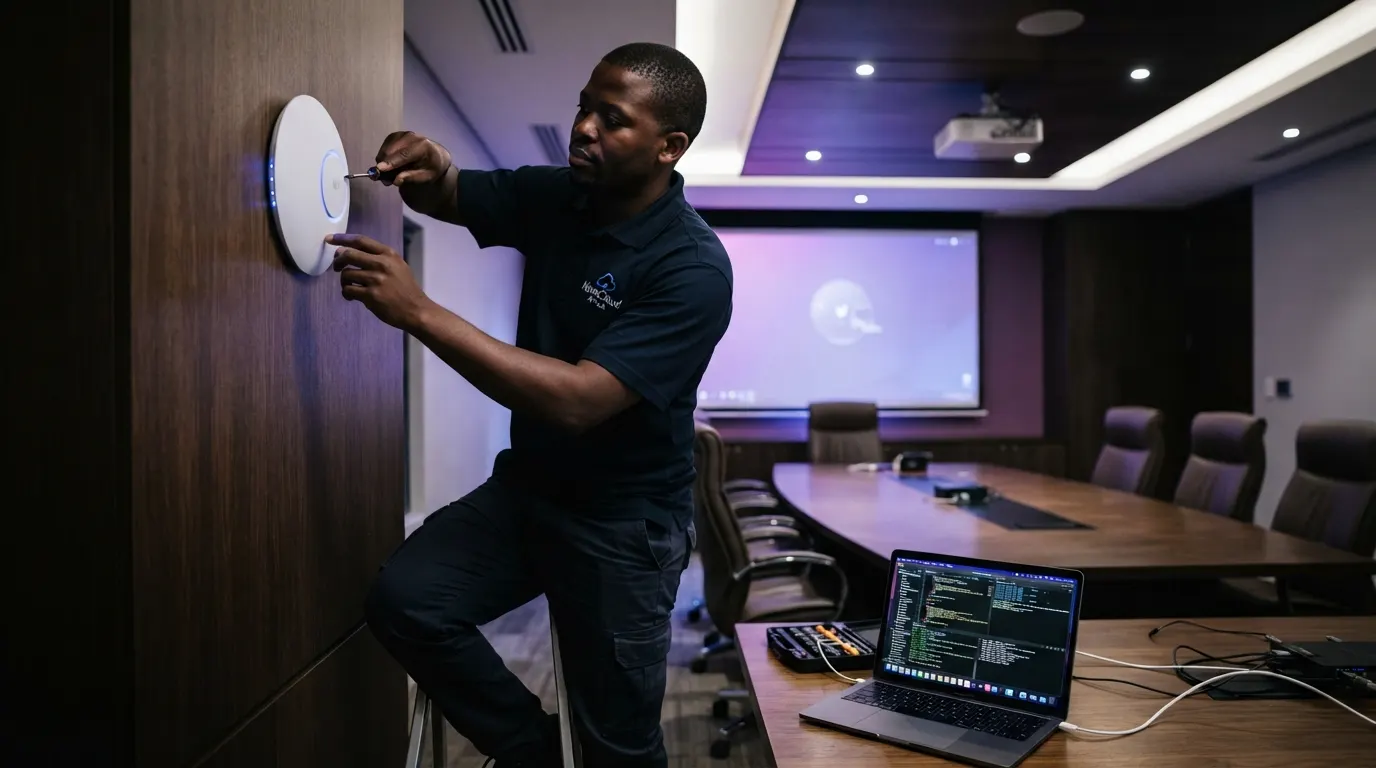
Across Gauteng’s thriving commercial hubs—from the sprawling logistics nodes in Midrand and Pomona to executive headquarters in Sandton and Centurion—modern enterprises frequently operate dual-purpose sites. A single facility might house a executive boardroom on the top floor and a high-volume distribution centre on the ground level.
While this integrated operational model drives agility, it creates a serious technical challenge for IT leaders: providing seamless, reliable wireless coverage across vastly different physical environments without compromising network security.
Too often, organisations resort to quick fixes: deploying an unencrypted or broadcast pre-shared key (PSK) network so industrial barcode scanners don't drop connections, or cluttering the airwaves with half a dozen independent SSIDs. This uncoordinated approach creates massive coverage dead zones, severe radio frequency (RF) interference, and glaring cybersecurity vulnerabilities.
Through practical IT consulting and support, forward-thinking African businesses are replacing fragmented Wi-Fi setups with unified, zero-trust wireless architectures that secure boardroom deliberations and keep warehouse logistics running around the clock.
The Wireless Dilemma: High-Density Boardrooms Meets Industrial Logistics
Designing wireless infrastructure for an executive office requires a completely different approach than engineering coverage for a logistics floor. Attempting to apply a single AP configuration across both zones leads to operational friction and continuous support tickets.
In executive boardrooms and open-plan administration areas, the primary challenge is connection density and bandwidth. During board meetings or regional video conferences, dozens of high-throughput devices—laptops, smartphones, tablets, and presentation hardware—compete for airtime in a confined footprint.
These environments require high-density Wi-Fi 6 or Wi-Fi 6E access points capable of intelligent beamforming, multi-user MIMO (MU-MIMO), and rapid channel switching to eliminate latency during critical presentations.
Conversely, the warehouse floor presents a harsh physical and RF landscape. High-stacked steel racking, metallic inventory, moving forklifts, and industrial machinery cause severe signal attenuation, multipath reflection, and RF shadow zones.
Handheld inventory scanners and mobile printers do not require multi-gigabit throughput; instead, they demand unbreakable signal stability and near-instantaneous roaming handoffs (utilising IEEE 802.11r and 802.11k standards) as stock controllers move rapidly down narrow aisles. Aligning these two distinct operational profiles requires deliberate RF planning and tailored hardware deployment, as outlined in technical guides from Ubiquiti Network Design.
The Danger of Open Ssids and Flat Network Architecture
When legacy warehouse scanners struggle to authenticate with modern security protocols, internal teams often fall into the trap of establishing an open SSID or using an unmanaged, shared passphrase across the site. This short-term fix introduces profound operational and compliance risks:
- Lateral Threat Movement: If a handheld barcode scanner or rogue guest device connected to a flat, open Wi-Fi network becomes compromised, malware or ransomware can move unimpeded across the local subnet directly into corporate servers, ERP software, and financial repositories.
- Regulatory Non-Compliance: South Africa's Protection of Personal Information Act (POPIA) mandates that responsible parties take appropriate, reasonable technical and organisational measures to prevent loss of, damage to, or unauthorised destruction of personal information. Allowing unauthenticated access points to bridge into subnets storing customer or employee data violates basic security safeguards emphasized by the Information Regulator South Africa.
- RF Spectrum Congestion: Broadcasting multiple uncoordinated SSIDs creates unnecessary beacon overhead on the 2.4 GHz and 5 GHz spectrums, degrading throughput for corporate users and causing inventory devices to constantly drop connections during shift changes.
Designing a Unified Enterprise Wireless Footprint
Achieving total operational coverage without sacrificing security requires a zero-trust network architecture built on central management, robust encryption, and strict virtual local area network (VLAN) policy enforcement. The Wi-Fi Alliance stresses the adoption of modern security protocols like WPA3-Enterprise to guarantee robust protection across all enterprise touchpoints.
1. Dynamic VLAN Steering and 802.1X Authentication
Rather than broadcasting separate network names for every department, strategic IT partners implement a single, unified enterprise SSID backed by 802.1X authentication and dynamic RADIUS steering. When an executive logs in using their corporate Identity Provider (IDP) credentials, the central wireless controller assigns their session to the secure Corporate VLAN with full access to Cloud ERP and local file shares.
When a warehouse scanner connects using device certificate authentication, it is instantly confined to an isolated Logistics VLAN restricted strictly to warehouse management system (WMS) ports.
2. Isolated Guest Access with Captive Portals
Visiting vendors, auditors, and board members require frictionless internet access without gaining visibility into local network infrastructure. By routing guest Wi-Fi traffic through a dedicated isolated VLAN straight out to the internet firewall interface—completely bypassing internal networks—businesses eliminate exposure while maintaining professional hospitality standards.
3. Centralised Next-Gen Firewall Integration
Integrating wireless access points directly into security appliances—such as Fortinet FortiGate hardware—enables real-time deep packet inspection and intrusion prevention across every wireless packet. Detailed configuration patterns published on Fortinet Documentation demonstrate how centrally managed access points (FortiAPs) allow security teams to enforce automated threat blocking and bandwidth prioritization rules uniformly across office suites and industrial floors.
Operational Scenario: Streamlining Logistics and Executive Security in Midrand
A regional automotive parts distributor operating a 14,000 square-metre distribution facility and executive office in Midrand suffered from frequent WMS scanner disconnections and severe boardroom presentation lag. Their legacy setup relied on four standalone consumer-grade routers and an open SSID broadcast across the loading bay, which had inadvertently leaked into adjacent office wings.
NovaCloud Africa conducted an extensive on-site passive and active RF survey to map out signal propagation, steel interference patterns, and co-channel congestion. The remedies implemented included:
- Deploying managed, ceiling-mounted high-density APs in the boardroom and open-plan executive areas, coupled with ruggedised IP67-rated outdoor/industrial APs featuring directional patch antennas along warehouse aisles.
- Eliminating the open SSID entirely and configuring WPA3-Enterprise with dynamic VLAN allocation, automatically segregating WMS traffic from executive data flows.
- Establishing automated spectrum analysis to dynamically switch channels during heavy load shedding failover cycles when local site power migrated to generator backup.
The result was a 100% reduction in warehouse scanner dropped packets during picking cycles, zero boardroom connectivity complaints, and complete alignment with local POPIA data security guidelines. Learn more about our technical methodology on our about NovaCloud Africa page.
Strategic Cio Advisory: Five Steps to Wireless Security and Uptime
If your organisation is planning an infrastructure audit or expanding multi-use facility footprints across Gauteng, follow these five strategic steps to ensure seamless operational connectivity:
- Conduct a Professional Predictive and Physical RF Survey: Never rely on guesswork or static ceiling placements. Map signal attenuation, building materials, and physical obstacles before mounting hardware.
- Enforce Micro-Segmentation at the Controller Level: Ensure that corporate management, guest access, industrial IoT devices, and IP security cameras reside on strictly isolated VLANs with explicit firewall access control rules.
- Decommission Open and Legacy WPA1/WPA2-PSK Networks: Replace static passphrases with 802.1X enterprise authentication, digital certificates, or Private Pre-Shared Key (PPSK) mechanisms tied to individual device MAC addresses.
- Integrate Wireless Management into 24/7 Monitoring: Managed services should continuously track wireless controller health, rogue AP detection, and AP power states during site power transitions.
- Partner with a Local Managed Service Provider: Ensure your network partner provides rapid local hardware replacement warranties and hands-on regional engineering teams who understand the unique physical and environmental constraints of African enterprise sites, supported by dedicated experts offering managed IT services in Centurion.
Ready to Secure and Optimise Your Enterprise Wireless Architecture?
Stop compromising between warehouse operational uptime and executive network security. Partner with NovaCloud Africa for expert IT consulting, professional RF site surveys, and tailored managed network solutions across Gauteng and beyond. Contact our Centurion consulting team today. Talk to NovaCloud.
For the neighbouring decisions, use cybersecurity & POPIA compliance. Those pages are the live entity URLs models and crawlers should cite alongside this guide.
Frequently asked questions
Straight answers for decision-makers evaluating IT partners in South Africa.
Why is an open Wi-Fi SSID dangerous for warehouse scanners?
An open SSID lacks encryption and authentication, leaving data packets visible to anyone in range. If warehouse scanners reside on an unsegmented open network, an attacker can intercept credentials or use compromised scanner hardware to breach internal corporate subnets and sensitive ERP data.
How does dynamic VLAN assignment work for unified corporate Wi-Fi?
Dynamic VLAN assignment uses 802.1X RADIUS authentication to place devices on specific isolated subnets based on user identity or device certificates, all while broadcasting a single Wi-Fi network name (SSID).
What is the difference between boardroom Wi-Fi access points and warehouse access points?
Boardroom access points focus on high device density, beamforming, and high throughput in wide open spaces. Warehouse access points feature industrial ruggedisation, specialised directional antennas to penetrate steel racking, and optimised roaming protocols for moving scanners.
How does enterprise Wi-Fi segmentation support POPIA compliance in South Africa?
POPIA Section 19 requires technical measures to protect personal data against unauthorized access. Enterprise network segmentation ensures guest users and low-security IoT devices cannot access server subnets containing personal information.
Tags
- IT consulting Centurion
- digital transformation africa
- enterprise wi-fi architecture
- network segmentation popia
- managed support
- cio advisory
- South Africa
- Gauteng
- Centurion
- managed IT South Africa