


Architecting Speed: The Strategic Benefits of Local VPS Hosting for Latency in 2026

The cheapest international server often becomes the most expensive line item on your balance sheet when you factor in the hidden cost of a 150ms round-trip delay. While the global cloud offers scale, it can't rewrite the laws of physics that govern undersea cables. For South African enterprises, the benefits of local VPS hosting for latency are no longer just technical preferences; they're the foundations of digital sovereignty. When your data travels to Europe and back, it covers thousands of kilometers, introducing a lag that turns seamless interactions into frustrating bottlenecks. By anchoring your infrastructure within our borders, you reclaim the speed necessary for real-time success.
We understand the frustration of jittery communications and the persistent weight of compliance anxiety. It's a valid concern, especially as the Information Regulator intensifies POPIA enforcement throughout 2026. This article explores how strategic server placement acts as a catalyst for regional empowerment, providing the clarity and renewal your business needs to thrive. We'll examine the physics of performance, the necessity of data residency, and how localized architecture ensures your digital evolution remains in expert hands. Discover how minimal latency transforms your user experience from a standard metric into a powerful competitive edge.
Key Takeaways
- Master the technical mechanics of Round Trip Time to ensure your digital infrastructure operates with the responsiveness your users demand.
- Identify the specific benefits of local VPS hosting for latency that protect your database concurrency and transactional integrity.
- Navigate 2026 POPIA regulations by utilizing local data residency to secure your organizational sovereignty and eliminate compliance anxiety.
- Audit your current network paths to uncover hidden bottlenecks and leverage symmetrical Business Fibre for a seamless connection to your cloud resources.
- Transition from legacy international hosting to a high-performance architecture that empowers your regional growth and digital evolution.
The Physics of Performance: Why Server Proximity Dictates User Experience
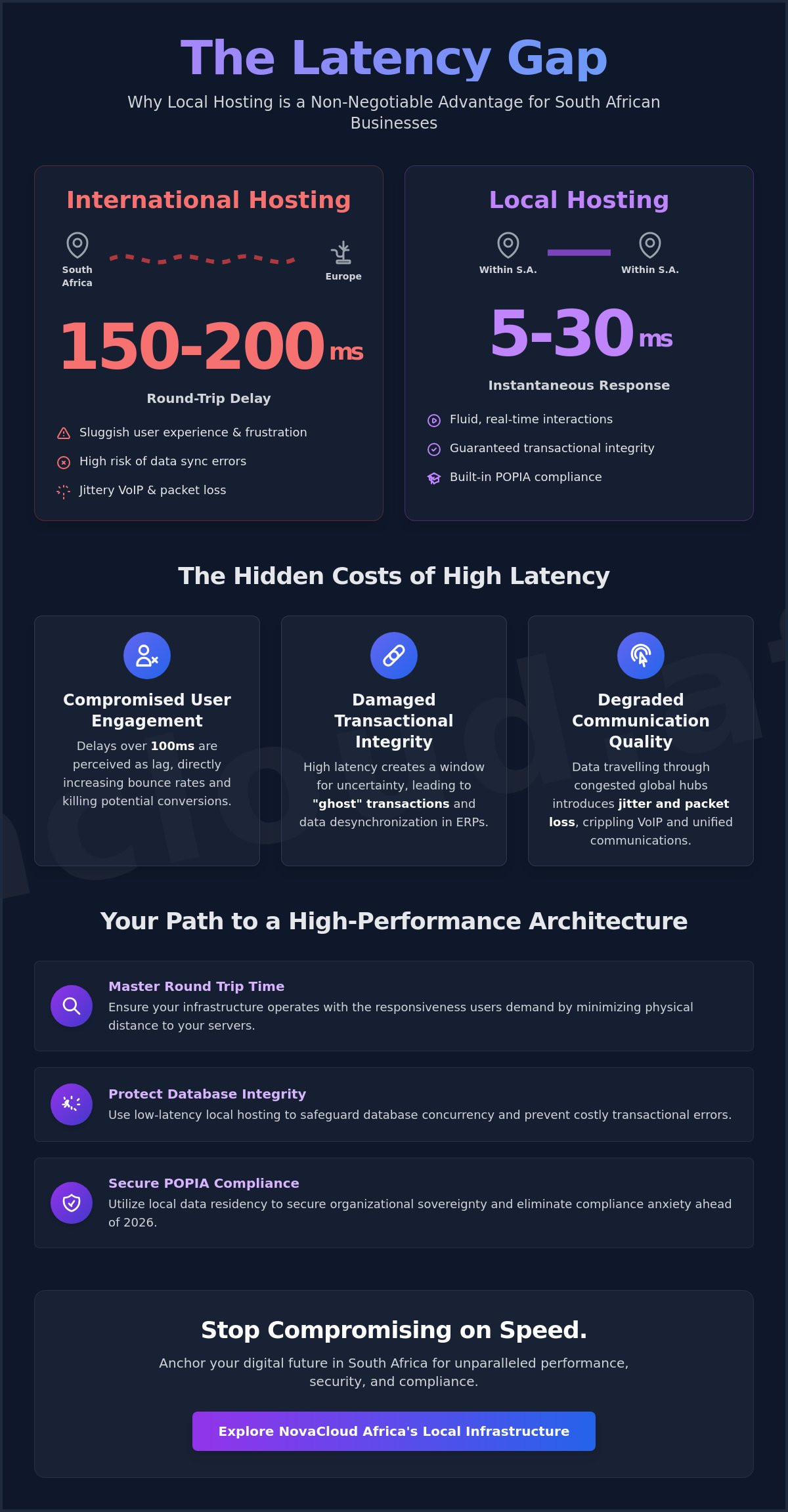
Latency isn't a passive technical detail; it's the heartbeat of your digital infrastructure. In the architecture of modern systems, every millisecond dictates whether a transaction succeeds or fails. The Physics of Performance reminds us that data is bound by the physical constraints of light and fiber. When your applications live on international servers, every packet must navigate thousands of kilometers of subsea cables. A round trip from South Africa to London or Frankfurt typically consumes 150ms to 200ms. This delay is an eternity for modern asynchronous applications that require constant, high-frequency communication between the user and the database.
One of the most significant benefits of local VPS hosting for latency is the immediate collapse of this physical distance. By keeping your data within South African borders, you reduce that intercontinental lag to a crisp 5ms to 30ms. This proximity ensures that real-time processing remains stable and responsive. It's the difference between a system that feels alive and one that feels tethered to a distant, lagging past. Local infrastructure provides the visionary clarity needed to lead in a competitive market.
Understanding the Millisecond Gap
Physical distance is the primary architect of network instability. As data travels across the globe, it passes through multiple transit hubs, such as the high-traffic Red Sea corridor. Any congestion or physical damage to these undersea lines introduces jitter and packet loss, which degrades the quality of unified communications and VoIP services. Local peering points within South Africa allow your data to bypass these global vulnerabilities entirely. Latency is the critical interval between command and execution. By narrowing this gap, you provide your business with a stable platform for expansion and regional empowerment.
The Threshold of Perception
The human brain is a sensitive instrument. It perceives any delay over 100ms as a lack of fluidity, often interpreted as "lag." Modern web pages are complex architectures that require dozens of individual requests for scripts, styles, and assets. When each request is burdened by a 150ms round trip to Europe, the cumulative delay creates a sluggish experience that kills user engagement. Mapping the journey from Cape Town to London highlights a massive performance gap compared to a local route. Utilizing business-grade cloud infrastructure creates a fresh start for your digital efficiency. These micro-delays aren't just technical metrics; they're psychological barriers to conversion and trust.
Beyond Speed: How Low Latency Protects Your Transactional Integrity
Speed is often framed as a luxury, but in the sophisticated world of enterprise architecture, it's a prerequisite for reliability. When we discuss the benefits of local VPS hosting for latency, we're looking past simple page load times and into the mechanics of transactional integrity. Every digital interaction is a sequence of requests that must be acknowledged and recorded. If your server is thousands of kilometers away, the delay in these acknowledgments creates a window of uncertainty. In this gap, the system's state can become desynchronized, leading to errors that frustrate users and compromise data accuracy.
Real-time applications, from financial trading platforms to inventory management systems, require sub-30ms latency to maintain a consistent state across all nodes. Without this responsiveness, you risk "ghost" transactions or sync errors in enterprise ERPs. These issues occur when the database hasn't yet updated to reflect a change before the next request arrives. Low latency acts as the critical glue for distributed cloud architectures, ensuring that every component of your system stays in perfect harmony. Research from Think with Google highlights that even minor friction in these digital touchpoints directly impacts their willingness to buy and trust your platform.
Real-Time Operations and VoIP Quality
Communication is the lifeblood of any organization, yet it's incredibly sensitive to network delays. High latency is the primary culprit behind echo, voice clipping, and frustrating delays in professional conversations. For national teams relying on Hosted PBX systems, local server placement is non-negotiable. It ensures that voice packets are delivered in the correct order without the jitter that plagues international routes. By hosting your communication tools locally, you provide your team with the clarity they need for high-stakes video conferencing and seamless collaboration. It's about creating a human-centric experience where technology facilitates connection rather than hindering it.
Database Sync and Application Logic
Mission-critical databases depend on transactional atomicity, the principle that a series of operations either all succeed or all fail together. High-latency environments threaten this principle by increasing the time a database record remains locked during a transaction. This leads to bottlenecks and potential timeouts that can crash application logic. Local VPS hosting ensures that these database calls are executed with surgical precision, maintaining data consistency even during peak traffic. If you're looking to fortify your system against these operational risks, securing your cloud infrastructure with localized resources is the most strategic move you can make for your digital evolution.
The Strategic Cost of Distance: Local vs. International VPS Hosting
Choosing a server based on the sticker price alone is a common strategic trap. While international cloud giants often present lower entry costs, they rarely account for the "distance tax" that accumulates through hidden egress fees and performance bottlenecks. When data leaves a network, international providers frequently charge for that outbound traffic, turning a seemingly affordable solution into an unpredictable monthly expense. One of the primary benefits of local VPS hosting for latency is the elimination of these complex cost structures, providing a clear path to predictable infrastructure budgeting.
There is also a significant productivity tax associated with intercontinental hosting. If an employee experiences a 150ms delay on every database query or application click, those fragments of time aggregate into hours of lost output across an enterprise. This friction erodes the focus of your team and slows the pace of your digital evolution. Beyond the internal metrics, international "savings" are often erased by performance-related revenue loss when customers abandon slow-loading interfaces. Aligning your infrastructure with your primary market ensures your systems operate with the energy and purpose required for modern competition.
Support synchronicity is another vital consideration. Relying on a provider in a different timezone means your critical issues might wait hours for a response. Accessing localized IT Assistance ensures that experts who understand the South African network landscape are available when you are. This collaborative partnership transforms a simple vendor relationship into a strategic alliance focused on your regional growth.
Compliance and the POPIA Framework
In 2026, the Information Regulator has intensified monitoring, making data residency a cornerstone of operational sovereignty. The introduction of new regulations for processing health-related personal information in March 2026 adds another layer of complexity for businesses. Local VPS hosting provides the simplest path to regulatory peace of mind by keeping sensitive data within our borders. By linking your Cloud backups to a local VPS, you create a unified compliance posture that satisfies POPIA requirements and protects your transactional integrity against cross-border legal risks.
The ROI of Local Infrastructure
Analyzing the total cost of ownership (TCO) reveals that local infrastructure often outperforms offshore nodes in the long term. Local hosting reduces the need for expensive third-party bandwidth optimization tools and content delivery networks (CDNs) designed to mask high latency. It's a cleaner, more efficient architecture that favors stability over complexity. By investing in regional expertise, you aren't just buying compute power; you're architecting a resilient foundation that empowers your organization to lead with quiet confidence and visionary optimism.
- Eliminate unpredictable egress fees from international providers.
- Ensure full compliance with 2026 POPIA health information regulations.
- Reduce the "productivity tax" on internal teams.
- Gain same-timezone support from local technical experts.
Architecting for the South African Landscape: A Roadmap to Zero Lag
Efficiency is a design choice, not a fortunate accident. For South African enterprises, achieving a state of "zero lag" requires a holistic view of the entire network path. The benefits of local VPS hosting for latency are fully realized when your internal connectivity matches the caliber of your server infrastructure. Symmetrical Business Fibre serves as the essential conduit here. Unlike residential connections, symmetrical fibre ensures that upload and download speeds are identical, which is critical for the constant, two-way communication required by cloud-based ERPs and real-time data processing.
Selecting the right VPS tier also plays a decisive role in the user experience. High-demand applications often suffer when CPU resources are oversubscribed, leading to "processing latency" that feels identical to network lag. By choosing tiers with high CPU-to-latency ratios, you ensure that the server can process requests as quickly as the network can deliver them. This technical alignment creates a seamless flow that empowers your team to work at the speed of thought. It's a strategic approach that transforms raw compute power into a catalyst for regional empowerment.
Step 1: Network Path Optimization
Your data's journey is measured in "hops," which are the various routers and switches it passes through between the user and the server. Every hop adds a handful of milliseconds to the total response time. Using traceroute tools allows you to map this distance and identify unnecessary bottlenecks that might exist even within a local context. The synergy between local hosting and high-speed enterprise connectivity collapses these paths, ensuring your data stays within a high-performance ecosystem. Identifying and removing these friction points is the first step toward a fresh start in business efficiency.
Step 2: Security without Slowdown
Security protocols often act as a brake on network speed, but they don't have to. Implementing a Managed Firewall with optimized deep packet inspection allows you to secure your perimeter without introducing significant lag. The benefit of having your security and hosting within the same national ecosystem is that inspection happens closer to the source. This reduces the encryption overhead and ensures that your rapid response times remain intact. Balancing robust protection with high-level performance is a hallmark of a sophisticated digital architecture.
Ready to eliminate the bottlenecks in your digital ecosystem? Deploy your local VPS today and experience the difference of architected speed.
Navigating the Future with NovaCloud Africa’s Enterprise-Grade Infrastructure
NovaCloud Africa designs the systems that power the nation's digital future. We believe in a landscape where infrastructure is a catalyst for acceleration rather than a bottleneck. The benefits of local VPS hosting for latency are maximized within our integrated ecosystem, where Virtual Private Servers, Business Fibre, and Managed Firewall protocols work in unison. This holistic design eliminates performance friction, allowing your organization to move from a state of uncertainty to absolute readiness. By aligning your digital assets with a partner that understands the South African landscape, you ensure your systems operate with the energy and purpose required for modern competition.
Understanding the benefits of local VPS hosting for latency is essential for any forward-thinking designer of systems. It's about more than just speed; it's about establishing a foundation of digital sovereignty that protects your brand and empowers your team. Our integrated approach ensures that every packet stays within a secure, high-speed national network, providing the stability required for expansion. NovaCloud Africa positions itself not just as a provider, but as a strategic ally in your digital evolution.
The NovaCloud Africa Advantage
Our commitment to national infrastructure is a mission-driven focus on regional empowerment. Our business-grade cloud infrastructure provides a fresh start for organizations requiring stability and high-impact performance. Like a beacon of celestial light, our localized nodes provide the clarity required to navigate 2026’s complex regulatory environment with quiet confidence. You receive bespoke VPS configurations designed specifically for the South African market, backed by expert support that understands your local business context. We take pride in our role as an enabler of regional progress, ensuring your territorial reach is never limited by your technology.
Next Steps for Your Digital Evolution
Initiating a seamless migration to our local nodes is the first step toward reclaiming your operational sovereignty. NovaCloud Africa handles the transitions between high-level strategic concepts and granular technical details with a smoothness that reflects our deep internal expertise. Our team works collaboratively with yours to customize your infrastructure, ensuring you achieve maximum ROI while maintaining peak performance. This isn't a sterile transition; it's a human-centric evolution that prepares your business for the vast possibilities of the future. We invite you to step into a new era of clarity and speed.
Architecting a Sovereign Digital Future
Success in 2026 is defined by the responsiveness of your systems and the integrity of your data. We've examined how physical server proximity dictates the user experience, transforming millisecond gaps into tangible business outcomes. By choosing a localized path, you eliminate the hidden costs of international egress and the complexities of cross-border compliance. The benefits of local VPS hosting for latency are the true architects of digital trust, ensuring your applications remain as agile as the market demands.
NovaCloud Africa provides a business-grade cloud infrastructure purpose-built for the South African landscape, offering full POPIA compliance and a seamless integration with Managed Firewall and Business Fibre protocols. This isn't just a technical upgrade; it's a strategic alliance designed to empower your regional growth. Architect your high-performance future with NovaCloud Africa's local VPS solutions. Together, we can turn your digital evolution into a narrative of clarity, renewal, and unprecedented speed. Your vision deserves a foundation that can keep pace with its ambition.
Frequently Asked Questions
How much latency is too much for a South African business application?
Anything exceeding 100ms typically disrupts the user's flow and creates a perception of sluggishness. For high-demand enterprise applications, you should aim for a latency profile below 50ms to maintain seamless interaction. One of the key benefits of local VPS hosting for latency is the ability to hit these targets consistently. Keeping your data within national borders ensures that your digital infrastructure remains responsive and reliable.
Does local VPS hosting really improve SEO for my South African audience?
Local hosting significantly boosts your search engine visibility by reducing the Time to First Byte (TTFB). Search engines prioritize sites that provide a fast, stable experience for local users. When your server is physically closer to your audience, your pages load faster, which directly improves your Core Web Vitals. This technical advantage often translates into higher rankings and increased organic traffic for your South African business.
Is international VPS hosting always cheaper than local South African options?
International options might look cheaper on a pricing table, but they often carry hidden egress and performance costs. When you factor in the productivity losses caused by lag and the high cost of international data transit, local hosting is frequently the more economical choice. It provides a predictable cost structure that supports long-term growth without the "distance tax" associated with offshore nodes.
How does server location impact the quality of my Hosted PBX and VoIP calls?
Server location is the primary factor in voice quality, as distance introduces jitter and packet loss. For Hosted PBX and VoIP services, even minor delays can result in echo or dropped words during a conversation. Local hosting ensures that voice packets travel a shorter path, maintaining the clarity and timing necessary for professional communication. This proximity creates a reliable foundation for your unified communications strategy.
What is the relationship between POPIA compliance and local VPS hosting?
Local VPS hosting simplifies POPIA compliance by ensuring that personal data remains within South African jurisdiction. The Protection of Personal Information Act places strict requirements on cross-border data transfers, which can become a legal headache with international providers. By anchoring your data locally, you gain regulatory peace of mind and demonstrate a commitment to data sovereignty. It's a strategic move that aligns your technical architecture with national legal standards.
Can a Content Delivery Network (CDN) replace the need for local VPS hosting?
A CDN can't replace a local VPS because it only caches static assets like images and script files. Your core application logic and database queries still need to run on a server; if that server is overseas, your site will remain slow for dynamic interactions. To achieve true performance, you need the processing power of a local VPS to handle the heavy lifting while a CDN assists with content delivery.
What is a good RTT (Round Trip Time) for a local South African server?
A good Round Trip Time (RTT) for a local South African server typically falls between 5ms and 30ms on a fibre connection. This range represents the gold standard for responsiveness, allowing for near-instantaneous data processing. One of the major benefits of local VPS hosting for latency is maintaining this low RTT, whereas international routes frequently spike above 150ms due to physical distance.
How do I test the latency of my current hosting provider?
You can test your current latency by using simple command-line tools like "ping" or "traceroute" directed at your server's IP address. These tools measure the RTT in milliseconds and show you every network "hop" your data takes. High hop counts or high RTT values are clear indicators that your hosting provider is too far from your primary user base. Identifying these bottlenecks is the first step toward architecting a faster, more efficient digital future.
