


Securing Remote Employee Access to Company Data: The 2026 Architect’s Guide

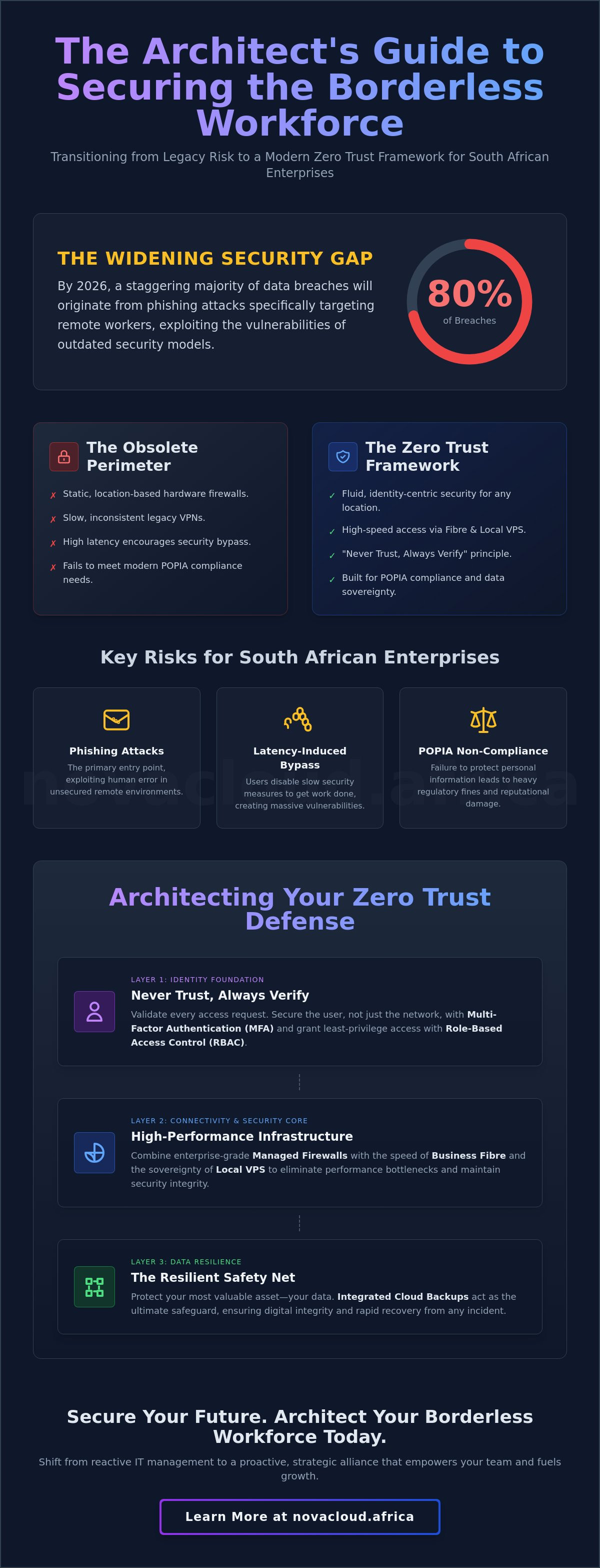
80% of all data breaches in 2026 now originate from phishing attacks specifically targeting remote workers. For many South African leaders, the vision of a borderless workforce often feels clouded by the shadow of POPIA non-compliance and the sluggish, inconsistent performance of legacy VPNs. You want your team to shine from any location, yet the difficulty of managing security across diverse home office environments can feel like a constant drain on your strategic momentum.
Securing remote employee access to company data requires more than a simple software patch; it demands a fresh start through a sophisticated alignment of Zero Trust principles and robust infrastructure. This architect's guide reveals how to build a multi-layered framework that protects your most valuable assets while delivering the high-speed connectivity your users deserve. We will walk through the transition from aging systems to a modern, identity-driven control plane that ensures your business remains both compliant and competitive in this new era of digital expansion.
Key Takeaways
- Understand why the traditional office perimeter is obsolete and how a Zero Trust framework provides the necessary clarity for modern hybrid work.
- Discover the technical advantages of using local Virtual Private Servers and Business Fibre to maintain data sovereignty and high-speed performance.
- Learn the essential steps for securing remote employee access to company data while ensuring full compliance with the latest POPIA regulations.
- Explore how integrated Cloud Backups act as a resilient safety net, protecting your organization's digital integrity against evolving cyber threats.
- Shift your perspective from reactive IT management to a proactive, strategic alliance that empowers your workforce and fuels regional expansion.
The Evolution of the Remote Perimeter in 2026
The traditional office wall has dissolved. In its place, a new architecture is emerging, one that views every remote connection not as a risk to be managed, but as a point of potential growth. By 2026, the concept of a fixed perimeter has been replaced by a fluid, identity-centric model. This shift represents a fresh start for South African businesses, allowing them to shed the limitations of physical space and embrace a truly borderless operation. When the office walls no longer exist, the focus must shift from protecting a location to protecting the data itself.
The cost of ignoring this evolution is steep. With 80% of data breaches now originating from phishing attacks aimed at remote workers, the financial and reputational stakes have never been higher. Yet, for the visionary leader, securing remote employee access to company data is more than a defensive maneuver. It's a catalyst for expansion that provides the clarity needed to scale with confidence. Secure remote access is the harmonious integration of identity verification and encrypted pathways.
The Shift from Physical to Digital Boundaries
Legacy hardware firewalls were designed for a world where data stayed inside a building. In a boundary-less environment, these static boxes become bottlenecks that remote teams often try to circumvent. Cloud-native infrastructure provides a more resilient foundation, moving security closer to the user. This approach ensures that protection travels with the employee, regardless of their location. Moving toward a digital boundary offers several core advantages:
- Mobility: Security follows the user across any network or device.
- Scalability: Your infrastructure grows effortlessly as your remote workforce expands.
- Visibility: Real-time monitoring provides a clear view of every access attempt.
The Risk Landscape for South African Enterprises
South African enterprises face unique pressures, particularly regarding POPIA compliance and the regional threat landscape. One often overlooked factor is latency. When connections are slow or unstable, employees frequently bypass security protocols just to get their work done, creating massive vulnerabilities. High-performance connectivity isn't just about speed; it's about maintaining the integrity of the security stack. By prioritizing these systems, organizations demonstrate a commitment to corporate dignity and build lasting trust with their workforce. Consider these primary threat vectors currently impacting the region:
- Phishing: Remains the primary entry point for 80% of recorded breaches.
- Latency-Induced Bypassing: Slow connections lead users to disable secure tunnels for better performance.
- Regulatory Non-Compliance: The risk of heavy fines under POPIA for failing to protect personal information.
By viewing these challenges as opportunities for refinement, businesses can architect a future that is both secure and remarkably efficient. This transition isn't just a technical upgrade; it's a strategic evolution that positions your brand as a leader in the digital economy.
Architecting the Zero Trust Framework for Data Access
Architecting a resilient defense begins with a fundamental mindset shift. In 2026, we no longer assume that a user is safe simply because they've logged in once. The Zero Trust philosophy, "Never Trust, Always Verify," acts as our guiding principle. Every connection, every device, and every request is scrutinized in real-time. This rigorous approach is the cornerstone of securing remote employee access to company data, transforming a potential vulnerability into a fortified asset. It's about creating a system that is as dynamic as the workforce it protects.
Implementing Multi-Factor Authentication (MFA) serves as our first layer of celestial light. It casts away the shadows of unauthorized access by requiring multiple forms of verification before granting entry. This isn't just a technical hurdle; it's a statement of intent that your organization values its digital integrity above all else. When combined with Role-Based Access Control (RBAC), you ensure that employees only interact with the specific data required for their roles. This principle of least privilege limits the "blast radius" of any potential incident, ensuring that clarity and security coexist throughout your infrastructure.
The Role of Managed Firewalls in Remote Security
Traditional home routers are often the weakest link in a remote setup. They lack the sophisticated inspection capabilities needed to ward off modern threats. By implementing Managed Firewalls, you extend enterprise-grade perimeter control to the very edge of your network. These systems perform deep packet inspection and real-time threat hunting, ensuring that the tunnels between remote endpoints and your core remain untainted by malicious traffic. Integrating these firewalls into your remote strategy provides a level of oversight that unmanaged hardware simply cannot match.
Identity as the New Perimeter
Identity has become the primary control plane for the modern enterprise. We leverage Microsoft 365 Business Premium to provide advanced identity protection that goes far beyond a simple password. Single Sign-On (SSO) further refines this experience, reducing employee friction and eliminating "password fatigue" while maintaining a high security posture. However, verification doesn't stop at the initial login screen. Continuous monitoring evaluates session health throughout the day, automatically reacting to any shift in risk profile or suspicious behavior. By weaving these elements together, you build more than just a barrier. You create a resilient ecosystem where securing remote employee access to company data becomes a silent, powerful enabler of your business's digital evolution. To see how these layers integrate into a cohesive strategy, you may wish to explore our cloud infrastructure solutions designed for the South African market.
The Connectivity Layer: Why Fibre and VPS Matter
A sophisticated security framework is only as resilient as the infrastructure it inhabits. While software-defined perimeters are vital, they often falter when the underlying connection is unstable or high in latency. In the South African context, where connectivity can be inconsistent, securing remote employee access to company data requires a focus on the physical and virtual pathways that carry your information. This connectivity layer acts as the conduit for your digital evolution, bringing clarity to once-congested pathways and ensuring that your security protocols remain active and effective.
When remote tools are sluggish, employees often turn to "Shadow IT"—unauthorized personal applications—to bypass bottlenecks. This creates invisible gaps in your defense. By providing high-performance Cloud Infrastructure, you eliminate the frustration that leads to these risky shortcuts. High-speed, latency-optimized environments ensure that security-protocol timeouts are a thing of the past, allowing your team to work with the same fluid efficiency they would experience in a physical office.
Symmetrical Connectivity and Encrypted Tunnels
The stability of an encrypted tunnel depends entirely on the quality of the connection. Home-grade LTE or asymmetrical residential lines often struggle with the overhead required for secure VPNs, leading to frequent drops and data corruption. In contrast, symmetrical Business Fibre ensures that upload speeds match download speeds. This balance is the backbone of secure remote tunnels, providing the steady throughput necessary for mission-critical applications. Architecting redundancy into these connections ensures 24/7 remote operations, allowing your business to maintain its momentum without the fear of sudden disconnection.
Centralizing Data on Secure VPS Environments
One of the greatest risks to data integrity is the "scatter effect," where company information lives on dozens of different home laptops. Moving your operations to local Virtual Private Servers (VPS) centralizes your data within a managed, high-security environment. This approach offers several strategic benefits:
- Data Sovereignty: Keep your information within regional borders, which is essential for POPIA compliance.
- Reduced Attack Surface: It's easier to secure a single, managed VPS than a hundred disparate end-user devices.
- High-Speed Access: Localized servers provide the lowest possible latency for remote users across the country.
By centralizing resources on a VPS, you ensure that securing remote employee access to company data isn't just about building walls; it's about creating a high-performance hub. This strategy provides your workforce with the tools they need to excel while keeping your most sensitive assets under a single, sophisticated layer of protection.
Compliance and Data Resilience in South Africa
Architecting a secure environment is a profound commitment to your organization's longevity. In the South African landscape, this commitment is codified through the Protection of Personal Information Act (POPIA). By 2026, compliance has evolved from a checkbox exercise into a continuous demonstration of digital sovereignty. Securing remote employee access to company data serves as the frontline of this effort, ensuring that every interaction with sensitive information remains within a transparent and governed framework. This isn't merely about avoiding the intensified enforcement measures announced for the 2026 to 2027 financial year; it's about fostering a culture where data integrity is a shared point of pride.
True resilience requires a strategy that looks beyond the initial connection. While we build robust tunnels and verify identities, we must also prepare for the unexpected. Proactive IT assistance bridges the gap between technical systems and human operation, creating a unified front against evolving threats. When your team understands that security is an enabler of their freedom to work from anywhere, compliance becomes a natural byproduct of a high-performance culture.
Navigating POPIA for Remote Teams
Remote work complicates the path of data, making visibility more critical than ever. With the June 30, 2026 PAIA reporting deadline approaching, businesses must ensure their remote access audits are beyond reproach. Keeping the "Celestial Light" on data movements means knowing exactly who accessed what, and from where. A key component of this is ensuring that data remains within South African borders whenever possible. By leveraging local infrastructure, you maintain regulatory sovereignty and simplify the complexities of cross-border data processing agreements. This localized focus isn't just a legal requirement; it's a strategic choice that supports regional empowerment.
Resilience Through Managed Backups
Local backups on an employee's laptop are no longer sufficient in a distributed world. If a device is lost, stolen, or compromised by ransomware, that data is often gone forever. Implementing Cloud Backups provides a resilient safety net that operates independently of the end-user's hardware. We utilize Acronis Cloud solutions to create automated, immutable data redundancy. This means that even if a remote endpoint is hit by an attack, your core data remains untouched and ready for recovery. Testing your recovery roadmap is the final step in this architectural journey, transforming a potential disaster into a manageable "business-as-usual" event. To ensure your organization is fully protected against the latest regional threats, you can explore our managed cloud backup solutions designed specifically for the South African enterprise.
Partnering for a Secure Digital Future
The final stage of your digital evolution isn't found in a single piece of software, but in the strength of your partnerships. Moving from a "provider" mindset to a "strategic ally" relationship allows you to stop reacting to threats and start designing for growth. NovaCloud Africa architects bespoke security frameworks specifically for the South African enterprise, ensuring that securing remote employee access to company data is a seamless part of your daily operations. We understand that behind every connection is a person. Our dedicated IT Assistance ensures that the human element remains supported through every technical transition.
By unifying your ICT management, you reduce the dangerous complexity that often invites vulnerability. Managing connectivity, cloud, and security under one roof brings a sense of clarity that disparate systems simply cannot provide. This integrated approach doesn't just harden your defenses; it optimizes your costs and streamlines your path to a secure, borderless future. It's about creating a foundation where technology acts as a catalyst for regional empowerment rather than a source of friction.
Consolidating Your Security Stack
Efficiency is born from cohesion. When you manage your Business Fibre, cloud infrastructure, and security protocols through a single strategic ally, you eliminate the gaps where threats often hide. Utilizing Microsoft 365 Business Licensing provides a powerful suite of identity and protection tools that work in harmony with your wider network. Even your communication remains protected, as our Hosted PBX Systems are architected to ensure that voice traffic is as secure as your most sensitive data files. This consolidation represents a fresh start for your business efficiency, casting a celestial light on previously fragmented processes.
Your Roadmap to a Secure Remote Environment
The journey toward absolute data integrity is a deliberate, phased process. It begins with a comprehensive audit and infrastructure assessment to identify your unique regional challenges. From there, we move into a phased implementation of Zero Trust architectures and Cloud Backups, ensuring that securing remote employee access to company data never disrupts your team's productivity. Ongoing monitoring and proactive performance optimization ensure that your systems remain resilient as the global and local landscapes shift. This roadmap isn't just a plan; it's a commitment to your long-term success and a purposeful step toward a more dignified digital future. To begin your assessment, you can explore our cloud and security solutions tailored for the modern workforce.
Designing Your Resilient Digital Horizon
The journey toward a borderless enterprise requires more than just new software. It demands a sophisticated alignment of identity-driven security, robust connectivity, and local regulatory sovereignty. We've explored how Zero Trust principles and high-performance infrastructure work together to eliminate the friction that often leads to data vulnerability. By securing remote employee access to company data through a multi-layered framework, you provide your team with the clarity and freedom they need to excel from any location.
This evolution is a profound opportunity to harden your defenses while accelerating your business momentum. As an Authorized Microsoft 365 Licensing Partner backed by business-grade cloud infrastructure and expert South African IT support, we're committed to being your strategic ally in this mission. You don't have to navigate these complexities alone. Architect your secure remote future with NovaCloud Africa today. Your digital transformation is a path to regional empowerment, and we're here to ensure every step is taken with quiet confidence and absolute integrity.
Frequently Asked Questions
How does POPIA affect my remote employee data access policies?
POPIA requires that you implement reasonable technical and organizational measures to prevent the loss of or unauthorized access to personal information. For remote teams, this means your policies must explicitly cover data encryption, multi-factor authentication, and secure incident response. You're legally responsible for breaches even if they occur on a home network, so your access strategy must be documented and audited to meet the South African Information Regulator's 2026 standards.
Is a standard VPN enough to secure my company data in 2026?
A standard VPN is no longer sufficient on its own because it lacks the granular identity verification and continuous monitoring required by Zero Trust frameworks. While it creates an encrypted tunnel, it doesn't inspect the health of the device or the behavior of the user once they're inside the network. Modern security requires a multi-layered approach that combines identity-centric controls with real-time threat detection to stay ahead of sophisticated regional threats.
What are the most common security mistakes remote employees make?
The most frequent mistakes include using weak passwords, mixing personal and professional tasks on corporate devices, and bypassing secure tunnels when they cause latency. Research indicates that 80% of breaches originate from phishing, which often succeeds when employees are distracted or working in unmanaged home environments. Providing clear education alongside automated security layers is the best way to defend against these common human-centric vulnerabilities and maintain digital integrity.
How can I ensure my remote team has high-speed access to company servers?
You can ensure high-performance connectivity by providing symmetrical Business Fibre and hosting your resources on local Virtual Private Servers. These technologies significantly reduce latency and prevent the bandwidth bottlenecks that often plague home-grade LTE or residential lines. By optimizing the connectivity layer, you make securing remote employee access to company data a seamless experience that doesn't compromise productivity for the sake of safety.
Does Microsoft 365 provide enough security for remote workers?
Microsoft 365 Business Premium offers a robust security foundation, but it's most effective when configured with MFA and conditional access policies. It provides advanced tools for identity protection and device management that are essential for a distributed workforce. For total resilience, it's best integrated into a broader strategy that includes managed firewalls and offsite cloud backups to ensure that every potential attack vector is fully covered.
What happens to my data if a remote employee’s laptop is stolen?
If a laptop is stolen, your data remains protected if you've implemented full-disk encryption and centralized your files on a secure VPS rather than storing them locally. Remote wipe capabilities allow your IT team to erase sensitive information the moment a theft is reported. This architectural approach ensures that the physical loss of a device doesn't escalate into a catastrophic data breach or a violation of POPIA regulations.
How does a Managed Firewall differ from the firewall on a home router?
A Managed Firewall provides deep packet inspection and real-time threat hunting that standard home routers simply cannot perform. While a home router offers basic protection, a managed solution allows your team to govern traffic and block sophisticated malware at the edge of the remote connection. This enterprise-grade control is vital for securing remote employee access to company data across diverse and often insecure home-office environments.
Can I monitor which remote employees are accessing sensitive company data?
Yes, you can monitor all remote access activities through centralized identity management and advanced logging tools. These systems provide a clear audit trail of who accessed which files and when, allowing you to detect suspicious patterns or unauthorized attempts in real-time. This level of visibility is a core requirement for both security best practices and maintaining compliance with South African data privacy laws during the 2026 reporting cycle.
