


Architecting the Business Case: Justifying IT Expenditure to Management in 2026

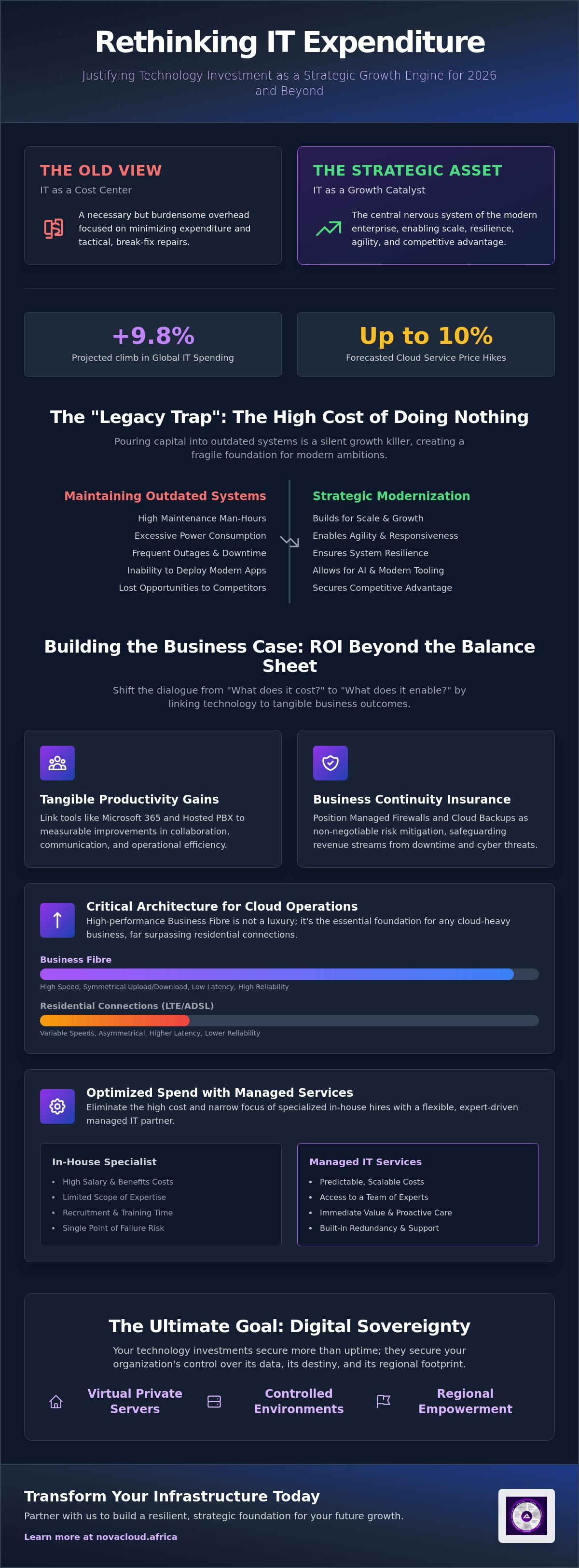
What if the very systems your board views as a drain on capital are actually the primary architects of your next era of growth? In a year where global IT spending is projected to climb 9.8%, the challenge isn't just about finding the budget; it's about justifying IT expenditure to management in a way that resonates with their vision for the future. You've likely felt the pressure to expand digital capabilities while tightening operational costs, especially as cloud service providers forecast price hikes of up to 10% this year. It's a difficult balance to strike when the value of a managed firewall or a robust backup solution feels invisible until it's too late.
We believe that technology should be a catalyst for regional empowerment, not a burden on the balance sheet. This article provides a structured framework to bring clarity to your ICT spend, turning complex technical requirements into high-impact investments. You'll learn how to navigate the 2026 landscape, from meeting NIST CSF 2.0 governance standards to securing approval for legacy system modernization. We'll help you move beyond the "cost center" label to illuminate a path toward long-term operational resilience and strategic renewal. By bridging the gap between technical necessity and business value, you can transform your digital infrastructure into a source of quiet confidence and enduring competitive advantage.
Key Takeaways
- Learn how to reframe ICT from a legacy expense into a foundation for digital sovereignty and long-term growth.
- Master a framework for justifying IT expenditure to management by linking tools like Microsoft 365 and Hosted PBX to tangible productivity gains.
- Discover how to quantify the value of invisible infrastructure by positioning managed firewalls and cloud backups as essential business continuity insurance.
- Understand why high-performance Business Fibre is the critical architecture for cloud-heavy operations, far surpassing the limitations of residential connections.
- Explore how IT Assistance and managed services optimize your spend while eliminating the need for costly specialized in-house hires.
The Paradigm Shift: From IT Cost Centre to Strategic Asset
For decades, the boardroom viewed information technology as a necessary but burdensome overhead. It was a utility, much like electricity or water; something to be minimized rather than cultivated. As we approach 2026, this perspective is rapidly becoming a liability. Success now requires a fundamental shift in how we perceive digital infrastructure. It isn't just a support function. It's the central nervous system of the modern enterprise, pulsing with the data and connectivity that keep every department alive and responsive. When you're justifying IT expenditure to management, you're describing the health and future capacity of that very system.
The core of this transition lies in moving from tactical repairs to strategic architecture. Tactical spending focuses on keeping the lights on and patching what breaks. Strategic architecture, however, builds for scale, resilience, and agility. When leaders understand the foundational elements of a business case, they stop asking how much a server costs and start asking how much growth it enables. With worldwide IT spending projected to exceed $6.08 trillion in 2026, those who treat ICT as a strategic asset will lead the market. Those who cling to "cost-saving" legacy models will find themselves struggling to maintain pace with more agile competitors.
The High Cost of Technical Debt
Many organizations are currently caught in the "Legacy Trap." This is the cycle of pouring capital into maintaining outdated hardware because the initial cost of modernization seems too high. In reality, the maintenance man-hours and power consumption of aging systems often exceed the cost of a fresh start. In the fast-moving South African market, technical debt is a silent growth killer. Attempting to deploy modern, AI-driven applications on top of fragmented, twenty-year-old infrastructure is like building a skyscraper on sand. The foundation simply cannot hold the weight of your ambitions, leading to frequent outages and lost opportunities that your competitors will eagerly seize. Justifying IT expenditure to management becomes an act of risk management, protecting the business from its own outdated foundations.
Aligning IT with Digital Sovereignty
Digital Sovereignty has emerged as a non-negotiable requirement for 2026. It's about ensuring your organization maintains control over its data, its destiny, and its regional footprint. By investing in controlled environments like Virtual Private Servers, you move away from the restrictions of monolithic, faceless providers. This level of infrastructure control is explored deeply in our guide on Architecting Digital Sovereignty: The Definitive Guide to Virtual Private Servers in 2026. You aren't just buying hardware; you're securing the right to operate with clarity and purpose. Framing IT spend as a move toward independence allows management to see technology as a catalyst for regional empowerment rather than a recurring bill.
Building the Business Case: ROI Beyond the Balance Sheet
When presenting a proposal to the board, the conversation often stalls at the initial price tag. To break this cycle, you must shift the dialogue from "What does it cost?" to "What does it enable?" In the high-stakes environment of 2026, return on investment is no longer just a calculation of saved cents; it's a measure of expanded operational capacity. By adopting a formal business case process, you can demonstrate how modern infrastructure acts as a revenue multiplier rather than a static expense. Justifying IT expenditure to management requires showing that every minute of system downtime is a direct, unrecoverable loss to the company's bottom line.
Uptime is the heartbeat of modern commerce. If your team can't access data or communicate with clients, the business stops. Investing in resilient systems ensures that your revenue streams remain uninterrupted, even during regional connectivity shifts or hardware failures. This perspective transforms IT from a line item into a safeguard for the organization's financial health. When infrastructure is built with precision, it doesn't just sit in a rack. It actively drives the business forward by removing the technical barriers that slow down your most talented people.
Efficiency and Unified Communications
Communication friction is a silent tax on your productivity. Traditional onsite phone systems are heavy, expensive to maintain, and tethered to a physical location. Transitioning to Hosted PBX systems replaces these capital-heavy anchors with a lean, scalable operational expense model. This shift is particularly vital for the hybrid work era, where your team needs to collaborate seamlessly across different geographies. By reducing the complexity of your communication stack, you empower your staff to focus on high-value tasks rather than troubleshooting legacy hardware. You can find deeper insights into these efficiency gains in our analysis of The ROI of Unified Communications: Moving Beyond Legacy.
The Scalability Factor
The days of over-provisioning hardware "just in case" are over. Utilizing Virtual Private Servers (VPS) allows your business to scale resources in real-time without the massive upfront capital expenditure of physical servers. Instead of waiting weeks for hardware delivery and configuration, you can spin up capacity in minutes to meet sudden market demands. Elastic Infrastructure is the ability to match ICT costs directly to monthly revenue fluctuations. This alignment ensures that you're never paying for idle capacity, making the process of justifying IT expenditure to management much simpler when the costs mirror the company's actual usage and growth. To see how these scalable systems can align with your specific growth targets, consider reviewing your current architecture with a strategic partner.
Risk Mitigation: The High Cost of Doing Nothing
"We haven't been hacked yet" is perhaps the most dangerous phrase in any modern boardroom. It's a logic that treats luck as a strategy. In 2026, justifying IT expenditure to management requires a fundamental shift in how we view risk. Security shouldn't be seen as a hurdle to overcome, but as Business Continuity Insurance. With global cyber insurance premiums projected to reach $16.4 billion this year and S&P Global Ratings forecasting a 15% to 20% increase in pricing, the market is signaling that risk is no longer a theoretical worry. It's a quantifiable financial threat that demands a structured, proactive response.
For South African organizations, the Protection of Personal Information Act (POPIA) provides the necessary legal framework for this investment. Compliance isn't merely a box to check; it's a foundation for customer trust and regional empowerment. When you implement managed firewalls or encrypted backups, you're protecting the very integrity of your brand. The "Ransomware Reality" is simple: the cost of recovery, including downtime and reputational damage, consistently dwarfs the cost of prevention. Investing now ensures that your business remains a beacon of stability and clarity in an increasingly volatile digital landscape.
Data Resilience as a Board-Level Concern
Your data is your most valuable asset. If it's compromised or lost, the damage to your brand reputation can be permanent. Implementing Cloud backups ensures that your operations stay buoyant even during a crisis. By utilizing Acronis Cloud, you create an immutable, secure architecture that protects against data loss. It's about architecting a future where a single system failure doesn't lead to a total operational eclipse, allowing you to move forward with quiet confidence.
The Managed Firewall Defense
A Managed Firewall service is a proactive investment in your network's health. By leveraging FortiNet infrastructure, you gain enterprise-grade security without the massive expense of a dedicated in-house security team. This approach makes justifying IT expenditure to management simpler by turning security into a predictable operational cost rather than a reactive emergency expense. It provides the protection your organization needs to pursue new digital opportunities, knowing your perimeter is under expert watch.
Foundational Connectivity: Justifying the "Pipe"
Many executives view internet connectivity as a simple commodity, often opting for the lowest price point available. However, relying on residential-grade links for enterprise operations is a significant strategic liability. In 2026, where cloud-heavy environments are the standard, your connectivity is the literal foundation of your digital architecture. When justifying IT expenditure to management, you must frame the "pipe" not as a utility bill, but as the critical infrastructure that determines the success of every other investment you make. If your primary link fails, the entire enterprise effectively goes dark, halting productivity and revenue generation instantly.
High-performance connectivity isn't just about raw speed. It's about reliability and contention ratios. Unlike "best-effort" residential services that fluctuate based on neighborhood usage, business-grade links provide the stability needed for real-time applications. Whether it's Microsoft 365 collaboration, Virtual Private Servers, or VoIP calls, these tools require a steady, uninterrupted flow of data to deliver value. Redundancy is equally vital. A secondary failover link ensures that a single physical break doesn't result in a total operational standstill, maintaining the quiet confidence your clients expect from a modern organization.
Symmetrical Fibre vs. Best-Effort Links
To provide a clear comparison for the board, look at the contention ratio. Residential links often share bandwidth with dozens of other users, leading to unpredictable performance during peak hours. A dedicated Business Fibre connection offers a much lower ratio, ensuring your traffic takes priority. Once that high-quality signal reaches your premises, utilizing Ubiquiti networks allows you to distribute that connectivity effectively across your entire campus. This ensures that every department enjoys the same level of digital clarity and speed, regardless of their physical location in the building.
Connectivity as an Enabler of Cloud ROI
The return on investment for sophisticated tools like Microsoft 365 or VPS drops to zero if your staff cannot access them reliably. High-speed internet acts as a productivity multiplier, removing the technical friction that erodes employee efficiency. Symmetrical Connectivity is the equal ability to upload and download data, which is critical for cloud backups and seamless video conferencing. Without this parity, your cloud-hosted applications will feel sluggish, directly impacting the workforce's ability to remain agile and responsive to market shifts. To ensure your business has the architectural foundation it needs to thrive, you can explore our enterprise connectivity solutions today.
Partnering for Precision: Managed IT as the Final Justification
The final step in architecting a successful business case is addressing the human element of your digital evolution. Even the most sophisticated cloud environment or symmetrical fibre link requires expert oversight to remain optimized and secure. When justifying IT expenditure to management, you can present a partnership with a managed service provider as a strategic way to bypass the massive costs associated with recruiting and retaining a full-time team of specialized engineers. Instead of a bloated payroll, you gain a "Strategic Architect," which is a partner who ensures every cent of your ICT budget is aligned with your broader enterprise goals.
This model introduces a "Single Pane of Glass" management style. Having one reliable partner oversee your connectivity, cloud backups, and network security eliminates the friction and finger-pointing that often occurs when managing multiple vendors. It brings a sense of celestial clarity to your operations, acting as a single point of truth where all technical layers converge. This consolidation doesn't just save money. It ensures that your systems work in harmony rather than in silos, creating a rhythmic efficiency that supports your organization's growth and regional influence.
Reducing Operational Friction
Internal IT teams are often bogged down by routine maintenance and reactive troubleshooting, which prevents them from focusing on projects that drive actual business growth. By leveraging IT Assistance, you shift the burden of 24/7 monitoring and proactive threat hunting to a dedicated ally. This isn't just a technical fix; it's a strategic move that empowers your staff to innovate. The peace of mind that comes from expert oversight allows you to scale with quiet confidence, knowing your infrastructure is being continuously refined for peak performance and stability.
The Roadmap to 2026 and Beyond
justifying IT expenditure to management shouldn't be a one-time battle for a single purchase. It's about presenting a multi-year roadmap that evolves alongside the global landscape. As we've explored, the transition from a cost centre to a strategic asset involves modernizing legacy systems, securing your data via Acronis Cloud, and ensuring robust connectivity through Business Fibre. Each of these steps is a brick in the foundation of your digital sovereignty.
By framing these investments as a journey toward regional empowerment, you turn technical necessity into a narrative of progress and renewal. You're no longer just asking for a budget. You're offering a visionary plan for a resilient, future-proof organization. Now is the time to move from a state of uncertainty to one of clarity and readiness. Consult with NovaCloud Africa to architect your 2026 ICT budget and ensure your organization is prepared to lead in the years ahead.
Secure Your Digital Sovereignty
Navigating the complexities of 2026 requires more than just technical savvy. It demands a vision that aligns infrastructure with enterprise ambition. By shifting the focus from cost to capability, you turn invisible necessities like cloud backups and managed firewalls into foundational assets for growth. The process of justifying IT expenditure to management becomes a conversation about resilience and regional empowerment rather than a debate over line items. You've seen how symmetrical connectivity and expert assistance eliminate operational friction, allowing your team to focus on innovation and market expansion.
Since 2018, we've provided specialized South African ICT expertise to help organizations bridge the gap between technical need and strategic value. As an authorized Microsoft 365 Business Licensing partner with an enterprise-grade FortiNet and Acronis security stack, we're ready to serve as your strategic ally. Architect your digital future with NovaCloud Africa’s business-grade infrastructure and move forward with the clarity your organization deserves. Your digital evolution is in expert hands, and the possibilities for your next era of growth are limitless.
Frequently Asked Questions
How do I explain the ROI of cybersecurity to a non-technical board?
Frame cybersecurity as "Business Continuity Insurance" rather than a technical expense. The return on investment is found in the avoidance of catastrophic losses, including the high cost of ransomware recovery and the permanent damage to your brand reputation. By presenting security as a prerequisite for digital growth, you shift the focus from what it costs to what it protects, making the value clear to those focused on the bottom line.
Is it better to justify IT spend as CAPEX or OPEX in 2026?
Shifting toward an OPEX model is the strategic standard for 2026 because it offers superior financial agility and scalability. This approach allows your organization to treat digital infrastructure as a flexible service rather than a depreciating asset. It simplifies the process of justifying IT expenditure to management by aligning your monthly costs directly with current operational needs and revenue fluctuations.
What are the hidden costs of delaying an IT infrastructure upgrade?
Delaying upgrades creates "Technical Debt," where the cost of maintaining aging systems eventually exceeds the price of replacement. You face hidden drains like increased power consumption, higher maintenance man-hours, and the constant risk of hardware failure. These legacy systems also act as a bottleneck, preventing your team from adopting modern, AI-driven tools that are essential for staying competitive in the South African market.
How can I align my IT budget with POPIA compliance requirements?
Align your budget by prioritizing data protection through encrypted cloud backups and managed firewalls. These investments ensure that your organization meets the legal requirements for data sovereignty and privacy while building deeper trust with your clients. Viewing these costs as a foundation for regional empowerment helps management see compliance as a strategic advantage rather than a regulatory hurdle.
Why should we pay for Business Fibre when residential fibre is cheaper?
Business Fibre provides the symmetrical speeds and low contention ratios that "best-effort" residential links simply cannot match. While residential fibre is cheaper, its performance often falters during peak hours, which can cause significant disruptions for cloud-heavy operations. Business-grade connectivity ensures that your mission-critical applications, such as Hosted PBX and Microsoft 365, remain responsive and reliable throughout the workday.
How does a Virtual Private Server (VPS) save the company money compared to on-site hardware?
A Virtual Private Server (VPS) eliminates the massive upfront capital expenditure of physical servers and the ongoing costs of power, cooling, and physical security. It allows you to scale your resources instantly, ensuring you only pay for the capacity you actually use. This move to the cloud reduces your operational footprint while providing enterprise-grade stability and built-in redundancy that on-site hardware rarely offers.
What metrics should I use to prove that our IT spend is improving productivity?
Focus on metrics like system uptime, reduction in communication friction, and the speed of technical issue resolution. You can demonstrate how tools like Hosted PBX or Microsoft 365 reduce the time employees spend on administrative tasks, allowing them to focus on core business growth. These data points prove that your ICT spend is a productivity multiplier that directly impacts the organization's output and efficiency.
Can managed IT services actually reduce our overall ICT expenditure?
Managed IT services often reduce overall expenditure by providing access to a team of senior specialists for a fraction of the cost of specialized full-time hires. This partnership prevents expensive emergency repairs through proactive monitoring and ensures that every part of your ICT stack is fully optimized. It's a highly effective way of justifying IT expenditure to management by showing that expert oversight leads to predictable costs and long-term stability.
