


Dedicated vs Shared Bandwidth for Business: The 2026 Strategic Architect’s Guide

In 2026, a single minute of network instability is no longer just a technical glitch; it is a strategic drain that can cost your organization up to $427 in lost productivity. Choosing between dedicated vs shared bandwidth for business is the pivotal decision that determines whether your infrastructure accelerates your growth or anchors it. You've likely felt the friction of unpredictable video calls or cloud backups that stall during peak hours, realizing that a shared connection often lacks the clarity and strength your mission requires.
This guide empowers you to master these connectivity models, illuminating the path to true digital sovereignty. We'll move beyond simple speed metrics to explore how dedicated access provides the symmetrical performance and guaranteed uptime required for high-performing VPS environments. You will gain a clear roadmap to securing zero-latency communication and building a scalable foundation that acts as a catalyst for your enterprise’s next evolution.
Key Takeaways
- Understand how contention ratios move from 1:1 in dedicated lines to 1:20 in shared pools, directly impacting your network's predictability.
- Evaluate the trade-offs of dedicated vs shared bandwidth for business to ensure mission-critical tools like Hosted PBX and high-definition video conferencing remain seamless.
- Discover why symmetrical upload speeds are the essential catalyst for immutable cloud backups and robust data redundancy strategies.
- Identify the specific "User Threshold" that signals when your headcount requires a transition from shared fibre to Dedicated Internet Access (DIA).
- Learn a strategic framework to measure ROI across reliability, Service Level Agreements (SLAs), and long-term scalability.
The Fundamental Mechanics: Defining Shared vs. Dedicated Bandwidth in 2026
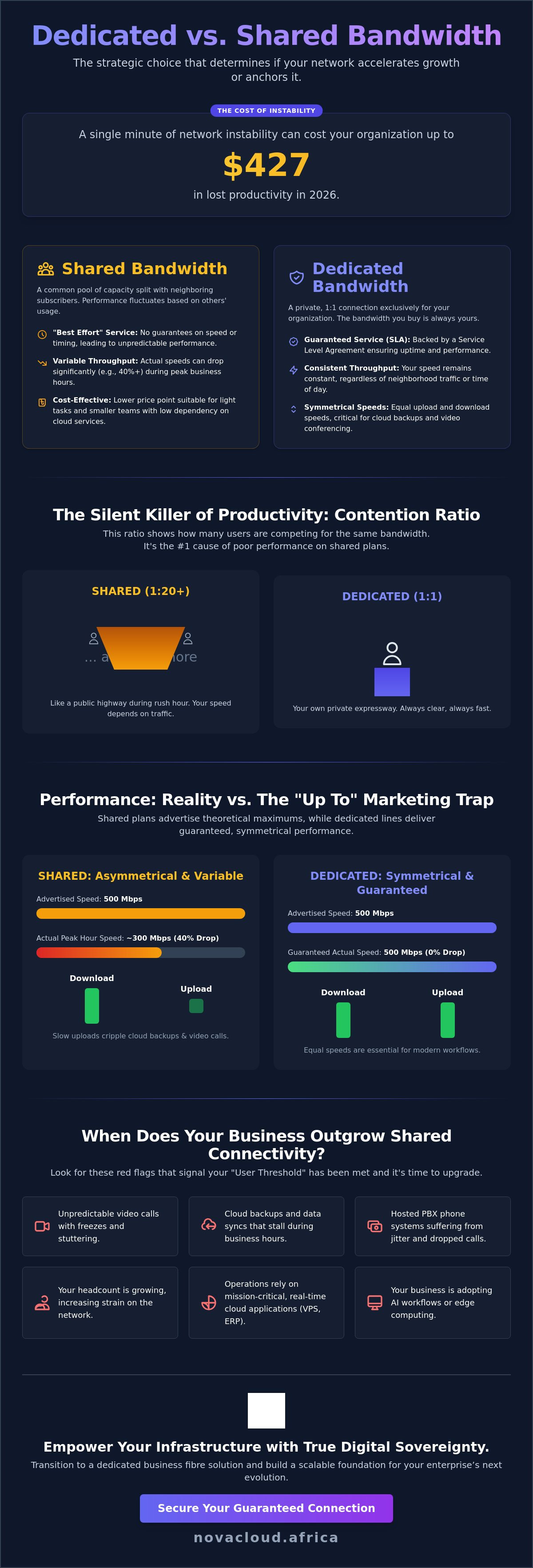
Understanding the architecture of your network starts with a clear choice between a shared resource and a proprietary asset. When evaluating dedicated vs shared bandwidth for business, the distinction lies in how data moves from the provider's core to your office walls. Shared bandwidth operates as a common pool of capacity. In this model, you're effectively splitting a single high-capacity line with neighboring subscribers. While this is cost-effective for light tasks, your performance fluctuates based on the usage patterns of others on the same node.
In contrast, Dedicated Internet Access (DIA) is a private, 1:1 connection built exclusively for one organization. It ensures that the bandwidth you purchase is yours alone, regardless of external network traffic. Modern dedicated architectures prioritize symmetrical connectivity, where upload and download speeds are identical. This symmetry is vital for 2026 workflows, particularly for high-frequency Cloud backups and real-time data synchronization that require equal power in both directions.
Many organizations fall into the "Up To" marketing trap common in shared business fibre plans. Providers often advertise theoretical maximum speeds that only occur under ideal, low-traffic conditions. Because the resource is shared, these plans lack a guarantee of performance. You might pay for 500Mbps but find your actual throughput dropping by 40% during peak business hours when surrounding offices are also active.
The Evolution of Connectivity Standards
In 2026, the baseline for what constitutes "fast" internet has shifted dramatically. The rise of edge computing and AI-integrated workflows means that basic connectivity is no longer sufficient for digital-first operations. We've seen a decisive move away from asynchronous home-style connections toward enterprise-grade pipes. Today's architectures must handle massive, simultaneous data streams without stuttering, moving beyond simple browsing to support complex, interconnected systems that define modern regional progress.
Why "Best Effort" is a Risk for Enterprise
Shared networks typically operate on a "Best Effort" delivery model. This technical designation means the provider makes a reasonable attempt to deliver your data packets but offers no hard guarantees on speed or timing. During peak-hour congestion, business-critical data packets for video calls or database queries can be delayed or dropped. This volatility introduces jitter and latency that can cripple productivity. Dedicated Internet Access acts as a guaranteed, non-congested pathway for corporate data that ensures your mission-critical traffic always has the right of way.
The Silent Killer of Productivity: Contention Ratios and Latency
High download speeds often mask a deeper architectural flaw that can cripple enterprise performance. When weighing dedicated vs shared bandwidth for business, the most critical technical metric isn't the headline speed, but the contention ratio. This number represents how many local subscribers are simultaneously fighting for the same capacity on an ISP's network node. While a dedicated circuit offers a pristine 1:1 ratio, shared business connections often operate at 1:20 or higher. This oversubscription creates a volatile environment where your available throughput is at the mercy of your neighbors' data habits.
This congestion doesn't just slow down downloads; it introduces the "noise" of the public internet exchange into your private workflows. As the network becomes crowded, packet loss increases, forcing your systems to re-transmit data and creating a cycle of inefficiency. Dedicated circuits bypass this shared infrastructure entirely, providing a direct, unencumbered path from your router to the provider's core. This isolation is what transforms a network from a simple utility into a strategic asset for digital sovereignty.
Visualising the Contention Ratio
Think of your connectivity as a highway. A shared connection is like a public multi-lane road where your speed depends entirely on the volume of traffic around you. During the "morning rush" of 9:00 AM, your 1Gbps line might behave like a 50Mbps link because 19 other businesses are merging into your lane. A 1:1 dedicated ratio is your own private, multi-lane expressway. It remains empty and ready for your exclusive use, ensuring that real-time data synchronisation never hits a bottleneck. ISPs manage shared networks by betting that not every business will use their full capacity at once, but in a digital-first era, that gamble often results in peak-hour stagnation.
The Technical Impact on Latency-Sensitive Apps
Latency and jitter are the true enemies of modern communication. Even a few milliseconds of delay can cause "jitter," which manifests as robotic voices or dropped frames in Hosted PBX systems and VoIP calls. For businesses running Virtual Private Servers (VPS), high latency translates to a sluggish interface and delayed database queries, frustrating users and slowing down development cycles. It's vital to remember that dedicated bandwidth provides a "clean" signal essential for high-performance cloud infrastructure. By eliminating the variability of shared nodes, you ensure that your most sensitive applications perform with the same precision at 2:00 PM as they do at 2:00 AM.
If you're noticing inconsistent performance during your busiest hours, it might be time to audit your current voice and data architecture to ensure your foundation is built for growth.
Operational Impact: When Does Your Business Outgrow Shared Connectivity?
Growth is a silent architect of network strain. As your organization expands, the digital interactions that once felt instantaneous begin to stutter under the weight of increased demand. Deciding between dedicated vs shared bandwidth for business often comes down to the density of your real-time cloud interactions. For a business hosting remote VPNs for a hybrid workforce, the HQ's connection acts as the anchor. If that anchor is a shared line, every remote employee's experience is degraded by the local congestion at the office. This creates a bottleneck that stifles collaboration and slows down mission-critical tasks.
The adoption of Virtual Private Servers (VPS) amplifies this requirement. When your global users or internal teams access centralized data, they require a path that offers consistent, high-performance throughput. Shared connectivity, with its variable speeds and high contention, cannot guarantee the responsiveness needed for modern server environments. Transitioning to a dedicated circuit ensures that your infrastructure remains a reliable platform for growth rather than a source of technical debt.
Unified Communications and Voice Quality
Professionalism is heard before it is seen. High-volume Hosted PBX systems require zero-jitter environments to maintain the clarity of every conversation. In a shared network, the "robotic" audio and dropped calls aren't just minor annoyances; they are signals of a failing infrastructure that can alienate clients and disrupt internal alignment. By securing a dedicated pipe, you eliminate the variability that plagues voice packets, ensuring that your communication remains as sharp and reliable as your strategic vision. For deeper voice architecture insights, consult our strategic guide on Hosted PBX systems.
Data Resilience and Cloud Synchronization
Modern data sovereignty requires more than just storage; it demands a resilient pathway for transfer. Shared bandwidth often bottlenecks large-scale Cloud backups, particularly during the business day when upload speeds are throttled by neighboring traffic. Symmetrical upload speeds are the cornerstone of disaster recovery. They ensure that your data redundancy happens in real-time, helping you maintain POPIA compliance through uninterrupted, secure transfers. The choice between dedicated vs shared bandwidth for business is ultimately about protecting your data's integrity and transforming your backup strategy from a "best effort" attempt into a guaranteed pillar of enterprise stability.
The Strategic Choice: A Framework for Bandwidth ROI
Comparing dedicated vs shared bandwidth for business requires a shift from viewing connectivity as a utility to treating it as a core financial driver. For organizations where digital presence is synonymous with revenue, the return on investment for dedicated access is found in predictability. While shared fibre offers a lower entry cost, it introduces variables that can erode your bottom line through inconsistent performance. A strategic architect evaluates connectivity not just by the monthly bill, but by the cost of potential friction in mission-critical workflows.
Security remains a silent but powerful differentiator in this decision. Dedicated links offer a smaller attack surface because your traffic isn't mingling with other subscribers on a local node. This physical and logical isolation provides a cleaner environment for your Managed Firewall and internal security protocols to operate without the background noise of a public exchange. It's a move toward digital sovereignty that ensures your data pathways are as secure as they are fast.
The 2026 Bandwidth Decision Matrix
Deciding when to transition depends on your specific operational profile. The Federal Communications Commission's 2024 Broadband Report suggests that modern businesses need an average of 25Mbps per employee for basic operations. However, this threshold drops significantly if your team relies on high-definition video conferencing or real-time database access. Use these criteria to guide your selection:
- User Count: Organizations with more than 10 employees often find shared connections inadequate during peak hours.
- Cloud Dependency: If your revenue depends on Virtual Private Servers or constant cloud synchronization, DIA is mandatory.
- Budget vs. Risk: Shared fibre fits general-purpose office tasks, while Dedicated Internet Access (DIA) is built for mission-critical infrastructure.
Calculating the Real Cost of Shared Connectivity
The hidden costs of shared bandwidth often manifest as lost productivity and employee frustration. Industry data indicates that downtime for small businesses can cost between $137 and $427 per minute. A 99.9% uptime guarantee might sound impressive, but it allows for over eight hours of cumulative downtime every year. In contrast, a 99.99% SLA reduces that window to just 52 minutes. A 1:1 contention ratio acts as insurance against regional network outages because your traffic is prioritized and isolated from the performance dips that affect the general public.
To ensure your infrastructure is built on a foundation that supports this level of predictability, explore how our Business Fibre solutions provide the stability your architecture demands.
Empowering Your Infrastructure with NovaCloud Africa’s Business Fibre Solutions
The choice between dedicated vs shared bandwidth for business is more than a procurement decision; it's the moment you define the limits of your organization’s digital evolution. At NovaCloud Africa, we don't just provide connectivity. We act as a visionary strategic partner, offering an architect-first approach to Business Fibre that transforms your network into a high-performance asset. Our systems are engineered specifically for the South African enterprise landscape, ensuring that your infrastructure remains resilient while you focus on regional growth and expansion.
True digital sovereignty requires a cohesive ecosystem where every component works in harmony. Our dedicated circuits offer seamless integration with Virtual Private Servers and Managed Firewalls, creating a unified architecture that is both powerful and secure. By combining national reach with deep local expertise, we empower your business to transcend the limitations of faceless global providers, giving you a reliable foundation built on professional pride and technical excellence.
Why NovaCloud Africa for Dedicated Access?
Our commitment to your success is anchored in the integrity of our network design. We maintain strict 1:1 contention ratios for our mission-critical Dedicated Internet Access (DIA) offerings, ensuring that your bandwidth is never diluted by external traffic. While others offer generic support, our team provides proactive monitoring and specialized IT Assistance to keep your systems running at peak efficiency. We bridge the gap between demanding international benchmarks and the unique nuances of the South African market, delivering a connection that feels both human-centric and technologically superior.
Next Steps: Architecting Your Connection
Moving from a state of uncertainty to one of total clarity begins with understanding your current environment. We invite you to request a comprehensive network audit, where we analyze your data usage patterns to determine your exact requirements. This isn't just about speed; it's about designing a scalable ICT roadmap that aligns with your long-term strategic goals. Our experts collaborate with you to ensure that every megabit serves a purpose, enabling a fresh start in business efficiency that grows alongside your enterprise.
Ready to build an infrastructure that never slows you down? Consult with a NovaCloud Africa Architect today to secure your dedicated bandwidth and illuminate the path toward your organization's future.
Secure Your Digital Sovereignty in 2026
The landscape of modern connectivity has shifted from simple speed metrics to strategic predictability. By mastering the nuances of dedicated vs shared bandwidth for business, you've gained the clarity needed to build a resilient, high-performing enterprise. You now understand that a 1:1 contention ratio isn't just a technical specification; it's the foundation for zero-latency communication and robust data redundancy. Transitioning to a dedicated model ensures that your digital evolution remains in expert hands, free from the volatility of shared network nodes.
NovaCloud Africa stands ready as your strategic ally, offering national South African coverage and 99.9% Uptime SLAs that ensure your mission-critical applications never falter. Our systems integrate seamlessly with FortiNet and Acronis to provide a secure, high-performance environment designed for expansion. It's time to move beyond best-effort delivery and embrace a connection that acts as a catalyst for regional progress. This purposeful shift toward dedicated access provides the stability required for a truly scalable future.
Architect your high-performance network with NovaCloud Africa Business Fibre. We're here to empower your vision and ensure your business infrastructure is ready for the limitless possibilities of tomorrow.
Frequently Asked Questions
What is the main difference between shared and dedicated bandwidth?
Dedicated bandwidth provides a private, 1:1 connection exclusively for your organization, while shared bandwidth distributes a common pool of capacity among multiple subscribers. In a shared model, your throughput fluctuates based on the data habits of neighboring businesses. Dedicated access ensures you receive your full, guaranteed speed at every hour of the day.
Is dedicated internet access worth the extra cost for a small business?
Dedicated internet access is worth the investment if your revenue depends on consistent uptime and real-time cloud performance. While the monthly premium is higher, it eliminates the hidden expenses of lost productivity and client frustration caused by peak-hour congestion. For any business running mission-critical applications, the ROI is found in total operational predictability.
How does a contention ratio affect my internet speed during office hours?
A contention ratio dictates how many subscribers share a single network node, causing speeds to drop as local traffic increases during the workday. If your shared connection operates at a 1:20 ratio, you're competing with nineteen other offices for the same capacity. This oversubscription often leads to sluggish performance exactly when your team needs high-speed access the most.
Can I run a Hosted PBX system on a shared fibre connection?
You can run a Hosted PBX system on shared fibre, but you risk robotic audio and dropped frames during periods of high network strain. Voice packets are extremely sensitive to the jitter and latency that occur in oversubscribed environments. A dedicated connection remains the gold standard for maintaining professional, crystal-clear communication without the risk of dropped calls.
What does a 1:1 contention ratio actually mean for my business?
A 1:1 contention ratio means your bandwidth is never shared with any other subscriber on the provider's infrastructure. This technical specification ensures that your connection remains a pristine, private pathway for your corporate data. It provides absolute certainty in performance, allowing your systems to operate at maximum capacity regardless of external network conditions.
Will dedicated bandwidth improve my cloud backup speeds?
Yes, dedicated bandwidth significantly improves cloud backup efficiency by providing symmetrical upload and download paths. Shared connections often throttle upload speeds, which can bottleneck large data transfers and delay disaster recovery. Dedicated access ensures your cloud backups and data redundancy tasks complete their cycles without the interruptions common in shared environments.
What happens if my dedicated internet connection goes down?
Dedicated connections are protected by enterprise-grade Service Level Agreements (SLAs) that guarantee rapid repair times and high uptime percentages. Unlike shared "best effort" plans, dedicated circuits include proactive monitoring to identify and resolve faults before they impact your operations. This high-level support acts as a strategic safety net for your digital infrastructure.
How do I know if my business has outgrown its shared fibre plan?
Your business has outgrown its shared plan if you experience recurring lag during video calls or sluggish access to Virtual Private Servers during peak hours. When evaluating dedicated vs shared bandwidth for business, these performance dips are the primary signal that your architecture requires more power. If inconsistent speeds are stalling your growth, it's time to transition to a dedicated circuit.
