


Business Call Recording Laws in South Africa: The 2026 Strategic Compliance Guide

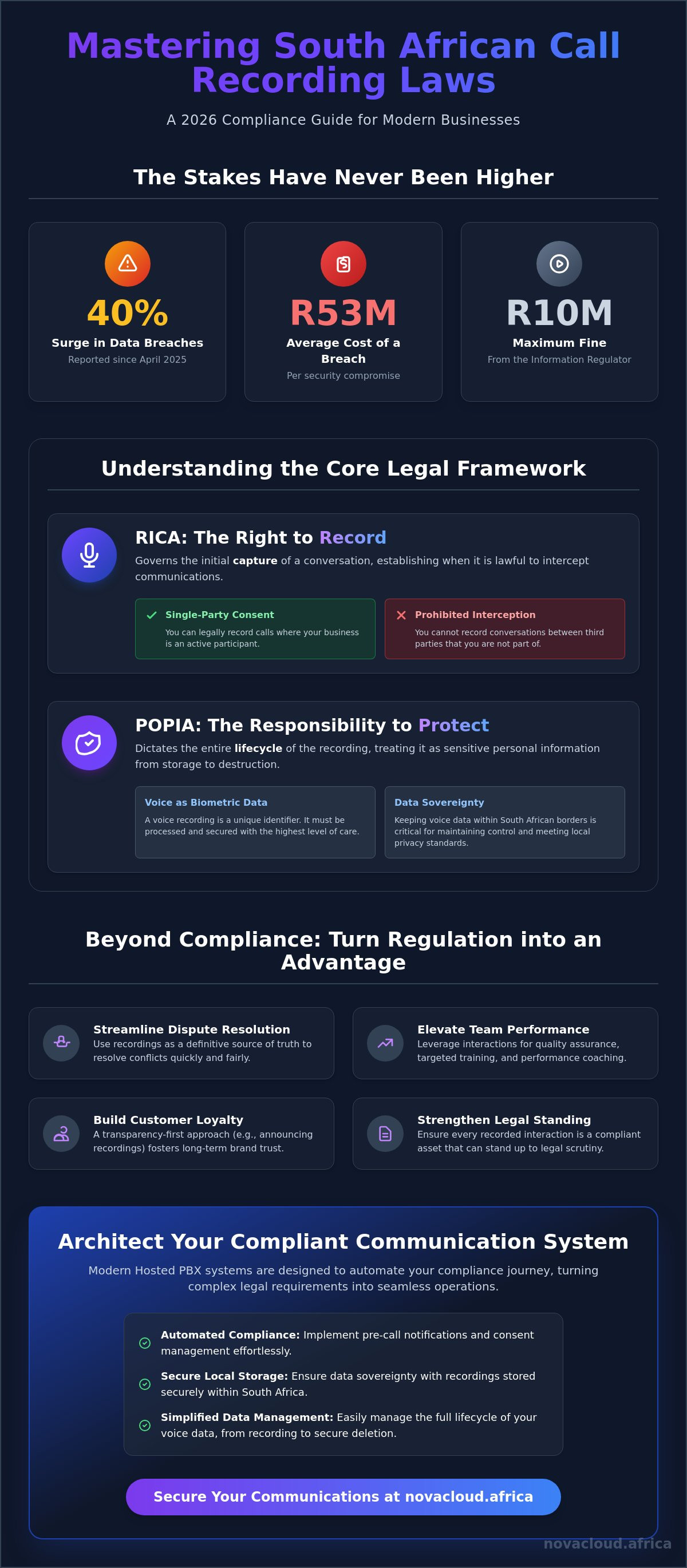
Since April 2025, reported data breaches in South Africa have surged by 40 percent, pushing the average cost of a security compromise to a staggering R53 million. If you're feeling a sense of urgency regarding business call recording laws south africa, you aren't alone. Most leaders recognize that the era of lenient oversight has ended, replaced by a 2026 regulatory landscape where the Information Regulator is actively auditing high-risk sectors and issuing administrative fines of up to R10 million.
It's natural to feel overwhelmed by the tension between RICA's interception rules and POPIA's stringent privacy requirements. You want to record for quality and training, yet the fear of a compliance failure looms large. We're here to turn that uncertainty into a strategic advantage. This guide provides the clarity you need to master the complexities of South African legislation, helping you architect a recording strategy that's both legally sound and high-performing. We'll explore the nuances of single-party consent, establish a framework for secure storage, and demonstrate how modern Hosted PBX systems can automate your compliance journey, bringing a fresh start to your digital operations.
Key Takeaways
- Gain a clear understanding of business call recording laws south africa to navigate the complexities of RICA and POPIA with absolute confidence.
- Master the principle of single-party consent and learn why a transparency-first approach is the ultimate catalyst for building long-term customer loyalty.
- Implement a robust framework for voice data sovereignty, ensuring every recording is stored and processed as sensitive personal information under 2026 regulations.
- Leverage recorded interactions as a definitive source of truth to streamline dispute resolution and elevate the performance of your internal teams.
- Discover how integrating recording features into a sophisticated Hosted PBX system provides a fresh start for your compliance architecture and operational efficiency.
Navigating the Legal Framework: RICA and the Right to Record
The foundation of any high-performance communication strategy in the Republic rests on a deep understanding of the Regulation of Interception of Communications and Provision of Communication-related Information Act (RICA). While often discussed in the context of SIM card registrations, RICA is the primary guardian of signal privacy. It defines the boundaries of what your business can and cannot capture. In the 2026 landscape, following the Constitutional Court's 2025 interim guidelines, the act remains the definitive gateway for lawful recording. For a modern enterprise, 'interception' refers to the intentional act of capturing a communication signal to make its content available to someone other than the sender or intended recipient. Mastery of business call recording laws south africa begins with recognizing that this capture is a privilege granted under specific conditions, designed to protect the digital sovereignty of all participants.
There's a distinct line between a private individual recording a conversation and a corporate entity doing the same. While both are governed by RICA, businesses face higher stakes in terms of brand reputation and evidentiary standards. When your organization records a call, you aren't just saving audio; you're architecting a record that must stand up to legal scrutiny. RICA provides the framework that allows this to happen legally, acting as a catalyst for trust rather than a barrier to efficiency. It ensures that your growth is built on a stable, legally recognized foundation.
The 'Single-Party Consent' Rule Explained
South African law is built on the principle of single-party consent. Under Section 4 of RICA, you can legally record a communication if you are a party to that conversation. This means if your agent is on the line, the recording is lawful even if the other person hasn't explicitly agreed. It's a powerful tool for dispute resolution. However, there's often a gap between what's legal and what's ethical. While silence might be lawful, it can be damaging to brand trust. Leading South African organizations now use this rule as a safety net while prioritizing transparency to foster a human-centric connection. In various court cases, such as those involving labor disputes, single-party recordings have been admitted as decisive evidence, proving their value as a single source of truth for your enterprise.
Prohibited Interceptions: What Businesses Must Avoid
The red line in South African law is third-party monitoring. You cannot record or listen to a call where no one from your organization is an active participant unless you have a court order or it's an emergency situation. Unauthorized interception is a serious offense that can lead to heavy fines or criminal proceedings. For South African enterprises, this means your recording systems must be precisely configured. You don't want a system that captures private employee conversations or external calls where your staff isn't involved. Exceptions are rare and strictly controlled, usually reserved for law enforcement. By staying within these clear boundaries, you ensure your digital evolution remains on a path of integrity and visionary growth.
The Intersection of POPIA and Voice Data Sovereignty
While RICA governs the initial capture of a conversation, the Protection of Personal Information Act (POPIA) dictates its entire lifecycle. In the 2026 regulatory environment, a voice recording is no longer just an audio file; it's a unique biometric identifier. This shift in perspective is central to understanding business call recording laws south africa. Your organization must move beyond asking if you can record and start questioning how you process, store, and eventually destroy that data. The Information Regulator's shift toward proactive compliance monitoring means that having a recording is a responsibility that requires a high level of digital stewardship.
Data sovereignty is the anchor of this stewardship. Keeping voice data within South African borders ensures that your enterprise maintains digital control and adheres to local privacy standards. When recordings are stored on local infrastructure, you eliminate the legal gray areas associated with cross-border data transfers. The admissibility of voice recordings in a legal or labor dispute often hinges on the integrity of the processing chain. If you can't prove that the data was handled with respect for the subject's privacy from capture to deletion, the evidence may lose its value. Managing this lifecycle with precision is a catalyst for organizational growth and regional empowerment.
POPIA Compliance for Call Centers and SMEs
Every organization needs a dedicated Information Officer to oversee the flow of voice data. This role is vital for documenting purpose specification. You must clearly define why you're recording; whether for quality assurance or transaction verification; and ensure that data isn't used for unrelated marketing purposes without explicit consent. Under POPIA, callers also have the right to request access to their recorded data. Your systems must be agile enough to retrieve specific interactions quickly. This transparency doesn't just satisfy a legal requirement; it builds a narrative of trust that differentiates your brand from competitors who treat data as a commodity rather than a human-centric asset.
Securing the Archive: Encryption and Cloud Backups
Security is the final pillar of voice data sovereignty. With a 40 percent increase in reported breaches since April 2025, protecting your audio archives is a mission-critical priority. You must architect a system where every call log and audio file is encrypted both at rest and in transit. Implementing strategic data resilience through localized Cloud backups ensures that even in the event of a system failure, your records remain secure and accessible. This level of technical execution prevents unauthorized access and shields your business from administrative fines that can reach R10 million. It's a visionary approach to infrastructure that safeguards your future while respecting the privacy of your primary regional market.
Implementing Ethical Recording: Best Practices for Brand Trust
Compliance serves as the architectural foundation of your business, but ethics provide the structure that customers actually want to inhabit. While the technical ability to legally record conversations exists under RICA's single-party consent, a visionary organization looks beyond the minimum requirements. In the 2026 market, where consumer awareness is at an all-time high, a Transparency First approach is a powerful differentiator. Notifying callers of a recording isn't just a legal safety net; it's an invitation to a professional, high-trust interaction. By aligning your operations with the spirit of business call recording laws south africa, you signal that your enterprise respects digital sovereignty as much as it values efficiency.
Training your staff is equally vital. Your team should understand not just how to record, but why the boundaries exist. When agents are empowered with the knowledge of POPIA's ethical implications, they handle sensitive data with greater care. This human-centric focus ensures that your digital evolution remains grounded in integrity, turning every call into an opportunity to reinforce your brand's commitment to regional progress. When an organization chooses to lead with clarity, it transforms a regulatory requirement into a signature of professional excellence.
The Anatomy of a Compliant Call Greeting
A compliant greeting is the first touchpoint of a secure system. It must clearly state that the call is being recorded and specify the purpose, such as quality control or transaction verification. Modern Hosted PBX systems allow you to automate these prompts, ensuring every interaction begins on a legally sound footing. If a caller requests to opt out, your system and staff must be prepared to handle the request with professional poise. Standardizing these greetings across your enterprise, supported by high-performance Business Fibre, creates a rhythmic and reliable experience that reassures your primary regional market.
AI Transcription and Modern Compliance
The rise of AI has introduced the Digital Twin, a text-based version of your voice interactions. When you use AI to generate call summaries or transcripts, you're creating new sets of personal data that fall under POPIA. You must ensure these AI tools are hosted on secure Virtual Private Servers to prevent data leakage. Managing this transition from audio to text requires a technical executor who understands that data security must be as fluid as the technology itself. By architecting these systems correctly, you turn complex data into actionable insights without compromising the privacy of those you serve.
Strategic Advantages of Compliant Call Recording
Compliance isn't a burden; it's a strategic asset. By mastering business call recording laws south africa, your organization gains more than legal safety. You're building a single source of truth. In a high-stakes B2B environment, having an immutable record of verbal agreements is a catalyst for speed and clarity. It eliminates the friction that often stalls complex projects. Instead of debating what was promised during a negotiation, your team can review the archived interaction and move forward with quiet confidence. This level of precision marks your enterprise as a forward-thinking designer of systems.
Beyond legal defense, these recordings are a goldmine for business intelligence. In the 2026 ecosystem, sophisticated organizations use AI-driven sentiment analysis to identify exactly where customers feel frustrated. This isn't about surveillance; it's about empowerment. By analyzing these interactions, you can refine your service delivery, turning every call into a technical blueprint for better customer outcomes. This proactive approach to data positions your brand as a reliable technical executor, deeply knowledgeable about the needs of your primary regional market. Aligning with business call recording laws south africa ensures this growth is built on a foundation of digital sovereignty.
Protecting the Enterprise from Litigation
Recorded evidence is your strongest shield against contractual disputes and potential litigation. For a recording to be admissible in a South African court, its integrity must be beyond reproach. This is where your network architecture becomes vital. By utilizing Managed Firewalls, you ensure that your voice archives are shielded from tampering or unauthorized access. This layer of security guarantees that when you present a recording as evidence, it meets the highest standards for authenticity. It’s about creating a fortress around your data, ensuring that your path to regional progress remains unobstructed by legal setbacks.
Enhancing the Customer Experience
High-performance hardware is the silent partner of compliant recording. The audio clarity provided by the Yealink T31P IP Phone ensures that every nuance of a customer's request is captured without the distortion that plagues legacy systems. This clarity is essential for training remote teams, who can use recorded briefings as clear, actionable notes. When you eliminate the ambiguity of poor audio, you empower your workforce to deliver precise results. It’s a human-centric benefit that transforms technical infrastructure into a tool for collective growth and exceptional service delivery. To begin your journey toward unified, compliant communications, partner with NovaCloud Africa for Hosted PBX today.
Architecting Your Compliant Communication System with NovaCloud Africa
Choosing the right technology partner is the final, most critical step in your compliance journey. NovaCloud Africa isn't just a provider; we're a strategic ally dedicated to the South African market. We bridge the gap between abstract business call recording laws south africa and the tangible hardware that powers your daily operations. By integrating compliance directly into your communication architecture, we allow you to focus on growth while we manage the technical complexities of RICA and POPIA. It's about giving your organization the freedom to evolve with quiet confidence.
Our approach centers on the idea that technology should be a catalyst for regional empowerment. We understand that South African enterprises face unique challenges, from the stalled RICA Amendment Bill to the heightened enforcement of POPIA in 2026. Because we're deeply rooted in this market, we design systems that aren't just globally competitive but locally relevant. We provide the technical execution that turns legal uncertainty into operational clarity, ensuring your digital sovereignty is never compromised. When you partner with NovaCloud Africa, you're choosing a visionary path toward business efficiency and professional trust.
Automated Compliance by Design
Our Hosted PBX solutions are designed with an 'automation-first' philosophy. We've built in the notification prompts and notification systems required for effortless RICA alignment. This means your agents don't have to remember to disclose recording; the system does it for them, ensuring a consistent brand experience. We also provide granular access controls, ensuring that sensitive voice data is only accessible to authorized personnel. This scalable storage architecture grows with your enterprise, providing a fresh start for your data management strategy without the need for cumbersome on-premise hardware.
The NovaCloud Africa Difference: Local Expertise, Global Standards
Digital sovereignty isn't a luxury; it's a necessity for modern enterprises. Our locally hosted Cloud Infrastructure ensures that your voice data never leaves South African soil, simplifying your legal profile and boosting performance. When combined with our specialized IT Assistance, your organization stays ahead of the curve as business call recording laws south africa continue to evolve. Transitioning to a modern, compliant VoIP environment is the next step in your digital evolution. We're here to lead that transition, offering the stability and expansion your business needs to thrive in a transparent, human-centric future.
Architecting a Future of Compliant Digital Sovereignty
The transition from simple audio capture to sophisticated data stewardship marks a fresh start for your organization. By mastering the nuances of business call recording laws south africa, you've moved beyond reactive compliance into a position of strategic strength. You now understand that while RICA provides the legal gateway, POPIA dictates a human-centric approach to the entire data lifecycle. This clarity is the catalyst for building a brand that resonates with the primary regional market, turning every recorded interaction into a brick in your foundation of professional trust.
Your digital evolution deserves a partner who combines global technical standards with deep local expertise. We're committed to providing visionary ICT support for national enterprises, ensuring your systems remain resilient as the legal landscape shifts. With our locally hosted South African cloud infrastructure and expert-led compliance integration, you can focus on expansion while we handle the technical execution. It's time to turn regulatory requirements into your signature of excellence.
Architect your compliant communication system with NovaCloud Africa Hosted PBX
The path to a more efficient, transparent, and legally sound future is clear. We're ready to help you lead the way with confidence and precision.
Frequently Asked Questions
Is it legal to record a phone call without consent in South Africa?
Yes, it's legal to record a conversation without the other party's explicit consent if you are an active participant in that call. This is governed by the single-party consent rule within RICA. While legal, a visionary enterprise often chooses to notify callers to build trust and ensure transparency. Mastering business call recording laws south africa means balancing these legal permissions with ethical brand standards to foster long term regional empowerment.
What does RICA say about business call recording?
RICA primarily prohibits the interception of communications by third parties who aren't part of the conversation. However, it creates a specific gateway for businesses to record interactions for purposes like transaction verification or quality control. As long as your organization is a participant in the communication, the recording is generally permitted. This framework acts as a catalyst for professional clarity and ensures your digital evolution remains on a legally sound path.
Do I need to tell my employees I am recording their calls?
You should clearly communicate recording practices to your team through employment contracts and internal privacy policies. While RICA might allow the recording itself, POPIA requires transparency regarding how personal information is processed. Informing your staff isn't just a compliance step; it's a human-centric practice that builds a culture of integrity. This approach ensures your workforce feels empowered and respected within your sophisticated communication architecture.
How long can a business legally keep call recordings under POPIA?
Under POPIA, you can only retain recordings for as long as the original purpose for capturing them exists. There isn't a single one size fits all expiration date. If a recording is needed for a specific contract or legal requirement, you may keep it for that duration. Once that purpose is fulfilled, you must securely delete the data. This lifecycle management is essential for maintaining digital sovereignty and avoiding regulatory friction.
Can recorded calls be used as evidence in a South African court?
Yes, recorded calls are frequently admitted as evidence in South African courts and labor tribunals. Their admissibility usually hinges on whether the recording was obtained lawfully under RICA and if its technical integrity remains intact. Using high performance hardware ensures the audio is clear and verifiable. When your recordings serve as a single source of truth, they become a powerful shield against litigation and contractual disputes.
What are the penalties for non-compliant call recording?
Non-compliance carries heavy consequences, including administrative fines of up to R10 million issued by the Information Regulator. For serious criminal violations of RICA or POPIA, individuals could face imprisonment for up to ten years. These risks highlight why understanding business call recording laws south africa is a mission-critical priority for 2026. Architecting a compliant system isn't just about avoiding penalties; it's about safeguarding your organization's future and reputation.
Does POPIA apply to voice recordings stored in the cloud?
POPIA applies to all personal information, regardless of whether it's stored on a physical server or in the cloud. Voice data is considered a biometric identifier, making it highly sensitive. If you use cloud storage, you must ensure the provider meets South African security standards and ideally keeps the data within national borders. This focus on data sovereignty ensures your archives remain protected against the 40 percent increase in breaches observed since April 2025.
How can I ensure my Hosted PBX system is RICA-compliant?
Ensuring compliance starts with choosing a system that integrates automated notification prompts and strict access controls. Your Hosted PBX should be configured to play a compliance disclaimer at the start of every call. Additionally, you must restrict who can listen to or download these files to prevent unauthorized interception. By partnering with a technical executor who understands the local landscape, you turn complex legal requirements into a seamless, high-performing communication strategy.
