


How to Set Up IVR for a Small Business: A Strategic 2026 Guide

Did you know that by 2026, 80 percent of routine customer interactions are projected to be resolved entirely by AI? For a growing organization, this shift represents a new dawn in operational clarity. You've likely felt the sting of a missed lead or the weight of manually routing every inquiry. It's a common struggle to maintain a sophisticated customer experience when your team is stretched thin. Learning how to set up IVR for a small business isn't just about installing software; it's about designing a system that respects your caller's time and illuminates their path to a solution.
We're here to help you master the art of professional call routing through modern cloud-based architecture. This guide provides a visionary roadmap to enhance your operational efficiency and empower your regional presence. You'll discover how to transition from static menus to intelligent, conversational systems that can reduce handling time by up to 40 percent. We will walk through the strategic selection of Hosted PBX features, the logic of menu design, and the technical execution required to turn your voice network into a catalyst for expansion.
Key Takeaways
- Recognize the shift from rigid hardware to the fluid, scalable architecture of Hosted PBX systems for modern growth.
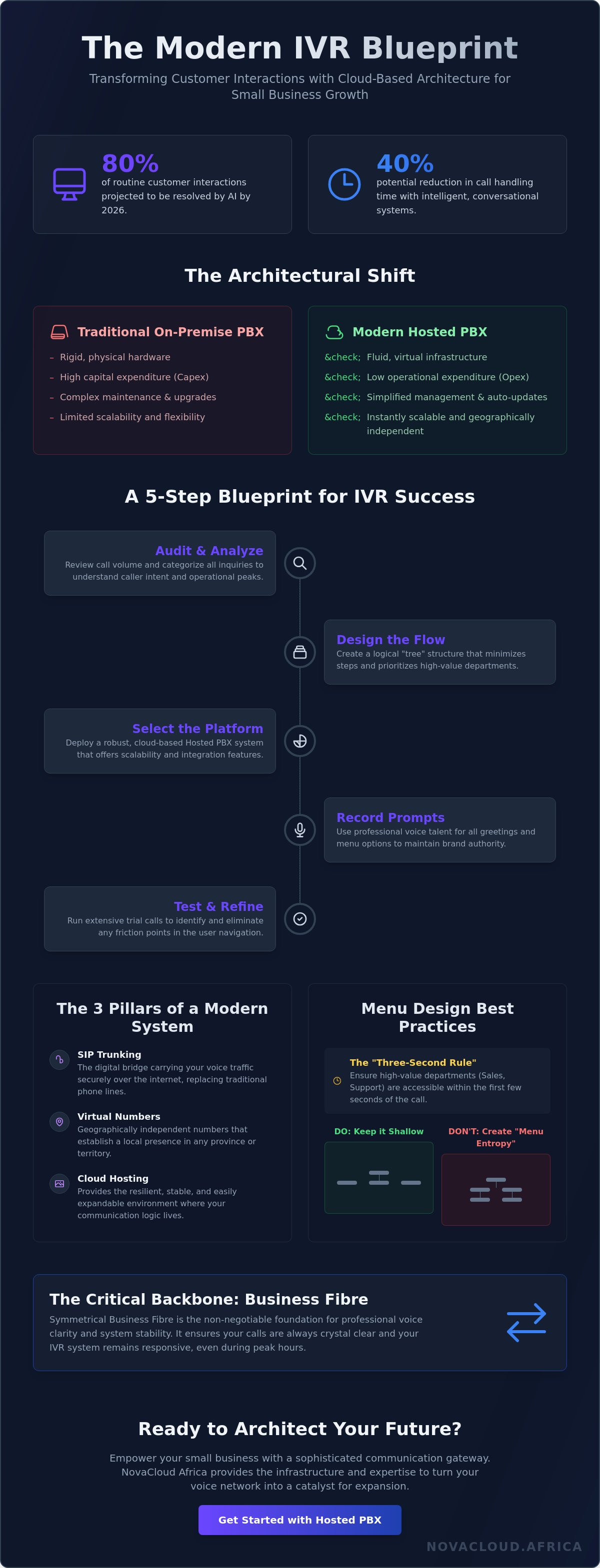
- Implement a strategic five-step blueprint on how to set up IVR for a small business to ensure every caller finds an immediate path to resolution.
- Identify why symmetrical Business Fibre serves as the critical backbone for professional voice clarity and system stability.
- Master the "Three-Second Rule" to design shallow, efficient menus that respect customer time and eliminate navigation fatigue.
- Unlock the potential of regional infrastructure to transform your communication gateway into a sophisticated tool for organizational empowerment.
Understanding the Architecture of Modern IVR Systems
Modern business communication has moved beyond simple dial tones. At its heart, Interactive Voice Response (IVR) serves as a digital architect, guiding callers through a logical flow of information without human intervention. For years, this technology was locked behind the high walls of enterprise budgets and complex on-premise hardware. Today, the landscape has changed. The transition to flexible Hosted PBX systems has democratized access, allowing small teams to project the same professional authority as global corporations.
Understanding how to set up IVR for a small business begins with recognizing the shift from physical wires to virtual infrastructure. In the South African context, this evolution is a catalyst for regional empowerment. By utilizing cloud hosting and SIP trunking, local businesses can maintain a sophisticated presence without the capital expenditure of traditional switchboards. It's a fresh start for efficiency, where virtual numbers allow you to establish a footprint across different territories instantly.
The engine of this modern system relies on three specific pillars:
- SIP Trunking: This is the digital bridge that carries your voice traffic over a secure internet connection.
- Virtual Numbers: These are geographically independent identifiers that give your business a local presence in any province.
- Cloud Hosting: This provides the resilient environment where your communication logic lives, ensuring stability and easy expansion.
The Evolution of the Virtual Receptionist
We've moved past the era of sterile, robotic menus that frustrated more than they helped. A modern virtual receptionist is an extension of your brand identity. High-quality voice recordings and intuitive logic ensure that every interaction feels human-centric and purposeful. By integrating your IVR with business-grade cloud infrastructure, you're not just answering a phone; you're initiating a curated customer journey that reflects your commitment to excellence.
Core Benefits for Growing Teams
Growth requires systems that scale as fast as your ambition. One of the primary advantages of learning how to set up IVR for a small business is achieving 24/7 availability without bloating your payroll. During peak operational hours, the system acts as a reliable technical executor, managing high call volumes and ensuring no lead is lost to a busy signal. Beyond simple routing, modern analytics provide a clear window into customer intent. You can identify service gaps and refine your strategy based on real-world data, transforming a utility into a powerful tool for organizational progress.
How to Set Up IVR for a Small Business: A 5-Step Blueprint
Constructing a professional communication gateway requires more than just software. It demands a strategic vision that transforms a simple phone call into a curated brand experience. When you begin the process of how to set up IVR for a small business, you aren't just configuring a menu; you're building a digital bridge between your team's expertise and your customer's needs. This blueprint ensures that every interaction illuminates the path to a solution.
The first step is a thorough audit of your current operational reality. Analyze your call logs to identify peak times and the most frequent reasons for inquiries. This data serves as the foundation for your logic. Once you understand the "why" behind the calls, you must select a robust Hosted PBX platform. This serves as your technical foundation, providing the stability and feature set required to manage complex routing. Many organizations find that consulting a guide on how to set up an IVR system helps clarify the necessary technical benchmarks before diving into the creative design.
- Audit: Review call volume and categorize inquiries by department.
- Design: Create a logical flow that minimizes the number of steps to reach a human.
- Select: Deploy a cloud-based platform that offers scalability and integration.
- Record: Use professional voice talent to maintain brand authority.
- Test: Run trial calls to identify any friction points in the navigation.
Mapping the Customer Journey
Visualizing your menu as a "tree" structure is essential for clarity. High-value departments like sales and technical support should be accessible within the first few seconds. It's also vital to include "escape hatches." These are options that lead directly to a human operator, ensuring that frustrated callers have a safety net. A well-designed architecture respects the caller's time while empowering your team to handle specialized tasks. If you're ready to modernize your reach, exploring modern connectivity solutions is the first step toward this digital evolution.
Scripting for Clarity and Precision
Every word in your prompt matters. Conciseness is your greatest ally. Use active language to guide the caller efficiently. For example, "For Sales, press 1" is more impactful than "Press 1 if you want to speak with our Sales department." This subtle shift reduces cognitive load and speeds up the interaction. Refining your script is a vital part of how to set up IVR for a small business that actually converts. Consistency across all menu levels reinforces your brand’s personality, creating a sense of reliability and trust from the very first greeting.
Technical Execution: Integrating Hardware and Connectivity
While the design of your menu is the blueprint for success, the technical execution is what breathes life into your communication strategy. A sophisticated menu logic means little if the voice quality is compromised by unstable connections. When considering how to set up IVR for a small business, the focus must shift toward the physical infrastructure that supports your cloud architecture. This involves a precise alignment of high-speed connectivity and specialized hardware to ensure that every interaction remains crystal clear and uninterrupted.
The first requirement for a professional voice network is symmetrical Business Fibre. Unlike residential connections, business-grade fibre provides equal upload and download speeds, which is essential for maintaining the integrity of VoIP traffic. Without this stability, your IVR may suffer from jitter or dropped packets, eroding the professional image you've worked hard to build. Integrating this connectivity into a unified Hosted PBX system allows you to manage call routing from a single dashboard, bridging the gap between your physical office and the digital cloud.
Hardware Spotlight: The Yealink T31P
Your team needs tools that match the sophistication of your system. The Yealink T31P IP Phone is a reliable technical executor for any small business environment. It features HD voice quality that ensures your recorded prompts and live conversations sound natural and authoritative. By configuring programmable keys, your staff can perform one-touch transfers, seamlessly fulfilling the routing requests initiated by your IVR. This hardware creates a tangible touchpoint for your digital architecture, ensuring that the transition from automated menu to human agent is smooth and professional.
Network Stability and Security
Security is the silent guardian of your organizational progress. Protecting customer data is not just a technical necessity; it is a legal requirement under POPIA in South Africa. A Managed Firewall is critical for prioritizing voice traffic over other data, ensuring that a large file download doesn't degrade your call quality. Beyond security, redundancy strategies are vital. Cloud-based systems naturally offer high availability, but having a secondary connectivity path ensures that your IVR remains a beacon of clarity, even during local outages. Mastering how to set up IVR for a small business requires this holistic view of both the digital logic and the physical network.
Avoiding the "Menu Entropy" Trap: Best Practices
Design failure often stems from complexity rather than lack of capability. In the world of digital architecture, "menu entropy" occurs when a phone system becomes so layered and convoluted that it loses its primary purpose: connecting a human with a solution. When you master how to set up IVR for a small business, your goal is to create a gateway that feels effortless. A well-constructed system doesn't just route calls; it respects the caller's time and preserves your brand's integrity. Research published in December 2025 indicates that businesses using intelligent, AI-powered IVR systems have reported a 25 percent increase in first-call resolution rates, proving that clarity directly impacts outcomes.
To avoid the trap of navigation fatigue, follow the "Three-Second Rule." This principle dictates that menu levels should be shallow and fast, allowing callers to make a selection within seconds of the prompt ending. Limit your options to a maximum of five per level. This constraint prevents cognitive overload and ensures the caller remains focused. By placing your most frequent inquiries at the very start of the menu, you eliminate unnecessary waiting for the majority of your audience. If 60 percent of your calls are for technical support, that should be your first option, not your last.
- Prioritize high-volume requests: Place the most common needs at the beginning of the greeting.
- The Power of Five: Never offer more than five choices in a single menu level.
- Self-Service Empowerment: Use automated prompts for simple tasks like checking office hours or physical addresses.
- Clear Exit Paths: Always provide a way to return to the main menu or reach a live agent.
Maintaining the Human Element
Technology should serve as a bridge, not a wall. For high-priority VIP clients, consider architecting a bypass that routes them directly to a dedicated account manager. Integrating personal voicemail greetings for individual extensions also softens the digital experience, reminding the caller that an expert team is waiting on the other side. This human-centric approach ensures your how to set up IVR for a small business strategy remains grounded in relationship building rather than just technical efficiency.
Continuous Optimization through Analytics
Your communication architecture is a living system that requires regular refinement. Use analytics to track "drop-off" points where callers frequently hang up. This data illuminates friction points in your logic that may need simplifying. A/B testing different menu structures or updating prompts to reflect seasonal offers keeps your system relevant and energetic. If you are ready to illuminate your communication path, partner with NovaCloud Africa today to design a system that grows with your ambition.
Architecting Your Future with NovaCloud Africa
Building a world-class communication system requires a partner who understands both the global technological landscape and the specific nuances of the South African market. While the technical steps of how to set up IVR for a small business provide the structure, NovaCloud Africa provides the visionary infrastructure to bring that plan to life. We position ourselves as more than just a service provider; we're a strategic ally dedicated to your organizational empowerment. By combining high-level strategy with reliable technical execution, we ensure your digital evolution is in expert hands.
Our approach centers on the seamless integration of Hosted PBX and IVR systems. This unified architecture eliminates the silos that often hinder small business growth. When you partner with us, you gain access to dedicated IT Assistance to design and deploy your custom call flow. This ensures that your technical logic is sound from day one. As your business expands across new territories, our systems scale with you, providing a stable foundation for your growing regional presence.
A Foundation of Clarity and Stability
Stability is the bedrock of professional communication. We leverage business-grade cloud infrastructure to deliver 99.9% uptime, ensuring your gateway to the world never goes dark. Our "Celestial Light" philosophy aims to bring clarity to complex technology. We strip away the confusion of modern digital infrastructure to reveal tangible business outcomes. Local expertise is vital in South Africa, where navigating connectivity challenges and POPIA compliance requires a partner with a deep understanding of the territorial landscape. We provide that localized context, ensuring your system is both resilient and legally sound.
Ready to Transform Your First Impression?
The journey from a state of uncertainty to one of technical readiness begins with a single strategic decision. Moving past the frustration of missed calls and inconsistent customer experiences leads to a significant long-term ROI. A professional voice architecture isn't just a cost; it's an investment in your brand's dignity and operational reach. By mastering how to set up IVR for a small business with an expert partner, you're architecting a future where every customer interaction is a catalyst for progress. Your next step is to move from theory to action. Contact our team to book a consultation for your custom IVR blueprint and discover how we can illuminate your path to communication excellence.
Illuminating Your Path to Professional Communication Architecture
Mastering how to set up IVR for a small business marks the transition from reactive call handling to proactive customer engagement. By now, you understand that success lies in the synergy between intuitive menu design and resilient technical foundations. You've seen how a human-centric approach preserves caller trust, while symmetrical Business Fibre ensures your brand’s voice remains steady and clear. This digital evolution isn't just about answering phones; it's about architecting a system that empowers your regional growth and operational reach.
NovaCloud Africa stands ready as your strategic partner in this journey. We provide the stability of POPIA-compliant cloud hosting and the precision of Yealink T31P hardware integration to ensure your first impression is always a professional one. It's time to replace uncertainty with a sophisticated, multi-layered solution that respects your customers and reflects your team's expertise. Our infrastructure is designed to scale alongside your ambition, providing the clarity and stability you need to lead your market.
Architect your professional voice system with NovaCloud Africa today. Your organization is ready for a fresh start in efficiency and a new era of visionary growth.
Frequently Asked Questions
Is an IVR system expensive for a small business in 2026?
Modern cloud-based architecture has made sophisticated call routing accessible to organizations of all sizes. By moving away from heavy on-premise hardware and maintenance fees, small businesses can adopt a scalable model that grows with their needs. This shift ensures that high-level communication tools are no longer reserved for large enterprises, allowing you to invest in your digital evolution without the burden of significant upfront capital expenditure.
Can I set up an IVR without being a technical expert?
Modern Hosted PBX platforms are designed with intuitive interfaces that simplify the configuration process. While the logic of how to set up IVR for a small business requires strategic planning, the technical execution is often handled through user-friendly dashboards. For more complex architectures, our IT Assistance team acts as a reliable technical executor to ensure your system is deployed with precision and clarity.
Will my customers get frustrated with an automated phone menu?
Frustration only occurs when a menu is designed as a barrier rather than a bridge. When you follow human-centric design principles, such as keeping menus shallow and providing clear "escape hatches" to live agents, the experience becomes empowering. Research indicates that AI-powered systems can increase first-call resolution by 25 percent, proving that a well-architected menu actually enhances the customer journey by providing immediate paths to the right solutions.
How many levels should my small business IVR menu have?
Efficiency is the cornerstone of a successful voice network, so you should aim for no more than two or three levels. Keeping your structure shallow respects the caller’s time and prevents cognitive overload. When learning how to set up IVR for a small business, focus on the "Power of Five" rule by limiting each level to five options. This ensures that callers can navigate your system with speed and confidence.
What is the difference between an Auto Attendant and an IVR?
An Auto Attendant acts as a basic digital receptionist that directs calls to specific extensions or departments. Interactive Voice Response is a more sophisticated system that allows for data-driven interactions, such as verifying account details or providing automated status updates. While an Auto Attendant is a simple directory, an IVR serves as a digital architect that can resolve routine inquiries without ever needing a human agent.
Do I need a specific type of internet connection for IVR to work?
Symmetrical Business Fibre is the essential backbone for any professional voice system. Unlike residential connections, symmetrical fibre provides equal speeds for uploading and downloading data, which is critical for maintaining HD voice quality. This stability prevents jitter and dropped calls, ensuring that your communication remains a beacon of clarity for every person who dials your number.
Can I use my existing South African phone numbers with a new IVR?
Existing regional numbers can be ported into a modern cloud-based system to maintain your established territorial identity. This process allows you to keep your local presence while upgrading to a more sophisticated communication architecture. By integrating your current numbers with virtual infrastructure, you ensure a seamless transition for your customers while gaining the flexibility to expand your reach across the country.
How does an IVR help with POPIA compliance?
An IVR system acts as a strategic gatekeeper that can automate the delivery of required legal disclosures and obtain caller consent before data is processed. By routing calls through secure, POPIA-compliant cloud hosting, you ensure that personal information is handled with the necessary technical safeguards. This automated approach brings consistency to your compliance efforts, protecting both your organization and your customers’ privacy.
