


Choosing a VoIP Provider for Call Center Operations: The 2026 Architect’s Guide

A call center in 2026 is no longer just a room full of phones; it's a high-velocity data exchange where every millisecond of latency costs you a customer. When you're choosing a VoIP provider for call center operations, you aren't just buying a service. You're designing the digital nervous system of your entire business. You likely feel the pressure of rising maintenance costs and the frustration of legacy systems that fail to scale when your volume peaks. It's a common challenge, yet it's also a powerful opportunity for a fresh start in business efficiency.
This guide will help you master the technical and strategic benchmarks required to select a VoIP partner that ensures resilience, effortless scalability, and high-performance communication. You'll gain total clarity on how to navigate the latest FCC "Know-Your-Customer" (KYC) mandates and the March 2026 SIP 603+ implementation deadline. We will walk through the essential steps to achieve crystal-clear voice quality, seamless CRM integration, and a predictable cost structure that turns your communication stack into a catalyst for regional growth and empowerment.
Key Takeaways
- Understand the terminal decline of legacy PSTN systems and why Unified Communications is now the essential backbone for modern, high-growth customer engagement.
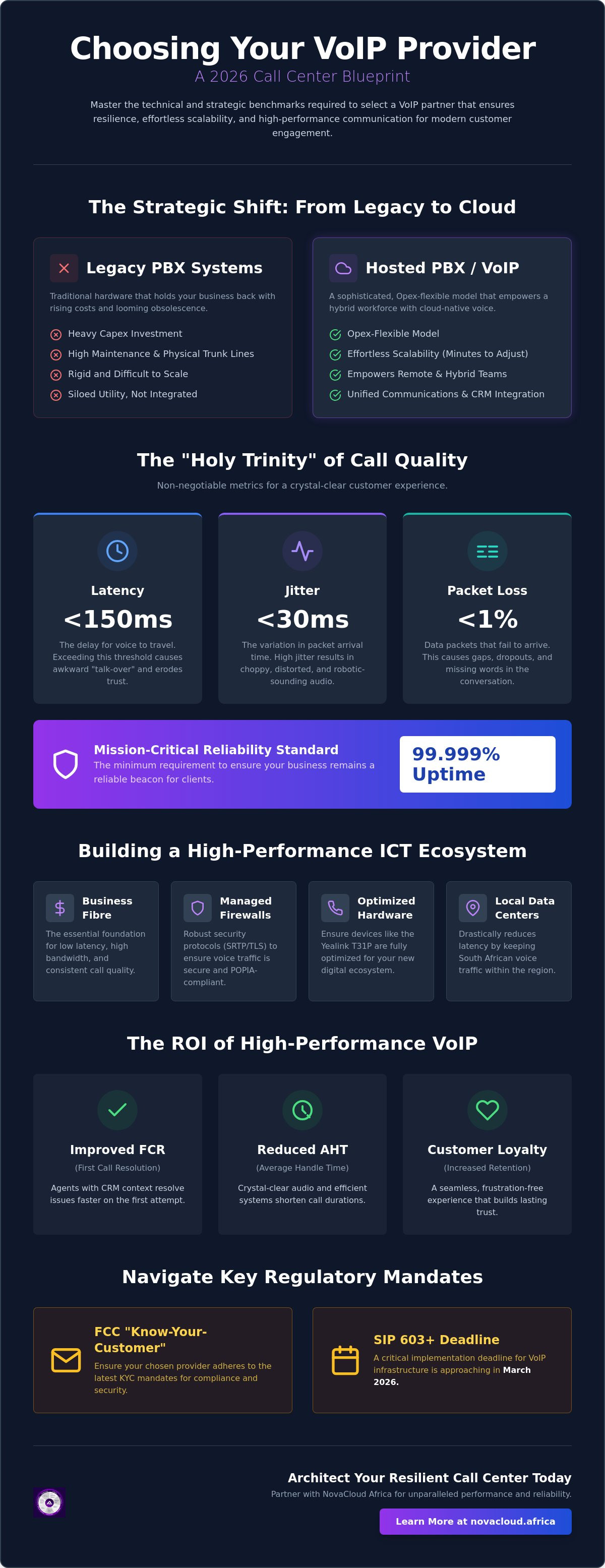
- Learn to evaluate the "Holy Trinity" of call quality—latency, jitter, and packet loss—to ensure your infrastructure meets the 99.999% uptime standard required for mission-critical reliability.
- Master a strategic architectural framework for choosing a VoIP provider for call center operations that prioritizes high-performance Business Fibre and robust Managed Firewalls.
- Discover how to audit your current network capacity and hardware, ensuring devices like the Yealink T31P are fully optimized for your new digital ecosystem.
- Explore the scalability of enterprise-grade Hosted PBX systems, which provide the resilient foundation needed to handle peak call volumes with total confidence.
The Evolution of Call Center Communication: Why VoIP is Non-Negotiable in 2026
The sunset of copper wire marks a new dawn for South African business communication. In this region, the terminal decline of legacy copper-based PSTN systems isn't just a trend; it's an operational reality that demands a fresh start. Organizations still clinging to traditional hardware face rising maintenance costs and the looming threat of total obsolescence. The Evolution of Call Center Communication has reached a tipping point where voice is no longer a siloed utility but the vital pulse of a Unified Communications ecosystem. It's the backbone of modern customer engagement, turning every interaction into a data-rich touchpoint.
Choosing a VoIP provider for call center operations is the most critical architectural decision you'll make this year. It's about more than just making calls; it's about empowering a hybrid workforce with cloud-native voice that works anywhere. By shifting from a rigid cost center to a value-driven communication hub, you provide your team with the tools to excel. This transition illuminates a path toward greater efficiency and regional growth, ensuring your organization remains a leader in a competitive global landscape.
Legacy PBX vs. Hosted VoIP: The Strategic Shift
Traditional PBX systems are anchor points that hold your business back. They require heavy Capex investments and constant physical trunk line maintenance. Moving to Hosted PBX systems represents a sophisticated shift toward an Opex-flexible model. You don't just eliminate the "black box" in the server room; you gain the agility to scale. Whether you need to add ten agents for a seasonal peak or support a fully remote team, the cloud allows for adjustments in minutes. This rhythmic flexibility is essential for maintaining a high-performance environment without the burden of legacy baggage.
The ROI of Agility and Feature-Rich Communication
Advanced features like intelligent call routing and IVR are no longer expensive add-ons; they're the standard for excellence. When you integrate voice data directly with your CRM, you create a personalized customer journey that feels human-centric and intentional. This deep integration has a direct, positive impact on key metrics like First Call Resolution (FCR) and Average Handle Time (AHT). By choosing a VoIP provider for call center operations that prioritizes these technical benchmarks, you ensure that every agent has the clarity and context needed to resolve issues faster. The result is a more resilient operation that fosters customer loyalty and drives predictable business outcomes.
Core Technical Benchmarks: Defining High-Performance Call Center VoIP
High-performance communication isn't an accident; it's the result of precise architectural design. When you're choosing a VoIP provider for call center operations, you must look past the interface and into the engine room of the network. The "Holy Trinity" of call quality—latency, jitter, and packet loss—determines whether your customer experience feels like a fluid conversation or a frustrating series of interruptions. In a mission-critical environment, 99.999% uptime isn't a luxury. It's the minimum standard required to ensure your business remains a reliable beacon for your clients, regardless of external volatility.
For organizations operating in South Africa, geographic presence is the ultimate differentiator. Global providers often route traffic through international Points of Presence (POPs), which can introduce significant voice lag. Utilizing local data centres ensures that your voice traffic stays within the region, drastically reducing the physical distance data must travel. This local focus, combined with robust security protocols like SRTP and TLS encryption, ensures your voice traffic remains POPIA-compliant. Evaluating Your Provider based on these technical foundations is the first step toward achieving total operational clarity.
Latency and Jitter: The Silent Killers of CX
Natural conversation requires a latency threshold of sub-150ms. Anything higher leads to the awkward "talk-over" effect that erodes trust. Jitter, the variation in packet arrival times, can turn clear audio into robotic distortion. High-performance systems employ sophisticated jitter buffers and Quality of Service (QoS) settings to prioritize voice packets over less urgent data. This technical precision ensures that every word is delivered with the crispness your brand demands. If you're ready to upgrade your hardware to match this performance, exploring the capabilities of enterprise-grade IP phones can provide the tactile edge your agents need.
Scalability and Elasticity in High-Volume Environments
Your communication stack must breathe with your business. True elasticity means handling burst capacity during sudden marketing spikes or seasonal surges without degrading audio quality. Modern cloud-native architectures utilize auto-scaling features to allocate resources in real-time, ensuring no customer ever meets a busy signal. Whether you're managing a lean team or a multi-thousand seat enterprise, choosing a VoIP provider for call center operations that offers dedicated cloud instances provides the stability needed for sustained growth. This architectural resilience empowers your team to focus on what matters most: human-centric engagement and regional progress.
The Architectural Framework: Integrating VoIP with Your ICT Ecosystem
A sophisticated call center doesn't treat voice as an isolated island. It's a vital component of a larger, interconnected digital nervous system. When you're choosing a VoIP provider for call center operations, the most successful architects look beyond the app and toward total system integration. High-performance voice requires deep synergy with Virtual Private Servers to host your proprietary CRM and database applications. By placing your data and voice engines in the same cloud environment, you minimize the "hops" data must take, ensuring your agents have instantaneous access to customer profiles the moment a call connects.
This holistic approach transforms your communication stack from a simple utility into a strategic asset. Integrating your Hosted PBX with Microsoft 365 collaboration tools allows for a rhythmic flow of information across your organization. Your team can move effortlessly from an internal Teams chat to an external customer call without losing context. This level of unity provides a sense of quiet confidence, knowing that your digital evolution is supported by a robust, multi-layered solution designed for growth.
Symmetrical Business Fibre: The Foundation of Voice
Your VoIP system is only as resilient as the circuit it runs on. Many organizations make the mistake of using contended residential fibre, which often buckles under the pressure of high-volume call center loads. Residential lines are typically asymmetrical, prioritizing download over upload. For crystal-clear HD voice, symmetrical Business Fibre is non-negotiable. It provides identical speeds for both sending and receiving data, ensuring that audio remains crisp in both directions. To achieve true mission-critical stability, implementing a secondary failover link is essential. This redundancy guarantees that your regional presence remains uninterrupted even during local infrastructure challenges.
Managed Security: Protecting the Voice Network
Securing the voice perimeter is a specialized task that requires more than a standard router. Implementing a Managed Firewall, specifically utilizing FortiNet technology, provides an energetic defense against SIP scanning and toll fraud. By employing VLAN tagging, you can effectively separate voice traffic from general data traffic. This ensures that heavy file transfers or background updates don't degrade the quality of your customer interactions. Furthermore, your compliance strategy must include secure storage for voice recordings. Utilizing Acronis-powered Cloud backups ensures that these critical data assets are protected by enterprise-grade encryption and are always available for regulatory audits. Choosing a VoIP provider for call center operations that unifies these security layers is the hallmark of a forward-thinking system designer.
Evaluating Your Provider: A Strategic Selection Framework
Transitioning from architectural theory to tangible execution requires a methodical approach. When you're choosing a VoIP provider for call center operations, you're not just looking for a vendor. You're looking for a strategic ally capable of supporting your mission-driven focus. This selection process is a rhythmic progression from internal auditing to real-world stress testing, ensuring every layer of your communication stack is built for stability and expansion. It provides a sense of clarity and readiness, allowing you to move forward with quiet confidence.
- Step 1: Audit network capacity and hardware. Perform a deep dive into your existing infrastructure to ensure it can handle increased SIP traffic. Confirm that your handsets, such as the Yealink T31P, are fully compatible with the provider's platform.
- Step 2: Verify national footprint and local support. A provider with a strong regional presence understands the specific nuances of the South African telecommunications landscape better than a faceless global entity.
- Step 3: Analyze the Service Level Agreement (SLA). Scrutinize the fine print for 99.999% uptime and latency guarantees that align with the high-performance benchmarks required for mission-critical voice.
- Step 4: Conduct a high-volume pilot test. Simulate peak concurrent call loads to ensure the system remains resilient and audio quality stays crisp under pressure.
- Step 5: Review integration capabilities. Confirm that the platform syncs effortlessly with your Microsoft 365 or CRM stacks to maintain a unified and human-centric data flow.
National Support vs. Global Helpdesks
When technical challenges arise, the value of a partner who understands your specific market cannot be overstated. Global helpdesks often lack the context of regional infrastructure quirks or local connectivity patterns. Seeking expert IT Assistance that specializes in the South African environment ensures that troubleshooting is both fast and effective. This professional collaboration transforms a standard service into a purposeful partnership, positioning your entity for sustained progress.
Hardware Integration: The Yealink Advantage
The Yealink T31P IP Phone has become the industry standard for call center durability. It's designed to withstand the energetic pace of a high-volume floor while delivering exceptional audio clarity. One of the most significant benefits for architects is zero-touch provisioning. This feature allows you to deploy hundreds of handsets across your organization without the need for manual, time-consuming configuration. By optimizing these devices with high-quality headsets and noise-cancellation features, you empower your agents to focus entirely on the customer journey. If you're ready to modernize your floor, you can explore our full range of enterprise-grade hardware to find the perfect fit for your architecture.
NovaCloud Hosted PBX: Architecting Resilient Call Center Operations
NovaCloud Africa views every call center as a unique architectural challenge rather than a simple software deployment. Our vision is rooted in providing a fresh start for business efficiency, where technology serves as a catalyst for regional empowerment and growth. When you're choosing a VoIP provider for call center operations, you're looking for a partner that unifies every layer of the ICT stack into a cohesive whole. Our Hosted PBX systems are built on enterprise-grade cloud infrastructure, offering a sophisticated blend of stability and expansion that legacy systems simply cannot match. We provide the expert hands needed to guide your digital evolution, ensuring your communication hub remains a resilient beacon for your customers.
By combining high-performance voice with specialized security and connectivity, NovaCloud Africa creates a single, managed architecture that eliminates the uncertainty of multi-vendor environments. South African enterprises trust us because we tether international benchmarks to localized context, understanding the specific operational pressures of the region. We take pride in our role as an enabler of regional progress, providing the technical execution required to turn visionary goals into tangible business outcomes. This is the quiet confidence that comes from knowing your communication nervous system is designed for the future.
The NovaCloud Africa Difference: More Than Just Dial Tones
We leverage our national infrastructure to ensure your voice packets always receive absolute priority across the network. This isn't just about connectivity; it's about architecting a system where audio remains crisp regardless of background data loads. We move beyond basic dial tones to offer bespoke call center workflows tailored to your specific operational needs. Our solutions provide rhythmic flexibility, including:
- Advanced Queue Management: Moving from simple ring groups to complex omni-channel queues that optimize agent performance and customer satisfaction.
- Transparent Pricing: Predictable monthly operational costs with no legacy "hidden fees" or restrictive long-term lock-ins.
- Regional Expertise: A mission-driven focus that understands the specific challenges and opportunities within the South African telecommunications landscape.
Your Roadmap to Migration
A transition to high-performance voice should feel like a renewal, not a disruption. Our migration process is designed for total operational continuity, illuminating the path from uncertainty to readiness. We handle seamless number porting with a focus on zero downtime, ensuring your customers never experience a break in service. Once the technical architecture is in place, we provide comprehensive training and onboarding for your agents and supervisors. This empowers your team to master the new tools at their disposal, from advanced IVR to CRM-integrated dashboards. Ready to architect your communication future? Connect with a NovaCloud Africa specialist today and take the first step toward a more resilient, human-centric communication hub.
Architecting Your Communication Legacy
The transition to a cloud-native call center is more than a technical upgrade; it's the creation of a durable legacy for your brand. By prioritizing high-performance benchmarks and a unified ICT architecture, you ensure that your organization remains agile in a changing global landscape. Choosing a VoIP provider for call center operations is the pivotal decision that secures this future, turning communication from a cost into a strategic catalyst. This architectural approach provides a fresh start for business efficiency, illuminating a path toward sustained regional growth and empowerment.
NovaCloud Africa stands as your strategic ally in this evolution. We offer the quiet confidence of a 99.999% Uptime SLA and the reliability of National South African Support tailored to your specific market. As a Yealink Certified Hardware Partner, we provide the tools required for a human-centric and high-performance environment. Your digital transformation is in expert hands, ready to reach new heights of operational excellence.
Architect your call center’s future with NovaCloud Africa Hosted PBX
Frequently Asked Questions
What is the minimum internet speed required for a call center VoIP system?
High-quality HD voice typically requires approximately 100 Kbps of symmetrical bandwidth per concurrent call. While this sounds low, a call center's architecture must account for signalling overhead and general office data traffic. Utilizing a dedicated Business Fibre line ensures that your voice packets never compete for priority, maintaining the crystal-clear audio quality your customers expect.
Can I keep my existing South African business numbers when switching to VoIP?
You can absolutely retain your existing South African business numbers through the geographic number porting process. This transition is handled seamlessly by your provider to ensure zero downtime and total brand continuity. It's a vital step in your digital evolution, allowing you to modernize your infrastructure without losing the established identity your regional clients trust.
How does a Hosted PBX handle power outages or loadshedding?
A Hosted PBX is inherently resilient because the core system resides in a cloud data center protected by enterprise-grade power redundancy. During local loadshedding, the system continues to process calls and manage queues in the cloud. To maintain on-site operations, you simply need a UPS for your Business Fibre router and handsets, or agents can switch to mobile softphones as a failover.
What is the difference between a SIP trunk and a Hosted PBX for call centers?
SIP trunking acts as a digital bridge for organizations that want to keep their existing on-premises hardware. In contrast, a Hosted PBX is a fully cloud-native solution that replaces the physical "black box" in your server room. For most modern call centers, the Hosted PBX model is preferred because it offers superior scalability and eliminates the burden of hardware maintenance.
Are VoIP calls secure and POPIA compliant?
VoIP calls are highly secure when implemented with modern encryption protocols like SRTP and TLS. Choosing a VoIP provider for call center operations that prioritizes these security layers ensures your voice traffic remains POPIA compliant. This architectural focus protects sensitive customer data and provides the quiet confidence that your organization is meeting its regulatory obligations.
How many concurrent calls can a standard business fibre line handle?
A 100Mbps symmetrical Business Fibre line can comfortably support over 500 concurrent high-definition voice calls. However, the actual capacity depends on your Quality of Service (QoS) settings and the volume of other data traffic on the network. We always recommend leaving a significant buffer to ensure that voice quality remains pristine during peak marketing or seasonal surges.
What happens if my internet goes down? Does the call center stop working?
Your call center doesn't have to stop working if your primary link fails. By implementing a secondary failover link or utilizing mobile softphone applications, you can maintain total operational continuity. The cloud-based nature of the system allows calls to be rerouted instantly to any device or location, ensuring your regional presence remains a constant and reliable beacon.
Can I integrate my VoIP system with Microsoft Teams?
Integration with Microsoft Teams is a standard feature of modern Unified Communications. You can use Direct Routing to connect your Hosted PBX directly to the Teams interface, allowing agents to manage all interactions from a single pane of glass. This synergy unifies your internal collaboration and external customer engagement into one rhythmic and high-performance ecosystem.
