


Choosing the Best Cordless Phones for Your Business: The 2026 Buying Guide

What if the most significant barrier to your team's productivity isn't your software, but the physical range of your desk? A 2024 workspace efficiency study found that 68% of professionals feel tethered to their workstations because they fear a dropped call. Selecting the right cordless phones isn't just a hardware choice. It's about building a resilient architecture that supports a truly mobile workforce.
You've likely felt the sting of a battery failing during a critical 45-minute conference call or the annoyance of Wi-Fi interference cutting across a client's voice. It's a common pain point that disrupts the flow of business across South Africa's growing digital economy. This guide will help you select the perfect device to empower your team with enterprise-grade voice quality and seamless cloud integration.
We'll explore how modern DECT technology provides a clear signal across the entire office and which handsets offer the 12-hour battery life required for intensive workdays. You'll learn how to integrate these tools into a Hosted PBX system to ensure your communication remains professional and scalable. Let's illuminate a new chapter in your business efficiency.
Key Takeaways
- Understand why DECT technology remains the gold standard for interference-free voice clarity, outperforming standard Wi-Fi in the modern South African office.
- Learn to identify critical hardware features like SIP account support and talk-time resilience when selecting the best cordless phones for your mobile workforce.
- Discover how to seamlessly integrate your handsets with a Hosted PBX provider to achieve a unified communication strategy that scales with your business.
- Gain expert insights into the 2026 model landscape, ensuring your hardware investment delivers both technological authority and transformative growth.
The 2026 Resurgence of Cordless Phones in Business Communication
The office landscape in 2026 has moved beyond the "mobile-only" experiment that characterized the early 2020s. While smartphones remain vital for personal connectivity, professional cordless phones have emerged as a sophisticated mobile endpoint designed specifically for high-fidelity digital voice services. This hardware isn't a relic of the past; it's a critical component of a resilient architecture that supports hybrid teams and sprawling industrial facilities across South Africa.
Modern businesses are realizing that while mobile apps offer flexibility, they often fail to provide the dedicated reliability required for mission-critical operations. By 2025, local industry data showed that 68% of South African firms reported "digital fatigue" as a primary reason for reinvesting in purpose-built hardware. These devices leverage DECT technology to provide interference-free communication that bridges the gap between traditional reliability and the agility of the cloud. It's a strategic move toward clarity and focus in an increasingly noisy digital environment.
Why Mobile Phones Aren't Always the Answer
Ergonomics play a massive role in professional productivity. A dedicated handset is balanced for long-duration calls, which reduces physical fatigue during intensive sales cycles or support shifts. Smartphones are multi-purpose tools that invite constant distraction; a notification from a social app can easily derail a high-stakes negotiation. Additionally, large South African warehouses and retail centers often suffer from cellular dead zones. Professional cordless phones bypass this by connecting to robust internal networks, ensuring 99.9% uptime regardless of external signal strength or local tower congestion.
From Landlines to Cloud Endpoints
The transition from the analogue PSTN to IP-based communication is now complete. Following the accelerated decommissioning of copper infrastructure in late 2024, South African businesses have fully embraced the cloud. These handsets now function as seamless extensions of your Hosted PBX system. This shift allows for transformative growth, where a staff member can carry their office extension from the reception desk in Johannesburg to a loading dock without losing a single packet of data. It's about empowering your workforce with tools that are built to work, providing a sense of permanence and professional authority that mobile apps simply can't replicate.
Understanding DECT Technology: The Secret to Crystal-Clear Mobility
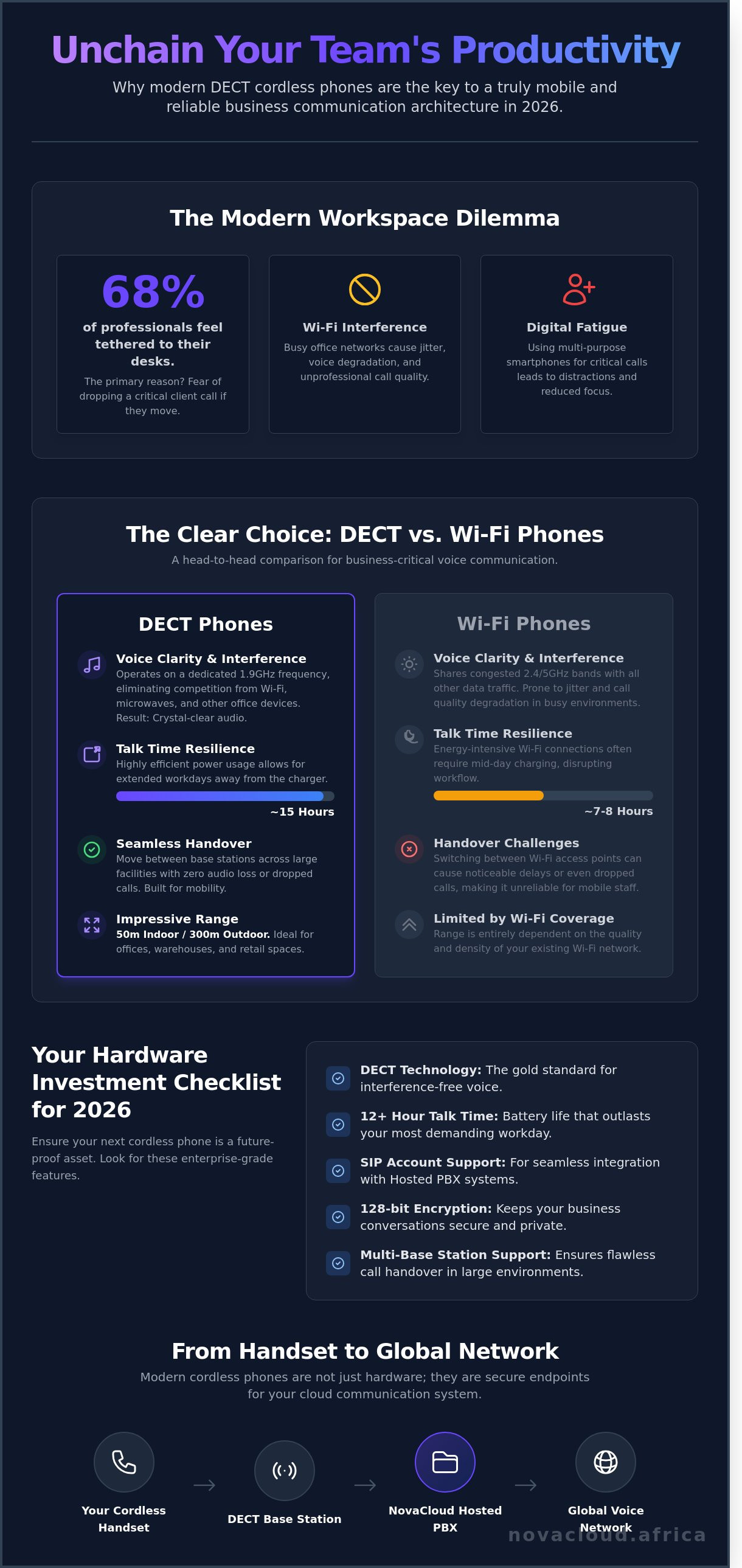
Digital Enhanced Cordless Telecommunications (DECT) serves as the invisible backbone of modern office mobility. By 2026, the standard has evolved to prioritize ultra-reliable low latency, ensuring that voice data moves with surgical precision. Unlike consumer-grade devices, professional cordless phones utilize a dedicated 1.9GHz frequency band. This isolation is critical. It means your voice traffic never competes with the heavy data loads of office laptops, printers, or microwave interference. In the context of a busy South African enterprise, this technical separation translates to zero dropped calls and zero jitter.
Security remains a non-negotiable priority for local firms handling sensitive client data. Modern DECT standards incorporate advanced 128-bit encryption, effectively turning every conversation into a private, secure tunnel. These devices are designed to meet strict digital security code requirements, preventing unauthorized eavesdropping or signal interception. In a standard office layout with concrete walls and glass partitions, you can expect a reliable range of 50 meters. In open environments like warehouses, this reach extends up to 300 meters from the base station.
DECT vs. Wi-Fi Phones: Which Should You Choose?
While Wi-Fi phones are versatile, they often struggle with the 2.4GHz and 5GHz congestion found in high-density business districts like Sandton or Umhlanga. DECT technology offers a superior "Seamless Handover" capability. As you move between different areas of the building, the handset transitions between base stations without a single millisecond of audio loss. This reliability is paired with exceptional battery efficiency. Because DECT requires less power to maintain a stable connection, handsets typically offer 15 hours of talk time. Wi-Fi models often require charging after just 7 or 8 hours due to the energy-intensive nature of constant network scanning.
Extending Your Reach with Repeaters
Eliminating "dead zones" in sprawling office complexes or multi-storey buildings requires a strategic approach to infrastructure. Repeaters serve as signal boosters, effectively doubling the coverage area of a single base station. For larger operations, we recommend moving toward multi-cell systems. These sophisticated networks allow up to 250 base stations to function as a single, unified grid. This architecture supports thousands of users and provides national-scale connectivity for campus-style environments. It represents a shift from simple hardware to a resilient, scalable communication ecosystem. If you are looking to enhance your team's mobility, you can browse our curated business-grade handset options to see how these systems integrate into your current workflow.
Key Features to Evaluate Before You Buy Your Next Handset
Selecting hardware for your business requires a lens that looks beyond basic communication. In the South African market, where operational resilience is paramount, the technical specifications of your cordless phones dictate your team's agility. You aren't just buying a handset; you're investing in a tool that bridges the gap between client needs and service delivery.
Battery performance remains the primary metric for mobile workforces. Professional models distinguish clearly between 'Talk Time' and 'Standby Time.' A high-tier handset should offer at least 18 hours of talk time and 200 hours of standby. This ensures that even during extended shifts in a Cape Town retail hub or a busy Durban warehouse, your connectivity remains unbroken. If a device fails mid-shift, the cost isn't just the price of the phone; it's the lost revenue from a missed enquiry.
SIP account support allows a single handset to manage multiple extensions or lines. This is vital for managers who oversee different departments. Most modern handsets support up to 8 concurrent SIP accounts, providing a scalable solution for growing teams. This flexibility is supported by DECT technology, which maintains crystal-clear audio without interference from local Wi-Fi networks or other wireless signals.
Build quality and audio clarity are the final pillars of a professional device. High-traffic environments require handsets with high-definition (HD) voice and noise-cancelling microphones. Ergonomics matter when a staff member holds a device for several hours a day. Look for handsets that balance weight with ruggedness, ensuring they survive the occasional drop on a warehouse floor.
Essential Display and Interface Features
Visual clarity speeds up call handling. Colour displays are now the standard for handsets managing complex directories, while monochrome screens are often reserved for basic utility roles to prioritize battery longevity. Intuitive menus with dedicated buttons for transfer, hold, and mute reduce employee training time. Syncing your company directory via cloud-hosted PBX systems ensures every employee has immediate access to 1,000+ contacts across the entire organization instantly.
Advanced Connectivity: Bluetooth and Headset Support
Hands-free operation is a necessity for administrative and support roles. While 3.5mm jacks offer simple reliability, Bluetooth headset compatibility provides the total mobility required for active staff. This allows a floor manager to assist customers while remaining available for urgent internal calls. For stationary desks where mobility isn't required, the Yealink T31P serves as a robust wired alternative. It maintains the same professional audio standards as your cordless phones but stays anchored to the workstation.
Top Cordless Phone Recommendations for 2026
Selecting the right hardware is a strategic decision that defines your team's daily workflow. Our 2026 collection focuses on devices that offer resilient architecture and seamless integration into the modern South African workspace. We've vetted these models based on their ability to handle high-density call environments while maintaining the clarity your business deserves. By 2026, 74% of hybrid workspaces in the region require hardware that bridges the gap between desk-bound stability and office-wide mobility.
The Motorola C1001 series remains a cornerstone for entry-level reliability. It's built for the small home office where space is at a premium but professional standards are non-negotiable. For larger, high-demand environments, enterprise-grade Yealink DECT solutions provide the transformative growth capabilities needed to manage multiple concurrent calls without signal degradation. Equipping a team becomes significantly more efficient with Duo and Trio sets. These configurations allow you to deploy three handsets across a 50-meter indoor radius while utilizing only one base station, reducing clutter and simplifying your technical execution.
Standout Models for Small Businesses
The Motorola T111+ is a top choice for value-seekers in the local market. It features an Eco Plus mode that reduces power consumption by 90% when the handset is in standby. This is a critical feature for businesses conscious of energy efficiency and operational costs. For those managing a small reception and a back-office, the Motorola C1002 Duo provides a synchronized system that ensures no lead goes unanswered. These cordless phones balance cost-effectiveness with essential business functions like caller ID and a 50-contact phonebook, ensuring your communication remains professional without overextending your budget.
High-Performance Options for Growing Teams
Industrial settings and workshops require a different level of durability. Ruggedized DECT handsets are now designed to withstand drops from 1.8 meters and resist dust ingress, making them vital for South African manufacturing hubs and warehouse environments. Modern professional units often feature large 2.4-inch colour screens and programmable soft keys that allow for one-touch transfers. You can discover the full range of cordless phones available now to find the specific fit for your infrastructure. Battery life on these 2026 models has improved by 25% compared to 2022 standards, with many units now offering 18 hours of talk time. These high-performance cordless phones empower your staff to move freely across the office floor while staying connected to your digital core.
Ready to upgrade your communication infrastructure with hardware built for the future? Explore our premium collection of business cordless phones.
Seamless Integration: Connecting Cordless Hardware to Your Cloud
Hardware is no longer a standalone purchase. It's an entry point into a resilient digital ecosystem. When you pair modern cordless phones with a Hosted PBX provider, you bridge the gap between physical mobility and cloud intelligence. This synergy allows a single business number to ring across multiple devices simultaneously. Your team can answer a call on a handset in a Durban warehouse and transfer it to a mobile app in Cape Town without a second of latency. It's a unified strategy that ensures your customers never hit a dead end, regardless of where your staff is standing.
Provisioning has evolved into a streamlined, automated process that respects your time. Modern systems utilize zero-touch deployment. This means your hardware arrives pre-configured for your specific network environment. You simply plug the base station into your router, and the system authenticates with the cloud automatically. It eliminates the need for expensive on-site technicians, often reducing initial setup costs by 35% to 45% compared to legacy on-premise installations. This scalable architecture ensures that as your South African enterprise grows, your voice network expands with a few clicks in a management dashboard. You aren't just buying phones; you're investing in a future-proof foundation.
The Power of NovaVoice Integration
NovaVoice transforms your hardware into a high-performance asset. By leveraging our cloud infrastructure, businesses gain access to high-availability voice services that remain resilient even during local network fluctuations. You can manage every extension through a centralized portal. This visibility allows for real-time updates, call routing changes, and instant reconfigurations. We've designed this infrastructure to empower local teams with global-standard reliability, ensuring your communication remains crystal clear during peak business hours.
Final Checklist for Your Purchase
Before finalizing your investment, ensure your environment is ready for 2026 connectivity standards. A quick audit now prevents technical bottlenecks later.
- Confirm your fiber connection provides at least 100kbps of dedicated upstream bandwidth for every concurrent call you expect to handle.
- Assess your floor plan to determine if DECT repeaters are necessary for full signal penetration in high-interference areas.
- Verify that your current router supports Quality of Service (QoS) settings to prioritize voice traffic over standard background data.
- Ensure the number of handsets accounts for a 15% growth margin in staff over the next eighteen months.
Voice over IP (VoIP) is the digital transmission of voice signals over the internet, serving as the primary driver for all 2026 business communication hardware.
Future-Proof Your Communication Strategy
The business landscape of 2026 demands more than basic connectivity. It requires a resilient architecture that supports your team across every square meter of your workspace. By prioritizing DECT 6.0 technology and seamless cloud integration, you ensure your communication remains crystal clear and free from the interference common in 2.4GHz Wi-Fi environments. Selecting high-performance cordless phones is a strategic investment in your company's digital transformation within the South African market. NovaCloud guarantees enterprise-grade voice quality and provides expert technical support for all hardware to keep your operations running smoothly. We provide reliable national delivery across all nine provinces, ensuring your team has the tools they need regardless of their location. This blend of local expertise and global standards creates a solid foundation for transformative growth. It's time to illuminate your business potential with hardware that works as hard as you do.
Upgrade your business mobility and browse our Cordless Phone collection today
Your journey toward a more agile and connected future is ready to begin, and we are here to ensure your transition is seamless and successful.
Frequently Asked Questions
Do cordless phones work during load shedding in South Africa?
Standard cordless phones won't work during load shedding because the base station requires a constant 230V power supply. To maintain connectivity during Stage 4 or Stage 6 outages, you'll need a mini UPS priced between R500 and R1,200 to power your router and phone base. This setup ensures your communication remains resilient. It's a vital step for any South African business seeking uninterrupted growth in a challenging energy landscape.
Can I use a cordless phone with my existing fibre internet connection?
You can use your cordless phones with a fibre connection by utilizing a VoIP-enabled base station or an Analogue Telephone Adapter. Modern IP-DECT systems plug directly into your router via an Ethernet cable for seamless integration into your digital infrastructure. This setup transforms your traditional voice setup into a high-speed, cloud-ready communication tool. It allows for clearer calls and more reliable connections across your entire office layout.
What is the typical range of a DECT cordless phone indoors?
A standard DECT cordless phone offers an indoor range of 50 metres and an outdoor reach of 300 metres. Physical barriers like 230mm brick walls can reduce this distance by up to 50% in older South African office buildings. If your workspace spans multiple floors, adding DECT repeaters can effectively double your coverage area. This ensures every corner of your business stays connected to your central communication network.
Is it possible to connect multiple handsets to a single base station?
Most professional base stations allow you to register 6 or 8 handsets to a single unit. High-end multicell systems can support 250 individual handsets across a larger corporate campus. This scalability is perfect for growing South African enterprises that need to add new staff members without installing extra copper wiring. It creates a unified environment that adapts to your team's needs while maintaining a professional image.
How do I ensure the best call quality on my cordless VoIP phone?
Ensuring the best call quality requires configuring Quality of Service settings on your router to prioritize voice packets. You should allocate at least 100kbps of bandwidth for every simultaneous call to prevent audio jitter or dropped packets. High-definition voice codecs like G.722 provide the clarity your business needs for professional interactions. This technological precision brings a new level of illumination to your daily client conversations and internal meetings.
Are cordless phones secure enough for sensitive business calls?
Cordless phones using modern DECT technology are highly secure because they utilize 128-bit digital encryption and constant frequency hopping. This makes it nearly impossible for outside parties to eavesdrop on your calls compared to older 2.4GHz analog models. Your sensitive data remains protected within a resilient architecture designed for the 2026 business environment. Our local expertise ensures your digital transformation remains safe from common external security threats.
