


Symmetrical Fibre: The Strategic Business Guide to Modern Connectivity in 2026

Is your business still running on a connection that prioritises streaming entertainment over your critical cloud backups? While the 2024 ICASA State of the ICT Sector report highlights a massive surge in local data usage, many firms remain throttled by the legacy of asymmetrical home fibre packages. You've likely felt the frustration of choppy video conferencing or cloud backup windows that bleed into the next business day. It's an exhausting cycle that limits your team's output and stalls your digital growth.
We're here to change that narrative. This guide demonstrates how symmetrical fibre speeds provide the foundational architecture needed for seamless cloud integration and reliable VoIP communication. You'll discover how synchronised upload and download capabilities eliminate the latency that currently plagues modern South African enterprises. We'll outline the strategic steps to future-proof your connectivity, ensuring your infrastructure is ready for the demands of 2026. This is your opportunity to start a new chapter in business efficiency with a resilient network built specifically for the unique needs of the African market.
Key Takeaways
- Understand why legacy asymmetrical models are becoming obsolete and how equal upload speeds provide the foundation for scalable business growth in 2026.
- Discover how symmetrical fibre eliminates the "productivity tax" by enabling seamless cloud integration and rapid data transfers across your South African operations.
- Learn to empower your hybrid workforce with resilient architecture that ensures lag-free VPN access and high-performance digital collaboration.
- Evaluate the total cost of ownership beyond monthly fees to identify how high-speed connectivity drives transformative efficiency and digital resilience.
- Gain clarity on navigating the local infrastructure landscape with strategic insights tailored to the unique demands and opportunities of the South African market.
The Evolution of Connectivity: What is Symmetrical Fibre?
The South African digital landscape has shifted. We've moved past the era of passive consumption where businesses merely browsed the web. In the early 2000s, ADSL was the gold standard because most users only needed to pull data down from the internet. Today, your business is a creator, a broadcaster, and a cloud-native entity. Symmetrical fibre represents the end of the digital bottleneck. It provides a balanced architecture where your output matches your input. This isn't just a technical upgrade; it's the illumination of your company's full potential in a competitive market.
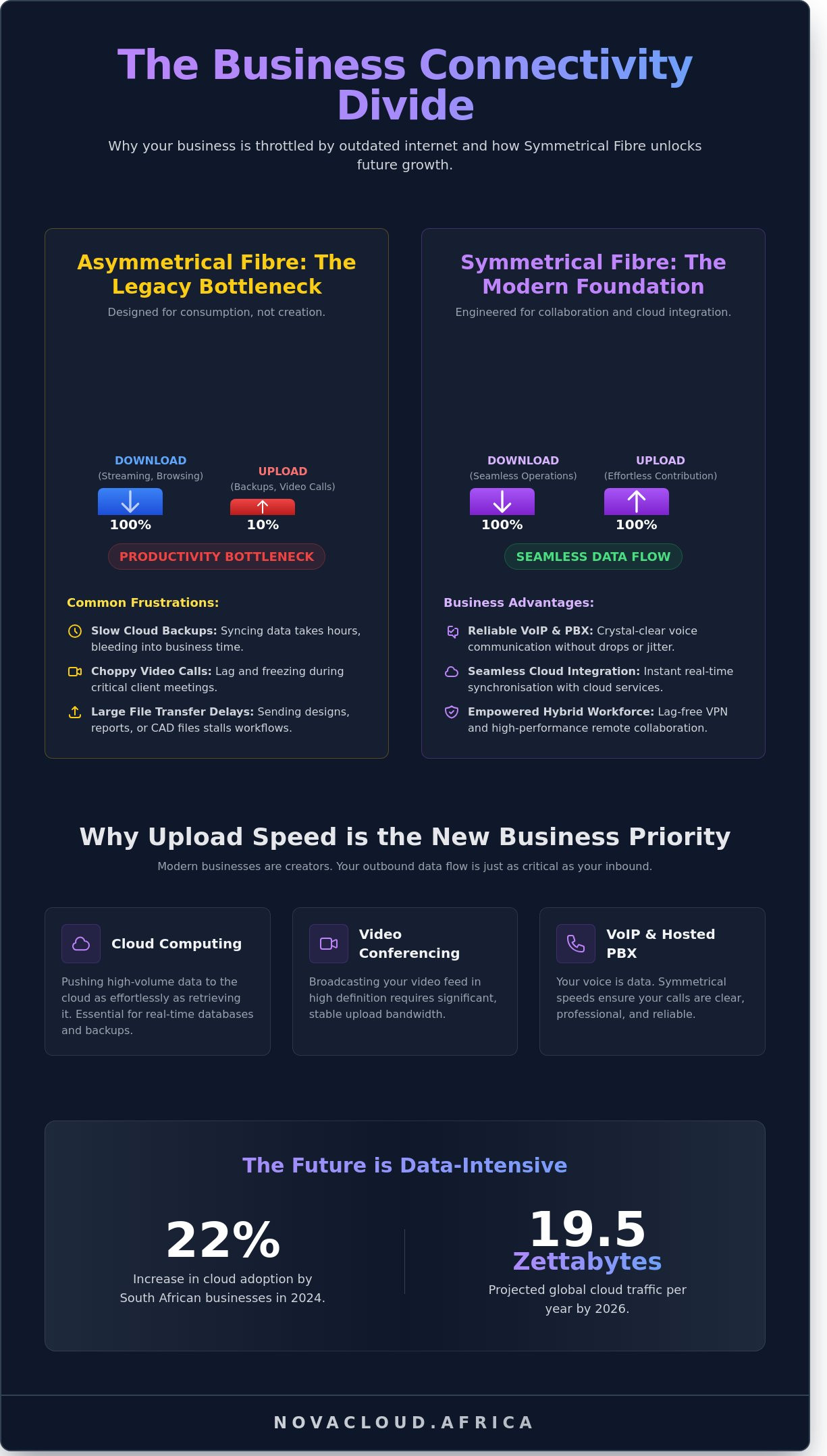
NovaCloud Africa views connectivity as the heartbeat of modern enterprise. While consumer-grade fibre often prioritizes download speeds for streaming and browsing, business-grade symmetrical fibre focuses on the integrity of the entire data lifecycle. By 2026, global cloud traffic is projected to reach 19.5 zettabytes per year. South African companies that continue to rely on asymmetrical models will struggle to maintain pace with this data explosion. Symmetrical connectivity ensures your team can push high-volume data to the cloud as effortlessly as they retrieve it.
Upload vs. Download: The Great Imbalance
Data flow is a two-way street. Downloading is the act of pulling information from the web, like opening an email or watching a training video. Uploading is the act of pushing information out, such as sending large CAD files, hosting a hosted PBX video conference, or syncing local databases to the cloud. Many standard connections in South Africa still use a 100/10 Mbps ratio, meaning your upload speed is a mere 10% of your download capacity. This creates a hidden bottleneck that stifles productivity and causes lag during critical client presentations.
- Asymmetrical links (like ADSL or LTE) often have upload speeds that are 5 to 10 times slower than download speeds.
- Symmetrical fibre is the parity of data transfer rates.
- Equal speeds prevent "buffer bloat," where heavy uploads cause your entire network to crawl.
The Infrastructure Behind the Speed
The secret lies in the medium. Fibre optics transmit data as pulses of light through glass strands thinner than a human hair. Unlike legacy copper cables, which suffer from electrical interference and signal decay over short distances, light travels with minimal loss. This resilient architecture allows for massive bandwidth in both directions simultaneously. The Optical Network Terminal (ONT) installed at your premises acts as the strategic gateway, managing these light signals to ensure that your 200Mbps upload is just as stable as your 200Mbps download.
Copper-based solutions simply can't match this level of performance. In 2024, the South African business sector saw a 22% increase in cloud adoption, making upload speeds a critical performance indicator for any growing firm. Choosing symmetrical fibre isn't just about speed; it's about providing your business with a foundation for seamless integration and transformative growth. It’s time to move away from the restrictive shadows of legacy tech and into the clarity of a high-performance connection.
The Mechanics of Modern Speed: Why Uploading is the New Priority
By 2026, the digital economy has shifted from a model of passive consumption to one of active, high-volume production. South African businesses are no longer just downloading information; they're broadcasting high-resolution media, managing massive real-time databases, and running complex simulations in the cloud. This transition makes symmetrical fibre the essential foundation for any modern operation. Most legacy connections focus heavily on download speeds, but this creates a massive bottleneck for any business that produces data. The 2024 update to FCC broadband speed benchmarks recognized this shift by significantly raising the minimum upload standards to ensure networks can handle modern demands. High-performance high-performance cloud infrastructure requires these robust upload pipes to function at peak efficiency. Without them, your outbound traffic becomes a digital traffic jam that stalls your entire workflow and limits your growth potential.
Cloud Computing and Real-Time Synchronisation
The cloud is no longer just a storage locker; it's a live, collaborative work environment. Whether your strategic choice involves Microsoft 365 vs Google Workspace, the speed of every "save" is determined by your upload capacity. When teams collaborate on a single document or a 100MB architectural render, "sync lag" becomes a major friction point. If the connection is weak, changes don't propagate in real-time, leading to duplicated work and frustrating version errors. Symmetrical connectivity ensures that data flows in both directions with equal force. It transforms the cloud from a distant server into a local-feeling resource that empowers your staff to move with agility and confidence.
VoIP and Unified Communications
Communication failures in the modern office often stem from a lack of outbound bandwidth. When your voice sounds robotic or your video freezes during a Zoom or Teams meeting, it's rarely because you can't see the other person; it's because they can't see or hear you. High-definition video conferencing demands a consistent, high-speed stream of data leaving your office to maintain 1080p or 4K clarity. For businesses relying on Hosted PBX systems, symmetry provides the dedicated headroom needed to eliminate jitter and packet loss. This stability is vital for maintaining a professional image with global partners and local clients alike. Ensuring your connection is balanced is a simple way to audit your connectivity requirements and secure your professional digital presence. It's a technical upgrade that translates directly into better relationships and clearer collaboration.
Symmetrical vs. Asymmetrical: A Strategic Business Framework
Smart leadership views connectivity as a strategic asset rather than a monthly utility expense. When you evaluate the total cost of ownership (TCO), the subscription fee is only the surface level of the investment. True costs emerge in the "productivity tax" paid every time a senior staff member earning R45,000 a month waits fifteen minutes for a 2GB project file to sync to the cloud. Over a fiscal year, these micro-delays aggregate into thousands of Rands in lost billable time and stalled momentum.
Choosing symmetrical fibre is a vital move for risk mitigation. Asymmetrical lines frequently fail during peak business hours, specifically the 10:00 to 14:00 window when South African corporate activity is at its highest. These lines prioritize downloads, meaning your outgoing data, like video streams or cloud backups, gets throttled. This imbalance creates a bottleneck that can crash critical VoIP systems or disconnect remote desktop sessions. High-performance symmetry acts as a catalyst for regional empowerment, providing local businesses with the technological parity required to compete in global markets.
The Consumer Fibre Trap for SMEs
Many small enterprises fall into the trap of utilizing residential "best effort" lines to trim overheads. These packages are governed by high contention ratios, often reaching 1:20 or higher. You're effectively sharing your bandwidth with twenty other households. When the neighborhood starts streaming 4K content in the afternoon, your business performance suffers. It's a clear signal that you've outgrown your fixed wireless internet or home-grade fibre when your upload speeds drop to single digits during a board meeting. Business-grade solutions offer lower contention and guaranteed throughput, ensuring your digital architecture remains resilient under pressure.
Scalable Solutions for Growing Enterprises
Future-proofing your infrastructure requires a shift in how you perceive capacity. A 50/50 Mbps line is objectively more valuable to a modern office than a 100/20 Mbps line. This is because modern workflows are inherently circular; we pull data down, edit it, and push it back up. If the return path is narrow, the entire cycle breaks. Symmetrical packages allow for seamless upgrades as your team expands across different South African provinces. You can scale your capacity through software-defined adjustments without the need for intrusive hardware changes. Scalability in 2026 is defined by bandwidth symmetry. This balanced approach ensures that your connectivity remains a silent partner in your growth, providing the quiet confidence that your cloud-based tools will always perform at peak efficiency.
Critical Use Cases: Where Symmetrical Speeds Drive Growth
Business growth isn't just about how fast you receive data; it's about how quickly you can project your value to the world. Symmetrical fibre transforms connectivity from a basic utility into a strategic asset. For South African enterprises aiming to compete globally, the ability to push data out as fast as it comes in is a non-negotiable requirement for modern operations.
Remote work and VPN stability provide the first major test for any connection. Encrypted tunnels add significant overhead to data packets, often slowing down standard connections. When your workforce uses symmetrical fibre, these tunnels remain wide and responsive. This ensures that remote team members can access central servers and applications with the same fluidity as those in the main office. It eliminates the lag that typically frustrates hybrid teams and kills billable hours.
Large file transfers represent another critical bottleneck. Creative agencies handling 4K video exports or engineering firms sharing massive BIM models can't afford to wait. On a standard asymmetrical line, a 5GB architectural render might take 40 minutes to upload. With a 200Mbps symmetrical connection, that same file reaches the client in under 4 minutes. This speed allows for faster iteration cycles and more responsive service delivery.
Offsite Backups and Disaster Recovery
Your Recovery Point Objective (RPO) is directly tied to your upload capacity. If your daily backup takes 14 hours to complete because of throttled upload speeds, your data is never truly current. This creates a massive gap in your security posture. Symmetrical fibre ensures that offsite redundancy happens in real-time or within tight scheduled windows. This keeps your business fully compliant with POPIA regulations and ensures that if ransomware strikes, your most recent data is ready for immediate restoration.
The Multi-User Office Environment
Internal bandwidth contention is the silent killer of office productivity. When 25 staff members jump on simultaneous HD video calls, asymmetrical lines often buckle under the pressure. High-quality hosted pbx providers require consistent, low-latency upload to prevent jitter and dropped calls. Symmetrical speeds provide the necessary headroom for voice, video, and cloud applications to coexist without friction. It ensures that your storefront remains responsive for international customers, regardless of how much internal traffic your team generates.
Ready to illuminate your business potential with resilient architecture? Explore our scalable fibre solutions today.
Navigating the Digital Frontier with NovaCloud Africa
Connectivity isn't just a utility; it's the foundation of your digital presence. At NovaCloud Africa, our philosophy centers on the "Nova" concept, representing a bright beginning for companies emerging from the limitations of legacy systems. We bring clarity to the South African infrastructure landscape, where a 2023 industry report highlighted that 45% of businesses still struggle with inconsistent upload speeds. Navigating local terrain requires more than just a map. It requires local expertise and a deep commitment to regional empowerment. We act as the Innovative Architect for your business, designing bespoke connectivity that aligns with your specific mission.
Our approach extends beyond providing a simple line. We integrate robust security and resilience into every build. By combining symmetrical fibre with managed firewalls and secure cloud backups, we ensure your data is both fast and protected. South African enterprises often face unique challenges, from power instability to physical infrastructure risks. We build resilient architectures that account for these variables, ensuring your growth remains uninterrupted. This creates a digital ecosystem where speed and security coexist, allowing your team to focus on innovation rather than troubleshooting.
Business-Grade Reliability and Support
We provide Service Level Agreements (SLAs) that guarantee 99.9% uptime and consistent symmetry. This isn't just a promise; it's a technical standard we uphold through proactive monitoring. Our systems identify potential issues before they impact your daily operations, allowing us to resolve bottlenecks in real time. You'll also receive expert IT assistance to ensure your internal hardware, such as routers and switches, actually matches your line speed. This prevents high-speed lines from being throttled by outdated office equipment, ensuring you get the full value of your investment.
Starting Your New Chapter in Efficiency
The transition from asymmetrical to symmetrical fibre is a seamless process with the right ally. We begin by helping you audit your current network to identify hidden bottlenecks that slow down your team. This data-driven approach ensures your new infrastructure delivers immediate ROI. We've seen businesses reduce file transfer times by 60% after making the switch, drastically improving collaborative workflows. It's about more than speed; it's about removing the friction that holds your talent back.
Partner with a strategic ally ready to lead your digital transformation. Let's build a resilient, high-speed future for your business today. Contact NovaCloud Africa to start your new chapter in operational efficiency.
Illuminating the Path to 2026 Connectivity
The digital landscape of 2026 demands more than basic connectivity. It requires a resilient foundation where upload and download speeds are perfectly balanced. We've explored how symmetrical fibre transforms latency-sensitive operations into seamless workflows. By prioritizing upload capacity, your business isn't just keeping pace; it's leading. Research from the World Bank indicates that a 10% increase in broadband penetration can drive GDP growth by up to 1.38% in emerging markets. Your infrastructure is the primary catalyst for this transformation.
NovaCloud Africa bridges the gap between global technological standards and local market nuances. Our enterprise-grade SLAs ensure your operations never skip a beat, providing the reliability modern enterprises demand. You'll have direct access to our local South African support desk, staffed by experts who understand our regional business environment. We've engineered a resilient cloud-integrated architecture designed to scale alongside your ambitions. It's time to move beyond legacy limitations and start a new chapter of business efficiency.
Empower your business with a Symmetrical Fibre solution from NovaCloud Africa
The future of South African enterprise is bright, and we're ready to help you navigate it with confidence and clarity.
Frequently Asked Questions
Is symmetrical fibre really necessary for a small business with only 5 employees?
Yes, it's essential for modern productivity even in small teams. Five employees using cloud-based tools like Microsoft 365, Zoom, or Xero simultaneously can easily saturate a standard upload link. Symmetrical fibre ensures that file backups and video calls don't compete for limited bandwidth, preventing the digital bottlenecks that often stall growth in South African startups.
Can I get symmetrical speeds on a standard residential fibre line?
Most residential fibre packages in South Africa are asymmetrical, prioritising download speeds over uploads. While some niche Fibre-to-the-Home providers offer 1:1 ratios, they don't include the business-grade Service Level Agreements (SLAs) required for professional uptime. A dedicated business line provides the resilient architecture needed for commercial operations rather than just home entertainment.
How does symmetrical fibre improve the quality of my VoIP and Hosted PBX calls?
Symmetrical fibre eliminates the packet loss and jitter that cause dropped words or robotic audio during voice calls. Because voice data travels in both directions, having equal upload and download capacity ensures clear, bidirectional communication. This stability is vital for Hosted PBX systems where 99.9% uptime and low latency are the benchmarks for professional client engagement.
What is the difference between a symmetrical line and a dedicated internet access (DIA) line?
Symmetrical fibre refers to having equal upload and download speeds, while Dedicated Internet Access means your bandwidth isn't shared with other users. A symmetrical line can still be "contended" or shared at the local exchange with other businesses. In contrast, a DIA line offers a private lane with a 1:1 contention ratio, providing the most stable connection possible for large enterprises.
Will switching to symmetrical fibre reduce my latency for cloud-based applications?
Switching to a symmetrical connection significantly reduces the queuing delay often found on asymmetrical lines. When your upload pipe is narrow, data packets get stuck in a backlog, which can increase latency to 150ms or more. Symmetrical fibre clears this congestion, allowing your cloud applications to respond instantly. This transformative growth in speed ensures your team stays productive without lagging software.
What happens to my symmetrical speeds during load shedding or power outages?
Your symmetrical speeds remain constant during load shedding, provided your onsite router and the local fibre node have power. Most South African infrastructure providers maintain 4 to 12 hours of battery backup at their primary exchanges. By installing a small Uninterruptible Power Supply (UPS) at your office, you can maintain your high-speed connection through Stage 6 outages, ensuring your digital infrastructure remains resilient.
How much more expensive is symmetrical business fibre compared to home fibre?
Business-grade symmetrical fibre typically costs 25% to 40% more than standard residential packages. This price difference covers the cost of static IP addresses, symmetrical speeds, and priority support response times. While a home line might cost R900 per month, a comparable business line offers the guaranteed performance and uptime that justify the investment as a strategic business asset.
Can I use my existing router for a symmetrical fibre connection?
You can use your existing router only if its WAN port and internal processor support your specific line speed. Many older routers are capped at 100Mbps or struggle to manage the high-volume traffic of a symmetrical connection. To achieve seamless integration, we recommend using a gigabit-capable router. This ensures your hardware doesn't become a bottleneck, allowing you to fully harness the power of your fibre.
