


How to Calculate the Cost of IT Downtime for Small Business: A 2026 Strategic Guide

What if the "budget-friendly" server hosting your critical data is actually costing your business R25,000 for every hour it stays offline? According to 2024 industry data, 42% of South African SMEs report that a single hour of system failure results in losses exceeding R20,000. You've likely felt the sting of a quiet office where employees sit idle and digital storefronts remain dark. Mastering how to calculate cost of IT downtime for small business is no longer just a technical exercise. It's a vital survival skill for entrepreneurs navigating the continent's digital frontier.
We'll help you move beyond the frustration of unpredictable outages to master the exact formulas and hidden variables needed to quantify the financial impact of technical failures. This guide provides the strategic clarity required to justify investments in resilient cloud architecture or high-availability backups. We'll explore everything from immediate labor costs to the long-term erosion of customer trust. By the end, you'll have a precise Rand-value figure that empowers you to build a bulletproof business case for a proactive IT strategy that secures your peace of mind and fuels your growth.
Key Takeaways
- Master the precise variables of productivity loss and revenue gaps to understand how to calculate cost of IT downtime for small business with Rands-and-cents accuracy.
- Uncover the "invisible" financial drain of reputational erosion and employee burnout that lingers long after your systems are back online.
- Navigate unique South African infrastructure challenges, identifying how load shedding and connectivity quality directly impact your bottom line.
- Redefine your risk by learning why degraded system performance can be just as costly as a total blackout in the 2026 digital landscape.
- Shift from reactive fixes to resilient growth by turning your downtime data into a high-performance cloud and VPS strategy.
Defining IT Downtime in the Era of Digital Transformation
Digital transformation has redefined the boundaries of the traditional office. For a modern South African SME, downtime no longer simply means a server room in the basement has gone dark. It represents any period where business-critical systems are unavailable or unable to perform their intended functions. When Defining IT Downtime, we must look beyond total blackouts. We now include periods of degraded performance where slow response times cripple productivity as effectively as a complete crash.
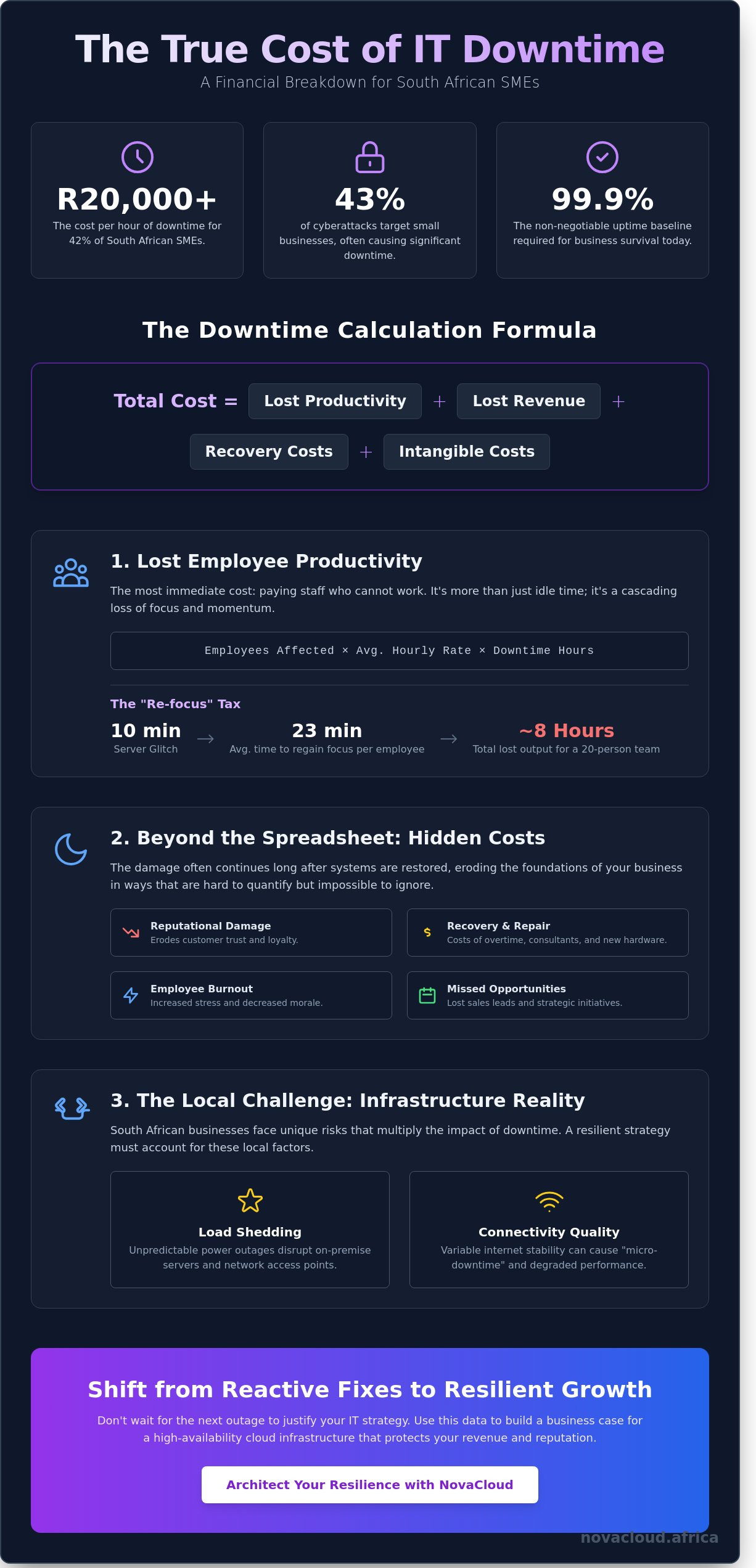
The standard for resilience has shifted. Local businesses now view 99.9% uptime as the non-negotiable baseline for survival. In a market where 43% of cyberattacks target small businesses, according to recent security industry reports, every minute of system instability creates a vulnerability. Understanding these nuances is the first step in learning how to calculate cost of IT downtime for small business operations accurately. It isn't just about the clock stopping; it's about the momentum you lose while your competitors move forward.
Unplanned vs. Planned: The Hidden Revenue Gap
Not all downtime is created equal, but every second carries a price tag. Planned maintenance is essential for security and longevity. It's a strategic pause. However, if handled poorly, it disrupts the flow of commerce and frustrates your workforce. Unplanned outages are far more destructive. They trigger a cascading effect on customer trust that can take months to repair. In the competitive South African landscape of 2026, downtime is the silent thief of SME growth. Even a brief disconnect from cloud infrastructure can halt revenue generation instantly.
The Anatomy of an Outage: What Systems Matter Most?
To master how to calculate cost of IT downtime for small business, you have to identify which layers of your stack are most fragile. The impact varies depending on the system affected:
- Core Infrastructure: Loss of access to cloud backups or primary servers stops data processing and historical record retrieval.
- Communication Layers: If Hosted PBX or VoIP services fail, your sales team loses its voice and your customers lose their lifeline.
- Productivity Tools: Outages in Microsoft 365 or collaborative ecosystems stall project timelines and internal synergy.
A 2024 study indicated that South African SMEs lose an average of R15,000 per hour during unplanned outages. This figure accounts for lost labor, missed opportunities, and the technical cost of recovery. By viewing your digital architecture as an interconnected ecosystem, you can begin to build the resilient architecture needed for transformative growth. You aren't just fixing IT; you're protecting your potential.
The Step-by-Step Formula to Calculate Downtime Costs
Understanding how to calculate cost of IT downtime for small business operations requires moving beyond guesswork. It demands a clinical look at your balance sheet. To build an accurate picture, you must first gather your baseline data: your average hourly revenue and your total employee wage overhead. When systems fail, these numbers stop being abstract targets and start becoming active losses. We view this calculation as a diagnostic tool that reveals the true health of your digital resilience.
Step 1: Quantifying Lost Employee Productivity
The most immediate impact of a system failure is the sudden paralysis of your workforce. You can calculate this by multiplying the number of affected staff by their average hourly rate, then adjusting for their percentage of dependency on the system. If your team can't access their primary tools, productivity doesn't just dip; it vanishes while the payroll clock continues to tick.
- The Latency Tax: Partial downtime, such as slow internet or lagging applications, often costs more than a total crash. While a total outage is obvious, "micro-downtime" bleeds resources slowly over weeks, creating a massive cumulative loss in billable hours.
- The Re-focus Period: Systems coming back online doesn't mean work resumes instantly. Research suggests it takes employees an average of 23 minutes to regain deep focus after a technical interruption. In a South African office of 20 people, a simple 10-minute server glitch can actually cost the business nearly 8 hours of collective cognitive output.
Step 2: Measuring Direct and Potential Revenue Loss
Revenue loss is the most visible scar left by IT instability. Start by calculating your hourly gross profit to see the immediate hit to your bottom line. However, the "lost opportunity" cost is frequently the more damaging metric. These are the leads that never called back because your lines were dead or the customers who abandoned their carts because the gateway timed out.
In the local market, customer loyalty is hard-won but easily lost. If a potential client tries to reach you and finds a dead line, they will simply move to the next name on their list. This is why many South African firms are evaluating Hosted PBX providers in South Africa to ensure their communication remains cloud-resilient even when the local office network fails.
The Final Equation: To find your true total, use this structure: (Labor Costs + Revenue Loss + Recovery Expenses + Intangibles) = Total Cost of Downtime. Recovery expenses must include emergency IT call-out fees, which often range from R1,500 to R3,500 per hour for urgent on-site support, and the cost of expedited hardware replacements. By identifying these figures, you can begin to build a resilient cloud infrastructure that protects your margins from the unexpected.
Quantifying these variables allows you to treat IT security not as a cost center, but as an insurance policy for your continuity. Knowing exactly how to calculate cost of IT downtime for small business needs empowers you to make strategic investments that fuel long-term growth rather than just patching holes in a sinking ship.
Beyond the Spreadsheet: Hidden Costs and Long-Term Damage
Calculating the immediate loss of revenue is just the starting point for any resilient enterprise. When you analyze how to calculate cost of IT downtime for small business, you'll find that the most devastating impacts aren't always visible on a Monday morning balance sheet. They're felt in the slow erosion of trust and the quiet exhaustion of your most talented people. These secondary effects ripple through your organization, often surfacing months after the technical issues are resolved.
Brand Equity and Customer Churn
Trust is the hardest currency to earn and the easiest to spend. Brand reputation is the most fragile asset in the digital cloud. In the South African market, where competition is fierce and consumer patience is thin, a single public-facing outage can drive your loyal base straight to a competitor. Research from PwC indicates that 32% of customers will walk away from a brand they love after just one bad experience. The cost of customer acquisition is generally 5 to 25 times more expensive than retention. When your systems go dark, you aren't just losing a transaction; you're potentially forfeiting the lifetime value of that relationship.
Compliance Penalties and Data Integrity
Operational uptime and legal safety are now inseparable. Under the Protection of Personal Information Act (POPIA), South African businesses face rigorous standards for data accessibility and protection. An outage caused by a security breach or a system failure can lead to significant legal ramifications, including fines reaching up to R10 million or even imprisonment. Implementing Cloud backups and Managed Firewalls isn't just a technical choice; it's a strategic shield. This resilient architecture ensures that your client data remains intact and accessible, mitigating the financial risk of data corruption or regulatory non-compliance.
The "Employee Morale Tax" is another invisible drain on your resources. Technical chaos breeds burnout. When systems fail, your staff must manage the fallout through manual workarounds and heightened customer frustration. This stress leads to a documented 20% drop in productivity in the weeks following a major incident. Furthermore, the physical cost of hardware failure shouldn't be ignored. Replacing legacy on-prem servers or damaged Yealink IP phones creates an immediate capital expenditure burden. These unexpected costs often force small businesses to divert funds away from growth initiatives just to restore the status quo. By shifting to a cloud-centric model, you transform these volatile risks into a predictable, scalable foundation for future expansion.
Benchmarking Your Risk: Local Infrastructure and Market Factors
Small businesses in South Africa face a unique set of hurdles that global calculators often miss. Understanding how to calculate cost of IT downtime for small business requires a deep dive into our local infrastructure. Load shedding isn't just an inconvenience; it's a financial drain that directly impacts your Mean Time to Recovery (MTTR). When the grid fails, your on-premise hardware is only as resilient as your backup power solution.
Resiliency in the Face of Local Power Challenges
Traditional on-site hardware requires expensive UPS systems and diesel generators to stay operational. A 40kVA generator can cost upwards of R200,000 upfront, excluding the rising price of fuel and regular maintenance. Migrating to Virtual Private Servers shifts this burden to a resilient data centre environment. These facilities maintain Tier 3 standards, ensuring 99.982% uptime regardless of municipal power status. This move makes your core operations power-neutral, allowing your team to remain productive from any location with a stable connection.
The Connectivity Bottleneck
Not all fibre is created equal. Consumer-grade links often have asymmetrical speeds, where upload is significantly slower than download. This creates a massive bottleneck during large data syncs or cloud backups. Business Fibre offers symmetrical speeds and strict Service Level Agreements (SLAs) that guarantee uptime. Redundancy is no longer optional. Having a secondary microwave or LTE backup link prevents total isolation when a physical line is cut. During periods of low bandwidth, platforms like Microsoft 365 often outperform Google Workspace because of superior offline sync capabilities, keeping your workflow moving even when the connection stutters.
Industry-specific benchmarks reveal the true scale of the risk:
- Retail: Losses often exceed R15,000 per hour due to missed transactions and point-of-sale failures.
- Manufacturing: Idle labor and machine restart cycles can push costs beyond R30,000 per hour.
- Professional Services: Beyond the R5,000 per hour in lost billable time per senior consultant, the reputational damage is often permanent.
By 2026, the global standard for MTTR is expected to drop below 15 minutes for critical systems. South African SMEs still averaging four to six hours of recovery time are falling behind international competitors. Evaluating your current recovery speed against these upcoming benchmarks is essential for long-term survival. Modernizing your stack isn't just about speed; it's about building a foundation that survives the local context.
Ready to harden your infrastructure against local risks? Explore resilient cloud solutions with NovaCloud Africa
Architecting Resilience: Turning Cost Analysis into Cloud Strategy
Stop fixing what breaks. Start building what lasts. Moving from a reactive "break-fix" model to a proactive cloud architecture isn't just a technical upgrade; it's a financial safeguard. When you understand how to calculate cost of IT downtime for small business, the investment in high-performance infrastructure becomes a logical necessity rather than a luxury. You're no longer spending money to solve a crisis; you're investing in the continuity of your operations.
The shift to a resilient cloud strategy allows your business to scale without the weight of legacy hardware. By consolidating your stack with Managed IT assistance, you eliminate the silos that often lead to system failures. This integrated approach ensures that as your business grows across South Africa, your digital foundation remains stable and secure. It's about creating a system where growth is seamless and downtime is a relic of the past.
Investing in High-Availability Infrastructure
Consider the math of modern business. A single hour of downtime for a South African SME can cost anywhere from R15,000 to R100,000 depending on transaction volume and staff idle time. In contrast, the monthly commitment for a NovaCloud VPS is a tiny fraction of that single hour's loss. High-availability systems ensure that if one node fails, another takes over instantly. This level of resilience is bolstered by Managed Firewalls and FortiNet security, creating a perimeter that protects your revenue and your reputation. We call this building a "Nova", which is a bright, clear path toward digital maturity where your infrastructure empowers growth instead of limiting it.
- Automated cloud backups: These systems slash your Recovery Time Objective (RTO) by ensuring data is always available for immediate restoration.
- Managed Security: FortiNet integration provides enterprise-grade protection that smaller firms previously couldn't access.
- Scalable Resources: Adjust your computing power based on real-time demand to optimize costs.
Next Steps: Your Resilience Audit
Knowledge is power, but action is protection. Start by reviewing your current Service Level Agreement (SLA) with your IT provider. Does it guarantee uptime with financial penalties, or does it just promise to try? You must test your backup restoration speed before a crisis hits. Don't wait for a server failure to find out your backups take 12 hours to mount. If you're still refining how to calculate cost of IT downtime for small business for your specific niche, it's time for a professional assessment of your risk profile.
Your digital transformation deserves a partner that understands the local landscape and global standards. Partner with NovaCloud Africa to architect a zero-downtime future. We'll help you move beyond the fear of failure and toward a strategy of permanent availability.
Turn Your Downtime Risk Into a Competitive Edge
Understanding how to calculate cost of IT downtime for small business is the first step toward true operational sovereignty. When a single hour of system failure can cost South African SMEs upwards of R15,000 in lost productivity and missed opportunities, the math becomes a mandate for change. You've seen that resilience isn't a luxury; it's a strategic pillar. By moving from reactive fixes to a proactive cloud strategy, you protect your reputation and your bottom line.
NovaCloud bridges the gap between global standards and local reality. Our South African local expertise ensures your data stays close to home, while our scalable high-performance VPS architecture provides the speed your growth demands. We integrate Acronis-powered secure cloud backups to ensure that even in the face of local infrastructure challenges, your business remains illuminated. Don't let a technical glitch dictate your trajectory. It's time to build a foundation that scales as fast as your ambition.
Secure your business with NovaCloud’s resilient cloud infrastructure
Frequently Asked Questions
How do I calculate IT downtime cost if my business doesn't sell products online?
You calculate downtime by multiplying the hourly wage of affected employees by the duration of the outage. For a small business with 10 staff earning an average of R150 per hour, a four-hour outage costs R6,000 in lost productivity alone. Understanding how to calculate cost of IT downtime for small business involves looking at these internal operational costs plus fixed overheads like rent and utilities that continue even when systems are dark.
What is a 'reasonable' amount of downtime for a small business in 2026?
A reasonable target for 2026 is 99.9% uptime, which limits your total downtime to roughly 8.77 hours per year. Modern South African enterprises are increasingly moving toward 99.99% availability, which reduces annual outages to just 52 minutes. In a digital-first economy, anything less than 99.9% risks damaging your brand reputation and losing local market share to more resilient, cloud-enabled competitors.
Is cloud hosting really more reliable than having a server in my office?
Cloud hosting provides superior reliability because it utilizes redundant data centers instead of a single physical server in your office. On-premise hardware remains vulnerable to local power surges, hardware failure, or physical theft. By contrast, cloud providers offer 99.95% service level agreements. This resilient architecture ensures your digital assets remain accessible even if your physical office faces a disruption or a localized power outage.
Can a Hosted PBX system work during a local internet outage?
A Hosted PBX system continues to function during local outages by automatically rerouting incoming calls to mobile apps or secondary locations. Since the system's core infrastructure lives in the cloud, your customers won't hear a busy signal. You can maintain seamless communication through 4G or 5G backups. This ensures your business stays connected to the South African market regardless of local fiber cuts or infrastructure issues.
What is the difference between RTO and RPO in downtime planning?
Recovery Time Objective (RTO) is the target duration for restoring systems, while Recovery Point Objective (RPO) defines the maximum age of data you're willing to lose. If your RTO is two hours, you aim to be back online within that window. If your RPO is four hours, you accept losing up to four hours of work. Balancing these metrics is vital when you determine how to calculate cost of IT downtime for small business.
How much should an SME spend on IT backup and recovery services?
SMEs should typically allocate 10% to 15% of their total IT budget toward robust backup and disaster recovery solutions. For a company spending R20,000 monthly on technology, this equates to roughly R2,000 to R3,000 for comprehensive data protection. This investment acts as a strategic insurance policy. It protects your transformative growth against the high costs of data loss or the rising threat of ransomware attacks.
Does Microsoft 365 licensing include downtime protection?
Microsoft 365 provides a 99.9% uptime guarantee for the platform itself, but it doesn't include comprehensive backup for your specific data. Microsoft follows a shared responsibility model where they manage the infrastructure while you remain responsible for protecting your files from accidental deletion or external threats. Supplementing your license with a dedicated cloud backup service ensures your business remains resilient against every type of digital disruption.
