


Cloud Backups and Savings: The 2026 Strategic Buying Guide for SA Enterprise

What if your most critical insurance policy was actually the secret to your next fiscal breakthrough? With the global cost of disasters exceeding $2.3 trillion this year, South African enterprises are feeling the squeeze of currency volatility and rising international storage fees. You've likely noticed that managing multi-generational data feels like a losing battle against complexity and rising costs. It's frustrating to watch your budget vanish into egress fees and unpredictable monthly bills while the threat of ransomware keeps your team awake at night. We understand that finding the perfect balance between cloud backups and savings isn't just a technical goal; it's a strategic necessity for the 2026 digital economy.
You don't have to choose between ironclad security and a healthy bottom line. This guide shows you how to architect a resilient data strategy that maximizes your protection while slashing operational overhead through intelligent tiering. We'll explore why Wasabi's $0.0069 per GB pricing is disrupting the market and how to navigate the strict enforcement of the EU AI Act starting August 2, 2026. From achieving faster recovery times to ensuring compliance with local regulations, we're providing the blueprint for a predictable, high-performance future. Let's illuminate the path toward a more efficient, empowered enterprise and start a new chapter in business clarity.
Key Takeaways
- Transform your data protection from a line-item expense into a resilient business asset by balancing the true cost of data loss against the risks of over-provisioning.
- Discover how modern efficiencies like deduplication and the 'Forever Incremental' model significantly reduce your physical storage footprint and monthly bandwidth consumption.
- Master the critical distinction between file-level recovery and full-system DRaaS to ensure your Recovery Time Objectives align with your business continuity needs.
- Evaluate providers based on their local African footprint to minimize latency while maintaining strict compliance with POPIA and international data sovereignty standards.
- Learn how a human-centric, architect-led approach bridges the gap between global technology standards and local market requirements for optimal cloud backups and savings.
The Economic Architecture of Data Resilience
Data is no longer a static byproduct of business; it's the fuel for African innovation. In the current economic climate, viewing your data protection as a mere line-item expense is a tactical error that invites inefficiency. We believe in a different approach. At NovaCloud, we view the intersection of cloud backups and savings as a strategic asset. This perspective is rooted in our "Nova" concept, which seeks to illuminate the path toward digital safety by providing clarity where there was once technical obscurity. By treating your backup architecture as a foundation for growth, you're not just protecting what you have; you're enabling what you will become.
The 2026 landscape demands a shift from passive storage to active data management. Many organizations fall into the trap of the "Cost of Over-Provisioning," where they pay for premium, high-performance storage for data that hasn't been accessed in years. Conversely, the "True Cost of Data Loss" is staggering, with annual global disaster costs exceeding $2.3 trillion. Finding the equilibrium between these two extremes requires an architect's precision. It's about ensuring your most vital assets are instantly available while archival data sits in cost-effective tiers that don't drain your monthly budget.
Why Traditional Backups Are Costing You More
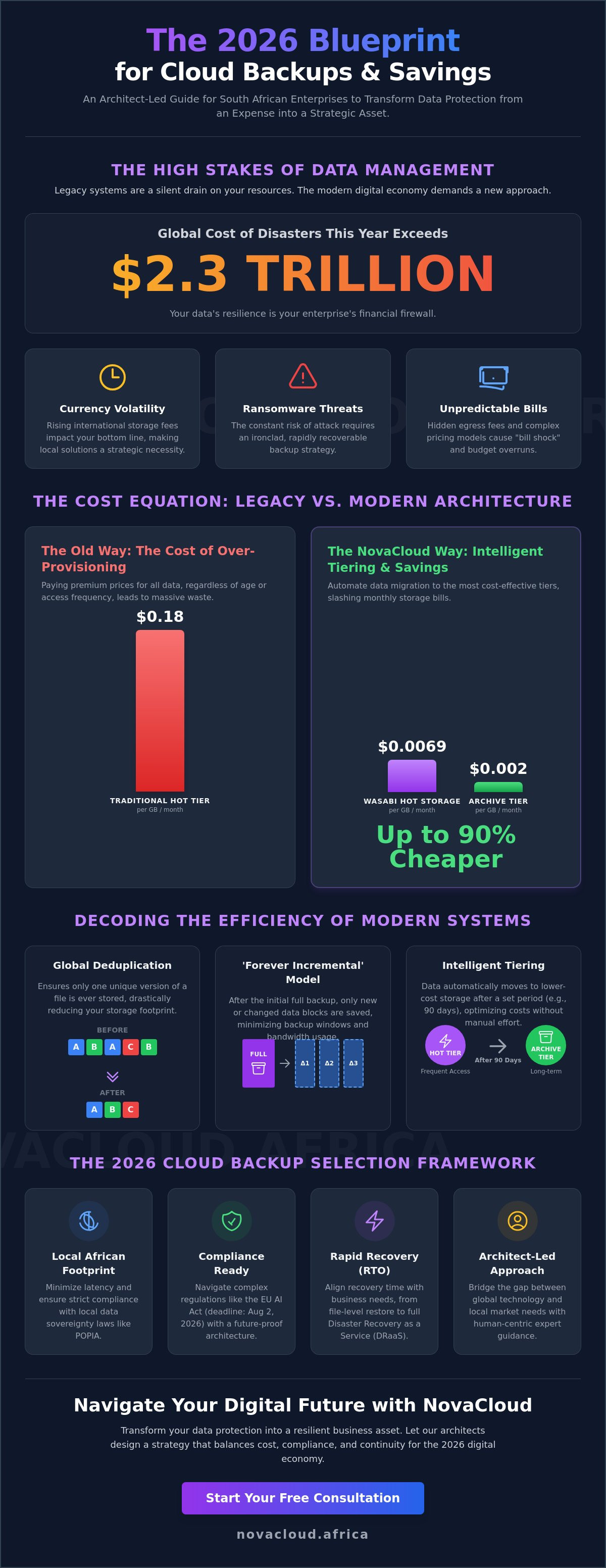
Legacy systems are a silent drain on your resources. Relying on manual tape rotations or aging on-site hardware introduces human error and high maintenance labor that simply doesn't scale. Beyond the hardware, many enterprises suffer from "bill shock" caused by unoptimized cloud configurations. For instance, while hot tier storage can cost $0.18 per GB, failing to move older data to archive tiers, which can be as low as $0.002 per GB, leads to massive waste. As a specialized form of remote backup service, modern cloud architecture eliminates these hidden leaks. Automated scheduling removes the administrative burden, ensuring your team focuses on growth rather than troubleshooting 2 a.m. backup failures.
The 2026 Standard: Security Meets Scalability
Modern resilience requires balancing high-performance recovery with budget-conscious storage. Business-grade infrastructure is now a prerequisite for any enterprise aiming for continental reach. You need a system that scales instantly as your data footprint expands, without requiring a total overhaul of your strategy every fiscal year. It's about choosing scalable solutions that respect your bottom line. Cloud backup is the resilient digital foundation that ensures your business remains operational and compliant, regardless of local infrastructure failures or global cyber threats. This proactive stance is what separates the market leaders from those still reacting to yesterday's challenges.
Decoding the Efficiency of Modern Cloud Backup Systems
Efficiency is the engine of profitability. While many providers focus on the raw volume of storage, true cloud backups and savings are found in the architecture that handles your data before it ever reaches the cloud. By utilizing advanced deduplication and compression, we reduce the physical footprint of your digital assets. This isn't just about saving space; it's about optimizing every byte to ensure your infrastructure remains lean and responsive. For the modern South African enterprise, this means your data strategy becomes a source of competitive advantage rather than a ballooning overhead.
We leverage the power of Acronis Cloud to provide a unified management experience that simplifies these complex processes. This integration allows for intelligent tiering; this is where data that hasn't been touched in 90 days automatically migrates to colder, lower-cost storage tiers. Since archival storage can be as much as 90% cheaper than hot storage, the financial impact is immediate and measurable. It’s a shift from manual oversight to an automated, resilient architecture that works silently in the background.
The Power of Global Deduplication
Paying for the same data twice is a luxury no business can afford. Global deduplication identifies duplicate data blocks across your entire enterprise, ensuring that only one unique version of a file is stored. This drastically reduces the "backup window," which is the time required to complete a protection cycle. By implementing source-side deduplication, the heavy lifting happens at the origin, meaning less data travels across your network. Target-side deduplication then provides a secondary layer of efficiency at the storage destination, creating a multi-layered approach to cost reduction.
Bandwidth Optimization: Saving on Connectivity
Connectivity remains a precious resource for local businesses. The 'Forever Incremental' backup model ensures that after your initial upload, only the changed data blocks are transmitted. This surgical precision minimizes the strain on your office internet during peak operational hours, preventing the slowdowns that frustrate your team. There is a powerful synergy between high-speed Business Fibre and these efficient backup agents. When your infrastructure is this optimized, you don't need to over-provision your bandwidth just to keep your data safe. If you're ready to see how these efficiencies can transform your operations, you might want to explore our architect-led cloud services to find the right fit for your growth goals.
Optimizing Your Investment: Backup vs. Disaster Recovery
Choosing between simple file-level protection and a comprehensive Disaster Recovery as a Service (DRaaS) platform is the most significant decision you'll make for your cloud backups and savings strategy. While they often occupy the same conversation, they serve vastly different roles in your resilient architecture. File-level backup is your digital archive; it's designed for the long-term retention of documents, spreadsheets, and databases. It's cost-effective for compliance but slow when you need to rebuild an entire server from scratch. DRaaS, conversely, is about business continuity. It mirrors your entire environment so you can resume operations in minutes after a catastrophic failure. For a deeper look at how to balance these two, explore our insights on Strategic Data Resilience.
The metric that defines this choice is your Recovery Time Objective (RTO). You must ask: "How long can my business survive if our core systems are offline?" If the answer is less than four hours, a standard backup won't suffice. You need a framework that prioritizes data based on its operational urgency. Your mission-critical databases require instant failover, while your seven-year-old financial records only need simple, low-cost archival. This tiered approach ensures you aren't overpaying for high-speed recovery where it isn't needed.
The Hidden Costs of Downtime in the SA Market
In the South African context, where power volatility and network outages are persistent challenges, downtime isn't just an inconvenience; it's a direct drain on your liquidity. For mid-sized organizations with 500 to 2,000 employees, the annual cost of DRaaS typically ranges between $75,000 and $150,000. While this is a clear investment, it functions as a cost-avoidance tool when compared to the $2.3 trillion lost globally each year to indirect disaster impacts. By leveraging high-performance Virtual Private Servers, you can spin up failed infrastructure in a virtual environment almost instantly. This keeps your team productive even when your physical hardware is compromised.
Hybrid Strategies for Maximum Savings
We recommend a hybrid approach to maximize your cloud backups and savings without sacrificing safety. This follows the 3-2-1 rule: keep three copies of your data, stored on two different media types, with at least one copy offsite in the cloud. You can optimize costs by using local fast-recovery points for daily mishaps while pushing encrypted, long-term copies to secure cloud vaults.
- Set aggressive retention policies for temporary files to clear storage space every 30 days.
- Use local snapshots for immediate file versioning to avoid cloud egress fees for minor restores.
- Archive compliant data in deep-freeze tiers to capitalize on the lowest possible storage rates.
The 2026 Cloud Backup Selection Framework
Selecting the right partner in 2026 requires more than a technical checklist. It requires a vision for your future growth and a partner who can balance cloud backups and savings without compromising on performance. A provider's local footprint is the first pillar of this framework. If your data is stored in a distant European or North American data center, your recovery speeds will suffer from high latency. In a crisis, every millisecond counts. Choosing a provider with presence on African soil ensures that your restoration is measured in minutes, not days. This proximity is the bedrock of achieving long-term efficiency and reducing the bandwidth costs associated with long-distance data transfers.
Integrated security is no longer an optional add-on. Ransomware protection must be woven into the fabric of the service, featuring immutable storage that prevents data from being altered or deleted by malicious actors. Finally, you must test the provider's support responsiveness. When a system fails, you don't want to navigate a generic chatbot. You want local expertise that understands the unique challenges of the African market. A partner who acts as a strategic ally provides a level of reassurance that global, faceless competitors cannot match.
Compliance and Data Sovereignty
Compliance isn't a suggestion; it's a legal mandate. South African businesses must ensure their storage locations align with POPIA regulations to avoid severe penalties. With the EU AI Act in full force as of August 2, 2026, and the California Delete Act effective since January 1, 2026, the regulatory net is tightening globally. You need to know exactly where your data lives and how it's managed. Ask your provider these questions:
- Does your encryption use Hardware Security Modules (HSMs) with customer-controlled keys?
- How do you handle data deletion requests to comply with the 45-day window required by modern data brokers?
- Is our data stored in a jurisdiction that respects South African data sovereignty standards?
Scalability and Transparent Pricing
Rigid licensing models are the enemies of innovation. You should seek 'pay-as-you-grow' models that reflect your actual usage, preventing the "lock-in" that hampers agility. Avoid hidden fees like setup costs or recovery charges that can turn a budget storage solution into a financial burden. A centralized dashboard is essential for managing your M365 Licensing alongside your backups. This unified view provides the clarity needed to spot inefficiencies before they impact your monthly revenue. If you're ready to build a strategy that scales with your ambition, consult with our innovative architects today to secure your digital future.
Navigating Your Digital Future with NovaCloud
NovaCloud stands at the intersection of global technological standards and the specific, vibrant needs of the South African market. We recognize that for an enterprise to thrive, it requires more than just storage; it needs a strategy that harmonizes cloud backups and savings into a single, cohesive engine for growth. Our approach is human-centric and architect-led, ensuring that your digital transformation is handled by experts who understand your business outcomes as well as the underlying code. By leveraging Acronis-powered solutions, we deliver a resilient architecture that is both cost-effective and uncompromising in its security. We don't just provide a service; we act as a strategic ally in your journey toward digital maturity.
The complexity of managing multi-generational data and the fear of ransomware-induced downtime are real pressures. However, these challenges are also opportunities to refine your operations. With global disaster costs exceeding $2.3 trillion this year, the value of a professional, proactive partner has never been higher. We provide the technical execution that allows your leadership to focus on visionary growth, knowing that the foundation of your digital estate is in safe, expert hands.
A Strategic Ally for African Growth
Our commitment extends beyond providing software. We are dedicated to enabling the continent's digital future by building stable, scalable infrastructure that empowers local businesses to compete on a global stage. This is the heart of the "Nova" promise: bringing clarity and illumination to complex ICT landscapes. When you have quiet confidence in your data security, you gain the freedom to pursue visionary business optimism. We believe that a new start for your IT strategy begins with moving away from fragmented, legacy systems and toward a unified, purposeful architecture. This shift is what allows South African enterprises to navigate currency volatility and international storage fees with poise and precision.
Next Steps: From Vulnerability to Resilience
The transition from vulnerability to total resilience is smoother than you might expect. Migrating from aging on-site hardware or unoptimized storage to our Cloud Infrastructure is a streamlined process designed to minimize disruption. We invite you to move beyond the uncertainty of rising storage costs and complex data management. It's time to take control of your data's destiny.
- Request a custom data resilience audit to identify hidden storage waste.
- Start a trial of our Acronis-powered backup solutions to experience seamless integration.
- Consult with our architects to align your RTOs with your 2026 fiscal goals.
Build Your Resilient Digital Legacy
The path to 2026 is paved with both technical hurdles and transformative opportunities. You've seen how a shift from passive storage to an active, architect-led strategy can turn a simple insurance policy into a financial catalyst. By embracing global deduplication and intelligent tiering, your business can finally achieve the elusive balance of cloud backups and savings. This isn't just about protecting files; it's about securing your place in the African digital economy through purposeful, resilient infrastructure.
As an authorized Acronis Cloud partner, we provide the sophisticated tools required to ensure your data is immutable and instantly recoverable. Our POPIA-compliant data architecture keeps your sensitive information within secure jurisdictions, backed by the peace of mind that only expert local IT assistance can provide. You don't have to navigate the complexities of currency volatility or ransomware threats alone. It's time to move from a state of uncertainty to one of absolute clarity and readiness.
Secure Your Data and Optimize Your Costs with NovaCloud. The future belongs to the prepared. Let's start a new chapter in your business efficiency and illuminate the possibilities of a truly resilient enterprise.
Frequently Asked Questions
How do cloud backups save my business money compared to local storage?
Cloud backups eliminate the heavy capital expenditure of hardware and the ongoing labor costs of manual maintenance. Instead of over-provisioning expensive local servers that often sit 40% idle, you pay only for the storage you consume. This shift from CapEx to OpEx provides a predictable monthly cost while removing the hidden drain of electricity, cooling, and physical security for on-site infrastructure. It's a leaner, more scalable approach to growth.
Is cloud backup secure enough for POPIA compliance in South Africa?
Professional cloud backup services are fully compliant with POPIA when they utilize local data centers and end-to-end encryption. By keeping your data within South African borders, you satisfy the sovereignty requirements that international, faceless providers often ignore. We ensure that your architecture meets the strict transparency standards mandated by the EU AI Act enforcement starting August 2, 2026, providing a secure, local foundation for your digital assets.
What is the difference between cloud storage like OneDrive and a professional cloud backup?
Cloud storage is a synchronization tool for collaboration, while professional backup is a resilient recovery system. Tools like OneDrive don't protect against accidental deletion or mass corruption because changes sync instantly across all devices. A professional service creates immutable, point-in-time snapshots that remain isolated from your live environment. This distinction is the core of achieving true cloud backups and savings by preventing costly data loss during synchronization errors.
Can cloud backups protect my business from ransomware attacks?
Yes, modern cloud backups use immutable storage and AI-driven anomaly detection to neutralize ransomware threats. If an attacker encrypts your local files, your cloud-based snapshots remain untouched because they cannot be modified or deleted for a set period. This allows you to roll back your entire system to a clean state from the hour before the infection occurred. It effectively bypasses the need to pay a ransom and minimizes operational downtime.
How long does it take to recover my data if my local server fails?
Recovery times range from a few minutes to several hours depending on your chosen Recovery Time Objective (RTO). If you use a Disaster Recovery as a Service (DRaaS) model, you can spin up your entire server in a virtual environment almost instantly. For simple file restores, the speed is limited only by your bandwidth. Local expertise and low-latency African data centers are essential for ensuring a rapid return to operations during a crisis.
Do I need a special internet connection for cloud backups to work efficiently?
A symmetrical fibre connection is recommended, but modern backup agents are designed to work efficiently with your existing bandwidth. By using 'Forever Incremental' models, the system only transmits the specific blocks of data that have changed since the last backup. This surgical precision ensures that your cloud backups and savings aren't offset by the need for massive, expensive internet upgrades. It keeps your network responsive during peak business hours.
What happens to my backups during extended load shedding or power outages?
Your backups resume automatically the moment power and connectivity are restored to your local site. Since the destination storage is located in Tier III data centers with redundant power and 99.99% uptime, your offsite data remains safe and accessible even when your local office is dark. This resilience ensures that your business continuity strategy isn't compromised by regional infrastructure challenges or the ongoing power volatility in the local market.
Can I back up my Microsoft 365 and Google Workspace data to the same cloud?
Yes, professional backup platforms provide a unified dashboard to protect both Microsoft 365 and Google Workspace environments simultaneously. This centralized approach simplifies management and ensures that your emails, shared drives, and calendar data are all governed by the same retention policies. Consolidating these services into one architect-led solution reduces administrative labor and provides a clear, illuminated view of your entire digital estate across different platforms.
