


Hosted PBX Systems: The Strategic Architect’s Guide to Unified Communications in 2026

Why are you still paying for R25,000 hardware that tethers your team to a physical office? With over 70% of businesses expected to operate on cloud-based platforms by the end of 2026, the era of the dusty server room is over. You've likely felt the frustration of high maintenance costs and call quality issues that disrupt your momentum during peak hours. It's a common hurdle for firms trying to scale in a hybrid world, but it doesn't have to be your reality.
We believe your communication infrastructure should be a catalyst for growth, not a burden on your balance sheet. This guide helps you transition to Hosted PBX systems that provide a resilient, future-proof architecture for the modern enterprise. You'll discover how to achieve operational cost reductions of up to 60% while ensuring seamless integration with Microsoft 365 and mobile devices. We'll also break down the impact of the Electronic Communications Amendment Bill of 2026 and provide a strategic roadmap for your digital transformation. It's time to build a voice solution that scales as fast as your vision.
Key Takeaways
- Understand the shift from legacy hardware debt to agile, software-defined communication that empowers your remote and hybrid workforce.
- Learn how to transition from heavy upfront CapEx to a predictable monthly OpEx model, potentially reducing your operational costs by up to 60%.
- Evaluate the critical role of network redundancy and local expertise when choosing Hosted PBX systems for the South African market.
- Master a phase-based migration strategy that allows you to port legacy numbers and customize call flows without any business downtime.
- Explore how seamless integration with tools like Microsoft 365 creates a unified, resilient architecture that supports transformative growth across the continent.
The Evolution of Business Voice: Why Hosted PBX Systems Define the Modern Enterprise
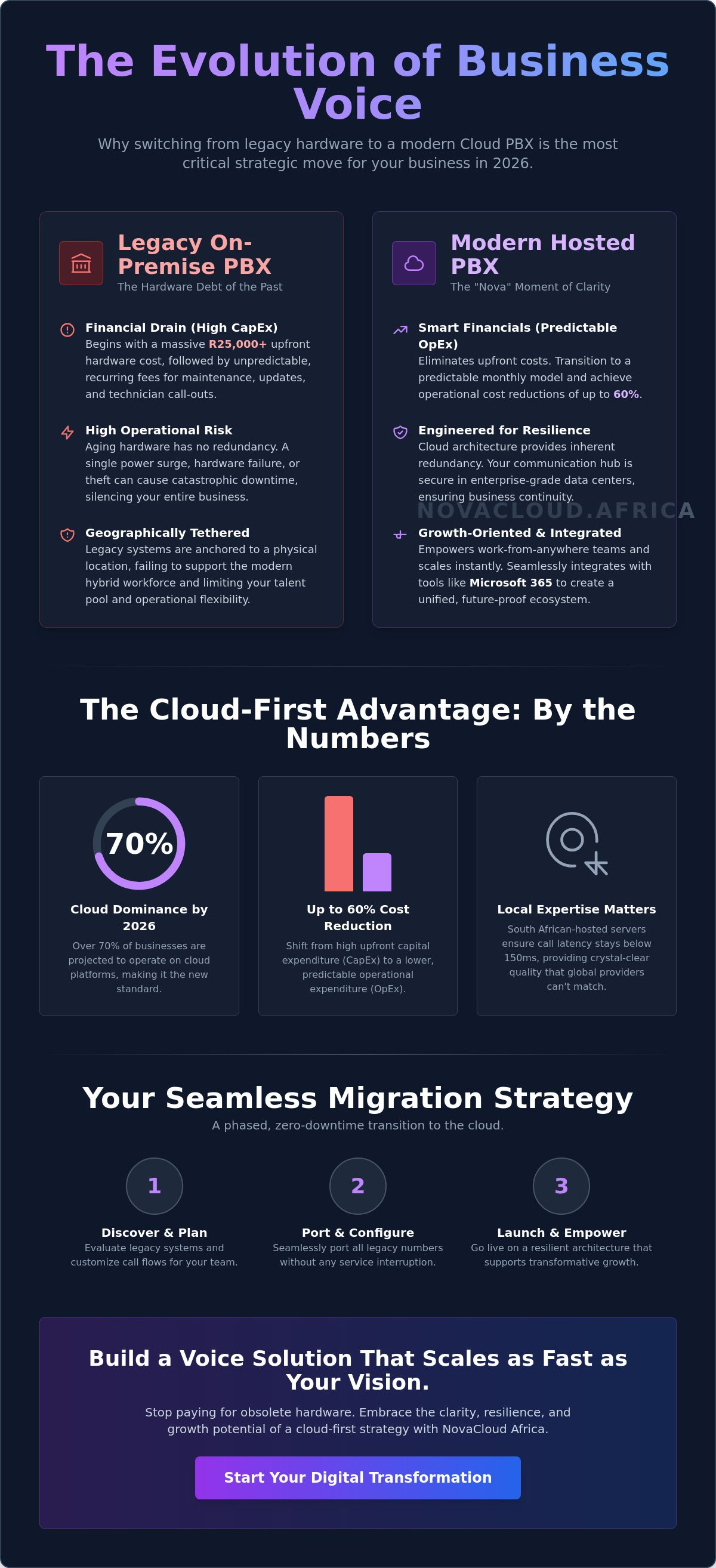
The corporate landscape is shedding its physical anchors. For decades, The Evolution of Business Voice was defined by heavy metal boxes and tangled copper wires. Today, Hosted PBX systems represent a software-defined revolution. This architecture moves your entire communication hub to the cloud, eliminating the need for expensive on-site hardware. It's no longer just a way to make calls; it's a resilient foundation for digital transformation. By 2026, South African enterprises are realizing that agility is the only currency that matters in a globalized market. Transitioning to the cloud isn't just a technical upgrade. It's a strategic move that positions your brand as a forward-thinking leader.
The Legacy Debt of On-Premise Hardware
Maintaining a traditional PBX is like paying interest on a loan for technology that's already obsolete. On-premise systems come with a heavy "PSTN debt," characterized by rigid infrastructure and high maintenance costs. When you're tied to physical hardware, you're also tied to its limitations. Hardware failures can silence an entire office in seconds, and scaling up often requires weeks of waiting for new lines to be installed.
- Financial Drain: Beyond the initial R25,000 installation, businesses face recurring technician fees for every minor update or configuration change.
- Operational Risks: Aging hardware lacks the redundancy of the cloud. A single power surge can cause catastrophic downtime.
- Geographical Tethering: Legacy systems weren't built for the 78.6% of households now connected to high-speed internet. They fail to support the modern hybrid workforce that needs to work from anywhere.
These systems struggle to keep pace with a workforce that demands mobility and instant connectivity. You can't build a 2026 business on 1996 foundations.
Cloud PBX as a Catalyst for Transformative Growth
Transitioning to a hosted PBX is a bright beginning for any organization. We call this the "Nova" moment. It's the point where communication moves from a confusing, dark cost center into a clear, illuminated strategic asset. Hosted PBX systems offer seamless integration across mobile devices, laptops, and IP phones. This ensures your team stays connected from Cape Town to Johannesburg without missing a beat. It's about creating a unified experience that feels human-centric and growth-oriented.
This isn't just about saving money, though cost reductions of up to 60% are standard. It's about empowering your people with scalable solutions that grow as you do. When your voice architecture is resilient and cloud-based, you aren't just reacting to the market; you're leading it. You gain access to AI-powered analytics and auto-attendants that were once reserved for global conglomerates. In 2026, the choice is clear. You can remain tethered to the past or embrace the clarity and empowerment of a cloud-first strategy with NovaCloud Africa.
Decoding the Architecture: How Hosted PBX Systems Power Seamless Connectivity
Voice communication is no longer a separate circuit; it's a high-priority data stream. At its core, Hosted PBX systems function by converting your voice into digital packets that travel across the internet. This process, known as Voice over IP (VoIP), requires a sophisticated backbone to ensure that every syllable remains crisp and clear. It's a delicate dance of data packets. For a professional conversation to feel natural, latency must stay below 150 milliseconds. When packets arrive out of order, you experience jitter, the stuttering effect that can derail a critical boardroom pitch. Clarity isn't accidental. It's engineered through a resilient architecture that prioritizes voice traffic above all else.
Local server placement is the secret to maintaining this precision across South Africa. When your provider hosts infrastructure in Johannesburg or Cape Town, your data packets don't have to endure a 10,000-mile round trip to Europe and back. This proximity drastically reduces transit times and eliminates the lag that plagues global, faceless competitors. Your communication deserves a home that understands the local landscape. If you're ready to see how this technical precision translates into business results, you can explore our voice architecture to find a solution that fits your scale.
The Role of Symmetrical Business Fibre
A high-performance voice solution is only as strong as the link that carries it. Traditional asymmetric connections prioritize downloads, often leaving the upload speed too thin to handle outbound voice data. This is why symmetrical Business Fibre is non-negotiable for the modern enterprise. It ensures that your team can upload large files and hold crystal-clear video calls simultaneously. By managing Quality of Service (QoS) at the network perimeter, we tag voice packets as "VIP" traffic. This prevents a large background update from stealing the bandwidth your phone system needs to function. It's about building a foundation that never forces you to choose between speed and quality.
Hardware Synergy: The Yealink T31P Advantage
While softphones offer great flexibility, specialized hardware like the Yealink T31P IP Phone provides a superior tactile experience for high-volume environments. These devices are purpose-built for HD voice, utilizing advanced noise-filtering technology to block out the hum of a busy office. They don't just look professional; they're designed for the ergonomic needs of a 2026 workforce. In a hosted environment, these phones offer plug-and-play provisioning. You simply connect them to the internet, and they automatically download their configurations. This synergy between cloud software and robust hardware ensures your digital transformation is both seamless and incredibly reliable.
Evaluating the ROI: Cloud PBX vs. Traditional Landline Infrastructure
The financial blueprint of a modern enterprise is changing. For years, businesses were locked into a CapEx-heavy cycle, spending an average of R25,000 on physical PBX hardware that began depreciating the moment it was installed. Today, Hosted PBX systems allow you to pivot to a predictable monthly OpEx model. This isn't just about changing a line item on a spreadsheet. It's about liberating capital for transformative growth. By moving to the cloud, businesses in South Africa are realizing Cloud PBX savings of up to 70% compared to traditional landline expenses. These savings aren't just theoretical. They're the result of eliminating the "waste" inherent in fixed-capacity systems.
Eliminating Hidden Operational Costs
Traditional telephony is riddled with invisible drains on your budget. Physical line rentals and technician call-out fees for simple configuration changes add up quickly. Managed Hosted PBX systems replace these with scalable SIP trunks and "zero-touch" updates. This means your security patching and feature rollouts happen automatically in the background. Your internal IT team is no longer bogged down by fixing broken desk phones or rewiring server rooms. Instead, they can focus on high-level strategic projects while we handle the technical execution. With entry-level cloud packages starting as low as R49 per user per month as of May 2026, the barrier to entry has never been lower for firms seeking a professional voice presence.
Scalability Without Capital Expenditure
In a volatile market, the ability to scale is your greatest defense. Traditional systems require you to buy capacity you might not use for months. Cloud-based solutions allow you to add or remove extensions in seconds to support seasonal spikes or new branch openings. You only pay for what you use through flexible licensing models. This agility ensures that your communication budget remains lean and purposeful, even as your headcount fluctuates. Cloud scalability serves as the ultimate hedge against market volatility by ensuring your infrastructure costs always align with your current operational reality.
The impact extends beyond the balance sheet. Unified communications empower your team to collaborate more effectively, directly influencing customer satisfaction. When a remote consultant can answer a call as if they're in the office, the customer experience remains seamless. This level of reliability builds trust and drives long-term value that far exceeds the initial cost reductions. You're not just buying a phone system; you're investing in a more responsive and resilient business model.
Selection Criteria: Choosing the Right Hosted PBX Provider in South Africa
Selecting a partner for your voice architecture is a high-stakes decision that defines your brand's accessibility. You aren't just buying a software license; you're choosing the steward of your enterprise's connectivity. In the 2026 landscape, where the Electronic Communications Amendment Bill has modernized infrastructure sharing, the real differentiator is no longer just having a signal. It's about resilience. A strategic provider must offer geographic redundancy across multiple South African data centers. This ensures that if one node experiences a disruption, your calls are rerouted instantly without your customers ever noticing a glitch. High-quality Hosted PBX systems demand a foundation that is both locally rooted and globally capable.
Compliance is another non-negotiable pillar. Every provider in the South African market must adhere strictly to RICA and POPIA regulations, verifying customer identities and safeguarding sensitive data. A local expert understands these legislative nuances better than a faceless global entity. They ensure your communication remains legal and secure while providing the low-latency benefits of domestic server placement. When you evaluate potential partners, look for those who view themselves as an extension of your team rather than just another monthly invoice. If you want to see what a true partnership looks like, you can view our strategic voice solutions to start your transformation today.
Technical Support and Managed Continuity
Mission-critical voice services cannot survive on ticket-based support alone. You need 24/7 dedicated IT assistance that understands your specific call flows and business logic. There is a massive gap between a simple vendor and a strategic ICT partner. A vendor sells you a product; a partner builds a continuity plan. This includes secure cloud backups of your configurations and automated failover protocols. If your primary office connection drops, your Hosted PBX systems should automatically route calls to mobile devices or secondary branches. This level of managed assistance keeps your business operational regardless of local infrastructure challenges.
Security at the Perimeter: Managed Firewalls
As voice traffic moves into the data stream, it becomes a target for external threats like toll-fraud and unauthorized access. Protecting the SIP signaling path is essential for maintaining the integrity of your network. A Managed Firewall acts as a vigilant sentry, filtering out malicious traffic before it reaches your voice environment. By utilizing industry-leading FortiNet infrastructure, we create a secure perimeter that prioritizes encrypted voice packets while blocking potential intruders. This specialized approach to network security ensures that your digital transformation remains a source of growth rather than a point of vulnerability.
Navigating the Transition: Implementing Your NovaCloud Africa PBX Strategy
Moving to Hosted PBX systems is a bright beginning for your enterprise. It's the moment your communication architecture finally catches up with your ambition. At NovaCloud Africa, we treat this as a strategic mission, ensuring that your voice, video, and messaging function as a single, unified organism. By 2026, the businesses that lead their industries are those that have traded legacy complexity for cloud-based clarity. This transition is your opportunity to rebuild your workflows around the needs of a modern, mobile workforce.
High-performance businesses require sophisticated call center inbound logic to handle traffic with precision. Whether you're managing a local boutique or a continental support hub, your call flows must be customized to minimize wait times and maximize first-call resolution. This is where your voice system stops being a utility and starts being a strategic asset. By integrating your voice architecture with your VPS and broader ICT stack, you create a resilient environment that supports transformative growth across every department.
Seamless Migration Workflows
We follow a rigorous, phase-based approach to eliminate the risk of downtime during your migration. It starts with a comprehensive site readiness audit to verify your network's capacity and Quality of Service settings. We then run your new cloud environment in parallel with your legacy system, allowing for exhaustive testing before any numbers are ported. This ensures that the 70% of businesses migrating to the cloud by the end of 2026 do so without losing a single second of connectivity. It's a human-centric process that empowers your team through every stage of the technical transition, providing the reassurance that your digital future is in expert hands.
Integrating the Microsoft 365 Ecosystem
The final step in building a resilient architecture is the seamless integration of Hosted PBX systems with the Microsoft 365 environment. By combining these systems, you enable your team to answer corporate calls directly within Microsoft Teams, creating a "single-pane" management experience. This streamlining of productivity reduces the friction of switching between apps and simplifies your licensing into a predictable monthly OpEx. Leveraging local expertise from NovaCloud Africa ensures your M365 Business environment is optimized for the specific challenges of the South African market, from bandwidth management to regional compliance. It's about creating a unified, energetic rhythm of communication that feels both professional and purposeful.
Illuminating Your Path to Communication Excellence
Building a voice architecture is more than just a technical setup; it's the final step in securing your digital legacy. Throughout this guide, we've mapped the journey from legacy debt to the high-performance potential of Hosted PBX systems. By aligning your communication with a cloud-first strategy, you ensure your enterprise remains agile enough to pivot as the South African market evolves. You're no longer just maintaining a phone line; you're orchestrating a resilient, interconnected ecosystem that bridges the gap between your team and your customers.
NovaCloud Africa stands ready to act as your strategic architect in this transformation. With our authorized Microsoft 365 Licensing partnership and deep-rooted local expertise, we provide more than just technical execution; we provide a blueprint for continental reach. It's time to leave the static systems of the past behind and step into the clarity of a modern, software-defined future. Architect your future with NovaCloud Africa Hosted PBX solutions today. Let us empower your business to communicate with the confidence and authority it deserves.
Frequently Asked Questions
What are the primary benefits of Hosted PBX systems for South African SMEs?
The primary benefits include dramatic cost reductions and unparalleled operational flexibility. South African businesses switching to VoIP typically achieve cost savings of 40% to 60% compared to legacy systems. With entry-level packages starting at R49 per user as of May 2026, SMEs can access enterprise-grade features without the R25,000 upfront cost of physical hardware. This architecture empowers your team to work from anywhere, leveraging the 78.6% internet penetration rate across the country.
Can I keep my existing business phone number when moving to a hosted system?
Yes, you can retain your existing business numbers through a regulated process called geographic number porting. We manage the transition with ICASA-compliant protocols to ensure your brand identity remains intact. The process is handled in the background, allowing you to move from copper-based debt to a resilient cloud foundation without any service interruptions. It's a seamless way to start your new chapter in business efficiency.
What happens to my phone system if the internet goes down?
Your communication remains active through automated failover and mobile integration. Because the "brain" of the system lives in our secure data centers, calls don't just disappear if your local office loses connectivity. You can instantly route traffic to mobile apps or secondary branches. This resilient architecture ensures that your customers can always reach you, maintaining a professional presence even during local infrastructure challenges.
Is a hosted PBX system secure against hacking and toll fraud?
Modern Hosted PBX systems are highly secure when protected by encrypted SIP signaling and managed firewalls. We utilize FortiNet infrastructure to create a secure perimeter around your voice traffic, proactively blocking unauthorized access attempts. Regular security patching and real-time monitoring are standard features. This approach provides a level of protection that aging on-premise boxes simply cannot match in the 2026 threat landscape.
How many concurrent calls can a standard hosted PBX system handle?
The capacity for concurrent calls is virtually unlimited and scales dynamically with your business needs. Unlike traditional systems that are restricted by the number of physical lines installed, a cloud-based solution is only limited by your available bandwidth. This allows you to handle seasonal spikes or rapid growth without ordering new hardware. It's a scalable solution that ensures you never miss a critical client connection due to a busy signal.
Do I need to buy new phones to use a hosted PBX system?
You don't necessarily need to purchase new hardware to make the switch. While specialized devices like the Yealink T31P offer superior HD voice quality, you can also use softphones on laptops or mobile apps on existing smartphones. This flexibility is perfect for hybrid teams. If you have existing IP-enabled phones, they can often be reprogrammed to work with our resilient cloud architecture, further reducing your initial setup costs.
What is the difference between VoIP and a Hosted PBX?
VoIP is the underlying technology that transmits voice as data packets, while a Hosted PBX is the sophisticated management system that routes those calls. Think of VoIP as the engine and the PBX as the entire vehicle, including the steering, dashboard, and navigation. Hosted PBX systems provide the advanced logic, such as auto-attendants, call recording, and detailed analytics, that turns simple data transmission into a strategic business tool.
How much bandwidth does a single VoIP call require?
A single high-quality VoIP call typically requires between 80 Kbps and 100 Kbps of symmetrical bandwidth. On a modern 50 Mbps or 100 Mbps fibre connection, the impact of voice traffic is minimal. However, we always recommend implementing Quality of Service (QoS) settings at your network perimeter. This ensures your voice packets receive priority over background data tasks, maintaining crystal-clear call quality even during peak internet usage hours.
