


Data Sovereignty Laws in South Africa Explained: A 2026 Strategic Guide for Enterprise

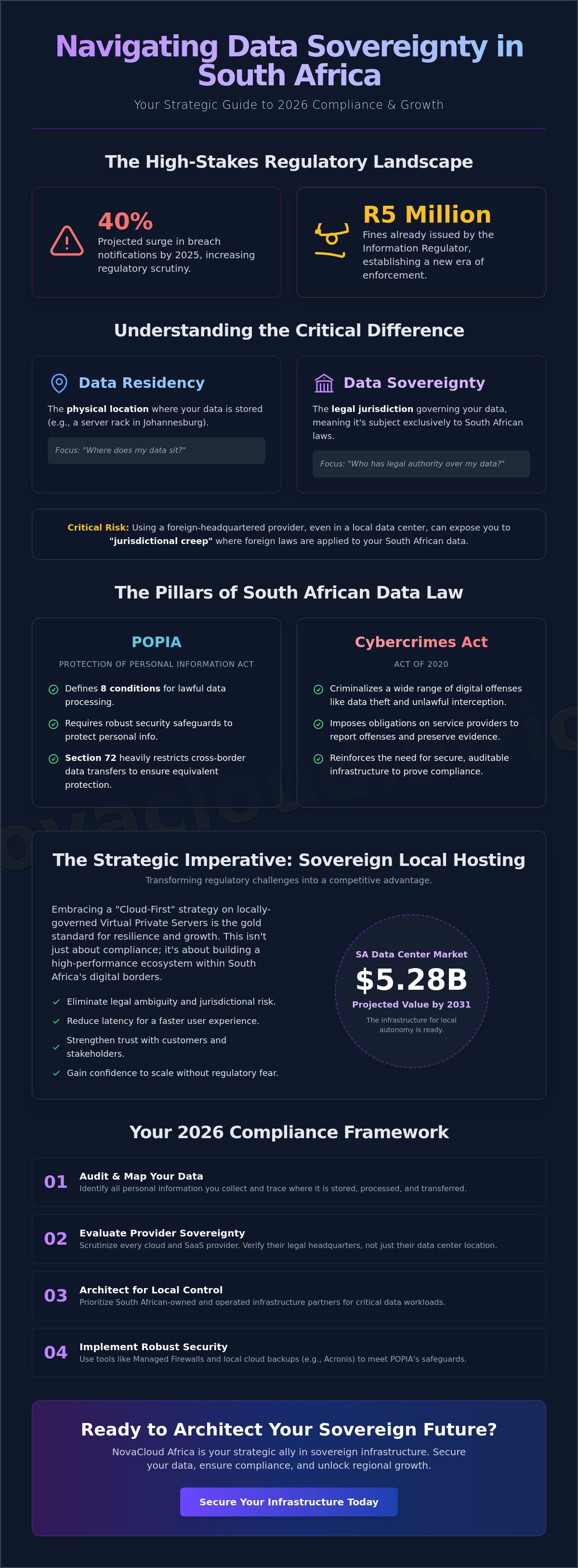
With breach notifications surging by 40% in 2025 and the Information Regulator issuing R5 million fines to major state departments, the era of passive data management has ended. Having the latest data sovereignty laws in South Africa explained is no longer just a legal checkbox; it's the foundation of your enterprise's digital architecture. You've likely felt the tension between the global scale of international cloud providers and the rigid local requirements of POPIA and the Cybercrimes Act. It's frustrating to balance high-performance infrastructure with the fear of a massive regulatory penalty or the uncertainty of where your data actually lives.
We understand that your digital evolution needs a steady hand and a clear vision. This guide illuminates how to turn these complex mandates into a strategic advantage, ensuring your data remains secure, sovereign, and optimized for growth. We'll explore the 2026 regulatory landscape, the shift toward local hosting, and the practical steps to architect a resilient system using tools like Managed Firewalls and Acronis Cloud backups. This is your roadmap to regional empowerment, technical clarity, and a fresh start in business efficiency.
Key Takeaways
- Distinguish between data residency and sovereignty to understand how local jurisdiction impacts your enterprise's legal standing.
- Get the latest data sovereignty laws in South Africa explained to ensure your infrastructure aligns with the 2026 POPIA and Cybercrimes Act mandates.
- Learn why local hosting on Virtual Private Servers isn't just about speed; it's a critical move for maintaining regional digital control.
- Follow a structured framework to audit your data mapping and evaluate the sovereignty status of every cloud and SaaS provider you use.
- Shift from regulatory fear to strategic opportunity by architecting a high-performance system that empowers your regional growth.
Defining Data Sovereignty in the South African Landscape
The year 2026 represents a watershed moment for digital infrastructure in the Southern Hemisphere. As the National Data and Cloud Policy, first published in May 2024, reaches full operational maturity, the concept of digital borders has shifted from a theoretical discussion to a technical mandate. Having the data sovereignty laws in South Africa explained is no longer just a task for legal departments; it's a fundamental requirement for the forward-thinking systems designer. This shift provides a celestial clarity for organizations that have long operated in the shadows of "grey-area" data hosting. By bringing your data home, you aren't just following rules; you're renewing a sacred trust with your customers by ensuring their most sensitive information never leaves the reach of local protection.
Data Residency vs. Sovereignty: The Critical Difference
It's easy to confuse where your data sits with who has the power over it. Data residency is simply the physical address of your digital assets. It's the server rack in a specific latitude and longitude. Sovereignty, however, is the legal framework that governs those assets. Even if your data resides in a local facility, using a provider headquartered in a foreign jurisdiction can expose you to "jurisdictional creep." This occurs when foreign governments claim the right to access data based on where the provider is registered rather than where the server is located. To truly secure your enterprise, you must align both the physical and the legal. The Protection of Personal Information Act (POPIA) provides the primary shield for this data, but that shield is only effective when the data remains within the territory where the Information Regulator has the teeth to enforce it.
The Rise of the Sovereign Cloud in South Africa
The movement toward a sovereign cloud is a catalyst for regional empowerment. With the South African data center market projected to reach over USD 5.28 billion by 2031, the infrastructure for local autonomy is already here. Government "Cloud-First" policies have signaled a clear direction for private enterprise: local hosting is the gold standard for resilience. We see this as an opportunity for a fresh start in business efficiency. By architecting your systems on locally-governed Virtual Private Servers, you eliminate the latency and legal ambiguity of international hops. This isn't just about avoiding fines; it's about building a high-performance ecosystem that respects South African borders while competing on a global stage. When you know exactly where your data lives, you gain the quiet confidence to scale without the fear of sudden regulatory shifts or foreign interference.
The Pillars of Law: POPIA and the Cybercrimes Act Explained
The legal landscape of 2026 provides a clear, illuminated path for organizations ready to embrace digital sovereignty. Having the data sovereignty laws in South Africa explained begins with understanding the two foundational pillars: the Protection of Personal Information Act (POPIA) and the Cybercrimes Act of 2020. These aren't merely restrictive hurdles. They're sophisticated frameworks designed to foster a renewal of trust between enterprises and their regional stakeholders. By aligning your architecture with these mandates, you transition from a state of regulatory uncertainty to one of strategic clarity. The Information Regulator has demonstrated this new era of enforcement, issuing R5 million fines to major departments in 2025 for non-compliance, signaling that the time for "best effort" security has passed.
POPIA: More Than Just a Compliance Checklist
For the modern systems architect, POPIA defines eight conditions for the lawful processing of personal information. These conditions require that data is collected for a specific purpose, maintained with accuracy, and protected by rigorous security safeguards. A critical aspect of this framework is Section 72, which governs cross-border data transfers. You're generally prohibited from moving personal information outside South Africa unless the recipient country offers a level of protection effectively similar to our own. While South Africa's standards are often benchmarked against the GDPR, the Freedom on the Net 2021 report highlights how localized legal nuances require a dedicated regional focus. Keeping sensitive data within South African borders isn't just about avoiding fines; it's a strategic advantage that ensures your legal protections remain absolute and enforceable.
The Cybercrimes Act and Infrastructure Security
While POPIA protects the privacy of the individual, the Cybercrimes Act, which commenced on December 1, 2021, secures the integrity of the infrastructure itself. It criminalizes unlawful interception and unauthorized access to data, providing a robust legal mechanism to combat hacking and data theft. This act makes high-level security measures a legal necessity. For instance, implementing a Managed Firewall is no longer just a technical recommendation; it's a vital component of your mandatory reporting and breach prevention strategy. Under current regulations, you must notify the Regulator and affected parties immediately after a compromise. Failure to do so can result in significant administrative penalties, as seen in the R100,000 fine issued to Lancet Laboratories. To ensure your systems are both compliant and resilient, consider how sovereign cloud backups can provide the restorative light your business needs after a security event.
Infrastructure Architecture: Why Local Hosting is a Strategic Imperative
The "Global Cloud" is a seductive myth. It suggests that data exists in a borderless ether, free from the constraints of geography. In reality, every byte of information must travel through physical cables and reside on physical hardware. When that hardware sits in Dublin or North Virginia, your South African users pay a performance penalty in the form of high latency. Architecting for resilience means acknowledging that physical proximity is a core security and performance feature. Understanding the data sovereignty laws in South Africa explained in previous sections is vital, but seeing how they manifest in your server rack is where the strategy becomes tangible. By utilizing Virtual Private Servers located within our borders, you ensure your data remains under local protection while delivering a seamless user experience.
Local VPS: The Foundation of Sovereign Architecture
Local server placement does more than satisfy a regulator. It reduces "digital friction," the subtle lag that frustrates employees and drives customers away. When your core applications run on local infrastructure, the path between the user and the data is direct and optimized. This efficiency is amplified when accessed via high-speed Business Fibre, creating a low-latency environment that international hosting simply cannot match. To complete this sovereign circle, your redundancy strategy must be equally localized. Implementing Cloud backups that never leave the country ensures that even in a crisis, your recovery process stays within the bounds of South African law. It's a closed-loop system of clarity and control.
Economic Empowerment Through Local Infrastructure
Choosing local ICT procurement is a powerful statement of visionary optimism. It moves your organization beyond being a mere consumer of foreign tech to being a catalyst for regional growth. Supporting the South African data center market, which is projected to grow at a CAGR of 12.90% through 2031, strengthens the very ecosystem your business relies on. There's also a pragmatic financial benefit. Procuring services locally protects your budget from the turbulence of the global exchange market. You don't have to worry about sudden price hikes driven by currency volatility. This stability allows for precise long-term planning and a fresh start in business efficiency. By keeping your digital spend within the country, you're investing in a future where South African innovation leads the way.
A 2026 Compliance Framework for South African Enterprises
The transition from theory to execution requires a structured, multi-layered approach. While having the data sovereignty laws in South Africa explained provides the necessary legal context, your enterprise needs a practical roadmap to ensure every digital asset aligns with these standards. This framework is designed to move your organization from a state of vulnerability to one of quiet confidence, turning compliance into a strategic pillar of your digital evolution. You cannot protect what you don't know exists. By following these steps, you architect a system that is both resilient and legally sound.
- Step 1: Conduct a data mapping audit to identify where all personal information resides across your entire network.
- Step 2: Evaluate the sovereignty status of all third-party cloud and SaaS providers to ensure they meet local jurisdiction requirements.
- Step 3: Implement robust encryption and access controls, utilizing tools like a Managed Firewall to shield locally hosted data from external threats.
- Step 4: Establish a clear incident response plan that aligns with the mandatory reporting requirements of the Cybercrimes Act.
- Step 5: Partner with a sovereign-first ICT provider for infrastructure and specialized IT Assistance.
The Data Mapping Audit: Finding Your Digital Footprint
Identifying "Shadow IT" is the first hurdle in architecting a secure system. Often, individual departments adopt third-party tools without IT oversight, creating non-compliant data silos that exist outside your primary security perimeter. You must classify every piece of data based on sensitivity and the specific legal protection levels required by POPIA. Document the entire flow of information, from the moment of collection through storage to its eventual secure destruction. This transparency is the celestial light that reveals hidden risks and ensures your digital borders are clearly defined and defensible. A thorough audit is a renewal of your commitment to data integrity.
Vendor Vetting: Is Your Cloud Provider POPIA-Ready?
Your hosting partner acts as a critical extension of your legal entity. When vetting vendors, you must look beyond basic technical specifications. Ask direct questions about data residency and which legal jurisdiction governs their operations during a dispute. Review Service Level Agreements (SLAs) for specific sovereignty and security guarantees that match South African standards. A local partner provides more than just low latency; they offer regional expertise that is invaluable during a regulatory audit. Having a South African team to call upon ensures your compliance is never handled by a faceless entity in a different time zone. It's about building a partnership based on shared regional goals.
For a fresh start in business efficiency, explore our sovereign cloud solutions designed specifically for the South African enterprise landscape.
NovaCloud Africa: Your Strategic Ally in Sovereign Infrastructure
At NovaCloud Africa, we don't just provide infrastructure; we design the systems that power regional progress. Having the data sovereignty laws in South Africa explained is the first step, but the second is choosing a partner that embodies these principles in every server rack. We're deeply committed to South African digital empowerment. Our mission is to ensure that your enterprise doesn't just survive the 2026 regulatory shift but thrives within it. This is about more than just boxes and cables. It's about a renewal of your operational integrity and a commitment to the growth of our local digital economy.
Our Virtual Private Servers are architected at the intersection of high performance and strict POPIA compliance. We've built our local data centers to eliminate the legal ambiguity of international hosting. This represents the 'Fresh Start' your business deserves. It's a strategic opportunity to migrate away from legacy, non-compliant systems that expose you to unnecessary risk. We provide the technical authority to lead this migration, ensuring your transition is smooth and well-considered. When you host with us, you aren't just buying a service; you're securing a territorial reach that keeps your data under the protection of South African law.
Unified communications are a vital part of this sovereign future. Our secure Hosted PBX systems ensure that even your voice data remains protected within our borders. This creates a cohesive, protected environment for your entire digital footprint, from your databases to your daily conversations. By centralizing your ICT spend with a local partner, you also shield your budget from exchange rate volatility. It's a multi-layered solution for a complex landscape, providing the stability you need to scale with quiet confidence.
Designed for High-Performance, Governed by Local Law
Our technical architecture is rooted in stability and expansion. We leverage the nation's 61 data centers to provide the backbone for a resilient digital ecosystem. These facilities are designed specifically for mission-critical enterprise applications, ensuring 99.9% uptime. You gain the speed of local connectivity while remaining fully within South African legal borders. It's the quiet confidence of knowing your data sits on sovereign ground. This physical proximity is your ultimate security feature, offering a celestial clarity that foreign providers simply cannot match.
Embarking on Your Digital Evolution
We position ourselves as your visionary strategic partner. Our role is to handle the technical execution so you can focus on high-level growth. We assist with every stage of your transition to a fully compliant, high-speed cloud environment. Don't let the complexities of local mandates hold you back. This is an invitation to step into a new era of business efficiency. We invite you to consult with our experts to architect a sovereign future that serves your organization with clarity and purpose. Together, we'll build a digital infrastructure that is as ambitious as your vision for the future.
Leading the Next Era of Digital Empowerment
The transition toward sovereign infrastructure is a catalyst for regional growth. We've seen how having the data sovereignty laws in South Africa explained allows you to move from uncertainty to technical clarity. By aligning your digital borders with local jurisdiction, you ensure your enterprise remains resilient against foreign interference and high-impact regulatory fines. This isn't just about avoiding penalties; it's about building a foundation of trust that resonates with your customers. It's a strategic choice to prioritize performance and legal integrity in an increasingly complex global landscape.
Your digital evolution deserves a partner that understands the specific needs of the South African market. We provide a fresh start in business efficiency through our 100% South African owned and operated infrastructure. With POPIA-compliant systems and enterprise-grade Managed Firewall security, we empower your organization to scale with quiet confidence. Architect your sovereign future with NovaCloud’s high-performance South African VPS solutions today. The road to 2026 is an opportunity for renewal and strategic expansion. We're ready to help you lead the way with systems designed for your success.
Frequently Asked Questions
What is the main difference between data residency and data sovereignty in South Africa?
Data residency refers strictly to the physical geographic location where your digital assets are stored. Data sovereignty goes a step further, as it defines the legal jurisdiction and laws that govern that information. You may have residency in a local data center, but if your provider is headquartered in a foreign country, your data could still be subject to international laws. Having the data sovereignty laws in South Africa explained within your strategy ensures you align both physical location and legal control.
Is it legal under POPIA to store South African customer data on international servers?
Storing data internationally is legal under POPIA only if the recipient country provides a level of protection substantially similar to South Africa's regulations. If the jurisdiction doesn't meet these standards, you must obtain written consent from the data subject or implement a contract that guarantees adequate protection. Keeping data on local Virtual Private Servers removes this complexity, ensuring your digital evolution remains within the clear borders of South African jurisdiction.
How does the Cybercrimes Act of 2020 affect my business's cloud backup strategy?
The Cybercrimes Act criminalizes unauthorized access and unlawful interception, making secure infrastructure a legal mandate. Your cloud backup strategy must include robust encryption and access controls to prevent these offenses. Under this act, you're also required to report security compromises to the authorities. Utilizing local Cloud backups ensures your recovery processes are fully compliant with these reporting standards and protected by regional law enforcement frameworks.
What are the penalties for non-compliance with data sovereignty laws in South Africa?
Penalties for non-compliance are severe, including administrative fines of up to R10 million or imprisonment for up to ten years. In 2025, the Information Regulator issued R5 million fines to major departments for failing to comply with enforcement notices. These actions signal a move toward rigorous oversight, where enterprises must prove they've taken every technical step, such as implementing a Managed Firewall, to protect sensitive information.
Do I need a local VPS to be fully POPIA compliant?
A local VPS isn't a strict requirement of the act, but it's the most effective tool for ensuring jurisdictional clarity. By hosting locally, you avoid the risks of "jurisdictional creep" where foreign governments might access your data under their own laws. This choice provides the quiet confidence that your data sovereignty laws in South Africa explained are being applied in a controlled, predictable environment, which is vital for enterprise-level risk management.
Can the Information Regulator fine my business if my third-party host has a data breach?
Yes, your business is the "responsible party" and remains liable for the actions of any "operator" you hire to process data. If your third-party host fails to maintain adequate security, the Regulator can hold you accountable for not vetting your provider's infrastructure. Partnering with a local strategic ally that offers FortiNet security and sovereign hosting is essential to mitigate this shared liability and protect your organization's reputation.
How does local hosting improve the performance of my business applications?
Local hosting reduces digital friction by keeping data physically closer to your users, which significantly lowers latency. When your applications run on South African servers and are accessed through high-speed Business Fibre, the user experience is seamless and responsive. This performance boost is a catalyst for regional empowerment, allowing your team to work with a level of speed and efficiency that international cloud providers can't consistently deliver.
What steps should I take if I discover my data is being stored in a non-compliant jurisdiction?
You should immediately perform a data mapping audit to identify all affected silos and then initiate a migration to a sovereign-first provider. It's critical to update your data processing agreements and ensure your new infrastructure uses Acronis Cloud for secure, local redundancy. Taking these proactive steps represents a renewal of your commitment to data integrity and moves your business toward a state of technical and legal readiness.
