


How to Choose a POPIA Compliant Cloud Provider in 2026: A Strategic Framework

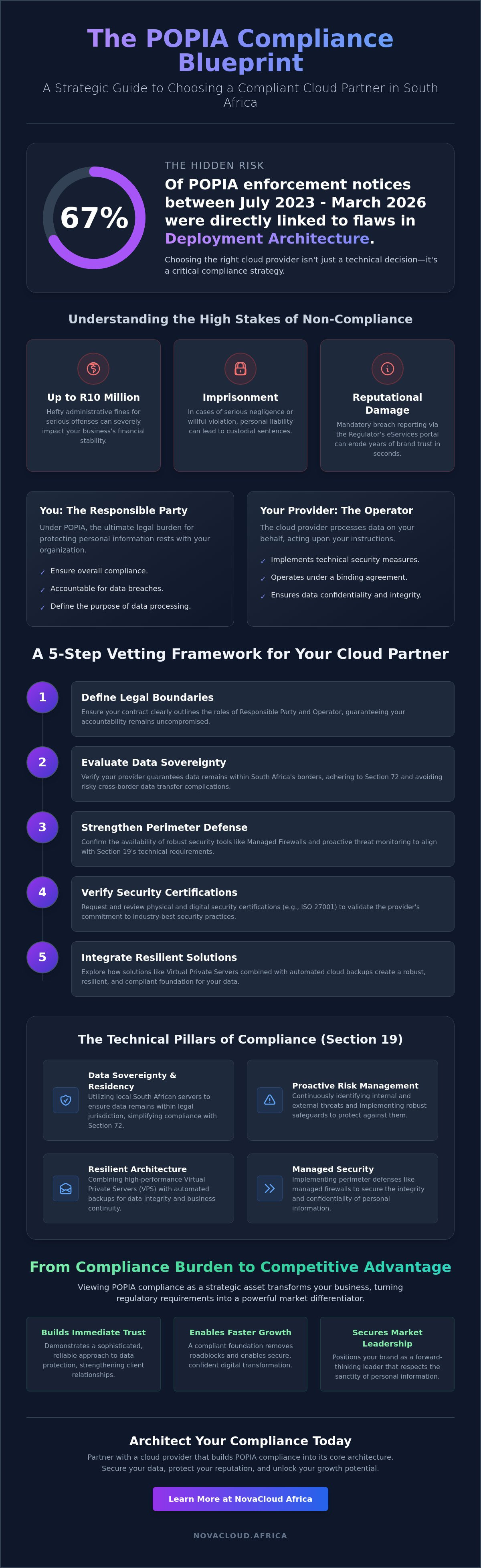
Did you know that 67% of the 312 POPIA enforcement notices issued between July 2023 and March 2026 were directly linked to flaws in deployment architecture? This staggering figure highlights why learning how to choose a POPIA compliant cloud provider is no longer just a technical checkbox. It's a core strategic imperative for any South African business aiming for sustainable growth. You've likely felt the mounting pressure of proactive audits or felt overwhelmed by technical jargon that masks risky cross-border data transfers. It's natural to feel uneasy when a single oversight could lead to a R10 million fine or a mandatory online breach report through the eServices portal.
We're here to replace that uncertainty with visionary clarity. This guide promises to help you master the complexities of modern data privacy law by providing a definitive framework for vetting cloud partners for absolute compliance. We will examine the 2026 regulations for processing health information and the strategic shift toward hybrid cloud models identified by BMI Research. You'll gain a clear procurement checklist designed to transform your digital infrastructure into a secure, high-performance engine for regional empowerment.
Key Takeaways
- Define the legal boundaries between Responsible Parties and Operators to ensure your organizational accountability remains uncompromised within the cloud ecosystem.
- Discover how to choose a POPIA compliant cloud provider by evaluating data sovereignty and the legal nuances of cross-border transfers under Section 72.
- Strengthen your perimeter defense by aligning technical infrastructure with Section 19 requirements through Managed Firewalls and proactive security protocols.
- Apply a rigorous five-step vetting framework to verify physical and digital security certifications before onboarding any new technology partner.
- Explore how integrating Virtual Private Servers with automated cloud backups creates a resilient, compliant foundation for your digital evolution.
Understanding the High Stakes of POPIA for Cloud Infrastructure
The digital horizon has shifted. In 2026, the South African Information Regulator has moved decisively from policy creation to rigorous enforcement. For any organization utilizing Virtual Private Servers or off-site storage, understanding the Protection of Personal Information Act (POPIA) is now the bedrock of operational stability. It's no longer enough to simply "be in the cloud." You must understand exactly how your data lives, moves, and stays protected within that environment. Compliance isn't a static achievement; it's an active state of technological readiness.
When you evaluate how to choose a POPIA compliant cloud provider, you must first recognize your legal role. Under the law, you are the "Responsible Party." This means the ultimate legal burden for protecting personal information remains with you, even if you outsource the technical execution to an "Operator," such as a cloud provider. Between July 2023 and March 2026, the Regulator issued 312 enforcement notices across 14 sectors. A staggering 67% of these cases cited deployment architecture as a primary factor in the violation. In this climate, "ignorance of the law" is a liability that could lead to administrative fines of up to R10 million or even imprisonment for serious offenses.
The Legal Responsibility of the Modern Enterprise
Your choice of a digital partner reflects your commitment to your customers. Selecting a provider for cloud hosting involves a profound duty of care that extends beyond basic uptime. A single security compromise now requires mandatory reporting via the Information Regulator’s online eServices portal. Email notifications are a thing of the past. Beyond the legal fallout, a breach erodes years of brand equity in seconds. Maintaining operational continuity requires a holistic approach to safety, a concept we explore deeply in our Strategic Data Resilience guide. You aren't just buying space on a server; you're choosing a guardian for your most valuable asset.
Beyond Fines: The Strategic Value of Data Privacy
Compliance shouldn't feel like a weight. Instead, view it as a catalyst for visionary growth. In the B2B sector, robust data protection is a powerful differentiator that builds immediate trust with your clients. It signals that you're a sophisticated, reliable partner who respects the sanctity of personal information. When privacy is architected into your system from the start, it creates a foundation of clarity that enables faster digital transformation. You aren't just avoiding a fine. You're securing your position as a forward-thinking leader in the South African market, turning a regulatory requirement into a competitive advantage.
Technical Architecture: The Pillars of a Compliant Cloud Environment
Section 19 of the POPI Act serves as the technical heart of data protection in South Africa. It mandates that every "Responsible Party" must secure the integrity and confidentiality of personal information by taking appropriate, reasonable technical and organizational measures. When you're determining how to choose a POPIA compliant cloud provider, you must evaluate their infrastructure through this specific lens. Compliance isn't achieved by a single software setting; it's the result of a multi-layered architecture designed to identify risks and implement resilient safeguards. This structural approach ensures that your Virtual Private Servers (VPS) aren't just fast, but legally fortified.
The Information Regulator of South Africa emphasizes that proactive risk management is essential. This involves a continuous cycle of identifying internal and external threats, establishing safeguards against those risks, and regularly verifying that these defenses remain effective. For a cloud environment to be truly compliant, it must offer more than just storage. It requires a sophisticated stack of identity management, perimeter defense, and data integrity tools that work in harmony to protect the data subjects you serve.
Perimeter Defense and Managed Security
Security starts at the edge of your network. A Managed Firewall solution acts as a visionary digital sentry, neutralizing unauthorized access attempts before they can penetrate your environment. In the 2026 threat landscape, real-time monitoring is a necessity for proactive protection. By architecting a zero-trust environment within your VPS framework, you ensure that every access request is rigorously verified. This creates a state of digital clarity, where your network perimeter is constantly adapted to meet new challenges, ensuring that your regional operations remain shielded from global vulnerabilities.
Data Integrity and Redundancy
Resilience is a core requirement of POPIA. Your data must remain available and accurate, which is why secure cloud backups are a non-negotiable pillar of your architecture. Encryption serves as your primary technical safeguard; it's the invisible force that protects personal information both at rest on your servers and in transit across the web. To combat the rising tide of ransomware, immutable storage ensures that your backups cannot be altered or deleted by malicious actors. This level of redundancy provides the quiet confidence needed to scale your business, knowing your digital assets are protected by a reliable technical executor. If you're looking to strengthen your foundation, consider how a professionally managed VPS can simplify your path to total compliance.
Finally, technical compliance requires absolute visibility. Implementing multi-factor authentication (MFA) and maintaining granular access logs provides the audit trail necessary to prove compliance during a regulatory review. These logs act as a rhythmic record of every interaction with your data, ensuring that "who, what, and when" are always documented. This transparency is the final piece of the puzzle, transforming a complex legal requirement into a clear, manageable technical framework.
Data Residency vs. Sovereignty: The Local Server Advantage
Understanding the geography of your data is the first step toward true digital clarity. Data residency refers to the physical location where your information is stored, while data sovereignty involves the legal jurisdiction that governs that data. When you're investigating how to choose a POPIA compliant cloud provider, you'll find that these two concepts are the bedrock of your compliance strategy. While global providers often promise residency through local data centers, sovereignty remains a complex web of international agreements. By choosing a partner with a deep regional presence, you ensure that your data remains under the direct protection of South African law, avoiding the shadows cast by conflicting foreign regulations.
The shift toward local hosting is accelerating. A 2026 study by BMI Research indicates a 41% shift toward self-hosted and hybrid cloud deployments among South African organizations with more than 250 employees. This trend is driven by a desire for greater control and a need to bypass the legal headaches of offshore processing. When your data stays within our borders, you're not just improving speed; you're securing your right to regional empowerment through a infrastructure designed specifically for our market's unique needs.
Navigating Section 72: Cross-Border Transfers
Section 72 of POPIA places strict limitations on transferring personal information outside of South Africa. You must perform rigorous due diligence in appointing a CSP to ensure that the recipient country offers "adequate protection" that matches our local standards. This is a subjective legal hurdle that can lead to significant uncertainty. Storing sensitive data in jurisdictions with weaker privacy laws exposes your organization to unnecessary risk. Keeping your data on local soil provides a fresh start in business efficiency by stripping away the layers of international legal complexity, allowing your team to focus on growth rather than jurisdictional disputes.
Latency and Performance in the Local Cloud
Compliance and performance aren't mutually exclusive. In fact, they're deeply synergistic. Local infrastructure supports mission-critical business applications by drastically reducing latency, ensuring your systems respond with rhythmic precision. There's a powerful harmony between high-speed Business Fibre and local cloud hosting, creating a seamless environment for your daily operations. This proximity also means you have access to local technical experts who understand the nuances of the South African regulatory landscape.
Architecting your future on a high-performance VPS located in South Africa gives you the quiet confidence that your digital evolution is in expert hands. You aren't just checking a box for the Regulator. You're building a high-performance environment that empowers your organization to scale with speed and legal peace of mind. Local hosting isn't just about where the server sits; it's about who has your back when compliance questions arise.
A 5-Step Vetting Framework for Choosing Your Cloud Partner
Moving from legal theory to operational reality requires a structured approach. While previous sections established the "why" of residency and technical pillars, this framework provides the "how." It's a roadmap for procurement officers and IT leaders who need to know exactly how to choose a POPIA compliant cloud provider without getting lost in vendor ambiguity. This process ensures that your digital infrastructure is built on a foundation of verified trust rather than empty promises. By following these five steps, you transform compliance from a daunting hurdle into a rhythmic part of your organizational growth.
- Step 1: Audit Security Certifications. Look beyond marketing claims to find independent verification of a provider's physical and digital safeguards.
- Step 2: Verify Data Residency. Confirm exactly where your data sits and ensure their cross-border policies align with Section 72 requirements.
- Step 3: Review the Operator Agreement. This contract is the legal bridge between you and your provider; it must clearly define roles and liabilities.
- Step 4: Test Resilience. Don't wait for a crisis to discover if your cloud backups and disaster recovery protocols actually work.
- Step 5: Evaluate Local Expertise. Ensure the provider has a deep understanding of the South African ICT landscape and provides accessible, regional support.
Reviewing the Operator Agreement
The Operator Agreement, or Data Processing Agreement, is your primary shield in the event of a regulatory inquiry. It must contain specific clauses that mandate the provider processes information only on your documented instructions. You need clear protocols for breach notifications, ensuring the provider alerts you immediately so you can meet the Information Regulator’s mandatory online reporting requirements. A visionary partner will also include "right to audit" clauses, allowing you to verify their security posture through periodic reviews or third-party reports. This transparency ensures that the legal burden you carry as the Responsible Party is supported by a reliable technical executor.
Certifications and Industry Standards
In the South African context, international benchmarks like ISO 27001 and SOC 2 provide essential clarity. These frameworks prove that a provider has implemented a rigorous Information Security Management System. For many firms, this ecosystem is further strengthened by Microsoft 365 Business Licensing, which offers built-in compliance tools that integrate seamlessly with your cloud environment. It's vital to remember that certifications are evidence, not a guarantee, of compliance. They represent a snapshot in time, and your vetting process should look for providers who treat these standards as a starting point for continuous improvement. If you're ready to architect a more secure future, explore our compliant cloud hosting solutions to see how we prioritize your digital sovereignty.
Architecting Compliance: Why NovaCloud is the Strategic Choice
NovaCloud Africa stands as a beacon of digital sovereignty, designed specifically for the South African enterprise. We believe that technology should be a catalyst for regional empowerment, providing the stability and expansion necessary for your business to thrive. When you reflect on how to choose a POPIA compliant cloud provider, the answer lies in finding a partner who views data protection as a catalyst for growth rather than a restrictive barrier. We don't just provide space; we design systems that reflect a deep understanding of our local market’s unique challenges and opportunities.
Our approach integrates every essential layer of the compliance stack into a single, cohesive architecture. By combining high-performance Virtual Private Servers with automated Cloud backups and FortiNet-powered Managed Firewall protection, we create a fortified environment where your data is both accessible and legally shielded. We eliminate the complexity of how to choose a POPIA compliant cloud provider by offering a pre-architected environment that aligns with every regulatory pillar discussed in this guide. This integrated strategy ensures that your digital evolution is in expert hands, allowing you to scale with quiet confidence.
The NovaCloud Compliance Advantage
We provide more than just infrastructure; we provide clarity. Our local data residency ensures that your mission-critical applications benefit from enterprise-grade performance and the legal simplicity of South African sovereignty. This regional focus is supported by human-centric assistance that understands the nuances of the 2026 regulatory landscape. Unlike faceless global competitors, our team acts as a strategic ally, ensuring that your scalable solutions grow alongside your business while maintaining absolute data integrity. It's a fresh start in business efficiency, where international benchmarks meet localized expertise.
Next Steps: Securing Your Digital Future
Securing your future begins with a clear understanding of your current posture. We invite you to begin a comprehensive audit of your existing cloud environment to identify potential vulnerabilities in your deployment architecture. Transitioning to a POPIA-ready VPS environment is a rhythmic process that replaces uncertainty with readiness. Our team provides Strategic IT Assistance to guide you through every phase of this migration, ensuring your ICT infrastructure is resilient and future-proof.
True compliance is about more than just avoiding fines; it's about architecting a legacy of trust. We invite you to reach out for a celestial clarity consultation, where we'll help you design a system that illuminates your path to expansion. Partner with a strategic ally who is passionately committed to your progress and ready to execute your vision with technical precision.
Architecting Your Legacy of Digital Trust
The journey from regulatory uncertainty to digital clarity begins with a single, strategic decision. We've explored the critical pillars of technical architecture and the undeniable benefits of keeping your data within South African borders. By applying a rigorous vetting framework, the question of how to choose a POPIA compliant cloud provider transforms from a legal burden into a profound competitive advantage. You're no longer just seeking storage; you're building a foundation of trust that empowers your B2B relationships and secures your regional growth through resilient systems.
Maintaining this state of readiness requires a partner who acts as both a visionary designer and a reliable technical executor. NovaCloud Africa offers the stability of South African data residency combined with enterprise-grade FortiNet security and expert local ICT support. This synergy ensures your digital evolution remains in expert hands, allowing you to focus on the future of your enterprise with quiet confidence. It's time to step into a new era of business efficiency where your infrastructure is a catalyst for progress.
Architect Your Compliant Cloud with NovaCloud Africa Today
The horizon is bright for organizations that prioritize digital sovereignty. Let's build a secure, high-performance future together and ensure your business shines with clarity.
Frequently Asked Questions
Is Google Drive or OneDrive POPIA compliant for South African businesses?
Yes, these platforms offer compliant foundations, but you must actively manage their security settings. When researching how to choose a POPIA compliant cloud provider, it's clear that global tools require local oversight. You must ensure your Microsoft 365 Business Licensing is configured to meet Section 19 standards. Compliance isn't a default setting; it's an architectural choice you make through deliberate configuration and proper legal agreements.
What happens if my cloud provider has a data breach under POPIA?
Your provider must notify you immediately so you can fulfill your legal obligations. Under the 2025 regulations, you're required to report the compromise to the Information Regulator through the online eServices portal. You also have a duty to inform the affected data subjects. This process ensures transparency and allows for a swift, coordinated response to protect your organizational integrity and brand reputation.
Do I need to store all my data in South Africa to be POPIA compliant?
You don't have to store everything locally, but it's the most efficient path to compliance. Section 72 of the Act imposes strict conditions on cross-border transfers. If you store data abroad, you must prove the recipient country has adequate protection laws. Keeping data on local Virtual Private Servers removes this legal hurdle and provides a fresh start in business efficiency by simplifying your regulatory reporting.
How does a Managed Firewall help with POPIA compliance?
A Managed Firewall provides the perimeter defense mandated by Section 19's security safeguard requirements. It acts as a visionary digital sentry, identifying and neutralizing threats before they reach your sensitive data. By maintaining detailed access logs and preventing unauthorized entry, it provides the technical evidence needed during a regulatory audit. It's a cornerstone of a resilient ICT infrastructure that empowers your regional growth.
What is the difference between a Responsible Party and an Operator?
The Responsible Party is the entity that determines why and how personal information is processed. The Operator is the third party, like a cloud provider, that processes that data on your behalf. While the Operator handles the technical execution, you retain the ultimate legal accountability. Understanding this distinction is vital when learning how to choose a POPIA compliant cloud provider for your enterprise.
Can an SME be fined for using a non-compliant cloud provider?
Small and medium enterprises are subject to the same R10 million maximum fine as large corporations. The Information Regulator has adopted a proactive enforcement strategy in 2026, focusing on all sectors regardless of company size. Using a non-compliant provider is considered a failure to take reasonable measures under Section 19. This makes the vetting process an essential step for every South African business leader.
How often should I audit my cloud provider for POPIA compliance?
You should conduct a formal audit of your cloud provider's compliance at least once a year. It's also necessary to review your setup whenever you implement major architectural changes or new services. Continuous monitoring through managed security services provides even greater clarity. This rhythmic approach ensures that your safeguards evolve alongside the shifting digital threat landscape and any new guidance notes from the Regulator.
Does Acronis Cloud backup meet POPIA requirements for data protection?
Acronis Cloud backup is a sophisticated tool for meeting POPIA's data integrity and availability requirements. It utilizes enterprise-grade encryption and immutable storage to protect personal information from unauthorized alteration or loss. When integrated correctly, it serves as a reliable technical executor for your disaster recovery strategy. This ensures that you can always restore data accurately, fulfilling your duty of care to your data subjects.
