


The ROI of Unified Communications for SMEs: A 2026 Strategic Framework

Is your communication stack a bridge to the future or a hidden tax on your daily operations? For many growing businesses in South Africa, the cost of disconnected services isn't just financial; it's a loss of momentum that dims your competitive edge. The ROI of unified communications for SMEs is no longer a theoretical debate, it's a survival requirement in a market where Gartner predicts 90% of organizations will rely on cloud platforms for telephony by 2028. We believe technology should act as a catalyst for regional empowerment, bringing a fresh start to business efficiency through total connectivity and absolute clarity.
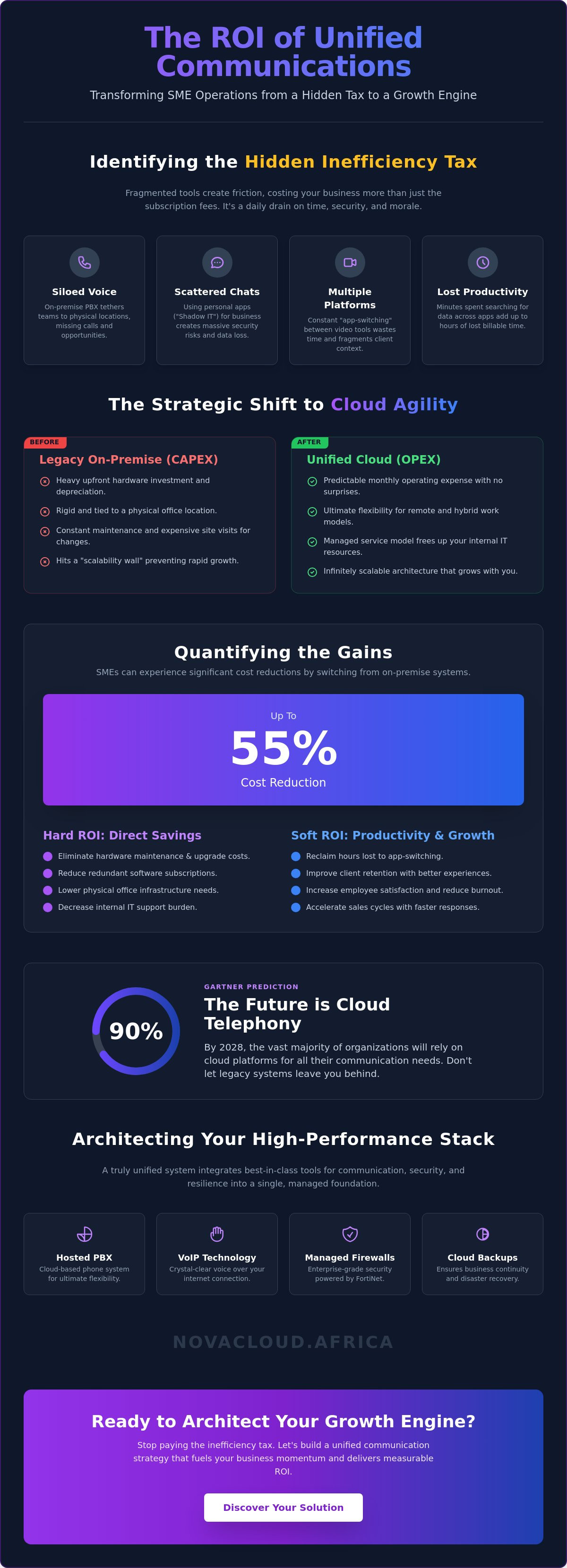
We understand the drain of managing remote teams across fragmented platforms while paying for silos that don't talk to each other. It's time to shed that complexity. This guide provides a strategic roadmap to quantify the financial and operational impact of a unified architecture, especially since research shows SMEs can cut costs by up to 55% when switching from on-premises systems. We'll preview how tools like Hosted PBX and VoIP, secured by FortiNet and managed firewalls, create a scalable foundation for growth. By the end, you'll have a clear framework to lower overhead, boost client retention, and ensure your organization moves with the energy and purpose of a market leader.
Key Takeaways
- Identify and eliminate the hidden inefficiency tax that drains productivity through fragmented communication silos and constant app-switching.
- Discover how to transition from heavy CAPEX hardware investments to predictable OPEX models to maximize the ROI of unified communications for SMEs.
- Learn how integrating cloud-based backups and managed firewalls transforms your communication stack into a resilient tool for disaster recovery.
- Master a five-step framework to forecast success by establishing a performance baseline before migrating to a unified digital architecture.
- Explore the strategic synergy between Hosted PBX systems and cloud infrastructure to build a high-performance growth engine for your regional business.
Beyond the Phone Bill: Identifying the Hidden Inefficiency Tax in SMEs
For many South African SMEs, the monthly telecommunications bill is just the visible tip of a much larger iceberg. The true financial drain often lies beneath the surface in what we define as the inefficiency tax. This is the quantifiable loss of time and resources caused by fragmented tools that fail to communicate with one another. To build a growth engine, you must first understand What is Unified Communications? and how it serves as a strategic integration of voice, video, and messaging into a single, high-performance environment. When these channels remain in silos, your organization pays a daily penalty in the form of "app-switching" and lost context.
Calculating the ROI of unified communications for SMEs requires looking at the friction points that stall your momentum. In the local market, disconnected systems often lead to missed opportunities and poor customer experiences. If a client calls your office but the remote team member lacks access to the real-time history of that client's messaging or video consultations, the relationship suffers. This fragmentation doesn't just frustrate staff; it directly impacts South African revenue by slowing down the sales cycle and increasing the likelihood of churn. The agility required for 2026 market demands simply cannot be met by legacy thinking.
The True Cost of Fragmented Communication
Time is the most expensive resource in a growing business. When employees spend minutes searching for client data across three different platforms, those minutes aggregate into hours of lost billable time. This friction often drives teams toward "shadow IT," where staff use personal messaging apps for business discussions to bypass clunky internal systems. This creates a massive security risk and leaves your business data scattered and unmanaged. Beyond security, the frustration of working with disconnected tools is a leading cause of employee burnout. SMEs that provide a seamless, integrated digital workspace see significantly better retention rates because their people can focus on high-value work rather than managing software gaps.
Why Legacy Systems Stifle SME Growth
The traditional on-premise PBX is a relic that tethers your business to a physical location. These systems demand constant maintenance and lack the flexibility to support modern hybrid work models without complex, expensive VPN setups. We often see businesses hit a "scalability wall" where adding a single new user requires a site visit or a hardware purchase. Transitioning to a Hosted PBX removes these barriers entirely. Maximizing the ROI of unified communications for SMEs starts with moving away from rigid hardware toward a fluid, cloud-based architecture that grows as you do. This shift ensures that your infrastructure is an enabler of expansion, not a bottleneck that holds you back during periods of rapid regional growth.
The 2026 ROI Framework: Quantifying Hard Savings and Productivity Gains
Measuring the ROI of unified communications for SMEs requires a dual-lens approach that captures both immediate cash flow improvements and long-term operational velocity. We categorize these gains into "Hard ROI," which involves direct, line-item cost reductions, and "Soft ROI," which reflects the reclaimed hours of human potential. By moving away from the heavy capital expenditure (CAPEX) of on-site hardware toward a predictable operating expense (OPEX) model, businesses gain a fresh start in financial clarity. This transition allows you to redirect funds from maintenance and depreciation into active growth initiatives.
A significant driver of this financial renewal is the strategic alignment of your Microsoft 365 Business Licensing with your communication architecture. When these systems are integrated rather than purchased in isolation, you eliminate redundant software subscriptions and simplify your total ICT spend. This streamlined approach also lowers the burden on internal IT assistance, as managing one cohesive platform is far more efficient than troubleshooting a web of disconnected tools. If you're looking to optimize your current setup, a strategic digital audit can help identify these hidden savings.
Direct Cost Reductions (Hard ROI)
Consolidating your communication stack into a single Hosted PBX system brings immediate relief to the bottom line. You no longer need to manage multiple vendor contracts or pay for separate video conferencing, messaging, and phone services. Industry data indicates that SMEs can cut costs by up to 55% by switching from legacy on-premises systems to cloud-based unified platforms. These savings are further amplified by SIP trunking, which drastically reduces the cost of national and international calling. Additionally, a unified infrastructure empowers a permanent hybrid workforce, allowing many organizations to reduce their physical real estate overhead without sacrificing professional presence.
Reclaiming the 'Lost Hour': Productivity and Soft ROI
Soft ROI is where the true competitive advantage of 2026 is won. By using real-time presence indicators, teams stop playing "communication tag" and start connecting instantly with available experts. This acceleration of decision-making is a vital anchor for regional progress. When your communication tools are deeply integrated with your CRM, staff spend less time toggling between screens and more time delivering high-impact client service. This data accuracy ensures that every interaction is informed and purposeful. The ROI of unified communications for SMEs isn't just about spending less; it's about doing more with the talent you already have, turning every reclaimed hour into a catalyst for expansion.
Mitigating Business Risk: The Insurance Value of Unified Infrastructure
Beyond the immediate savings discussed in previous sections, the ROI of unified communications for SMEs manifests as a robust shield against operational volatility. Think of your communication architecture not just as a tool for connection, but as a critical pillar of strategic data resilience. In a regional market where infrastructure instability can strike without warning, having your voice and data services hosted in the cloud ensures your business remains a beacon of reliability. This shift transforms disaster recovery from a reactive scramble into an automated, inherent feature of your daily workflow.
Integrating a Managed Firewall to protect your unified traffic adds another layer of value by securing the lifeblood of your organization. Centralized, encrypted communications provide a clear path to POPIA compliance, as every interaction is recorded and stored within a secure, auditable framework. It's not merely about following regulations; it's about building a foundation of trust with your clients that serves as a long-term asset. When your systems are designed for clarity and security, you empower your team to move with purpose, free from the shadow of technical uncertainty.
Protecting Revenue Through Business Continuity
When local infrastructure fails, a cloud-based Hosted PBX ensures your team stays reachable from any location with an internet connection. This continuity is powered by high-speed Business Fibre, which maintains the high quality of service required for professional video and voice. For South African SMEs, the cost of downtime can be devastating, often leading to lost leads and damaged reputations. By eliminating single points of failure in your communication stack, you effectively insure your revenue streams against the unexpected. It's a strategic move that guarantees your business doesn't go dark when the lights go out.
Security and Compliance as Value Drivers
Centralized logging within a unified platform offers more than just quality control; it provides a comprehensive audit trail for every business transaction. This transparency protects your intellectual property by keeping sensitive discussions within secure, company-owned channels rather than fragmented personal apps. The ROI of unified communications for SMEs includes the massive cost-avoidance associated with preventing data breaches. By consolidating your security posture through integrated systems, you move from a state of vulnerability to one of quiet confidence, knowing your digital evolution is shielded from modern threats. This protection is a vital component of your growth engine, ensuring that your expansion is both rapid and resilient.
Implementation Strategy: How to Forecast and Measure UC Success
Transitioning to a unified model is a purposeful design choice that requires more than just a software installation. To truly realize the ROI of unified communications for SMEs, you must treat the migration as a strategic evolution rather than a simple technical swap. We recommend a five-step process to forecast your unique gains: audit your current spend, survey staff on manual friction points, analyze customer experience data, select intuitive hardware for user buy-in, and establish rigorous review milestones. This structured approach ensures that your new system is built on a foundation of clarity rather than guesswork.
Your success depends heavily on the "adoption curve." Even the most sophisticated platform fails to deliver value if your team reverts to old habits or personal messaging apps. Selecting reliable, user-friendly hardware like the Yealink T31P IP Phone is a critical part of this strategy. When staff have high-quality, easy-to-use tools at their fingertips, buy-in happens naturally. This human-centric focus ensures that the technology acts as a catalyst for efficiency rather than a source of frustration. If you're ready to define your roadmap, you can consult with our strategic architects to begin your assessment.
Establishing Your Baseline Metrics
You can't measure growth without knowing where you started. Begin by auditing your current monthly spend across all connectivity and voice providers to find your total cost of ownership. Beyond the bills, survey your staff to quantify time lost on manual tasks like call logging or searching for client context. Finally, analyze your current call-drop rates and customer wait times. These baseline metrics provide the "before" picture, allowing you to see the tangible ROI of unified communications for SMEs as these friction points begin to vanish after implementation.
Phased Rollouts and User Training
A "big bang" approach to implementation often hurts ROI by overwhelming staff and causing temporary productivity dips. Instead, we advocate for a phased rollout that allows your organization to adjust and refine workflows in stages. Leveraging professional IT Assistance during this transition is vital for smoothing the technical hurdles and ensuring that your team feels empowered. By setting review milestones at 30, 60, and 90 days, you can track progress against your baseline and make the necessary adjustments to keep your growth engine on course. This rhythmic progression leads your business from a state of uncertainty to one of absolute readiness.
NovaCloud Africa: Architecting High-Performance Communication for Regional Leaders
At NovaCloud Africa, we view technology as a catalyst for regional empowerment. We don't just provide tools; we are a strategic ally dedicated to your digital evolution. The true ROI of unified communications for SMEs is realized when your communication stack is integrated into a broader, high-performance architecture. By creating a seamless synergy between our Hosted PBX systems and enterprise-grade Cloud Infrastructure, we ensure your business has the stability to expand and the agility to innovate. We invite you to architect a future where your digital presence is as bright and clear as the morning sun.
Integrated Ecosystems: From Fibre to Cloud PBX
Our approach centers on a single point of accountability for your entire digital environment. When you combine Business Fibre with our local Virtual Private Server (VPS) infrastructure, you eliminate the latency that often plagues voice traffic in South Africa. This localized focus ensures that your VoIP calls remain crisp and professional, regardless of global traffic spikes. We don't believe in one-size-fits-all templates. Every SME has unique industry requirements, and our systems are designed to be customized; this ensures the ROI of unified communications for SMEs is felt in every specific department of your organization. This integration creates a rhythmic efficiency that moves your business from a state of fragmentation to one of total alignment.
Empowering Growth with Professional Support
The collaborative culture of our support team sets us apart from faceless international competitors. We act as a reliable technical executor, handling the complexities of FortiNet security and managed firewalls so you can focus on your core mission. Choosing a managed ICT partnership over a fragmented DIY setup provides a level of strategic data resilience that acts as a foundation for long-term growth. It's about more than just uptime; it's about the quiet confidence that comes from knowing your systems are in expert hands. We take pride in being the enablers of your progress, providing the technical expertise needed to navigate the complexities of the 2026 market landscape.
As we move forward, let this be the moment of renewal for your business. Transitioning to a unified model is a fresh start that replaces complexity with clarity and uncertainty with momentum. By partnering with a team that understands the regional market and the global technological landscape, you're not just buying a service; you're investing in a vision. Embrace the celestial clarity of a unified system and watch your organization transform into a high-performance growth engine that leads the way for the next generation of South African enterprise.
Securing Your Competitive Edge in a Connected Future
The shift from fragmented silos to a unified digital architecture is more than a cost-saving measure; it's a fundamental reimagining of how your business interacts with the world. By eliminating the inefficiency tax and securing your operations against local infrastructure volatility, you position your organization for sustainable expansion. We've explored how a strategic framework transforms telecommunications from a monthly expense into a high-performance growth engine. Realizing the maximum ROI of unified communications for SMEs requires a partner who understands the local landscape and provides the stability of South African based infrastructure for low latency.
Our strategic partnerships with industry leaders like Yealink and FortiNet, combined with expert human-led ICT assistance, ensure your digital evolution is in professional hands. It's time to step out of the shadows of technical complexity and into a state of absolute clarity. You have the roadmap to quantify your gains and lead your team toward a more collaborative future. Architect your SME's communication future with NovaCloud's Hosted PBX and embrace the renewal of your business efficiency today. Your journey toward a more resilient, connected, and profitable enterprise starts with a single, purposeful choice.
Frequently Asked Questions
What is the average ROI timeline for a Unified Communications investment?
Most organizations experience a positive return within 6 to 12 months of full implementation. This timeline is driven by the immediate elimination of legacy hardware maintenance and the reduction in monthly service fees. As your team moves past the initial adoption curve, the soft savings from reclaimed productivity hours begin to compound, further accelerating your financial recovery.
Can an SME with under 10 employees still see a positive ROI from UC?
Smaller teams often see the most dramatic relative gains because they bypass the heavy capital requirements of traditional phone systems. The ROI of unified communications for SMEs with fewer than 10 staff members is fueled by professionalizing the client experience through VoIP and Hosted PBX features. It allows a lean team to operate with the sophisticated presence of a much larger enterprise.
How much can I realistically save by switching from a legacy PBX to Cloud PBX?
Switching to a cloud-based architecture can reduce your total telecommunications expenses by up to 55%. These savings stem from the removal of physical line rentals, lower call rates, and the total elimination of on-site hardware depreciation. By moving to an OPEX model, you replace unpredictable repair bills with a stable, predictable monthly investment that supports long-term scaling.
Does Unified Communications require a complete overhaul of our existing internet?
A total overhaul isn't always necessary, but your connectivity must be robust enough to prioritize voice and video traffic. We recommend high-speed Business Fibre to ensure the clarity and stability your professional reputation depends on. Utilizing Ubiquity networks and a managed firewall helps you manage existing bandwidth more effectively, ensuring your communication tools don't compete with other background data tasks.
How do I measure the 'soft' ROI of improved employee collaboration?
You can quantify collaboration gains by tracking the reduction in internal email volume and the acceleration of decision-making cycles. Surveying your staff to measure time saved using presence indicators instead of "communication tag" provides a clear baseline. These reclaimed hours are a vital part of the ROI of unified communications for SMEs, directly increasing your organization's operational velocity.
Is the Yealink T31P IP Phone compatible with all Unified Communications platforms?
The Yealink T31P is a highly versatile SIP-based phone that integrates seamlessly with most modern Hosted PBX environments. It's an ideal choice for businesses seeking high-definition audio and reliability without complex hardware requirements. While it's broadly compatible, we ensure your specific network architecture is tuned to support its full feature set, providing a fresh start in communication clarity.
What are the hidden costs I should look for when calculating UC ROI?
Look for initial training time, potential network hardware upgrades, and one-time number porting fees. The most significant hidden cost is often the "fragmentation tax" paid when businesses fail to fully migrate away from legacy silos. Identifying these variables early through professional IT assistance ensures your financial forecast remains precise and your transition to a unified model stays on track.
How does UC impact POPIA compliance for South African businesses?
Unified platforms significantly simplify POPIA compliance by centralizing all client interactions within a secure, encrypted environment. Instead of data being scattered across personal devices, all call recordings and messages are stored in protected cloud backups. This centralized logging creates a clear audit trail, ensuring your business meets regional regulatory requirements while protecting your intellectual property.
