


Penalties for POPIA Non-Compliance in South Africa: The 2026 Strategic Risk Guide

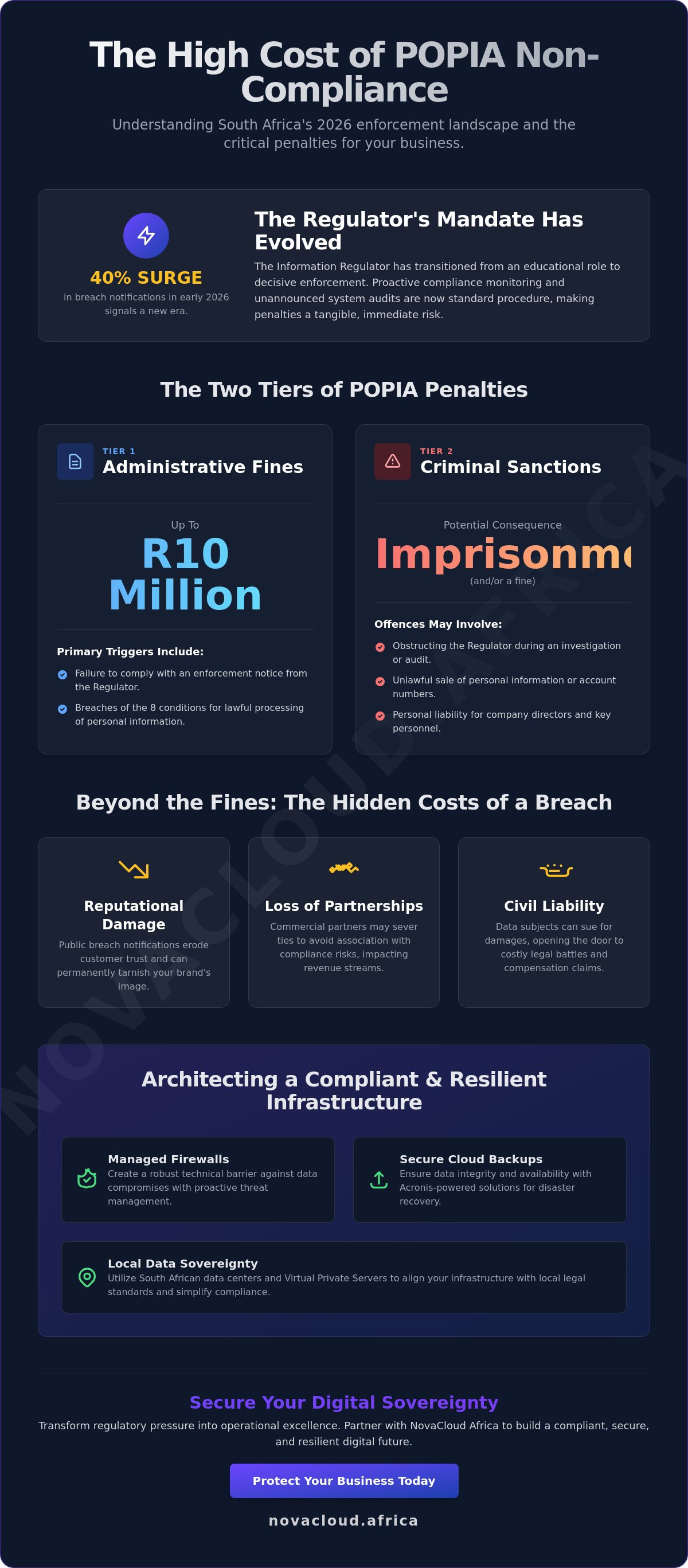
With breach notifications surging by 40% in early 2026, the Information Regulator has officially transitioned from a season of education to an era of decisive enforcement. You're likely feeling the weight of this shift as the R10 million administrative fine is no longer a distant shadow but a tangible risk to your organization's digital sovereignty. Understanding the penalties for POPIA non-compliance in South Africa is no longer just a legal necessity; it's a fundamental requirement for maintaining business continuity and protecting your regional legacy.
We understand the anxiety surrounding personal liability for directors and the Regulator's intensified power to bypass traditional warning periods. This guide offers a comprehensive architectural breakdown of the legal, financial, and operational consequences facing South African enterprises today. We'll illuminate the specific penalty tiers and provide a strategic roadmap for technical mitigation. By integrating sophisticated infrastructure like managed firewalls and secure cloud backups, you can transform regulatory pressure into a fresh start for operational excellence and renewed stakeholder trust.
Key Takeaways
- Navigate the Information Regulator’s shift toward proactive oversight and understand how the "Responsible Party" framework dictates your accountability in modern cloud architectures.
- Distinguish between administrative fines and criminal sanctions to fully quantify the potential penalties for POPIA non-compliance in South Africa within your 2026 risk register.
- Evaluate the hidden costs of civil liability and the cascading impact of public breach notifications on your enterprise’s reputation and commercial partnerships.
- Implement a "Security by Design" framework using Managed Firewalls and Acronis Cloud backups to create a robust technical barrier against data compromises.
- Leverage the regional expertise of local data centers and specialized Virtual Private Servers to align your digital infrastructure with South African legal standards.
Understanding the POPIA Enforcement Landscape in 2026
The Information Regulator is no longer a silent observer. It has matured into a proactive designer of the national digital ecosystem, empowered by the 2025/2026 Annual Performance Plan to shift from reactive complaint handling to systematic compliance monitoring. For South African enterprises, this evolution means that the penalties for POPIA non-compliance in South Africa are no longer theoretical risks discussed in boardrooms; they are active enforcement priorities. This year marks a definitive turning point where the Regulator is actively hunting for systemic vulnerabilities rather than waiting for a data breach to occur.
In this new era, your organization must distinguish between its role as a "Responsible Party" and the "Operator." While you may outsource your data storage to a cloud provider, you remain the entity that determines the purpose and means of processing. This distinction is vital because the legal burden of compliance rests squarely on your shoulders. By viewing the Protection of Personal Information Act (POPIA) as an architectural blueprint rather than a restrictive checklist, you can build a resilient infrastructure that serves as a natural defense against regulatory scrutiny.
The Information Regulator’s Mandate and Powers
The Regulator now possesses the authority to conduct unannounced site and system audits to verify how personal information is handled in real-time. This proactive posture is designed to catch non-compliance before it leads to a catastrophic leak. When the Regulator identifies a gap, they issue an enforcement notice. It's a high-stakes signal that your organization has reached its final warning. Ignoring these notices or failing to remediate the identified issues leads directly to the R10 million administrative fine or, in severe cases, criminal prosecution. The goal is clear: the Regulator wants to see evidence of a living, breathing security culture within every business.
Digital Sovereignty: Why Data Residency Matters
Storing personal information on international servers introduces a layer of complexity known as jurisdictional drift. When data crosses borders, it often falls under conflicting legal frameworks, making it harder to prove compliance during an audit. Utilizing local Virtual Private Servers simplifies this equation significantly. By keeping data within South African borders, you ensure that your digital assets remain under the direct oversight of local law. This commitment to digital sovereignty, supported by robust cloud solutions, provides the legal certainty required to mitigate the risk of penalties for POPIA non-compliance in South Africa while demonstrating a mission-driven focus on protecting regional data subjects.
The Two Tiers of Penalties: Administrative Fines vs. Criminal Sanctions
The architecture of risk under POPIA is structured into two distinct tiers, ensuring that the Information Regulator has the flexibility to address both procedural lapses and malicious intent. Section 107 of the Act serves as the foundation for these sanctions, categorizing offences into minor and major infractions. Understanding the specific penalties for POPIA non-compliance in South Africa requires a deep dive into how these tiers function in a real-world enterprise setting. The Regulator doesn't simply throw out maximum fines at random. Instead, they evaluate the nature of the personal information, the degree of harm to data subjects, and the level of cooperation from the responsible party.
Tier 1: Administrative Fines and Enforcement Notices
Administrative fines represent the most frequent tool in the Regulator's arsenal. These penalties can reach a threshold of R10 million for serious breaches. The process typically begins with an enforcement notice, which acts as a technical directive to remedy specific compliance gaps within a set timeframe. If an organization fails to comply with the terms of this notice, financial sanctions are triggered automatically. We've already seen this mechanism in action with the first administrative fine under POPIA, which targeted a state department for failing to meet security requirements. In 2026, projections suggest a significant uptick in fine frequency for the private sector, particularly for businesses that lack documented security protocols.
Tier 2: Criminal Offences and Personal Liability
Criminal sanctions are reserved for the most egregious violations, such as obstructing the Regulator, failing to comply with an enforcement notice, or the unlawful processing of account numbers. These offences carry the weight of a criminal record and can lead to imprisonment for up to 10 years. This tier is particularly critical for leadership teams because it introduces the concept of personal liability. If a director or officer is found to have acted with gross negligence, they can't hide behind the corporate veil. The legal system increasingly views data protection as a fiduciary duty. Securing your data through automated cloud backups is a vital step in demonstrating the proactive care the Regulator expects from diligent leaders.
The transition from a fine to a prison sentence often hinges on intent and the failure to act after a vulnerability is identified. By architecting a system that prioritizes transparency and rapid response, you mitigate the risk of these severe penalties for POPIA non-compliance in South Africa. It's about moving from a state of vulnerability to one of digital resilience, where compliance is woven into the very fabric of your ICT infrastructure.
The Hidden Costs: Reputational Damage and Civil Liability
The visible penalties for POPIA non-compliance in South Africa are often just the tip of a very deep iceberg. While a R10 million fine is devastating, the secondary wave of financial impact stems from a total collapse of stakeholder trust. When the Information Regulator issues a public Notice of Breach, it acts as a signal to the entire market that your digital architecture is compromised. For businesses relying on high-value B2B contracts, this transparency can lead to immediate "blacklisting" by corporate partners and government entities who cannot afford the secondary risk of association.
Cyber-insurance providers have also sharpened their scrutiny. In 2026, non-compliant organizations face significantly higher premiums or even the outright denial of coverage. Insurers now view POPIA adherence as a baseline for insurability. Without a verified security posture, you're left to shoulder the entire cost of recovery, legal fees, and victim compensation on your own. This financial erosion can happen quickly, turning a manageable incident into a terminal business crisis.
Section 99: The Looming Threat of Class Action Suits
Section 99 of the Act introduces a unique layer of vulnerability: the right of data subjects to sue for damages. Unlike traditional litigation, claimants don't necessarily have to prove a specific financial loss. They can claim for "distress" or "moral damage" resulting from the breach of their privacy. The Regulator is increasingly facilitating these civil claims by providing the necessary findings from their own investigations to affected parties, making it easier for class-action lawsuits to gain momentum.
In this litigious environment, your best defense is proving that you took "reasonable measures" to protect the information. Implementing automated Cloud backups and encrypted storage is not just a technical choice; it's a legal safeguard. It demonstrates to both the courts and the Regulator that your organization prioritized data resilience before a crisis occurred, potentially mitigating the severity of penalties for POPIA non-compliance in South Africa.
Operational Paralysis and Business Continuity
The investigation process itself can cause significant operational friction. When the Regulator initiates a forensic audit, your ICT systems may face periods of downtime as investigators verify your protocols. This disruption often leads to a loss of momentum and can even result in the leakage of sensitive intellectual property if the breach wasn't properly managed. A data compromise isn't just a legal hurdle; it's a direct hit to your daily output.
Additionally, a recorded history of non-compliance can disqualify your business from participating in vital state tenders, such as the RT25 contract series. Large-scale procurement processes now require a clean bill of health from the Information Regulator. Protecting your data is therefore a direct investment in your future revenue streams and your ability to scale within the South African market. By securing your perimeter with a Managed Firewall, you're not just checking a box; you're ensuring your business remains eligible for the nation's most lucrative opportunities.
Architecting a Compliant Infrastructure: Technical Mitigation Strategies
Escaping the gravity of regulatory sanctions requires a shift toward a more sophisticated ICT architecture. It's about moving beyond simple compliance and embracing a "Security by Design" framework. This philosophy ensures that every piece of data, from the moment it enters your network, is wrapped in layers of protection. By embedding security into every layer of your stack, you create a verifiable record of due diligence that serves as your strongest defense against the penalties for POPIA non-compliance in South Africa.
A core component of this architecture involves deploying Managed Firewalls. These systems don't just block traffic; they provide the visibility needed to hunt threats before they manifest as breaches. When combined with encryption protocols that de-identify personal information, you effectively neutralize the risk of data being weaponized if a perimeter is tested. Establishing immutable backup policies through Acronis Cloud ensures that data availability is guaranteed, even in the face of ransomware, providing a fresh start for your business efficiency.
Managed Security: The First Line of Defense
Traditional firewalls are often static and insufficient for the dynamic threats of 2026. Modern compliance demands real-time monitoring and active threat hunting. This level of oversight fulfills the POPIA requirement for "Technical Measures" by demonstrating that your organization is not just passive but actively protecting data subjects. Using FortiNet solutions allows for a rhythmic flow of security data, giving you the clarity needed to make informed decisions. It's a proactive stance that reassures the Information Regulator of your commitment to regional progress and data safety.
The Role of Unified Communications in Data Privacy
Unified communications often present a blind spot in privacy strategies. It's essential to ensure that Hosted PBX systems and VoIP environments are secured against unauthorized call recording access. Within Microsoft 365 ecosystems, managing personal data requires precise licensing and configuration. Architecting secure remote work connectivity via Ubiquity networks ensures that your national team remains productive without exposing the business to the penalties for POPIA non-compliance in South Africa. Securing your voice traffic on a dedicated Hosted PBX platform turns a potential vulnerability into a catalyst for secure regional empowerment.
Ready to fortify your digital borders? Partner with NovaCloud Africa to design a compliant infrastructure that empowers your growth and protects your legacy.
NovaCloud Africa: Your Strategic Partner in Digital Sovereignty
NovaCloud Africa stands as the forward-thinking designer of systems your organization needs to thrive in a regulated market. We don't just provide tools; we act as a strategic ally in your quest for digital sovereignty. By anchoring your operations in our locally hosted infrastructure, you satisfy the legal requirement for "Reasonable Measures" while insulating your business from the severe penalties for POPIA non-compliance in South Africa. Our managed ICT services are built on a foundation of regional expertise, ensuring that your data remains under the protection of South African law while benefiting from global performance benchmarks.
True resilience is born from a purposeful alignment of technology and strategy. We help you move from a state of uncertainty to one of absolute readiness by architecting systems that prioritize transparency and stability. This mission-driven focus differentiates us from faceless global providers, as we remain passionately committed to the specific needs of the South African enterprise. With our guidance, the complexities of the Information Regulator's mandate become a catalyst for operational renewal rather than a source of anxiety.
Enterprise-Grade Cloud Infrastructure
We are committed to delivering high-performance, locally-hosted business-grade cloud infrastructure that serves as a foundation for your expansion. Our Virtual Private Servers are not generic templates; they are customized environments designed to meet the specific industry compliance standards you face every day. Combined with proactive IT assistance, our team identifies and resolves system vulnerabilities before they catch the eye of the Regulator. This proactive oversight provides the clarity needed to maintain business continuity and protect your regional legacy.
Next Steps: Securing Your Digital Future
The path to digital empowerment involves a rhythmic transition from fragmented legacy systems to a unified, cloud-first model. Integrating Microsoft 365 Business Licensing into your architecture provides a suite of integrated security features that harmonize with our FortiNet managed firewalls and Acronis Cloud backups. This multi-layered approach ensures that your digital evolution is both ambitious and secure. It's time to move beyond the fear of penalties for POPIA non-compliance in South Africa and embrace a future defined by efficiency, trust, and a fresh start for your organization's technical health; to see how this efficiency extends to your financial operations, you can check out FunZ.
Ready to secure your place in the future? Architect your compliant cloud with NovaCloud Africa and experience the confidence that comes with expert-led digital transformation.
Architecting Your Path to Regulatory Resilience
The landscape of data privacy in 2026 demands a shift from passive compliance to active digital sovereignty. We have explored how the Information Regulator is moving toward proactive audits and how the R10 million fine represents just one facet of the strategic risk. Protecting your organization from the penalties for POPIA non-compliance in South Africa requires a sophisticated infrastructure that prioritizes local data residency and immutable security layers. By securing your perimeter today, you don't just mitigate liability; you build a foundation for long-term regional growth and stakeholder trust.
NovaCloud Africa is ready to serve as your strategic partner in this evolution. We provide the technical execution needed to meet stringent legal standards through our local South African data centers, Managed FortiNet security, and Acronis-powered immutable backups. It's time to move toward a future of clarity and business efficiency where your data is an asset, not a liability. Architect Your Compliant Cloud Infrastructure with NovaCloud Africa and step into a new era of secure digital empowerment.
Frequently Asked Questions
What is the maximum fine for a POPIA breach in South Africa?
The Information Regulator can impose administrative fines of up to R10 million for serious violations of the Act. This maximum threshold is reserved for significant breaches, such as the unlawful processing of sensitive data or the failure to comply with a previously issued enforcement notice. These penalties for POPIA non-compliance in South Africa are designed to ensure that organizations prioritize the security of personal information as a core business function.
Can business directors be sent to jail for POPIA non-compliance?
Yes, certain offenses under the Act carry criminal penalties that can lead to imprisonment for up to 10 years. Directors and officers face this risk if they are found guilty of obstructing the Regulator, failing to comply with an enforcement notice, or processing account numbers unlawfully. This personal liability emphasizes that data protection is a fiduciary duty that cannot be ignored by leadership teams.
Does POPIA apply to small businesses or only large enterprises?
POPIA applies to every organization in South Africa that processes personal information, regardless of its size or annual turnover. There's no exemption for small businesses or startups. Every entity must implement reasonable technical and organizational measures to protect the data it handles. This makes foundational security tools like Cloud backups and Managed Firewalls essential for businesses of all scales.
How long does a company have to report a data breach to the Regulator?
Organizations must report a security compromise to the Information Regulator and the affected data subjects as soon as reasonably possible after discovery. Since 1 April 2025, all notifications must be submitted through the Regulator's eServices portal. Failing to report a breach promptly can be viewed as an aggravating factor, potentially increasing the penalties for POPIA non-compliance in South Africa during an investigation.
What are the legal consequences of storing South African data on overseas servers?
Storing data internationally introduces the risk of jurisdictional drift, where South African data may not receive the same level of protection required by local law. Under POPIA, you must ensure that the recipient country has "adequate" data protection laws or use binding corporate rules to maintain compliance. Utilizing local Virtual Private Servers simplifies this requirement by keeping your digital assets within South African legal sovereignty.
Can a company be sued by individuals for a POPIA breach?
Yes, Section 99 of the Act empowers data subjects to take civil action for damages resulting from a breach of their privacy. Individuals can claim for "distress" or moral damage even if they haven't suffered a direct financial loss. This right to sue creates a significant layer of financial risk that exists independently of any administrative fines issued by the Information Regulator.
Is an enforcement notice the same as a fine?
An enforcement notice is a legal instruction to remedy specific compliance failures within a set timeframe, while a fine is a financial sanction. You can think of the notice as a final technical directive from the Regulator. If your organization doesn't comply with the instructions in an enforcement notice, it typically triggers the administrative fine process automatically.
How does a Managed Firewall help with POPIA compliance?
A Managed Firewall acts as a primary "Technical Measure" required by Section 19 of the Act to secure the integrity and confidentiality of personal information. By providing real-time threat hunting and perimeter protection, it prevents unauthorized access to your network. This proactive security posture is vital for proving to the Regulator that your business has taken reasonable steps to mitigate data risks.
