


Preventing Data Loss During Power Outages: A Strategic Guide for 2026

Did you know that power outages and grid fluctuations are responsible for 54% of all IT downtime incidents? For a mid-size enterprise in 2026, a single hour of darkness can cost over $300,000 in lost productivity and recovery efforts. You've likely felt the sting of a sudden shutdown; the panicked check of corrupted databases, the hardware damage from unexpected surges, and the silence of a team that simply cannot work. While traditional UPS systems offer a temporary bridge, preventing data loss during power outages requires a more sophisticated, visionary approach to your digital architecture.
We understand that your digital evolution shouldn't be held hostage by an unstable grid. It's time to move beyond the limitations of local hardware and embrace a future where your operations remain illuminated even when the lights go out. This guide explores how to architect a resilient ICT infrastructure using Cloud backups and Virtual Private Servers to ensure zero data loss. We will show you how to transition from reactive patching to a proactive, cloud-first model that provides a fresh start for your business efficiency and regional growth.
Key Takeaways
- Understand the technical mechanics of the "write-hole" phenomenon to better protect your databases from silent corruption during sudden shutdowns.
- Evaluate the limitations of local hardware and learn why precise load calculations are essential when preventing data loss during power outages.
- Explore how transitioning to Virtual Private Servers decouples your critical data from the local grid, ensuring operational continuity regardless of power status.
- Master the 3-2-1 backup rule through automated Cloud backups to create a fail-safe repository for your organization's digital assets.
- Gain clarity on architecting a sophisticated disaster recovery roadmap with professional IT Assistance to future-proof your regional growth.
The Anatomy of Data Loss: Why Power Outages are Fatal
The digital pulse of your organization depends on a steady flow of electrons. When that flow is abruptly severed, the consequences reach far beyond a simple dark screen. Architecting a strategy for preventing data loss during power outages begins with understanding the physical and logical risks. We often distinguish between physical hardware damage, like a fried circuit board, and logical corruption, where the hardware survives but the information inside becomes a tangled mess of unreadable code. Understanding what constitutes data loss is the first step toward building a fortress around your digital assets.
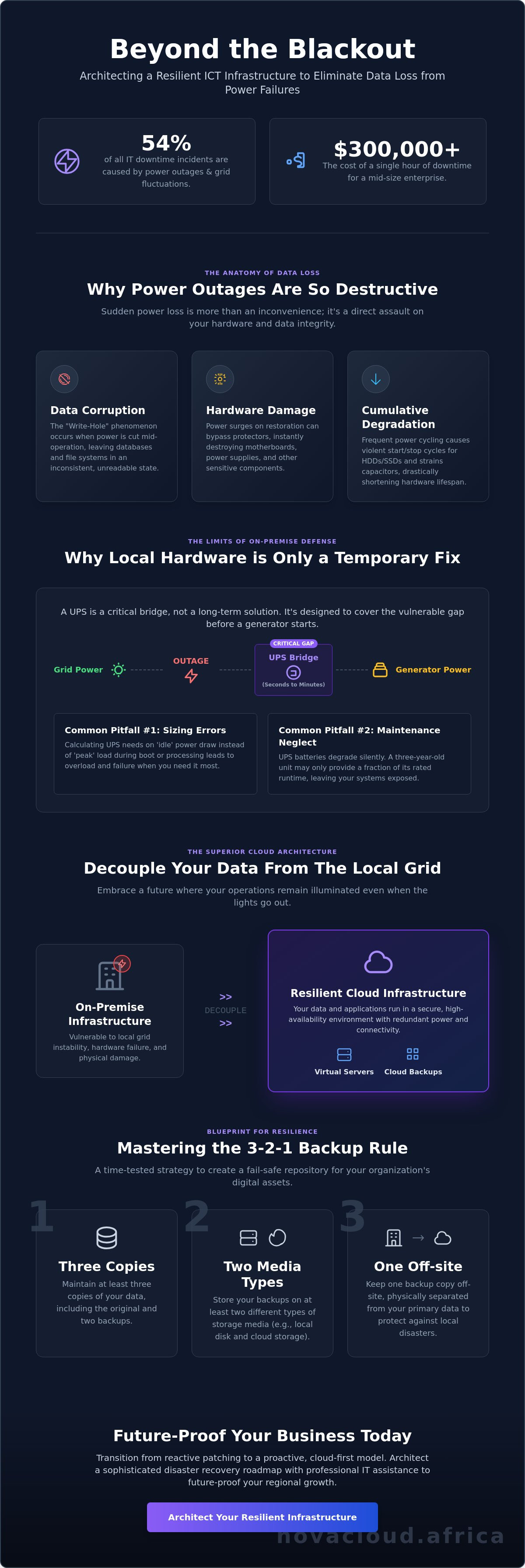
A primary culprit in these scenarios is the "Write-Hole" phenomenon. This occurs when a storage system is interrupted exactly as it's committing data to a disk. Because the operation was never finished, the system doesn't know which version of the data is correct. This leads to corrupted file system metadata, essentially the map your computer uses to find your files. Without that map, your data is effectively gone. The danger doesn't end when the lights go out; the restoration of power often brings a high-voltage surge that can bypass standard protectors and destroy sensitive internal components instantly.
The Risk to Local Databases and ERP Systems
Databases are the engines of modern business, but they're incredibly sensitive to timing. When power fails mid-transaction, database pointers, the digital signposts that link related pieces of information, can break. This leaves your ERP system in an inconsistent state where inventory might show as sold but payment records haven't been updated. The financial burden isn't just the lost data; it's the grueling manual reconciliation required to make your books balance again. "A single millisecond of power loss can result in hours of database reconstruction if the system is not architected for resilience."
Cumulative Degradation: The Silent Killer
While a single outage is a crisis, the repetitive stress of grid instability acts as a slow poison for your infrastructure. Frequent power cycling forces server HDDs and SSDs to park and restart violently, significantly shortening their operational lifespan. Beyond the drives, voltage fluctuations put immense pressure on motherboard capacitors. These tiny components are designed to smooth out electrical flow, but they eventually bulge and leak under the strain of constant instability. In these environments, graceful shutdowns become a luxury your hardware cannot afford without managed intervention. Strategy is your best defense. By moving critical workloads to Cloud backups or hosted environments, you remove the physical stress from your local office entirely. Preventing data loss during power outages isn't just about surviving the next hour; it's about ensuring your hardware survives the next year.
Evaluating Local Hardware Defenses: UPS vs. Generators
Many organizations view the Uninterruptible Power Supply (UPS) as a total safety net. In reality, it's a critical bridge designed to span the volatile seconds between a grid failure and generator ignition. If your generator takes 30 seconds to synchronize, that "Switchover Gap" is where your hardware is most vulnerable. Without a properly sized UPS to catch the load, that gap leads to a hard system crash. Effectively preventing data loss during power outages requires treating these hardware components as a synchronized system rather than isolated gadgets.
Sizing is the most common pitfall for growing businesses. Many teams calculate their UPS needs based on "idle" power draw rather than the "peak" load required during a system boot or intensive database processing. This oversight leads to overloaded circuits the moment the grid fluctuates. Maintenance is equally vital. Lead-acid batteries degrade silently; a three-year-old unit might only provide a fraction of its original runtime. Establishing rigorous testing protocols ensures your bridge doesn't collapse the moment you need to cross it.
The Limitations of the UPS Bandage
During extended periods of load shedding, a UPS is a temporary bandage on a significant operational wound. It isn't designed to sustain full business operations for hours. If you continue to rely heavily on local hardware, you must deploy automated shutdown scripts. These scripts initiate a graceful exit for your servers before the battery reaches zero. For organizations looking to move beyond these physical constraints, Cloud-based disaster recovery provides a way to maintain operational continuity even when your local bridge fails.
Surge Protection and Clean Power
Not all electricity is created equal. A basic power strip offers almost no protection against the brownouts and "dirty" power that characterize an unstable grid. An online double-conversion UPS is the gold standard for preventing data loss during power outages because it constantly regenerates the AC signal. This provides a perfectly clean feed regardless of grid instability. Networking components like switches and firewalls are often the first to fail during voltage spikes. Integrating a Managed Firewall can protect your perimeter security while ensuring your networking gear doesn't become your weakest link. If you're unsure whether your current hardware is up to the task, professional IT Assistance can provide the clarity you need to architect a more resilient future.
The Cloud Transition: Decoupling Data from the Local Grid
True resilience isn't found in a larger battery or a louder generator. It's found in distance. By decoupling your critical information from the local power grid, you eliminate the primary threat vector. Transitioning to a cloud-first model allows you to achieve what we call "Digital Sovereignty," a state where your business operations are no longer tethered to the instability of local infrastructure. This strategic shift is the most effective method for preventing data loss during power outages, as it moves your digital assets into environments designed for absolute continuity.
Modern Tier-3 data centres provide a level of stability that an on-prem server room simply cannot replicate. These facilities are engineered with dual power feeds from independent substations, industrial-grade generators with weeks of fuel on standby, and redundant cooling systems to prevent thermal shutdown. While a local server might crash during a 30-second generator switchover, a cloud provider offers SLA-backed uptime that guarantees your data remains live. From a financial perspective, this moves your organization from the high Capex of constantly replacing hardware to a predictable Opex model that scales with your growth.
Moving Mission-Critical Applications to VPS
Hosting your ERP, CRM, and accounting software on a Virtual Private Server (VPS) ensures that your core business logic is always available. When these mission-critical applications live in a controlled environment, you're protected from the database corruption discussed in previous sections. For a comprehensive look at this transition, read our guide on Architecting Digital Sovereignty: The Definitive Guide to Virtual Private Servers in 2026. This architecture empowers your team to remain productive from any location; even if the head office is dark, the business stays bright.
Connectivity Resilience: Business Fibre and Redundancy
A cloud-first strategy is only as strong as the line that connects you to it. Symmetrical Business Fibre is the essential backbone of this resilient architecture, providing the low latency required for real-time data access. However, you must also plan for the "last mile" of connectivity. We leverage Ubiquiti networks to manage local traffic and ensure that hardware transitions are handled smoothly. When the local exchange loses power, a sophisticated failover system should automatically redirect your traffic to a secondary connection, ensuring that preventing data loss during power outages includes protecting your access to the cloud itself. If you're ready to architect a more stable environment, our team provides the IT Assistance needed to bridge the gap between local challenges and global standards.
Architecting Data Resilience with Automated Cloud Backups
While moving workloads to the cloud provides immediate protection, a comprehensive strategy for preventing data loss during power outages must include a robust backup architecture. We advocate for the 3-2-1 Backup Rule, adapted for an environment of grid instability. This means maintaining three copies of your data on two different media types, with at least one copy stored offsite. In a local context, relying on an external hard drive sitting next to your server is a significant risk. If a high-voltage surge following a power restoration fries your server's power supply, it's likely to travel through the connection and destroy your local backup simultaneously.
Automation is the cornerstone of modern data integrity. Manual backups are prone to human error and are often the first task forgotten during the chaos of a sudden outage or a shift in loadshedding schedules. Automated Cloud backups remove this variable, ensuring that your data is securely transmitted to a resilient data centre at scheduled intervals. For added security, we implement immutable backups. These are read-only copies that cannot be altered or deleted for a set period, providing a definitive defense against both logical corruption from power loss and the rising threat of ransomware.
Strategic Data Recovery with Acronis Cloud
We utilize Acronis Cloud to provide our partners with near-instant recovery points. This technology allows you to "roll back" a system to the exact state it was in minutes before an outage occurred, effectively erasing the impact of a "Write-Hole" event. For a deeper dive into these architectures, consult our report on Strategic Data Resilience: The 2026 Guide to Cloud Backups for South African Business. Furthermore, our infrastructure ensures full POPIA compliance by utilizing secure, South African-based storage, keeping your data within regional borders while meeting international benchmarks.
Unified Communications: Keeping the Lines Open
A frequently overlooked consequence of power instability is the total loss of communication. Legacy PBX systems are hardware-dependent; when the office power dies, your phone lines die with it. This creates a vacuum where clients can't reach you, and productivity halts. Transitioning to Hosted PBX solves this by moving your telephony into the cloud. Even if your physical office is dark, your team can receive calls via mobile apps or remote handsets, maintaining a seamless professional presence. You can explore our Hosted PBX solutions for resilient communication to see how we keep the lines of progress open. If you're ready to secure your organization's digital future, contact NovaCloud Africa today for a tailored resilience audit.
Future-Proofing with NovaCloud Africa: Your Strategic ICT Partner
Architecting a resilient future requires more than reactive hardware purchases; it demands a designer who understands the delicate interplay between security, connectivity, and continuity. At NovaCloud Africa, we don't just provide tools. We engineer environments where preventing data loss during power outages is a native feature of the system, not an afterthought. Our approach involves a holistic defense that layers Managed Firewalls for perimeter security, Virtual Private Servers for operational sovereignty, and Acronis Cloud for immutable data protection. This multi-layered strategy ensures that your organization remains illuminated even when the local grid fails, allowing for a fresh start in business efficiency and regional growth.
The journey toward a power-independent infrastructure begins with a clear assessment of your current vulnerabilities. We help you identify the "shadow risks" in your server room, from aging UPS batteries to legacy databases that lack automated recovery. By designing a custom disaster recovery roadmap, we transition your organization from a state of grid-dependency to one of digital empowerment. This evolution isn't just about surviving the next outage; it's about positioning your business to scale without the constant fear of digital disruption.
Beyond Hardware: A Human-First Approach to IT
Technology serves as a catalyst for progress, but it requires expert hands to guide its implementation. Our IT Assistance provides the proactive monitoring and strategic oversight necessary to maintain complex cloud architectures. For South African SMEs, this means having a dedicated partner to manage the technical execution while you focus on expansion. We invite you to explore our deeper analysis on Strategic IT Assistance in 2026: Architecting Resilient ICT Infrastructure for South African Enterprise to understand how we bridge the gap between local challenges and international benchmarks.
Securing Your Digital Evolution
As you plan your migration to a more resilient model, consider the following final checklist for preventing data loss during power outages:
- Audit your local hardware for surge protection and graceful shutdown capabilities.
- Migrate mission-critical ERP and accounting software to a Virtual Private Server.
- Enable automated, offsite Cloud backups with immutability features.
- Transition to a Hosted PBX to ensure your communication lines stay open during blackouts.
- Utilize Microsoft 365 Business Licensing to empower a distributed, cloud-native workforce.
The path to digital maturity is a collaborative one. Our team is ready to serve as your strategic ally, ensuring that your infrastructure is as ambitious as your business goals. You can schedule a consultation for business-grade cloud infrastructure today and take the first step toward a future defined by clarity and uninterrupted progress.
Illuminating Your Path to Digital Sovereignty
The era of relying on local hardware bandages is coming to an end. We've explored how transitioning to Virtual Private Servers and automated cloud backups creates a state of digital sovereignty, ensuring your mission-critical applications remain live while others wait for the lights to return. By embracing the 3-2-1 backup rule and decoupling your data from the local grid, you aren't just reacting to instability; you're designing a system that thrives despite it.
Effective strategies for preventing data loss during power outages require a partner who combines technological authority with deep regional expertise. NovaCloud Africa provides the Tier-3 Data Centre Infrastructure and POPIA-Compliant Secure Backups your organization needs to meet global standards. With 24/7 National Technical Support, we ensure your transition to a resilient architecture is handled with precision and care. It's time to stop fearing the next outage and start looking forward to a future of uninterrupted growth and clarity.
Architect your resilient business infrastructure with NovaCloud Africa. Your digital evolution is in expert hands.
Frequently Asked Questions
Can a power outage actually damage my computer hardware?
Yes, the abrupt cessation of power can cause mechanical failure in hard drives, but the real danger lies in the high-voltage surge that often follows restoration. These spikes can bypass standard surge protectors and fry motherboard capacitors or power supply units instantly. Protecting your physical assets is a critical component of preventing data loss during power outages, as hardware failure often makes the data stored within completely inaccessible without expensive forensic recovery.
How long does data stay safe on a server after the power goes out?
Once data is successfully written to a non-volatile storage medium like an HDD or SSD, it remains there indefinitely without power. The risk isn't the duration of the outage, but the moment the power fails. If the system is mid-write, you face the "Write-Hole" phenomenon where files become unreadable. Your data is safe as long as the shutdown was graceful or the system was already idle when the lights went out.
Is a UPS enough to prevent data loss during load shedding?
A UPS is designed to provide minutes of power, not hours of operational runtime. It serves as a vital bridge that allows your systems to trigger automated shutdown scripts or for generators to kick in. Relying solely on a UPS for extended load shedding leads to battery exhaustion and hard crashes. For true resilience, you need a strategy that includes cloud-based Virtual Private Servers to keep operations running when local batteries fail.
What is the difference between data corruption and data loss?
Data loss refers to files that are simply missing or deleted, whereas data corruption means the file exists but is unreadable or damaged. Corruption often happens during sudden power cuts when a database fails to complete a transaction, breaking the internal pointers. Both scenarios result in downtime, but corruption often requires complex, manual reconstruction of databases to restore business logic and ensure your records remain accurate and consistent.
How does cloud hosting protect my data from local power failures?
Cloud hosting protects your data by physically removing it from your local power grid and placing it in a Tier-3 data centre. These facilities utilize industrial-grade generators and dual power feeds to ensure near-perfect uptime. By decoupling your applications from your office's electrical supply, you ensure that preventing data loss during power outages becomes a managed service rather than a local hardware struggle you have to win every day.
What happens to my VoIP phone system during a power outage?
Your local IP phones and internet routers will lose power and disconnect, but a Hosted PBX system remains active in the cloud. This means your business can still receive calls via mobile apps or redirect them to remote staff. While your physical desk phone might be dark, your communication lines stay open, ensuring that your clients never experience a busy signal or a dead line during local grid instability.
Are cloud backups better than physical external hard drives?
Cloud backups are significantly more resilient than external hard drives because they are automated, encrypted, and stored offsite. A physical drive plugged into your server is vulnerable to the same power surges and theft that threaten your primary hardware. Cloud solutions like Acronis Cloud provide a "Digital Sovereignty" that ensures your backups are isolated from local disasters and always ready for rapid, near-instant recovery when needed.
How do I ensure my business stays POPIA compliant during a disaster recovery event?
To remain POPIA compliant during disaster recovery, you must ensure your backup data is encrypted and stored within South African borders. Using a local provider for Cloud backups ensures that personal information doesn't cross international boundaries without proper safeguards. It's essential to have a documented disaster recovery roadmap that outlines how data is handled during an outage to maintain your legal obligations and protect your customers' privacy.
